
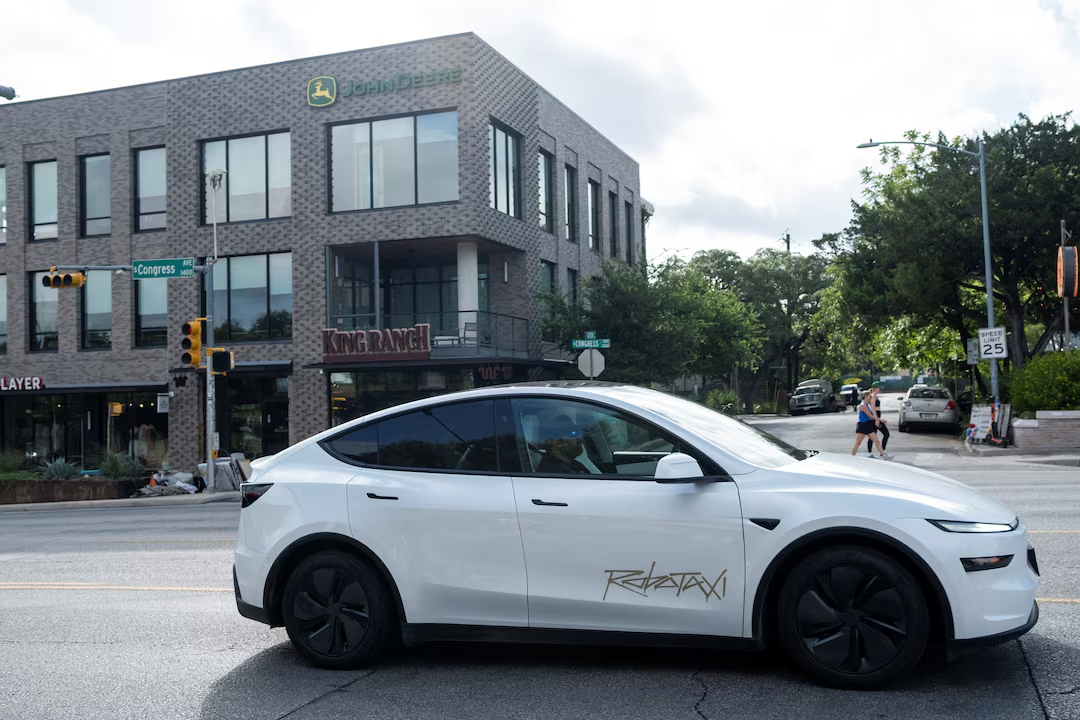
On June 22, 2025, Tesla quietly flipped the switch on its much‑anticipated Robotaxi service in downtown Austin, Texas. What began as an invite‑only pilot for Full Self‑Driving (FSD) subscribers has rapidly become the centerpiece of Elon Musk’s vision to transform urban mobility. Branded informally by Musk as “Airbnb for cars,” Robotaxi aims to allow Tesla owners—and eventually the public—to summon a self‑driving Tesla as easily as hailing a rideshare, with AI at the wheel and no human chauffeur required.
This article provides an in‑depth look at Tesla’s Robotaxi: from its technical underpinnings and phased rollout plan to the user experience, competitive positioning, and risks ahead. We trace how Tesla evolved its FSD suite into a geofenced robo‑taxi service, examine real‑world rider feedback, explore stock market reactions, and assess regulatory hurdles on the road from Texas to California’s Bay Area. By the end, you’ll understand how Robotaxi may disrupt ride‑hailing, reshape Tesla’s financial outlook, and usher in a new era of autonomous mobility.
II. Background and Technology
1. Evolution of Full Self‑Driving Software
Tesla’s journey toward Robotaxi began in late 2014 with the introduction of Autopilot hardware—a suite of cameras, ultrasonic sensors, and radar—installed on all new Teslas. Early Autopilot offered lane‑centering and adaptive cruise control. Over successive hardware iterations (HW2.5 in 2017; HW3 “FSD Computer” in 2019), Tesla steadily shifted from driver‑assist features toward true autonomy, culminating in the FSD Beta program launched in October 2020.
By mid‑2024, FSD Beta 12.5 introduced neural‑network–based vision processing that significantly improved object detection and decision‑making. Over-the-air (OTA) updates then expanded FSD’s capabilities, from urban driving to more complex maneuvers such as navigating roundabouts. Robotaxi leverages these advances, employing a specialized “Safety Monitor” model trained on millions of miles of real‑world driving data.
2. The Safety Monitor’s Role
The Safety Monitor is a neural‑network layer whose sole purpose is to anticipate and avert risky actions by the driving policy network. Trained on terabytes of labeled video—identifying scenarios like jaywalking pedestrians or aggressive lane changes—it continuously assesses whether the car’s planned trajectory adheres to Tesla’s stringent safety envelope. In Robotaxi, the Safety Monitor’s thresholds are tuned conservatively: it can override or stop the vehicle if it detects potential collisions or rule violations, ensuring a high margin of safety.
3. Geofencing Mechanics
To manage risk and reduce edge‑case errors, Tesla initially restricts Robotaxi to geofenced zones. In Austin, the service covers a roughly 10 km² area encompassing downtown, the University of Texas campus, and adjacent neighborhoods. Geofence boundaries are uploaded via OTA and enforced by the FSD software, ensuring the car never drives beyond tested streetscape maps. Each street in the zone has detailed LiDAR‑grade mapping, refined by Tesla’s fleet data to account for construction, new traffic patterns, and signal timing.
III. Service Rollout Phases
1. Phase 1: Invite‑Only Austin Operation
Tesla’s Phase 1 kicked off with select invite codes sent to FSD subscribers who registered interest. Early participants received flat‑rate credits—enough for several rides—to test the system under real‑world conditions. Tesla monitored rider behavior, route patterns, and system stability, adjusting pricing and UI elements based on feedback. Initial rides were capped at midday hours to avoid peak‑traffic complexity.
2. Phase 2: Expanded Austin Coverage
Following a successful first week marked by zero at‑fault incidents, Tesla expanded service hours and geofence size. Coverage now extends to key transit hubs like Austin–Bergstrom International Airport mart shuttle areas. Pricing shifted from complimentary credits to a promotional flat fee of $4.20 per ride—echoing Musk’s penchant for humor—regardless of distance or time, to incentivize widespread usage and data collection.
3. Phase 3: Bay Area Plans
California’s Department of Motor Vehicles (DMV) and Public Utilities Commission have been reviewing Tesla’s Autonomous Vehicle Deployment Application (AVDA) since May 2025. Pending approval, Tesla aims to launch a similar invite‑only pilot in San Francisco and Silicon Valley by late summer. The Bay Area’s complex road network—double‑parked tech shuttles, bikers, and steep hills—will serve as a robust stress test before national expansion.
IV. Customer Experience & Pricing
1. Promotional Flat‑Rate Model
Tesla’s introductory $4.20 flat rate created a media splash and ushered in a rush of first‑time riders. Unlike dynamic‑pricing rideshares, Robotaxi’s flat fee eliminates surge concerns. Some early users report “fun rides” to test corners and lane changes; others rely on Robotaxi for daily commutes. Tesla has hinted that future pricing may shift to per‑mile or minutes‑in‑motion, with loyalty discounts for owners who add their own vehicles to the fleet.
2. Rider Feedback and Case Studies
Early adopter interviews reveal high satisfaction with smooth lane merges and stop‑sign compliance. A University of Texas student noted, “Catching a free robo‑taxi between classes saved me 20 minutes each way.” However, riders in dense downtown traffic have flagged occasional “hesitation” at complex intersections and slower performance in unmarked crosswalks.
3. Comparison to Waymo, Uber, and Lyft
Unlike Waymo’s decade‑long Micromobility and Phoenix pilots, Tesla’s advantage lies in leveraging its installed hardware base—over 4 million cars on the road. Whereas Uber and Lyft remain dependent on human drivers, Tesla’s Robotaxi requires no wages or driver‑insurance overhead. Yet Waymo’s curated geofences in Phoenix boast near‑perfect reliability, a benchmark Tesla must match to win regulatory confidence in larger markets.
V. Market & Stock Impact
1. Short‑Term Stock Fluctuations
Following the Austin launch, Tesla shares rose 3.8% in after‑hours trading, fueled by analyst upgrades citing potential service revenue streams. High‑frequency traders keyed on phrases like “Mobility‑as‑a‑Service” in Musk’s Twitter post, driving options volume.
2. Long‑Term Valuation Tied to Robo‑Taxi
Wall Street models Tesla’s total addressable market (TAM) for robotaxis at nearly $1 trillion annually. If Tesla captures even 10%, service revenue—distinct from vehicle sales—could add $100 billion in annual recurring revenue. Analysts at Morgan Stanley project a $300–$500 per share “robotaxi premium” in Tesla’s valuation by 2028.
3. Analyst Perspectives
While most bullish on service monetization, some analysts warn that initial deployments may scare private investors: “If safety incidents occur, regulators could clamp down,” cautions an RBC report. Others emphasize competition from deep-pocketed legacy automakers pivoting to shared mobility.
VI. Challenges & Risks
1. Regulatory Hurdles
California’s stringent AVDA rules require proof of disengagement rates below 0.3 per 1 000 miles. Even one high-profile collision could delay certifications for Bay Area and Los Angeles rollouts. Texas regulators have been more permissive, but approvals in states like New York and Florida will demand extensive safety data.
2. Technical Glitches
FSD still grapples with “phantom braking”—false obstacle detection in harmless scenarios—and occasional confusion in construction zones. Geofenced operation limits exposure, but as Tesla expands boundaries, edge cases multiply.
3. Public Perception and Media Coverage
Media narratives can swing public opinion. Waymo has maintained a “zero‑incident” streak in Phoenix, generating trust. Tesla must manage PR tightly, transparently reporting disengagement statistics and incident analyses to maintain confidence.
VII. Conclusion
Tesla’s Robotaxi service represents a bold stride toward autonomous, on‑demand urban mobility. From the cautious Phase 1 in Austin to the ambitious Bay Area launch, the initiative leverages Tesla’s FSD suite, geofencing, and OTA scalability. Early feedback shows promise—smooth rides, low cost—and stock markets have taken notice. Yet regulatory reviews, technical edge‑cases, and public trust remain critical hurdles. If Tesla navigates these successfully, Robotaxi could redefine ride‑hailing economics and position Tesla as a leader not just in electric vehicles, but in AI‑driven transportation services.
VIII. FAQ
Q1: When will Bay Area operations begin?
Pending California DMV approval, Tesla expects an invite‑only launch in San Francisco and neighboring counties by late Q3 2025.
Q2: Can Tesla owners join the fleet?
Yes. Musk envisions Robotaxi eventually enrolling owner‑provided vehicles, sharing service revenue with owners.
Q3: What safety measures are in place?
Extensive geofencing, a conservative Safety Monitor neural net, remote monitoring centers, and human‑review protocols for any disengagement.