
1. Introduction: The End of the "European Autopilot" Era
For nearly a decade, the European Tesla experience has been defined by a sense of "regulatory FOMO." While North American owners have watched the rapid, iterative leaps of Full Self-Driving (FSD) through versions 12, 13, and now 14, European drivers have been tethered to a sanitized version of Autopilot—limited by decades-old UNECE regulations.
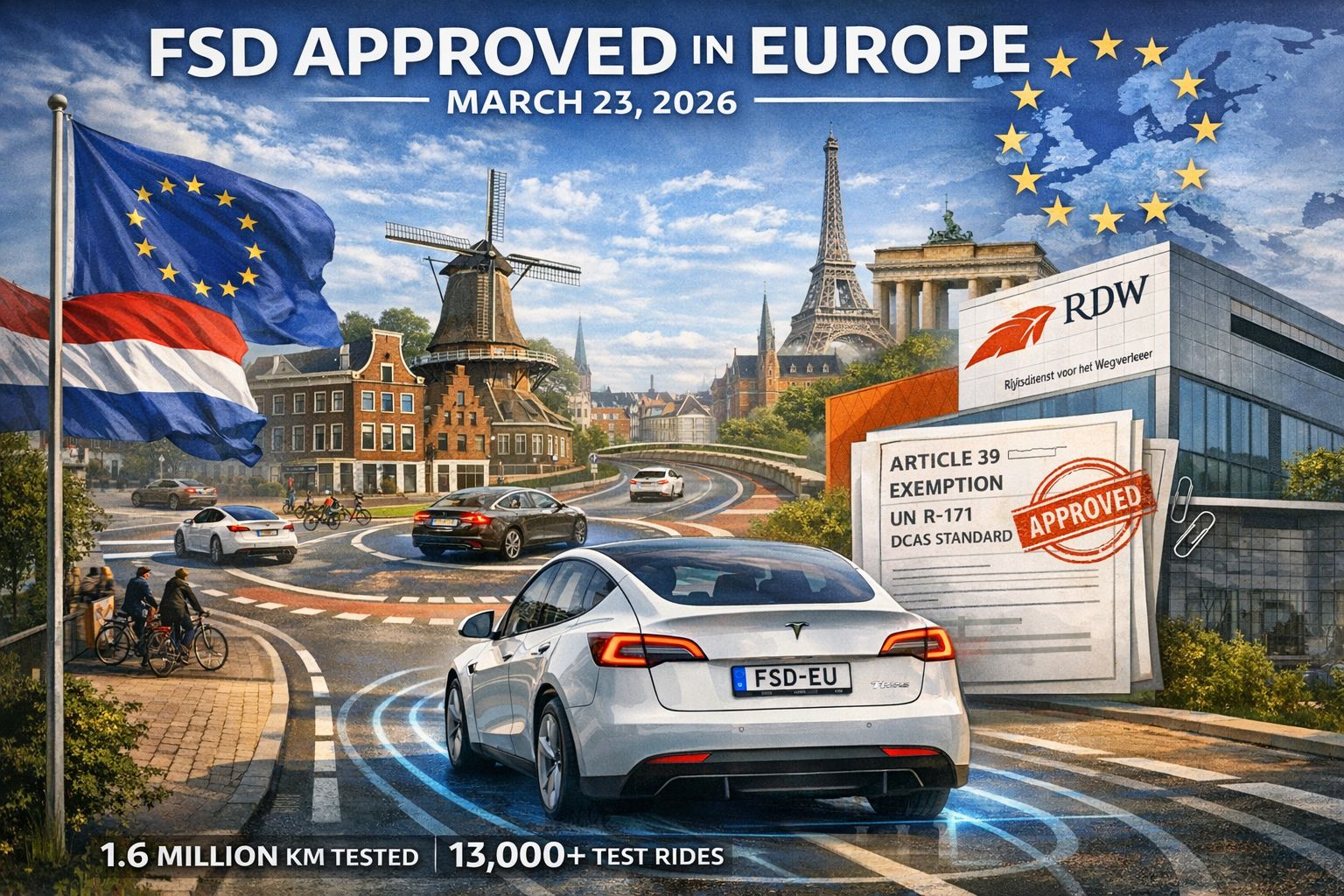
Today, March 23, 2026, that disparity officially begins to dissolve. Tesla Europe has confirmed the completion of the final vehicle testing phase with the RDW (the Netherlands Vehicle Authority). This isn't just a software update; it is a geopolitical and technical victory that establishes the Netherlands as the official "beachhead" for Tesla’s autonomous future in the Eastern Hemisphere.
2. The Regulatory Masterpiece: Article 39 & UN R-171
The primary barrier to FSD in Europe has never been the code—it has been the paperwork. European regulators operate on a "deterministic" model (expecting coded rules), while Tesla’s FSD uses an "end-to-end neural network" (probabilistic AI).
2.1 The UN R-171 "DCAS" Standard
Tesla’s breakthrough today centers on compliance with UN Regulation No. 171, a new standard for Driver Control Assistance Systems (DCAS).
-
Beyond Lane Keeping: Unlike previous rules that only allowed basic lane-centering, R-171 allows for "system-initiated maneuvers"—meaning the car can decide to overtake a slow vehicle or navigate a roundabout without a manual "stalk flick" from the driver.
-
The "Hands-On" Requirement: To satisfy European safety councils, FSD in the EU remains "hands-on" for now, but with significantly reduced "nags" thanks to advanced cabin-camera driver monitoring.
2.2 The Article 39 "Innovation" Exemption
Because FSD v14 behaves more like a biological brain than a set of if-then rules, it technically breaks some legacy EU laws. Tesla solved this by filing for Article 39 exemptions via the RDW.
-
National Approval: This allows the Netherlands to approve the technology locally as an "innovative system."
-
The Cascade Effect: Under EU Mutual Recognition rules, once the RDW issues its final sign-off (now officially targeted for April 10, 2026), other EU nations like Germany, France, and Italy can recognize that approval almost instantly, bypassing their own lengthy testing cycles.
3. Testing by the Numbers: 1.6 Million Kilometers
The data package submitted to the RDW today is arguably the most comprehensive safety study in the history of automotive software.
-
European Real-World Data: Tesla has logged over 1.6 million kilometers of FSD (Supervised) testing specifically on European roads across 17 countries.
-
Scenario Stress-Testing: The team executed over 4,500 specific track scenarios, focusing on uniquely European challenges like narrow "one-and-a-half" lane Dutch roads, aggressive moped traffic, and complex multi-lane roundabouts.
-
Customer Validation: Over 13,000 customer ride-alongs were conducted to gather "subjective safety" data, ensuring the AI drives in a way that feels natural to European sensibilities.
4. Hardware Realities: HW3 vs. AI4 in Europe
As the rollout nears, a technical "great divide" is emerging. While the FSD v14 architecture is unified, the European regulatory environment demands extreme precision.
4.1 The AI4 (Hardware 4) Advantage
Vehicles equipped with AI4 (found in the Model 3 Highland and Model Y Juniper) feature high-resolution 5MP cameras and significantly higher processing bandwidth. In the fog-heavy, low-light conditions of Northern Europe, AI4's superior "dynamic range" is critical for the RDW's "degradation detection" requirements.
4.2 The HW3 "Quantization" Factor
For the millions of HW3 owners, the news is still positive, but with a caveat. Tesla is using INT8 quantization to fit the massive v14 neural nets into the older 2019-era chips. While performance is nearly identical to AI4 in the US, European regulators may impose stricter "Operational Design Domains" (ODDs) for HW3 cars—potentially limiting their use in heavy rain or at night until more data is gathered.
5. Conclusion: The Roadmap to Summer 2026
The completion of the final testing phase today is the green flag.
-
April 10, 2026: Expected official RDW approval for the Netherlands.
-
May 2026: National recognition filings in Germany and the UK.
-
Summer 2026: Wide-scale European "FSD (Supervised) Trial" for all eligible owners.
Tesla has successfully navigated the most difficult regulatory landscape on earth. By the end of this year, a Tesla driving through the streets of Amsterdam will be indistinguishable from one driving through San Francisco—marking the birth of a truly global autonomous fleet.
FAQ: What Every EU Owner Needs to Know
Q: Do I need a hardware upgrade to get FSD in Europe?
-
A: No. If you have a car built after 2019 (HW3 or AI4), you have the necessary hardware. However, older Model S/X cars with HW2.5 will likely require a computer retrofit.
Q: Will FSD work in the UK immediately after the Netherlands approval?
-
A: Not immediately. The UK is no longer in the EU and follows its own "Automated Vehicles Bill." However, Tesla is running a parallel testing program with the UK’s DfT, expected to conclude by June 2026.
Q: Can I use FSD on city streets or just motorways?
-
A: Under the new R-171 DCAS rules, FSD (Supervised) is permitted on all road types, including complex urban environments and roundabouts, provided the driver remains "visually engaged."