
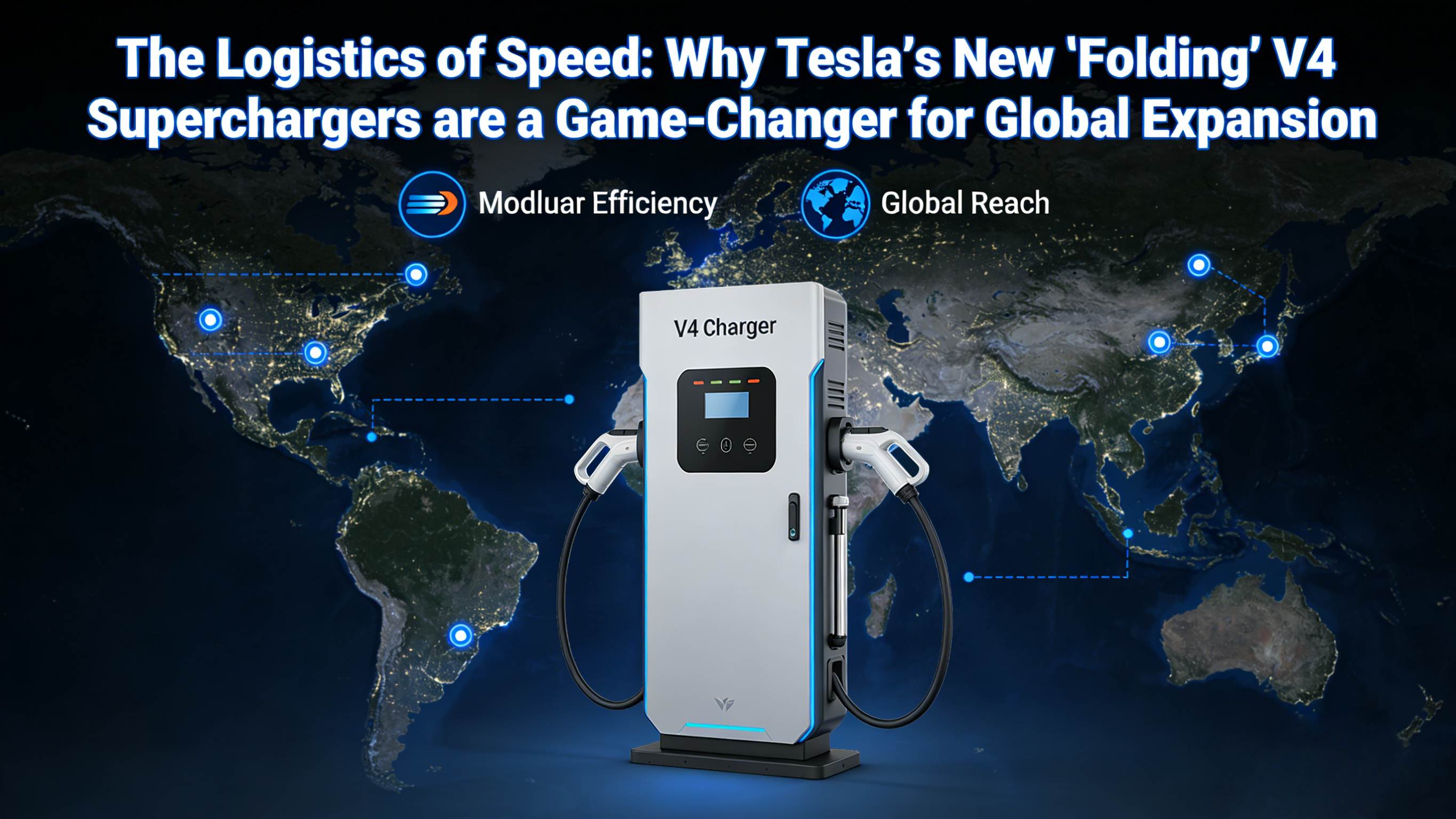
1. Introduction: The Infrastructure Bottleneck
For over a decade, the Tesla Supercharger network has been the company’s "crown jewel"—the primary reason many consumers choose a Tesla over a competing EV. However, as we enter March 2026, a new challenge has emerged. With the opening of the network to non-Tesla vehicles and the impending mass-market launch of the "Project Redwood" (Model 2), the sheer demand for stalls is outstripping the speed at which they can be installed.
Traditionally, deploying a Supercharger station was a multi-week civil engineering project involving heavy cranes, specialized on-site wiring, and complex logistical choreography. Today, March 26, 2026, Tesla has officially solved this "Deployment Debt." With the unveiling of the "Folding V4" Supercharger, Tesla is transitioning from being a manufacturer of hardware to a master of industrial logistics. This is the story of how Tesla is moving from "fast charging" to "fast building."
2. Engineering the "Fold": High-Density Logistics
The "Folding V4" is not merely an aesthetic update; it is a structural rethink of how high-voltage hardware moves across the planet.
2.1 33% Higher Shipping Density
In the previous V3 and early V4 eras, Supercharger stalls were shipped in their upright, permanent positions. This wasted significant vertical space in shipping containers and on flatbed trucks.
-
The Mechanism: The new V4 stall features a heavy-duty industrial hinge at the base. This allows the 6.5-foot stall to fold flat against its own concrete mounting plate during transit.
-
The Result: Tesla can now fit 33% more charging units on a single delivery truck. For a 20-stall site in Germany or California, this reduces the logistics from three trucks down to two, drastically lowering the carbon footprint and shipping costs per stall.
2.2 The "Plug-and-Play" Pre-Integrated Base
The most revolutionary part of the Folding V4 is hidden beneath the folding hinge.
-
Factory Pre-Wiring: Each folding unit arrives with its internal high-voltage cables already terminated and tested at the factory.
-
The 20-Minute Set: Once the delivery truck arrives at a site with pre-poured concrete slabs, a small crane lifts the folded unit into place. As the crane lifts, the stall "unfolds" into its upright position. The crew then secures four heavy-duty bolts and clicks in a single "Megawatt-class" quick-connect coupling.
-
Labor Reduction: This "plug-and-play" architecture reduces the specialized electrical labor required on-site by nearly 50%. A site that previously took 14 days to wire can now be commissioned in under 48 hours.
3. Power Performance: 500kW and the 1.2MW Future
While the logistics are impressive, the power electronics inside the Folding V4 are designed for the next decade of EV evolution.
3.1 500kW Passenger Charging
The V4 cabinets are officially rated for 500kW peak output. While current Model 3 and Model Y "Juniper" vehicles are capped at 250kW, the V4 stalls are future-proofed for the 800V-1000V architectures expected in the 2027 Tesla lineup. This ensures that as battery chemistry evolves, the infrastructure will not be the bottleneck.
3.2 1.2MW Semi and Cybertruck Support
The Folding V4 is the first passenger-focused stall designed to play a dual role. When paired with Tesla’s new industrial-grade power cabinets, these stalls can support up to 1.2MW of density. This is critical for the "Yermo Megastation" style deployments, where Cybertrucks and Tesla Semis share the same real estate as Model Ys.
-
Cooling Innovation: To handle this massive power in a folding form factor, Tesla developed a new high-flex, liquid-cooled cable that can withstand thousands of folding/unfolding cycles without degrading the coolant channels.
4. The Global "Moat": Expansion in North America and Europe
Infrastructure is a game of real estate and speed. By making Superchargers easier to ship and faster to install, Tesla is making it impossible for third-party networks (like Ionity or Electrify America) to keep pace.
-
European Corridor Strategy: In Germany and Poland, Tesla is using the Folding V4 to "blitz-build" stations along the A2 and A4 motorways. The ability to deploy a 40-stall station in a single weekend allows Tesla to claim the most valuable rest stops before competitors can even clear their local permit hurdles.
-
North American Rural Expansion: For the "Great Plains" and rural Canada, the lower shipping costs of the Folding V4 make low-traffic stations financially viable for the first time.
5. Conclusion: The Industrial Machine
The Folding V4 Supercharger is a perfect example of the "Tesla way." It isn't just a better product; it is a better process. By optimizing for the shipping container and the installation crew, Tesla has ensured that its charging moat will only grow wider in 2026.
For the Tesla owner, this means fewer queues and more locations. For the competition, it means the goalposts have just moved significantly further down the field.
FAQ: What Owners Need to Know
Q: Will the Folding V4 charge my older Model 3/Y faster?
-
A: You will still be limited by your vehicle's onboard battery management system (BMS). However, V4 stalls offer better "power sharing" between stalls, meaning you are more likely to get your full 250kW even if the station is nearly full.
Q: Are these folding stalls less durable?
-
A: No. Once the stall is "unfolded" and bolted, the hinge is locked behind a reinforced steel shroud. Tesla’s stress testing indicates the locking mechanism is rated for Category 5 hurricane winds.
Q: When will we see these in Europe?
-
A: Installations have already begun at a pilot site in Tilburg, Netherlands. A wide-scale rollout across the UK and Germany is expected to begin in Q3 2026.