
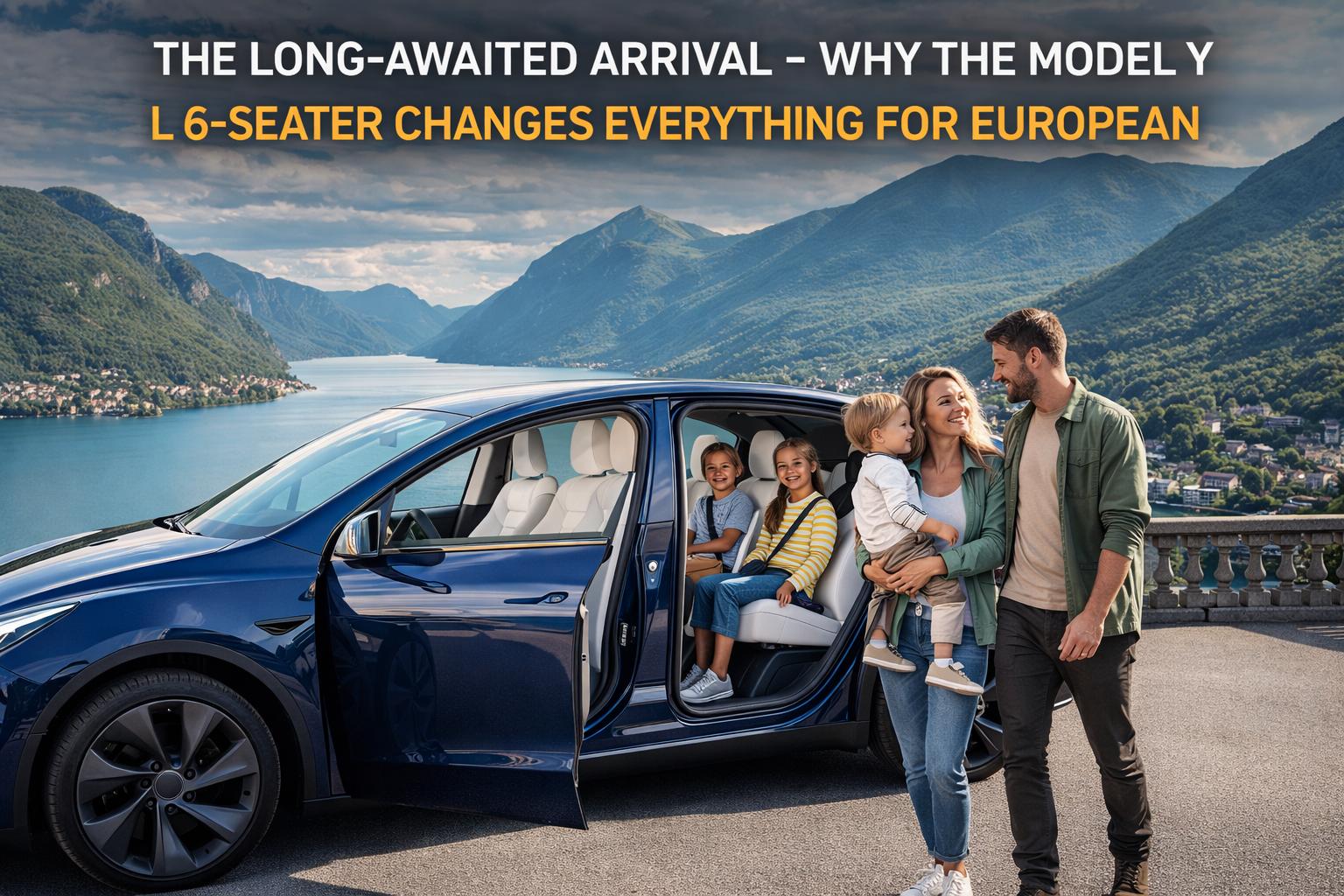
Introduction: The Model Y Finally Grows Up
Let's be honest about something that Tesla has never wanted to admit: the standard Model Y's third row was a joke. When the company first introduced a seven-seat configuration back in 2021, it crammed two tiny seats into a cargo area never designed to accommodate human legs. The result was something automotive journalists politely called "occasional seating" and everyone else called "the kids' punishment zone." Adults simply didn't fit, and even teenagers found the experience sufficiently miserable that they'd rather walk.
For years, European families who actually needed three rows had two choices: move up to the Model X with its eye-watering price tag and falcon-wing doors, or look elsewhere entirely. Many looked elsewhere. The Audi Q7, BMW X5, and Mercedes GLE continued to dominate the premium three-row SUV segment, largely unchallenged by an electric vehicle that could genuinely replace them.
That changes now.
The Model Y L—the "L" stands for "Long," though it might as well stand for "Legroom"—has finally entered production at Gigafactory Berlin-Brandenburg . It's already received EU type approval, with documents filed with the Dutch vehicle authority RDW confirming that this vehicle meets all European regulatory requirements . First deliveries are expected before the end of the first quarter of 2026, meaning that within weeks, European driveways will begin receiving a Tesla that finally understands what families actually need.
This isn't simply a Model Y with some extra seats thrown in. This is a fundamental reengineering of the vehicle, with a wheelbase extended by 150 mm (roughly six inches) to 3,040 mm, overall length stretching to nearly five meters, and a complete interior overhaul that prioritizes adult comfort over the pretense of maximum passenger count . For the first time, Tesla has built a vehicle that can genuinely compete with the established kings of the European family SUV segment.
The timing is strategic. European EV adoption continues to accelerate, but families have remained hesitant to switch from their trusted German internal combustion SUVs. Range anxiety, charging infrastructure concerns, and the perceived compromise of three-row EV packaging have all been barriers. The Model Y L addresses each of these directly: the range is class-leading, the Supercharger network remains Europe's most reliable charging infrastructure, and now the packaging finally works.
Section 1: The Size Difference-What 150 mm Actually Buys You
Numbers on a spec sheet rarely tell the full story, but in the case of the Model Y L, they come surprisingly close. The standard Model Y, for all its virtues, operates within the dimensional constraints of a vehicle designed first as a five-seater. Its wheelbase of 2,890 mm is generous for its class, but it's insufficient to accommodate three rows of seating that actual humans can occupy without surgical intervention.
The Model Y L extends that wheelbase to 3,040 mm—a 150 mm increase that translates directly into cabin space . Total vehicle length grows to 4,976 mm, up from 4,751 mm in the standard model, and height increases by 40 mm to 1,668 mm . These aren't trivial adjustments; they represent a comprehensive resizing of the vehicle's fundamental proportions.
What does 150 mm actually buy you? In the standard Model Y's seven-seat configuration (still offered in North America, though its days are surely numbered), the third row is positioned directly above the rear axle, with passengers' knees pressed against the second-row seatbacks. There is no legroom to speak of—literally, you cannot speak of it because there isn't any. The seats are suitable for children under ten and essentially unusable for anyone who has completed puberty.
In the Model Y L, those extra 150 mm go almost entirely to third-row legroom and second-row adjustability. The third row now sits behind the axle rather than directly above it, allowing for seatbacks that can recline and foot space that actually accommodates adult-sized feet. Early reviews from China, where the Model Y L has been on sale since August 2025, confirm that while the third row still isn't limousine-spacious, it's now genuinely usable for adults on journeys of reasonable length .
The external visual effect is subtle but distinct. From the front, the Model Y L is virtually indistinguishable from its shorter sibling—the same minimalist front fascia, the same distinctive headlight design, the same flush door handles. Walk around to the side, however, and the stretched proportions become apparent. The rear overhang is longer, the roofline carries back more gracefully, and there's a visual heft to the vehicle that the standard Model Y lacks. Australian reviewer Mark Rainford, who tested the Model Y L in Shanghai, noted that it's "fat and round" from certain angles, particularly from the rear three-quarter view, but that it has a presence that photographs poorly while looking quite natural in person .
For European buyers accustomed to parking in medieval city centers and navigating narrow village streets, the added length is a legitimate concern. At nearly five meters, the Model Y L is longer than a current-generation BMW X5 (4,922 mm) and approaching the length of an Audi Q7 (5,067 mm). It will require more care in tight spaces, and some older parking garages may present challenges. But for those who genuinely need three rows, there's simply no substitute for the additional length. You cannot cheat physics, and Tesla has finally stopped trying.
Section 2: Interior Configuration-The Captain's Chair Revolution
The most significant interior change in the Model Y L isn't the third row—it's the second. By switching from a three-seat bench to a pair of individual captain's chairs, Tesla has fundamentally altered the vehicle's character and utility.
These second-row seats are, in a word, impressive. They're power-adjustable in multiple directions, heated and ventilated, and equipped with fold-down armrests that create a genuine sense of separation between passengers . The center aisle between them provides easy access to the third row, eliminating the need to tumble seats forward or perform contortionist maneuvers to reach the back.
This 2+2+2 configuration—six seats total, arranged in three rows of two—is fundamentally different from the 2+3+2 layout of the North American seven-seater. It prioritizes comfort over capacity, acknowledging that most families rarely need to transport seven people but frequently need to transport four or five in genuine comfort. When you're carrying only four, the captain's chairs transform the Model Y L into something approaching a executive transport, with each second-row passenger enjoying space and amenities that rival those of the first row.
The seats themselves have drawn particular praise. One reviewer described the front seats as feeling "like home" the moment you sit in them, with perfect support and adjustment range that accommodates drivers of varying sizes . The second-row seats, while firmer than the fronts, still offer excellent support and enough adjustment range to find a comfortable position. The third row, inevitably, is the compromise zone—but it's a much less severe compromise than before.
In the third row, passengers get their own USB-C charging ports (though their placement on the front of the seat cushion has been criticized as vulnerable to careless children), seat heating, and power recline adjustment . Headroom is adequate thanks to the extended roofline, and the glass roof extends all the way back, providing an airy feel even in the way-back. Legroom is sufficient for adults up to about 5'10" (178 cm), provided the second-row passengers are willing to slide their seats forward a bit. For children and teenagers, it's genuinely comfortable.
What the Model Y L is not, despite its name, is a true seven-seater. Tesla has made a deliberate choice here: six seats with proper comfort, rather than seven seats with proper misery. This aligns the vehicle with the preferences of European families, who according to industry analysts prioritize second-row comfort and third-row accessibility over raw seat count . It also positions the Model Y L as a direct competitor to vehicles like the Kia EV9 and the upcoming Volkswagen ID. Buzz, both of which offer captain's chair configurations as premium options.
Cargo space with all six seats in use is, inevitably, limited. Tesla claims 381 liters behind the third row—enough for a couple of carry-on suitcases or a week's worth of groceries . Fold the third row flat (which they do electrically, via switches in the cargo area), and space expands dramatically. Fold the second row as well, and you get a cavernous 2,423-liter cargo bay suitable for everything from IKEA runs to sleeping accommodations .
The interior materials have also been upgraded. The Model Y L features a black headliner rather than the light-colored material used in earlier models, creating a more cohesive and premium appearance . The badging is now black rather than chrome, and the ambient lighting has been upgraded to a multi-color system that can pulse with the music—a small touch, but one that contributes to the overall sense of occasion.
Section 3: The Driving Experience-Still a Tesla at Heart
Here's the surprise: despite its stretched dimensions and family-focused mission, the Model Y L remains unmistakably a Tesla to drive. In fact, it might be the most driver-focused three-row SUV on the market.
The powertrain is familiar but potent. European-spec Model Y L vehicles will use a dual-motor all-wheel-drive configuration, with power output rated at 340 kW (456 horsepower) and torque at 630 Nm . This is sufficient to propel the 2,200 kg vehicle from 0-100 km/h in 4.5 seconds—not quite Ludicrous mode, but faster than any internal combustion competitor and faster than any family realistically needs. The throttle response is instant and linear, with the characteristic Tesla acceleration that pins passengers to their seats when you ask for maximum thrust.
But the real story is the chassis. The Model Y L introduces continuously variable damping (CVD) shock absorbers—essentially, adaptive suspension that can adjust its characteristics in real-time based on road conditions and drive mode selection . This is a first for the Model Y platform and represents a significant upgrade over the fixed-rate dampers of standard models.
Drivers can choose between two suspension modes: "Rear Comfort" and "Balanced." In Rear Comfort mode, the suspension prioritizes rear-passenger comfort, softening its response to small imperfections and isolating occupants from the worst of rough pavement. It's not a magic carpet—you'll still feel significant impacts over large bumps—but it's a meaningful improvement over the sometimes-harsh standard Model Y.
In Balanced mode, the suspension tightens up, providing the precise, connected feel that Tesla drivers have come to expect. Australian reviewer Mark Rainford described the Balanced mode as the one that makes the Model Y L "playful," with steering that remains "go-kart-like" in its precision and body control that defies the vehicle's size and weight . The Model Y L, he concluded, is a car "you'll want to drive quickly by sheer virtue of the playfulness it exudes from the moment you grab the wheel."
This driving engagement is the Model Y L's secret weapon. Most three-row SUVs are appliances—competent, spacious, and utterly soulless. They transport families from point A to point B without inspiring any particular emotion along the way. The Model Y L, by contrast, retains the essential Tesla character: the instant torque, the precise steering, the sense that you're piloting something genuinely engaging rather than merely operating a vehicle.
There are compromises, of course. Ride quality on rough surfaces remains firm, and road noise at highway speeds is more pronounced than in premium competitors like the Mercedes EQS SUV or BMW iX . The suspension can struggle with repeated impacts, transmitting shudder through the chassis on coarse pavement. And the turning radius—a Tesla weakness for years—remains disappointingly large, requiring three full lanes to complete a U-turn .
But for drivers who actually enjoy driving, these compromises are acceptable trade-offs for the engagement the Model Y L provides. It's a vehicle that respects the driver's desires while accommodating the family's needs, and in the three-row SUV segment, that combination is vanishingly rare.
Section 4: Battery, Range, and Charging-The European Specs
European buyers will receive a Model Y L that differs in one crucial respect from its Chinese counterpart: the battery. While Chinese-market vehicles use an 82 kWh NMC battery pack from LG, European-spec Model Y L vehicles will be equipped with a larger 88.2 kWh LG 5N battery pack .
Why the difference? The answer lies partly in testing cycles and partly in regional optimization. Chinese vehicles are rated using the CLTC cycle, which is notoriously optimistic; they claim 751 km of range, but that figure doesn't translate directly to real-world driving. European vehicles are rated using the WLTP cycle, which is more stringent and more representative of actual usage patterns.
With the larger battery and WLTP testing, the European Model Y L achieves 681 km of range on 19-inch wheels . That's an exceptional figure—sufficient for London to Edinburgh on a single charge, or Paris to Marseille with a single stop. It's more range than any internal combustion competitor can achieve on a tank of fuel, and it effectively eliminates range anxiety for all but the most extreme long-distance journeys.
Real-world range will, of course, vary based on driving style, weather conditions, and highway speeds. At a steady 120 km/h on the autobahn, expect something closer to 500-550 km—still excellent, and still sufficient for most journeys without charging stops. In urban driving, with regenerative braking harvesting energy at every traffic light, you may exceed the WLTP figure.
Charging performance is another area where Tesla continues to lead. The Model Y L supports DC fast charging at up to 250 kW, which is sufficient to add up to 280 km of range in 15 minutes under ideal conditions . The charging curve isn't as flat as some competitors—the vehicle peaks at 250 kW briefly before tapering off—but the combination of charge speed and access to the Supercharger network makes long-distance travel seamless.
That Supercharger access is the true differentiator. Europe's public charging infrastructure remains fragmented and unreliable, with different networks requiring different apps, different payment methods, and different RFID cards. Tesla Superchargers, by contrast, offer a unified experience: plug in, charge, pay automatically. The network is extensive, covering major highways and many secondary routes across Western and Central Europe. And with the recent opening of Superchargers to other brands, Tesla's own vehicles still enjoy priority access and the best pricing.
The Model Y L also introduces Vehicle-to-Load (V2L) capability for European markets, allowing owners to draw up to 3.3 kW of AC power from the vehicle's battery . This transforms the Model Y L into a mobile power station, capable of running camping equipment, powering tools at a job site, or keeping the refrigerator running during a power outage. For active families who camp, tailgate, or pursue outdoor hobbies, V2L is a game-changing feature.
Section 5: Market Positioning-What This Means for Europe
The arrival of the Model Y L in Europe coincides with a moment of transition for Tesla on the continent. European EV sales have softened somewhat as incentives phase out and competition intensifies, and Tesla's market share has faced pressure from a wave of new entrants from established manufacturers and Chinese startups alike.
The Model Y L is Tesla's answer to that pressure—not with a cheaper vehicle, but with a better one.
Pricing has not yet been officially announced for European markets, but based on Chinese pricing (approximately €36,000 equivalent) and European market dynamics, expect a starting price around €55,000-60,000 for the Long Range AWD configuration . That positions it competitively against the Kia EV9 (starting around €65,000), the Audi Q6 e-tron (€60,000+), and the Mercedes EQB (€55,000 but significantly smaller). It's not cheap, but it's competitively priced for what it offers.
Production at Gigafactory Berlin-Brandenburg brings several advantages. First, it avoids the 10% import tariff that would apply to vehicles shipped from China, keeping pricing competitive. Second, it shortens delivery times dramatically—orders placed today can be fulfilled in weeks rather than months. Third, it allows Tesla to respond more quickly to European market feedback, potentially adjusting specifications or options based on regional preferences .
The manufacturing localization also has symbolic importance. Tesla is no longer an American company shipping cars to Europe; it's a European manufacturer with a significant industrial footprint on the continent. The Berlin factory employs thousands of German workers and has become an integral part of the local economy. The Model Y L rolling off that assembly line is, in a real sense, a European vehicle.
For European families considering the switch to electric, the Model Y L eliminates the last major objection. It has the space. It has the range. It has the charging network. And it has the driving dynamics that make the transition from a BMW or Audi feel like an upgrade rather than a compromise.
The competition isn't standing still. Kia's EV9 has earned widespread praise for its combination of space, style, and value. Volvo's EX90 promises Scandinavian luxury with three-row capability. The Volkswagen ID. Buzz appeals to nostalgia while offering genuinely practical family transport. And the upcoming Hyundai IONIQ 9 looms as a serious contender.
But none of these competitors offer the combination of Supercharger access, over-the-air updates, and brand cachet that Tesla provides. None have the same enthusiast following or the same network effect—the sense that you're joining a community, not just buying an appliance.
Conclusion: The Family EV That Finally Gets It Right
The Model Y L represents a maturation of Tesla as a car company. It acknowledges that not every buyer wants a performance vehicle or a minimalist statement; some buyers simply need a vehicle that can carry their family in comfort, with sufficient range to reach the destinations that matter, and with enough driving engagement to make the journey enjoyable.
Tesla has made compromises with this vehicle, but they're the right compromises. The third row isn't as spacious as a dedicated people-mover's, but it's genuinely usable. The ride isn't as plush as a Mercedes's, but it's vastly improved over the standard Model Y. The price isn't entry-level, but it's competitive for what you get.
For European families who have been waiting for an electric vehicle that can replace their Q7 or X5, the wait is finally over. The Model Y L is here, it's in production, and it delivers on the promise that Tesla made years ago: an electric vehicle for everyone, including those who need to carry more than five.
The standard Model Y will continue to serve singles, couples, and small families admirably. But for those who need more—more space, more seats, more capability—the Model Y L is the answer. It's the Model Y that finally grew up.