
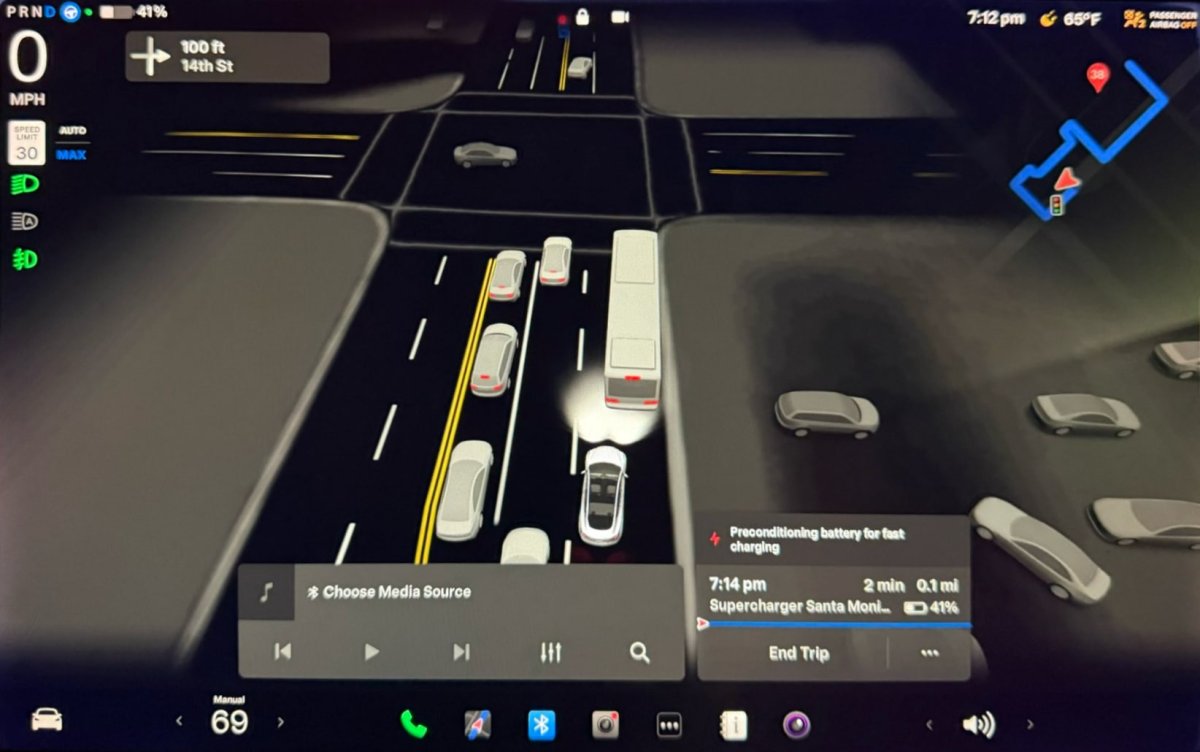
The release of Full Self-Driving (FSD) V13 has been positioned as a major leap forward in Tesla's quest for autonomous mobility. The company's AI team has touted a number of ambitious technical targets, with the CEO himself offering familiar "mind-blown" promises. However, the reality of the V13 rollout is a tale of two separate experiences. On one hand, the software represents a significant technical advancement in its architecture and capabilities. On the other hand, its real-world implementation is fraught with challenges, exposing a widening gap between the company's visionary claims and the practical realities of a phased, hardware-dependent, and geographically restricted deployment. This analysis will dissect the technical architecture of V13, examine the implications of its hardware-specific rollout, provide a balanced view of user impressions, and address the significant regulatory hurdles that continue to impede its expansion, particularly in Europe.
The Technical Architecture of V13
The FSD V13 update is a package of substantial technological upgrades that lay the foundation for a new era of autonomous capability. At its core, the system now utilizes 36 Hz, full-resolution AI4 video inputs, which is a significant leap forward in data collection and processing. This is coupled with a massive scaling of the underlying models and training data, including a 3x increase in model size and context length scaling, and 4.2x data scaling. The system now features new capabilities that enhance its usability and safety, such as integrated unpark, reverse, and park functions, as well as the addition of audio inputs to better handle emergency vehicles. The company has reported a "4x increase in miles between necessary interventions" compared to the v12.5.4 version, a key metric that demonstrates a tangible improvement in the system's performance and reliability.
The Hardware Divide and the Phased Rollout
The rollout of FSD V13 has not been uniform, creating a significant divide within the customer base. The "wide release" of V13.2.1 is reserved for vehicles equipped with the newer Hardware 4 (HW4) computers. This decision has left owners with older Hardware 3 (HW3) computers with an older version of the software and without the same capabilities. This is a reversal of an earlier stance by the CEO, who had previously suggested that HW3 owners would get updates in advance. Analysis suggests that the HW3 computer may be reaching its performance limits, which would require a mass upgrade event that the company would prefer to avoid. This creates a two-tiered system where the newest and most advanced features are only available to a subset of the customer base.
The User Experience: Hype vs. Reality
The real-world impressions of FSD V13 are as varied as the users themselves. Many users with HW4 vehicles have provided positive feedback, describing a "really good" highway experience and a general feeling of increased confidence in the system. Some have called it "easily the best update Tesla has put out," noting that it feels more confident in its decisions.
However, this praise is not universal. Other users have reported what they describe as an "anxiety-filled" experience, with the system tailgating other cars, struggling with lane discipline on turns, and stopping too late at intersections. The notorious "auto wipers" issue also remains a common pain point for some users. The experience variability is striking, with user impressions seemingly differing wildly based on location, driving style, and prior FSD experience. This paradox of wildly different user experiences, even with the same software, highlights a significant hurdle for mainstream adoption.
The European Roadblock
The challenges facing FSD are not just technical or perceptual; they are also deeply rooted in the regulatory landscape, particularly in Europe. The expansion of FSD into Europe requires navigating a complex environment of EU-wide directives and country-specific rules governing vehicle safety and data privacy. Key hurdles include compliance with the GDPR (General Data Protection Regulation), which imposes strict rules on data collection and storage, and the need to pass type approval tests that assess system reliability under European traffic conditions.
European roads also present unique challenges for the camera-based system, including complex roundabouts, historic city centers with tight turns and faded lane markings, and multilingual signage. The company has also faced a public perception problem. A recent survey showed deep consumer skepticism, with nearly half of respondents believing FSD should be illegal. The survey also found that FSD features made consumers "less likely to buy a Tesla by a two-to-one margin". This creates a significant problem for the company, as the CEO has previously suggested that the inability to offer FSD in Europe is a reason for weak sales.
FSD V13's rollout and reception expose a classic technological "hype cycle." The update is a tangible technical improvement, but it doesn't live up to the "mind-blowing" promises often perpetuated by the CEO and some influencers. This gap between promise and reality creates a user base with wildly different expectations and experiences. For experienced users who understand the system's limitations, it is a useful tool. For a new user, it can be an "anxiety-filled" experience, especially given the high cost of the add-on. This dynamic creates a significant hurdle for mainstream adoption and public trust.
There is a direct, self-reinforcing problem in Europe. The CEO has pointed to the lack of FSD approval as a reason for weak European sales, suggesting FSD is a critical sales driver. However, a survey reveals that a large percentage of European consumers are skeptical of the technology and say it makes them
less likely to buy a car. This creates a catch-22: the company needs FSD to justify its price and drive sales in Europe, but the technology is met with regulatory and public resistance. The solution isn't just a software update; it requires a new approach to European regulators and a public trust campaign.
In conclusion, while FSD V13 is a technical milestone, its full potential remains constrained by a fragmented hardware base and significant regulatory and consumer-perception barriers, particularly in the critical European market. The path to "unsupervised autonomy" is less a technical race and more a marathon of legal, regulatory, and public relations challenges that must be overcome to fully realize the company's vision.
FSD V13 vs. FSD V12: Key Technical Improvements
| Feature | FSD V12 | FSD V13 | Improvement |
| Video Inputs | Legacy AI3 inputs |
36 Hz, full-resolution AI4 video inputs |
Higher resolution and frame rate for better data |
| Model Size Scaling | - |
3x scaling |
Enhanced ability to process complex scenarios |
| Context Length Scaling | - |
3x scaling |
Greater understanding of the driving environment |
| Data Scaling | - |
4.2x scaling |
More data for training the neural network |
| New Capabilities | No |
Integrated unpark, reverse, and park capabilities; audio inputs for emergency vehicles |
Adds new functionality and improves safety |
| Performance Metric | Lower |
4x increase in miles between necessary interventions |
Greater reliability and less driver intervention required |
Frequently Asked Questions
Q: What is the main difference between HW4 and HW3 for FSD? A: Hardware 4 is the company's newest self-driving computer, and it is the only hardware capable of running the latest version of FSD V13. While older HW3-equipped vehicles will continue to receive updates, they will not get the same capabilities as HW4 vehicles, as the older hardware appears to be reaching its performance limits.
Q: When will FSD V13 be available in Europe? A: The full-featured FSD system is not yet approved for use in Europe due to a complex regulatory landscape that includes strict data privacy laws, diverse road infrastructure, and different liability standards. The company is working with EU agencies to demonstrate compliance, but a phased rollout is expected.
Q: Is FSD V13 safe to use? A: FSD V13 is a driver-assist system, and the driver is required to remain attentive and ready to intervene at all times. While the system has made significant technical improvements, user experiences vary widely, and it still faces challenges with "edge cases" such as complex weather or unusual road layouts.