
I. Introduction: The Paradox of Progress
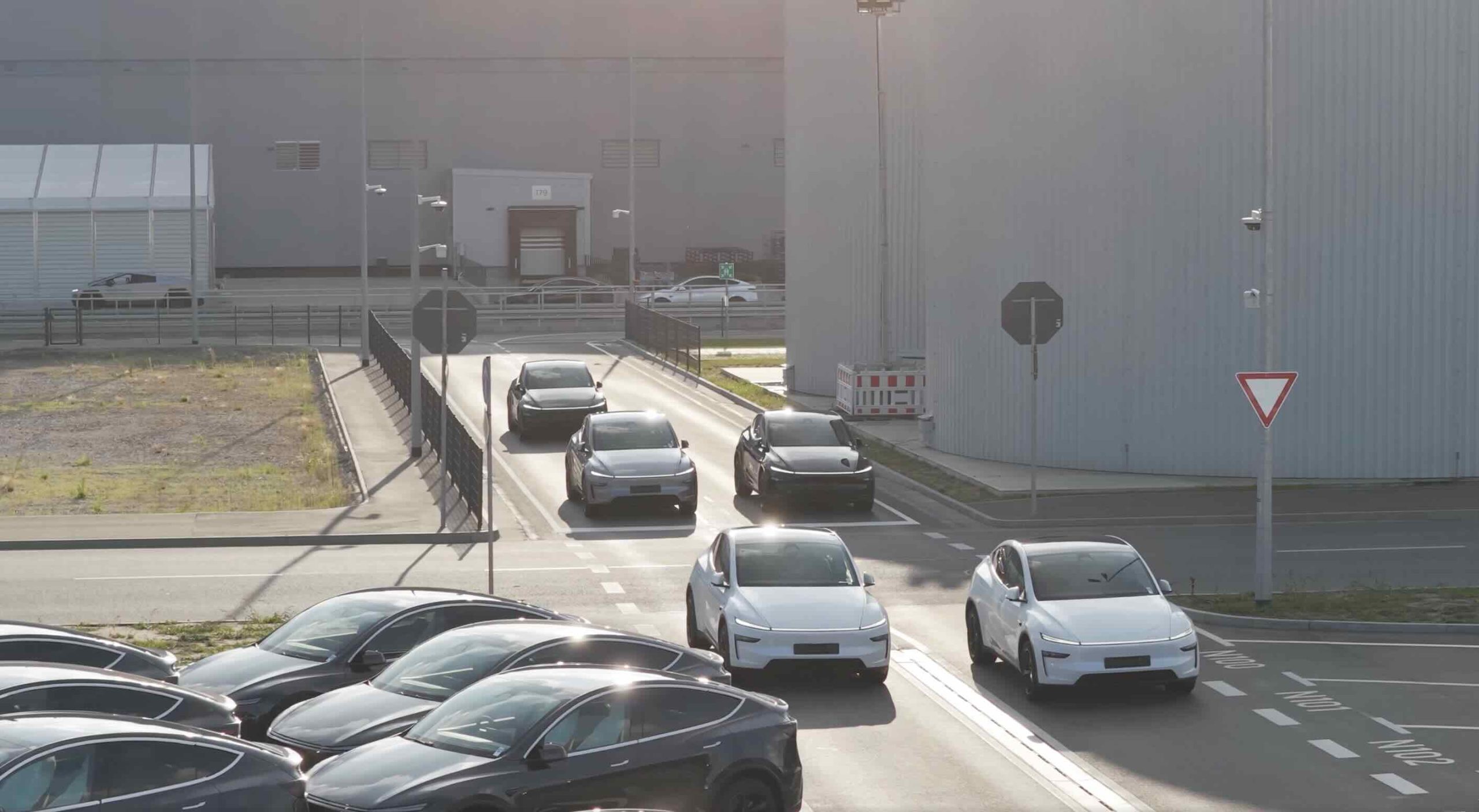
The world of automotive manufacturing is undergoing a profound transformation, driven not by traditional engineering but by artificial intelligence. A striking recent video from the Tesla AI team has offered a glimpse into this future, showing a new Model Y unit at the Giga Berlin production facility navigating itself autonomously from the end of the production line to a Supercharger and then to its designated holding area, all without a human driver. This is not a futuristic concept; it is a live, operational implementation of Unsupervised Full Self-Driving (FSD) in a controlled environment. Giga Berlin plant manager André Thierig confirmed the system is a cornerstone of the factory's logistics, stating that "Every Tesla we built has the ability to drive autonomously and we use this feature 100% for outbound operations".
This demonstration presents a fascinating paradox that defines Tesla's current position in the European market. Inside the geofenced, controlled environment of a factory, Tesla's AI is performing a critical operational function with a level of autonomy that is impressive and efficient. However, outside the factory gates, the vast majority of its customers in Europe who have paid for the FSD package are still waiting for a public release of the system. The technological reality inside the factory is years, if not a decade, ahead of the legal and regulatory reality that governs public roads. This report will explore this central conflict, analyzing the significance of the Giga Berlin deployment, the complex regulatory landscape of Europe, and the tangible implications for Tesla's customers and its broader strategy.
II. The Unveiling at Giga Berlin: A New Era for Factory Logistics
The deployment of Unsupervised FSD at Giga Berlin is a significant development that extends far beyond the typical scope of an in-house logistics tool. This system, which enables vehicles to autonomously transport themselves, streamlines a crucial and often bottleneck-prone part of the manufacturing process. The Model Y units showcased in the demonstration were seen autonomously parking themselves at on-site Superchargers and navigating to the outbound lot. This operational efficiency provides a clear economic benefit, as it automates tasks traditionally handled by human labor and reduces the time a vehicle spends in transition after it rolls off the production line.
More importantly, this deployment serves as a powerful proof of concept for Tesla’s AI-first strategy. It demonstrates that the core AI and vision technology developed for consumer vehicles is robust enough to be repurposed for large-scale industrial applications. This is a fundamental validation of the company's long-term vision, as articulated in Master Plan Part 4, which positions Tesla not merely as a car manufacturer but as a leader in artificial intelligence and robotics. The ability to transfer its core technology stack from a consumer product to a logistical asset shows that the company's value is derived from its scalable AI systems, which can be applied to diverse domains like factory automation. This operational success validates the strategic pivot that Elon Musk has been championing, confirming that the company's primary asset is its AI and the data it has collected, not just its ability to produce electric vehicles. The Giga Berlin deployment is a tangible milestone in this transition, proving that the company’s AI can perform in a complex, real-world, yet controlled, environment.
III. The Roadblocks: Europe's Regulatory Maze
Despite the clear technological readiness demonstrated at Giga Berlin, the full rollout of FSD in Europe is still a distant prospect, trapped in a complex web of legal and regulatory hurdles. The primary challenge lies with the European Union's strict UNECE Regulation on Driver Control Assistance Systems (DCAS), which currently limits FSD to "hands-on" driving, known as Phase 1. This regulation prevents the system from being operated by regular consumers on public roads in the same manner as it is in the United States.
While Tesla has been actively testing and demonstrating its Unsupervised FSD system on public roads in several European countries, including France and Germany, these remain trials and not a full-scale public launch. The wait continues, to the frustration of many Tesla owners who have purchased the FSD package. National authorities, such as the Dutch RDW, are coordinating with Tesla and acting as a pilot instance for potential EU-wide approval, but progress is slow and meticulous.
Elon Musk has publicly expressed his dissatisfaction with these delays, arguing that the protracted approval process is counterproductive to public safety. "Waiting for Dutch authorities and then the EU to approve. Very frustrating and hurts the safety of people in Europe, as driving with advanced Autopilot on results in four times fewer injuries!" Musk wrote on X. This public stance frames the regulatory lag as a direct compromise on safety, as it prevents the deployment of a technology that, based on Tesla's data, is significantly safer than human-only driving. This highlights the inherent tension between a company’s desire for rapid innovation and a regulator's mandate for cautious, evidence-based approval. The regulatory delays are not simply a business inconvenience; they create a tangible impact on the customer base. European owners who have paid for FSD see the system's full capabilities demonstrated in the US and internally in Europe, yet their own vehicles remain restricted. This has put their patience to the test. This mounting frustration among the user base provides a public relations tool for the company, as it can leverage the customer sentiment to apply pressure on authorities. This creates a causal feedback loop where regulatory inaction leads to consumer frustration, which in turn becomes a catalyst for public appeals from the company.
IV. Implications for European Tesla Owners
For European Tesla owners who have purchased the FSD package, the current situation presents a difficult value proposition. The technology is latent in their vehicles, but its full potential is locked behind regulatory firewalls. The purchase becomes an act of faith—an investment in a future capability that has yet to materialize. The company's internal use of the system at Giga Berlin only highlights this disparity, proving that the technology exists and works, but its real-world application for consumers is entirely dependent on external forces.
The path forward for a broader FSD rollout is likely to be incremental. A recent development points to a potential "halfway step" toward autonomy. New UNEC regulations, which were formally adopted in March 2025 and will take effect on September 26, 2025, cover "system initiated maneuvers on highways". This will allow cars, including Teslas, to perform certain actions on highways by themselves, but the driver must always remain responsible. While this is a move in the right direction, it is not "full FSD autonomy". The possibility of a domino effect remains a key source of optimism; some observers believe that if a major European nation like the Netherlands or Norway grants approval, it could pressure others to follow suit, leading to a faster, albeit still slow, rollout across the continent.
For a customer, this presents a unique situation where the market value of the FSD feature in Europe is divorced from its technological value. The system is technologically capable, as evidenced by its internal factory use and public road testing. However, its market value to a European consumer is diminished because its full capabilities are legally restricted. This presents a unique challenge for the company: how to maintain the value of an expensive software package when its most compelling features are held in legal limbo.
V. Conclusion: A Tale of Two Realities
The deployment of Unsupervised FSD at Giga Berlin is a powerful testament to Tesla's technological prowess and its commitment to an AI-driven future. It confirms that the company's core technology stack is not just a consumer product but a scalable system with broad industrial applications. However, this impressive internal progress stands in stark contrast to the external market reality in Europe, where a cautious regulatory environment and a complex web of national authorities continue to delay the public release of the system.
Ultimately, Tesla is a company operating on two very different timelines: a rapid, agile technological development cycle and a slow, methodical regulatory one. For its European customers, the wait is far from over, but the Giga Berlin deployment is a significant milestone that validates the company's core technology and demonstrates its long-term vision. The question is no longer if the technology is ready, but when the legal and regulatory frameworks will be.
VI. FAQ: Answering Your FSD Questions
The regulatory landscape for autonomous driving in Europe is complex and varies by country. The following table summarizes the status of Full Self-Driving technology in key European markets.
| Country/Region | Current Status & Key Details | Key Regulatory Body | Potential Timeline |
| Europe (General) |
Unsupervised FSD not yet available for public use. System-initiated maneuvers on highways may be allowed after September 26, 2025, under new UNEC regulations. |
UNECE, EU Commissions |
Limited functionality by late 2025; Full autonomy likely 2026+ |
| Netherlands |
Active testing and coordination with regulators. Considered a pilot instance for EU-wide approval. |
RDW (Netherlands Vehicle Authority) |
A leader in the approval process, potentially among the first to allow public use |
| Germany |
Testing has been reported, with demonstrations to regulators. Tesla's website updates suggest it is a targeted launch country. |
National Transport Authority |
Pending full regulatory approval |
| Norway |
Received approval for live testing of FSD Supervised on public roads for two years. |
Norwegian Road Authority |
Pending full regulatory approval; a key testing ground |
| France |
Test drives have been conducted, including complex traffic scenarios. |
National Transport Authority |
Pending full regulatory approval |
| Czech Republic |
A new law passed in January 2025 paves the way for FSD use starting in January 2026, though it is not yet active. |
National Transport Authority |
Not expected until 2026 at the earliest |