
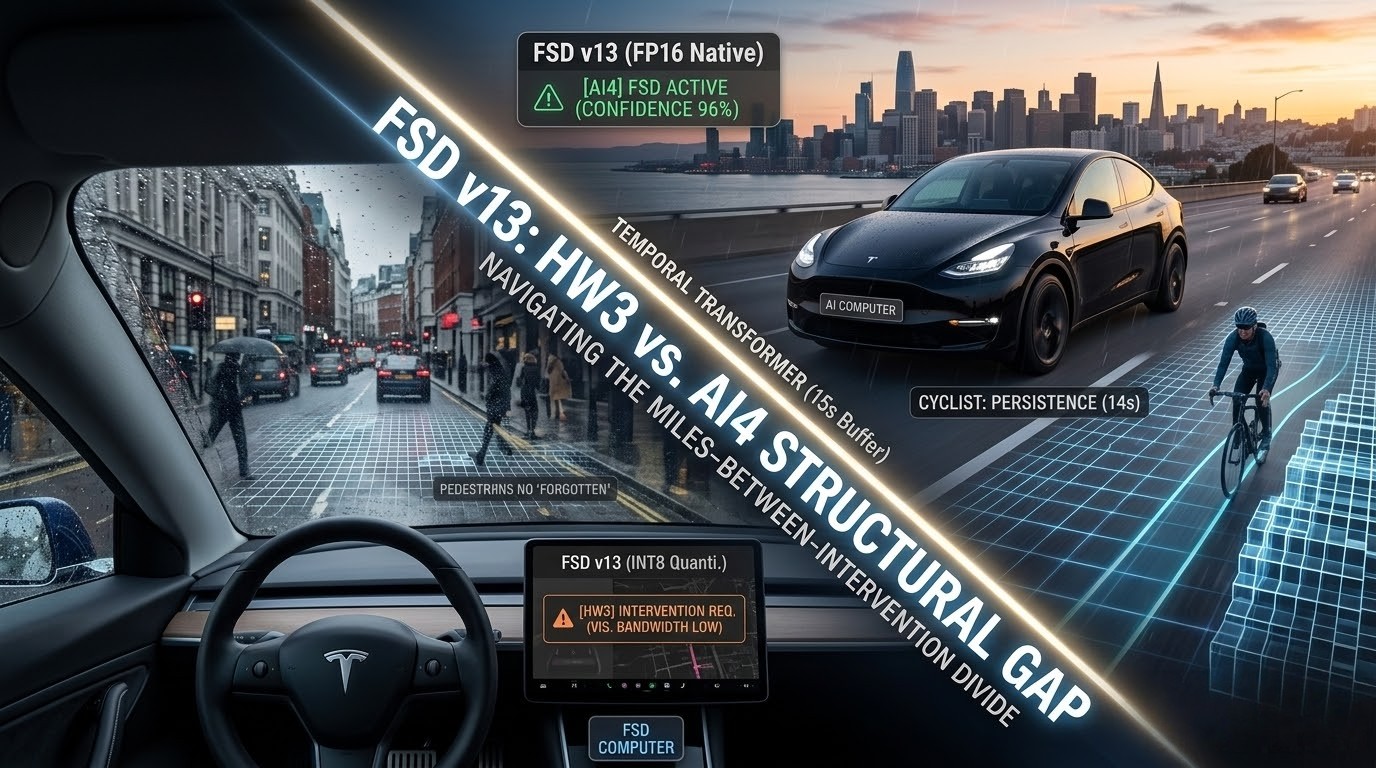
1. Introduction: The 2026 Paradigm Shift
As of March 16, 2026, the Tesla ecosystem has officially moved past the "Snapshot Era" of driver assistance. With the wide-scale deployment of firmware 2026.8, containing the FSD v13 software stack, the conversation among owners in London, Oslo, and San Francisco has shifted from "when will it arrive" to a much more critical technical frontier: Temporal Intelligence.
For years, Full Self-Driving operated on a behavioral cloning model that reacted to the world in a series of high-speed static frames. V13 marks the full transition to an End-to-End Temporal Transformer architecture. This shift has essentially given the car a sense of "time" and "persistence." However, as the initial excitement of the March rollout settles, a harsh reality is emerging for legacy owners: the widening structural performance gap between Hardware 3 (HW3) and the newer AI4 (Hardware 4) platforms.
2. The Technical Core: End-to-End Temporal Transformers
The headline innovation in v13 is the abandonment of separate, isolated modules for perception and planning. Instead, the system uses a unified "World Model" that understands the physics of motion over time.
2.1 The 15-Second Temporal Buffer
In previous versions like v12.5, if a pedestrian was momentarily occluded by a parked van, the system's "memory" was shallow. V13 introduces a 15-second Temporal Buffer.
-
Object Permanence: The AI now maintains a mathematical probability path for every occluded object. If a ball rolls into the street, v13 "remembers" the likely presence of a child following it, even before they are visible.
-
Smoothness: By processing a sequence of events rather than snapshots, the "jerkiness" often associated with unprotected left turns or complex roundabouts has been reduced by an estimated 60% on AI4 platforms.
2.2 Voxelization and Occupancy Network 3.0
To support this temporal understanding, Tesla has upgraded its Occupancy Network to version 3.0. The system discretizes the 3D world into high-resolution voxels (volumetric pixels).
-
8x Resolution Boost: For AI4-equipped vehicles, the voxel resolution has been increased eight-fold. This allows the car to "see" and categorize fine details—like a stray nail or a shallow pothole—at twice the distance compared to HW3.
-
Pure Spatial Awareness: Unlike older lidar-reliant competitors, v13 utilizes these voxels to understand empty space vs. occupied space without needing to "classify" every object first, leading to faster reaction times in unstructured environments.
3. The Hardware Paradox: HW3 vs. AI4 Divergence
While v13 is technically compatible with HW3, the March 2026 fleet data indicates a clear "compute ceiling" has been reached for older silicon.
3.1 Miles Between Intervention (MBI) Metrics
Real-world data tracked across North America and the EU highlights a staggering disparity:
-
AI4 Platforms (Model 3 Highland / Model Y Juniper): Achieving an average of 450 miles between critical disengagements.
-
HW3 Platforms (Legacy 2019-2023 Models): Hovering around 120 miles.
The reason is structural. AI4 features significantly higher NPU (Neural Processing Unit) throughput and runs v13 natively in high-precision FP16. HW3, however, requires aggressive neural pruning and INT8 quantization to fit the massive v13 model into its smaller memory bandwidth. This "quantized thinking" manifests as hesitations in high-complexity "edge cases," such as heavy rain in Seattle or dense urban traffic in Paris.
3.2 Perception Bandwidth
AI4 processes full 5-megapixel feeds at a native 36 frames per second (fps). HW3 is limited by its 1.2-megapixel sensors and lower RAM, forcing the AI to "guess" details of distant objects. This is the primary reason why AI4 owners report "near-human" confidence in highway merges, while HW3 owners still experience occasional "phantom" micro-braking.
4. Safety Shields and Regulatory Compliance
To meet the 2026 mandates from the NHTSA and European regulators, v13 includes a new "Black Box" Logging System.
-
Confidence Scores: The AI now generates real-time "Neural Confidence Scores." If the system’s certainty drops below a specific threshold (due to mud on a lens or ambiguous road markings), it initiates a proactive 2-second warning before requiring a takeover.
-
European Adherence: In the UK and EU, v13 has been specifically tuned for "smooth nudging" in traffic and better interaction with cyclists, a key requirement for achieving Level 3 certification in the Dutch and German markets.
5. New Ownership Features in 2026.8
The firmware update isn't just about driving logic; it brings several "Quality of Life" improvements for the modern Tesla owner:
-
Comfort Braking: A hardware-software synergy in newer builds (Juniper/Highland) that uses a new hydraulic channel to eliminate the "neck-snap" sensation when transitioning from regenerative braking to a full stop.
-
Parked Blind Spot Warnings: Particularly for Cybertruck and Model Y owners, the car now pings your phone and flashes exterior lights if you are about to open a door into an approaching cyclist or vehicle.
-
Grok AI Integration: For European markets, the Grok voice assistant now supports a native British persona ("Leo"), allowing for natural language control over complex navigation and vehicle settings.
6. Conclusion: The Road to Unsupervised Autonomy
FSD v13 is the "End of the Beginning." By solving the temporal dimension of AI perception, Tesla has removed the final logical hurdle to achieving a system that truly understands the world. However, for the professional blogger and the enthusiast owner, the message is clear: Silicon is the new limit.
While HW3 remains a safe and capable "Supervised" driver, the "Unsupervised" future—the world of the steering-wheel-less Cybercab—belongs to AI4 and the upcoming AI5. As we approach the end of Q1 2026, the performance gap suggests that for those seeking a "zero-intervention" lifestyle, a hardware upgrade or trade-in has become a functional necessity rather than a luxury.
FAQ: What You Need to Know Today
Q: Will my 2019 Model 3 ever get "Unsupervised" FSD?
-
A: Based on current v13 performance, HW3 will likely remain a "Supervised" Level 2+ system. Silicon limitations make the safety margins required for Level 4 (Unsupervised) difficult to hit on the older chipsets.
Q: Is the FSD v13 "Comfort Braking" available as a retrofit?
-
A: No. While software plays a part, Comfort Braking relies on newer hydraulic valves found only in the 2025/2026 Model 3 and Model Y "Juniper" refreshes.
Q: How do I check my hardware version?
-
A: Go to Controls > Software > Additional Vehicle Information on your touchscreen. If it lists "AI Computer," you are likely on AI4; if it says "FSD Computer," you are on HW3.