
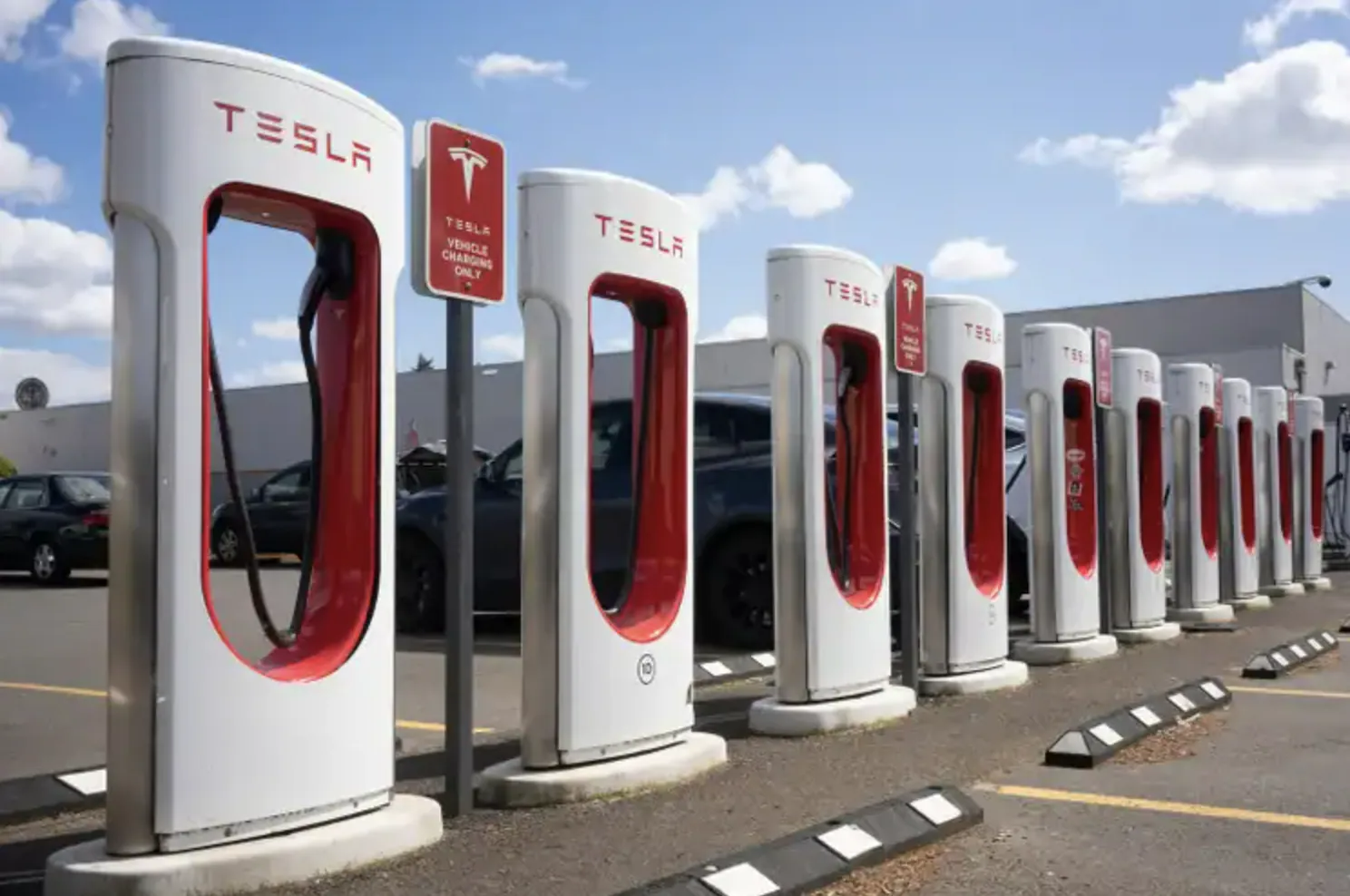
Pull into a busy service plaza on Interstate 95 between New York and Washington D.C. in the late summer of 2025. You will see a familiar sight: rows of sleek, white-and-red Tesla Supercharger stalls. But look closer. A Ford Mustang Mach-E is plugged in, its pony emblem a stark contrast to the nearby Tesla "T". A few stalls down, a Rivian R1T is replenishing its battery, its rugged adventure-ready aesthetic parked next to a sophisticated Model S. A driver with a GM-branded adapter is just pulling up in their Cadillac Lyriq. This scene, once unthinkable, is now the new normal. It’s the physical manifestation of a revolution that has been quietly unfolding, a revolution built around five simple letters: NACS.
The decision by Tesla to open its proprietary charging standard—now rebranded as the North American Charging Standard (NACS)—and subsequently open its vast Supercharger network to other automakers is, without a doubt, the most strategically significant move the company has made since it first unveiled the Model 3. This wasn't merely a gesture of goodwill; it was a calculated play to cement Tesla's role as the undisputed backbone of electric vehicle infrastructure. In doing so, Tesla has not only accelerated the EV transition for everyone but has also unlocked a powerful new revenue stream and fortified its competitive moat for the decade to come. This article will explore the real-world impact of the NACS rollout across America, contrast it with Tesla's tailored charging strategy in Europe, and analyze how the Supercharger network is evolving from a simple owner perk into a dominant, multi-billion-dollar business unit that profoundly impacts the entire energy market.
Chapter 1: The Great American Rollout: NACS in Action
The transition from a proprietary, Tesla-only network to an open, continent-wide standard has happened with a speed that has stunned the automotive industry. What began with a surprise announcement from Ford in 2023 quickly became a domino effect, with virtually every major automaker selling EVs in North America—from General Motors and Rivian to Volvo and Nissan—committing to adopt the NACS port in their future vehicles. In 2025, we are living in the results of that sea change.
Beyond the Adapter
The initial phase of this transition was dominated by adapters. Legacy automakers rushed to provide their existing CCS-port-equipped vehicle owners with NACS-to-CCS1 adapters, granting them access to a large portion of the Supercharger network. While functional, this was a temporary bridge. The real revolution is happening now, on the 2025 and 2026 model year production lines. New Ford, GM, and Rivian vehicles are rolling out of factories with NACS ports integrated directly from the start.
This native integration is a game-changer. It eliminates the friction, potential compatibility issues, and the simple inconvenience of carrying around a bulky adapter. For new EV buyers, the charging experience becomes seamless and standardized. They can pull up to a Supercharger, plug in, and the car communicates directly with the network to handle authentication and billing, just like a Tesla. This "Plug and Charge" simplicity, a hallmark of the Tesla experience, is now becoming the industry standard, and it's all happening on Tesla's terms and on Tesla's network. This move has effectively marginalized the competing CCS1 standard in North America, turning a standards war into a decisive victory for Tesla's elegant and compact connector design.
The "Magic Dock" Experience
While new cars get native NACS ports, what about the hundreds of thousands of existing CCS-equipped EVs? For them, Tesla has deployed its clever solution: the Magic Dock. This integrated adapter is housed directly within the Supercharger stall itself. A Tesla driver pulls up and plugs in as normal. A non-Tesla driver uses the Tesla app to select their stall; the app then sends a command to the charger, which unlocks the Magic Dock. The driver can then pull out the connector, which now has the CCS1 adapter attached, and plug it into their vehicle.
From a user experience perspective, the Magic Dock is a masterclass in engineering. It's robust, intuitive, and ensures that no one is ever left without the correct adapter. For non-Tesla drivers, the process is straightforward. They download the Tesla app, create an account, add a payment method, and they're ready to go. Reviews of the experience are overwhelmingly positive, focusing on two key Tesla strengths: reliability and simplicity. While other public charging networks have been plagued by broken chargers, confusing payment systems, and inconsistent speeds, Superchargers simply work. Non-Tesla drivers are now experiencing this reliability firsthand. They are achieving consistent, high-speed charging sessions, often at or near their vehicle's maximum charging rate. This positive experience is not just a service; it's a powerful marketing tool for the entire Tesla brand.
Network Strain and Expansion
The most immediate and obvious question raised by opening the floodgates was: will this ruin the Supercharger experience for Tesla owners? The fear of increased wait times and congested stations was palpable. Tesla anticipated this and has been executing an aggressive expansion plan to stay ahead of the demand curve. The deployment of the new V4 Supercharger stalls is central to this strategy. V4 stalls not only support higher peak charging rates for future vehicles but also feature significantly longer charging cables. This is a crucial design choice, as it accommodates the wide variety of charge port locations on non-Tesla vehicles, preventing situations where a car might have to park awkwardly or block another stall.
Tesla's data-driven approach to site selection is now being used to serve the entire EV market. New stations are popping up not just along major Tesla travel corridors, but also in locations that are strategic for, say, Ford F-150 Lightning or Chevy Silverado EV owners. The company is using anonymized data from all vehicles using its network to identify choke points and areas of future demand. The goal is to maintain the core promise of the Supercharger network: fast, reliable, and available charging, wherever you want to go. While some popular locations have seen increased traffic during peak holiday travel, the overall network has absorbed the new demand remarkably well, thanks to this proactive expansion.
The Owner's Perspective
For long-time Tesla owners, the transition has been a mixed bag emotionally, but largely positive practically. Gone is the feeling of being part of an exclusive club. However, this has been replaced by a new reality. The "range anxiety" that once plagued all EV owners is now effectively a thing of the past for everyone, which accelerates the overall transition away from gasoline cars—a core part of Tesla's mission.
Furthermore, there are direct benefits. The massive influx of revenue from non-Tesla drivers is being poured directly back into network expansion and maintenance, benefiting all users. This economy of scale also puts downward pressure on charging prices. As utilization of each station increases, the cost per kilowatt-hour delivered decreases, allowing Tesla to offer some of the most competitive fast-charging rates on the market. Tesla owners are finding that their "home" network is now bigger, better maintained, and more affordable than ever before, even if they now have to share it with a few new friends.
Chapter 2: A Tale of Two Continents: The European Charging Strategy
While North America has undergone a rapid consolidation around NACS, the charging landscape in Europe is a different story. The continent is firmly committed to the CCS2 standard, a physically larger connector that is the law of the land. Here, Tesla's strategy is not one of conversion, but of integration and competition.
CCS2 Dominance and "Open" Pilots
Tesla vehicles sold in Europe have come equipped with a CCS2 charge port for years, allowing owners to use both the Supercharger network and third-party networks like Ionity or Fastned. Tesla's strategic play in Europe has been to selectively open its own CCS2-equipped Supercharger stations to non-Tesla EVs. What started as a small "Non-Tesla Supercharger Pilot" in the Netherlands has now expanded across the continent, covering key markets like Germany, France, the United Kingdom, and Scandinavia.
The rollout is strategic and data-driven. Tesla opens stations in areas where there is a high density of other EV brands and where existing third-party charging infrastructure may be lacking in reliability or capacity. This allows Tesla to fill a crucial market gap and demonstrate the superiority of its network's user experience, even when using the same physical plug as its competitors. The goal is the same as in North America: make the Supercharger network the default choice for all EV drivers, regardless of the car they own.
The V4 Supercharger's Role
The new V4 Supercharger stall is even more critical in Europe than in North America. Its design, with a much longer cable, was conceived with the fragmented European EV market in mind. A Porsche Taycan has its charge port on the front fender, a Renault Megane E-Tech has it on the side, and a Tesla Model 3 has it on the rear. A short cable, like on the older V2 and V3 stalls, would make it impossible for some cars to charge without blocking adjacent spots. The V4's long cable solves this logistical nightmare, ensuring that any EV, regardless of its design, can easily plug in. This seemingly small detail is a huge competitive advantage, as it removes a point of friction that plagues many other charging networks with less thoughtful hardware design.
Pricing, Politics, and Partnerships
Tesla employs a clever pricing strategy in Europe to incentivize both usage and brand loyalty. Non-Tesla drivers can charge on a pay-per-use basis at a higher rate, or they can pay a monthly subscription fee (similar to a Costco membership) to access the same lower electricity rates that Tesla owners enjoy. This model encourages frequent users to commit to the Tesla ecosystem via its app, creating a recurring revenue stream.
Politically, opening the network has been a savvy move. Several EU countries and the UK offer significant government subsidies for the construction of public charging infrastructure, but these funds are often contingent on the chargers being open to all users. By opening its network, Tesla can now tap into these public funds to accelerate its expansion even further, effectively having governments help finance its competitive dominance. This pragmatic approach allows Tesla to grow faster and build a more robust network than any competitor, solidifying its position as essential public infrastructure.
Navigating a Fragmented Market The European fast-charging market is a battleground, with strong players like Ionity (a consortium of automakers including BMW, Mercedes, Ford, and Hyundai) and independent networks like Fastned and Allego. However, they often struggle with the same issues that plagued non-Tesla networks in the US: inconsistent reliability, complex payment methods (requiring multiple apps or RFID cards), and chargers that are frequently out of service.
Tesla's competitive advantage remains its vertically integrated, seamless experience. The integration of the charger, the vehicle (for Tesla owners), and the app creates a frictionless process that competitors struggle to replicate. By opening its network, Tesla is not just selling electricity; it's showcasing its superior user experience to its competitors' customers. Every time a VW ID.4 driver gets frustrated with a broken Ionity charger and successfully uses a nearby Supercharger instead, it serves as a powerful advertisement for the Tesla ecosystem.
Chapter 3: More Than Just a Charger: The Supercharger Network as a Business
The evolution of the Supercharger network from a cost center and owner perk into a major, profitable business unit is a critical, and often overlooked, part of the Tesla story in 2025.
A New Billion-Dollar Revenue Stream
For the first time, Tesla's quarterly financial reports are beginning to highlight the significant revenue being generated from "Services and Other," with specific callouts to charging revenue. While Tesla doesn't break out the exact numbers, industry analysts estimate that revenue from non-Tesla charging is already running into the hundreds of millions of dollars annually and is on a trajectory to become a multi-billion-dollar business within the next two years.
This revenue is high-margin. Once a station is built, the primary operating costs are electricity and maintenance. By dramatically increasing the utilization of these expensive assets with traffic from other brands, Tesla is maximizing its return on investment. This new cash flow provides a self-funding mechanism for even more rapid network growth, creating a virtuous cycle of expansion and profit.
The Data Moat
Perhaps more valuable than the direct revenue is the data. With millions of non-Tesla EVs now plugging into its network, Tesla is gaining an unprecedented, real-world view of the entire electric vehicle market. It can see the charging patterns, battery performance, and peak charging rates of its competitors' vehicles. This information is invaluable. It can inform Tesla's own R&D, helping them to benchmark their battery and powertrain technology against the competition. It provides a granular, real-time map of EV density and travel patterns, allowing for hyper-efficient planning of future Supercharger locations. This competitive intelligence, gathered with every plug-in, is a "data moat" that no other automaker has access to.
The Energy Ecosystem Link
Increasingly, new Supercharger stations are being built as integrated energy assets. They are being paired with Tesla's own Powerwall units for local storage and, where feasible, large solar panel canopies. This strategy has several benefits. It reduces the station's reliance on the local utility grid, insulating it from demand charges and time-of-use pricing, which lowers the cost of the electricity it serves. During a grid outage, these stations can potentially continue to operate in a limited capacity, providing a critical emergency service.
On a larger scale, these stations are becoming key nodes in the energy grid. Tesla can use the stationary batteries at its charging sites to provide grid stabilization services, selling energy back to the utility during times of peak demand. This transforms a simple "gas station for EVs" into a dynamic, distributed energy asset that participates in the broader energy market, creating yet another revenue stream from the same piece of real estate.
The Competitive Moat
Ultimately, the open Supercharger network is Tesla's ultimate competitive moat. In the past, people bought a Tesla partly because it was the only way to access the best charging network. Now, other automakers are essentially paying Tesla to showcase its superiority to their own customers. This move has hamstrung competitors. Why would a rival automaker consortium invest billions to try and build a network to compete with Superchargers when their customers can just use the Superchargers anyway?
Tesla has effectively commoditized the fuel, but has done so on a network that it owns and controls completely. It has turned a potential weakness (a proprietary plug) into an industry standard and a core profit center. By controlling the most critical piece of the EV puzzle—reliable, ubiquitous fast charging—Tesla has ensured that even as the number of compelling electric cars from other brands grows, the entire ecosystem will continue to lean on, and pay tribute to, the company that built it first and best.
Conclusion
The decision to open the Supercharger network and champion the NACS standard was a strategic masterstroke, a classic case of playing the long game. In North America, it has ended the charging standards war, unifying the market around Tesla's technology. In Europe, it has provided a powerful tool for competing in a fragmented market by highlighting Tesla's core strengths of reliability and user experience.
Far from being a simple act of altruism, this move has transformed the Supercharger network into a formidable business in its own right. It generates significant revenue, provides invaluable competitive data, and integrates seamlessly with Tesla's growing energy business. It has created a durable competitive moat that is not based on exclusivity, but on acknowledged superiority. The NACS revolution is reshaping the entire EV landscape, accelerating the transition to sustainable transport for all, while ensuring that for the foreseeable future, all roads—and all charging cables—lead back to Tesla.
FAQ Section
As a Tesla owner, how can I see if a Supercharger station is open to other EVs? In your Tesla's navigation system, you can tap on any Supercharger icon on the map. The pop-up details will typically include information on the number of stalls, power output, and pricing. For stations that are part of the "Non-Tesla Pilot," there will often be a note indicating that the site is open to all compatible EVs.
What are the typical charging speeds for a non-Tesla EV at a Supercharger? The charging speed is determined by the specific EV's battery architecture, not the charger itself (as long as the charger's output is higher than the car's maximum). Most modern CCS-equipped EVs will charge at or very near their advertised maximum DC fast-charging speed, as V3 and V4 Superchargers can supply ample power (250kW or more).
Are there membership plans for non-Tesla drivers to get lower charging rates? Yes. In both North America and Europe, Tesla offers a membership program through its app. Non-Tesla drivers can pay a monthly subscription fee (e.g., around $12.99 in the US or €12.99 in Europe) which grants them access to the same, lower per-kWh pricing that Tesla owners pay. For those who use Superchargers frequently, this can offer significant savings over the standard pay-per-use rate.
Will all Superchargers eventually be open to all EVs? That appears to be the long-term goal. Tesla is systematically retrofitting older stations with Magic Docks and ensuring new stations are built to accommodate all EV brands. The pace of the rollout depends on hardware availability and strategic priorities, but the clear trend is towards a 100% open network in regions where it is deployed.
How is Tesla ensuring station etiquette and preventing congestion? Tesla uses a combination of strategies. Idle fees, which charge owners for every minute their fully-charged car remains plugged in, apply to all users and encourage rapid turnover. The deployment of V4 chargers with longer cables helps prevent cars from blocking stalls. Finally, the aggressive network expansion, funded by the new revenue, is the primary long-term solution to preventing congestion by ensuring supply always stays ahead of demand.