
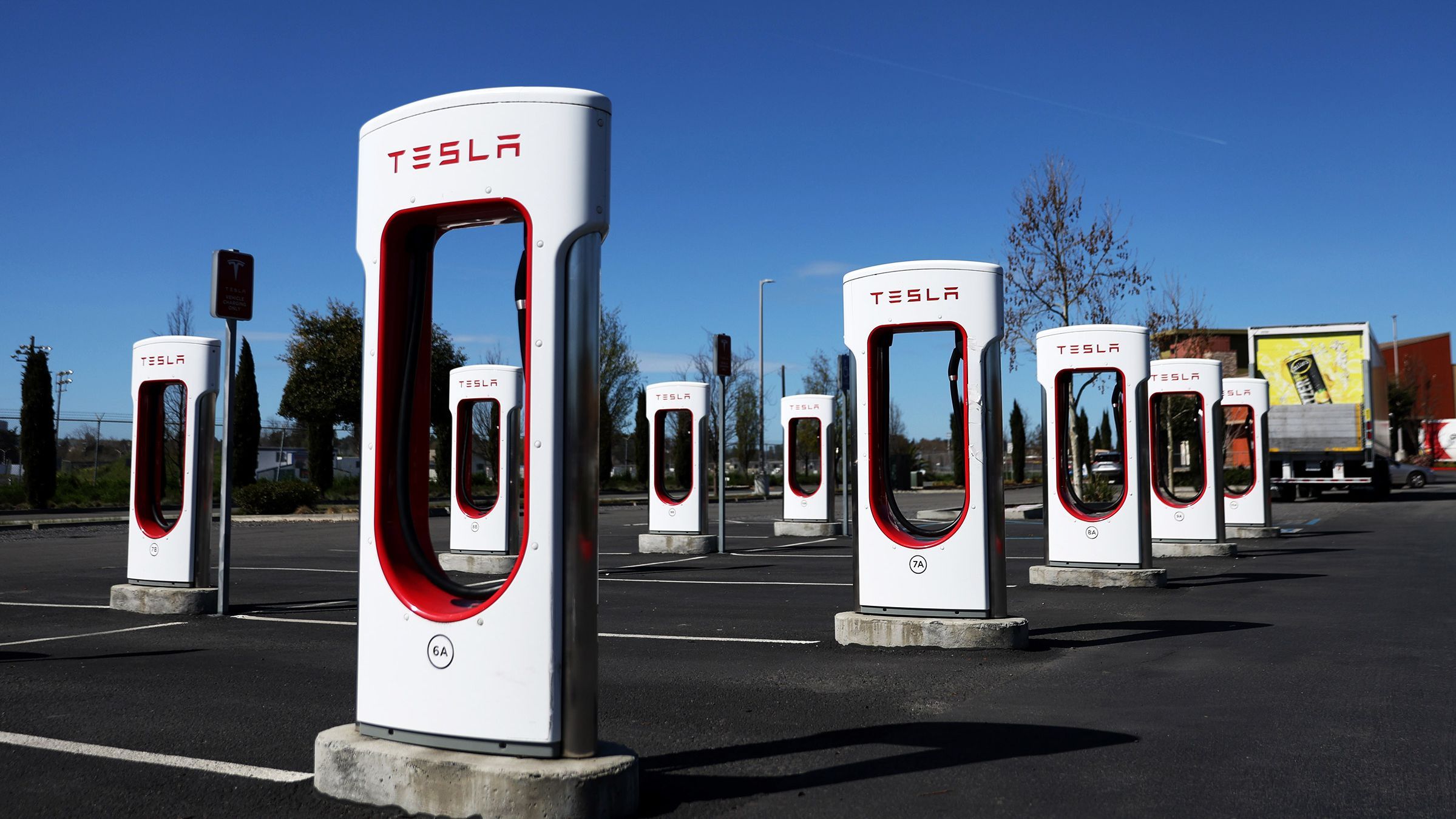
Picture a busy service station on a holiday weekend. For the better part of a decade, this scene, if it was a Tesla Supercharger station, was a picture of serene, futuristic uniformity. A silent sea of Model 3s, Ss, Xs, and Ys would occupy the stalls, their owners confident in the seamless, exclusive experience. It was a private club for the electric age. Now, look at that same station today, in late 2025. A Ford Mustang Mach-E is plugged in next to a Model Y. A sleek Hyundai Ioniq 5 is drawing power two stalls down from a Model S Plaid. A Volkswagen ID.4, a Polestar 2, a Rivian R1T—all are welcome. The scene is no longer homogenous; it's a vibrant, diverse snapshot of the entire electric vehicle market. This reality, once the subject of speculative fiction in online forums, has arrived.
This transformation begs a crucial question that has echoed through the automotive world: Why would Tesla willingly dismantle its own crown jewel? For years, the Supercharger network—with its effortless user experience, bulletproof reliability, and strategic placement—was the single greatest competitive advantage the company possessed. It was the definitive rebuttal to range anxiety and the most powerful closing argument for countless sales. Why, after investing billions to build this exclusive "walled garden," would Tesla open the gates and invite the competition inside?
The answer is that this is no act of charity or surrender. It is a calculated, audacious, and brilliant strategic pivot. This article will demonstrate that Tesla's decision to open its network is a gambit to evolve from a car company that has an infrastructure asset into an energy company that serves the entire transportation sector. It is a deliberate move to monetize a colossal investment, secure billions in public funding for future growth, and cement its technology as the undisputed global standard. By sacrificing exclusivity, Tesla is not draining its moat; it is widening it to encompass the entire industry, forcing everyone else to play on its terms.
Join us as we explore this pivotal moment in the EV transition. We will journey back to the origins of the exclusive "walled garden" to understand its power. We will break down the complex technical and logistical feat of opening a closed system. We will analyze the powerful, multi-layered business case that made this move an inevitability. We will look at it from the perspective of the loyal Tesla owner, weighing the risks and benefits. And finally, we will examine the profound shockwaves this decision is sending through the entire EV charging landscape, forever changing the future of how we "refuel."
Chapter 1: The "Walled Garden": A Decade of Exclusive Dominance
To understand the magnitude of Tesla's decision, one must first appreciate the fortress they chose to unlock. In the early 2010s, the electric vehicle was a novelty, hampered by a classic chicken-and-egg dilemma: people wouldn't buy EVs if there was nowhere to charge them on long trips, and companies wouldn't build a charging network for the handful of EVs on the road. Tesla, under the leadership of Elon Musk, recognized this as an existential threat. They realized that to sell their cars, they first had to build the electric equivalent of the entire national gas station infrastructure from scratch.
The Supercharger network was born of this necessity. It was a bold, capital-intensive, and vertically integrated solution to a problem the rest of the industry—governments, utility companies, and other automakers included—had failed to solve. But Tesla didn't just build chargers; they built an experience. They meticulously crafted a system designed to eliminate every point of friction that plagued early EV ownership.
The anatomy of this experience was a study in perfection. First and foremost was the magic of "Plug & Charge." A Tesla driver simply had to park, open the charge port, and plug in the connector. There were no RFID cards to swipe, no clunky mobile apps to initiate, no credit card readers to fail. The charger instantly and securely communicated with the car, authenticating the owner's account and handling billing automatically in the background. It just worked, every single time.
Second was its unmatched reliability. While the burgeoning third-party charging networks became a running joke among EV drivers—a "reliability lottery" where one might find broken screens, failed payment systems, or simply dead chargers—the Supercharger network boasted a widely cited uptime of over 99%. This reliability transformed the psychology of EV road trips from a stressful, anxiety-ridden adventure into a predictable and mundane affair, just like in a gasoline car.
Finally, there was the intelligent integration. The network was not a standalone entity but a core component of the Tesla operating system. A driver could enter any destination in the car's navigation, and the software would automatically plot a route, including the necessary Supercharger stops. It would calculate the required charging time at each stop and, crucially, begin preconditioning the battery as the car approached the station, ensuring it was at the optimal temperature to accept the fastest possible charging speed. The app and in-car screen showed real-time stall availability, eliminating the fear of arriving at a full station.
This seamless, reliable, and intelligent ecosystem became the most powerful competitive moat in the automotive industry. For years, it was the definitive answer to why a prospective buyer should choose a Tesla over a competing EV, even if the competitor had a nicer interior or a lower price tag. It created a powerful lock-in effect and a fiercely loyal customer base. The "walled garden" was safe, predictable, and exclusively for its own citizens. The decision to now tear down those walls was, therefore, nothing short of revolutionary.
Chapter 2: Opening the Gates: The Technical and Logistical Feat
Making the world's largest proprietary charging network universally accessible is not as simple as flipping a software switch. It was a multi-year, multi-faceted engineering challenge that required different solutions on different continents, all while ensuring the core experience remained as frictionless as possible.
Europe, in many ways, served as the testbed for this global transition. Due to EU regulations, the charging infrastructure was standardized around the Combined Charging System (CCS) Type 2 connector. To sell cars in Europe, Tesla was compelled to adopt this standard, building its European Model 3 and Model Y vehicles with a CCS2 port. This meant that its newer V3 and all its latest V4 Supercharger stalls were already equipped with the universal CCS2 plug from the factory. The primary challenge in Europe was on the software side: creating a robust system within the Tesla app for non-Tesla owners to locate stations, select a specific stall, initiate a charging session, and handle payment. The "Non-Tesla Supercharger Pilot Program" began in late 2021 in the Netherlands and was gradually and carefully expanded across the continent, allowing Tesla to gather data and refine the app-based user experience.
North America presented a far greater hardware challenge. Here, Tesla had established its own, smaller, more elegant connector as the dominant standard for its fleet of over a million vehicles. The prevailing public standard was the much bulkier CCS1 connector. Forcing existing stations to serve both standards could have meant costly retrofits with dual cables, creating a clumsy and confusing user experience. Tesla's solution was a stroke of engineering genius: the "Magic Dock."
The Magic Dock is a small, integrated CCS1 adapter housed within the Supercharger's holster itself. From the outside, the stall looks almost identical to a standard one. The magic happens through the app. When a Tesla vehicle, which communicates natively with the charger, plugs in, the dock remains locked in place, and the user connects the slim NACS handle as usual. However, when a non-Tesla owner selects that same stall in the Tesla app and initiates a session, a small electromechanical lock releases. The driver can then pull out the entire holster assembly—the NACS handle now securely nested inside the CCS1 adapter. They plug this larger, unified connector into their vehicle, and the session starts. It is an elegant, robust, and cost-effective solution that allows a single cable and stall to serve both standards seamlessly, without confusing users.
The universal key to this entire global operation is the Tesla mobile app. It has become the central nervous system for the open Supercharger network. For non-Tesla owners, the app provides the full suite of services that Tesla drivers get in their cars: a map of available stations, real-time data on how many stalls are free, and a simple interface to start, monitor, and pay for charging. Tesla has invested heavily in making this process as smooth as possible, understanding that a clunky app experience would undermine the network's reputation for simplicity. The global rollout, from the early European pilots to the full-scale launch across the United States, has been a masterclass in this iterative, data-driven approach, a testament to Tesla's identity as a software and logistics company as much as a car company.
Chapter 3: The Business Case: From Moat to Multi-Billion Dollar Profit Center
While Tesla's official mission is to accelerate the world's transition to sustainable energy, the decision to open the Supercharger network was driven by a powerful and multifaceted business case. It represents a strategic pivot from using the network as a defensive moat to protect car sales, to wielding it as an offensive weapon to generate revenue and dominate the future of energy distribution.
The most direct motivation is the ability to unlock a stranded asset. Over the past decade, Tesla has invested tens of billions of dollars to build out its global network of over 50,000 Superchargers. From an accounting perspective, this massive capital expenditure was largely a "cost of sales"—a necessary expense to enable and support vehicle sales. By opening the network to millions of non-Tesla EVs, the company instantly transforms this cost center into a powerful, high-margin, recurring revenue stream. With each kilowatt-hour sold to a Ford, a Hyundai, or a Rivian, Tesla monetizes its prior investment, creating a new business division that could one day rival its automotive sales in profitability.
A second, equally critical driver was the allure of government incentives. Recognizing the urgent need for robust public charging, governments around the world have allocated billions of dollars in subsidies for infrastructure development. The catch is that this public money is almost universally reserved for open, interoperable charging stations. In the United States, the National Electric Vehicle Infrastructure (NEVI) program, funded by the Bipartisan Infrastructure Law, set aside $7.5 billion for this purpose. By keeping its network proprietary, Tesla was ineligible. By "flipping the switch" and opening its network with solutions like the Magic Dock, Tesla instantly unlocked this golden ticket. It can now use billions in public funds to finance the future buildout of its network, effectively having taxpayers and competitors' customers fund the expansion of its dominance.
The strategic endgame, however, is to become the de facto standard. In any new technology sector, there is a battle to establish the dominant standard—think VHS vs. Betamax, or Windows vs. Mac. By opening its vast, reliable, and well-located network, Tesla is setting the benchmark for what consumers should expect from public charging. This puts enormous pressure on competing networks like Electrify America, Ionity, and EVgo, whose brands have become synonymous with faulty chargers and frustrating user experiences. Tesla isn't just selling electricity; it's selling reliability and convenience at scale. This move has already forced a reckoning in North America, where nearly every major automaker has announced they will adopt Tesla's NACS connector in their future vehicles, effectively ending the "connector war" and cementing Tesla's technology as the North American standard.
Finally, this all ties back to accelerating the mission. Tesla's leadership understands that the company thrives when the entire EV market grows. The single biggest deterrent for potential EV buyers remains the fear of a poor charging experience. By making its best-in-class network available to everyone, Tesla removes a massive psychological barrier to entry for millions of consumers, regardless of the brand they choose. This grows the entire pie, and as the undisputed market leader in EVs, Tesla is positioned to claim the largest slice.
Chapter 4: The Owner's Experience: A Double-Edged Sword?
The announcement of the open Supercharger network was met with a wave of anxiety from Tesla's most loyal customers. Their number one fear was simple and rational: congestion. Having paid a premium for a vehicle that came with access to an exclusive, hassle-free charging network, they now faced the prospect of arriving at their favorite station only to find it filled with other brands, leading to long waits and a degraded experience. Would the velvet rope be cut, only to let the club be overrun?
Tesla anticipated this backlash and has been executing a multi-pronged counter-offensive to mitigate these concerns and preserve the premium owner experience. The most crucial element of this strategy is a hyper-aggressive expansion of the network. Using the new revenue generated from non-Tesla customers and the unlocked government subsidies, Tesla has dramatically accelerated the pace of its network buildout. The company is not only adding brand new, larger stations in high-demand areas but is also actively adding more stalls to existing locations. The goal is simple: keep the supply of chargers growing faster than the demand from both Tesla and non-Tesla vehicles.
The second tool is smart pricing and membership. Tesla has implemented a tiered pricing structure that creates a clear value proposition for its core customers. Non-Tesla drivers pay a significantly higher per-kWh rate to charge. They can, however, opt to pay a monthly membership fee (around $12.99 in the US) which grants them access to the same lower rates that Tesla owners enjoy. This model achieves two things: it generates high-margin revenue from occasional non-Tesla users, and it still ensures that dedicated Tesla owners and paying members receive preferential pricing, maintaining a sense of "in-group" benefit.
Finally, Tesla is leveraging its existing built-in efficiencies to maximize station throughput. Features like Idle Fees—which charge a per-minute penalty to any car, Tesla or not, that remains plugged in after its charging session is complete—strongly incentivize drivers to move their vehicles promptly. Furthermore, due to Tesla's highly integrated battery and charging technology, its vehicles can often charge more efficiently and reach higher peak speeds than many competitors on the same V3 Superchargers, meaning their sessions are often shorter.
While the fear of congestion is real, there are also hidden benefits for Tesla owners. The influx of external revenue ensures the long-term financial health and viability of the network, guaranteeing it will be maintained and expanded for years to come. It's now a profitable, growing business, not just a line item on the automotive balance sheet. This move future-proofs the network, ensuring that the infrastructure will continue to be a world-class asset for every Tesla on the road.
Chapter 5: The Ripple Effect: Forcing a Reckoning in the Charging Industry
Tesla's decision to open its network was not just a change in its own strategy; it was an earthquake that has permanently reshaped the entire third-party charging landscape. For years, companies like Electrify America (backed by Volkswagen), EVgo, and the European consortium Ionity (backed by BMW, Mercedes, Ford, and Hyundai) operated in a somewhat protected space. While their reliability was often criticized, they were the default option for all non-Tesla EVs. That has changed overnight.
They are now in a direct, head-to-head battle with the largest, most reliable, and most trusted brand in the industry. This has triggered a "reliability reckoning." The >99% uptime of the Supercharger network is no longer a Tesla marketing point; it is the new consumer expectation for all networks. The days of excusing broken chargers, frozen payment screens, and failed charging sessions are over. These companies are now under immense pressure to pour capital into maintenance, software development, and quality control simply to remain competitive. For the average EV driver, regardless of their car, the result will be a long-overdue improvement in the quality of public charging across the board.
This intense new competition is also likely to drive industry consolidation. Smaller, less capitalized, or less reliable charging networks may find it impossible to compete on price and quality against the scale of Tesla. We are likely to see a wave of acquisitions and mergers as the industry matures, with a few large, reliable players emerging as the dominant forces.
Perhaps the most dramatic ripple effect has been the de facto standardization of the charging connector in North America. For years, the industry was fragmented between Tesla's NACS plug and the CCS1 plug used by everyone else. Once Tesla opened its network and demonstrated its reliability, other automakers were faced with a choice: continue building cars with a plug that connects to a sub-par charging experience, or switch to the plug that connects to the best one. In a stunning cascade of announcements, Ford, GM, Rivian, Volvo, and virtually every other major automaker selling in North America have declared that they will be equipping their future EVs with Tesla's NACS port. This move effectively ends the "connector war" in the region, crowning Tesla's design as the victor and paving the way for a single, unified charging standard for all.
This leaves legacy automakers, especially the European giants behind Ionity, with a serious strategic dilemma. They have already invested billions in their own proprietary network to try and build a competitor to Tesla. Do they now double down on this investment, knowing they are years behind in scale and reliability? Or do they cut their losses and join the NACS standard, effectively conceding that Tesla has won the infrastructure war? The shockwaves from Tesla's decision are forcing a strategic re-evaluation in every automotive boardroom in the world.
Conclusion
The opening of the Supercharger network is a masterclass in corporate strategy, a move that will be studied in business schools for years to come. Tesla took its single greatest defensive asset, its exclusive and beloved moat, and with a single, audacious decision, transformed it into its most powerful offensive weapon. It was a calculated sacrifice of exclusivity in exchange for market-wide dominance.
When executed to its full potential, this strategy creates a rare win-win-win scenario. Tesla wins by unlocking a massive new revenue stream, securing public funding, and setting the global standard for charging technology. Non-Tesla owners win by gaining access to a vastly superior, more reliable, and more convenient charging experience, effectively solving the biggest pain point of EV ownership. And the entire EV movement wins, as the removal of the infrastructure barrier paves the way for a more rapid and confident transition to sustainable transportation for everyone.
This pivotal moment signals the maturation of the electric vehicle industry and the emergence of a new corporate giant. The battle is no longer just about building the most desirable electric car; it is about controlling the vital energy ecosystem that powers them all. The "gas station" of the 21st century is taking shape on our highways today. Through its bold gamble to open its gates, Tesla has ensured that its iconic red and white logo will not just be a symbol of a car company, but the most recognized and trusted symbol of reliable power on the electric highways of tomorrow.
FAQ Section
1. As a non-Tesla owner, what do I need to do to use a Supercharger? You need to download the official Tesla app on your smartphone. From there, you will create an account, add a payment method, and use the map to find a nearby Supercharger station that has been opened to all EVs. Once at the stall, you select it in the app to begin the charging session.
2. Is it significantly more expensive for me to charge my Ford or Hyundai at a Supercharger? Yes, the per-kilowatt-hour price is typically higher for non-Tesla "pay-per-use" customers. However, you can subscribe to a monthly charging membership in the Tesla app (usually around $12.99/month in the US) which gives you access to the same lower pricing that Tesla owners receive. This is a cost-effective option if you plan to use Superchargers frequently.
3. Will opening the network to other cars slow down my Tesla's charging speed? No. Your Tesla's charging speed is determined by the charger's power output and your car's battery state of charge and temperature. The presence of other cars does not affect the power delivered to your vehicle. In some V3 stations, power can be shared between adjacent stalls, but this has always been the case and is not related to the network being open.
4. Why can I use some Superchargers with my non-Tesla EV, but not others? The rollout is being done in phases. Tesla is prioritizing upgrading stations in high-traffic corridors and areas with few other reliable charging options. In North America, only stations retrofitted with the "Magic Dock" can serve non-Tesla vehicles. You can see which specific sites are available to you in the Tesla app.
5. What exactly is the "Magic Dock" and how does it know which car I have? The Magic Dock is a built-in adapter. The system knows what kind of car you have based on how you initiate the charge. If you just plug in (as a Tesla owner), the dock stays locked. If you initiate the charge through the app (as a non-Tesla owner), the dock's lock releases, allowing you to pull out the combined NACS-plus-CCS1 connector.
6. With all major automakers switching to Tesla's plug in the US, is CCS officially dead? In North America, the CCS1 standard is rapidly being phased out for new vehicle production. While millions of CCS1-equipped cars will be on the road for years to come (and will use adapters), Tesla's NACS is unequivocally the future standard for the region. In Europe, however, the CCS2 standard is mandated by law and will remain the standard for the foreseeable future.