
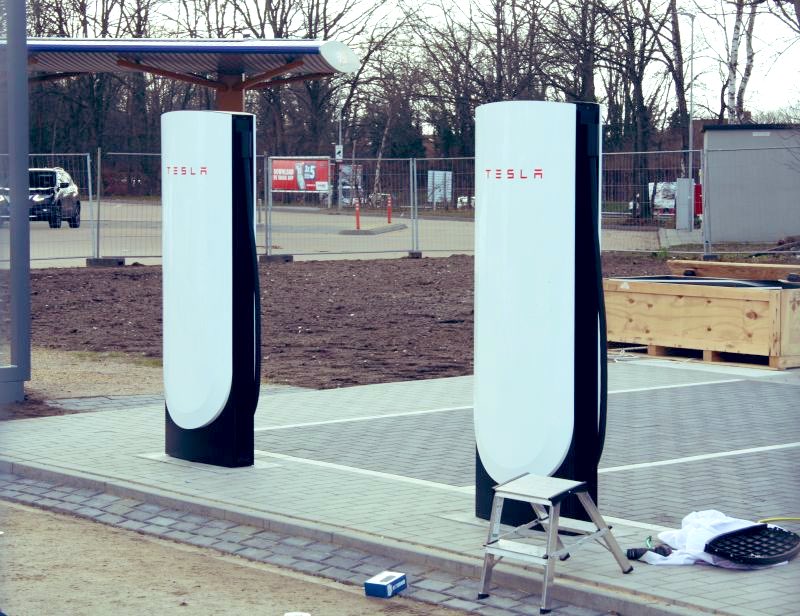
Tesla’s Supercharger network is no longer strictly “for Teslas.” Over 2024–2025 Tesla has accelerated a strategic shift: rolling out higher-power V4 hardware, selectively marking stations “Open to NACS,” and enabling non-Tesla charging by vehicles that either include the North American Charging Standard (NACS) port natively or use certified NACS-to-CCS adapters. Parallel to that, many automakers — including Porsche, VW Group brands (Audi/Porsche), Volvo/Polestar, Ford, Hyundai/Kia and others — have committed to NACS adoption or adapter distributions for 2025–2026 model years, or are offering factory-supplied adapters to existing owners. These moves create immediate practical benefits for European EV drivers (more usable high-power sites) but also raise real operational questions: adapter availability and compatibility, charging speed limits for certain high-voltage platforms, station congestion management, pricing parity, and how Europe’s CCS-centric networks (Ionity, Fastned, etc.) will respond. This article explains the technical differences, the current rollout status, the user experience and limitations, grid and business impacts, and clear, practical recommendations for owners and fleet operators.
1. Quick tech primer: NACS vs CCS2
Charging ecosystems have two main elements that matter for drivers: the physical connector and the communications & control protocol.
-
CCS2 (Europe’s dominant standard): Combined Charging System Type 2 (CCS2) is the de-facto European standard for DC fast charging. Most European public fast chargers (Ionity, Fastned, many public networks) use CCS2 and support very high currents and the communication protocols that manage power and payment.
-
NACS (North American Charging Standard / Tesla’s native plug): Originally Tesla’s proprietary connector in North America, NACS integrates the physical connector and Tesla’s plug-and-charge semantics. Over the last 18 months Tesla publicly documented support for opening the Supercharger network to NACS-equipped vehicles and third-party access via adapters. For owners, NACS means simpler physical plug handling in North America and, increasingly, in regions where OEMs adopt the port.
Why does the connector choice matter? It affects:
-
Plug compatibility (do you need an adapter?),
-
Plug-and-charge / app integration (native NACS with plug-and-charge avoids manual payment steps), and
-
Potential charging speed limitations due to electrical architecture mismatches (especially for high-voltage EV platforms).
2. The current status: Tesla opening Superchargers + V4 hardware rollout
Tesla has publicly documented that many Supercharger sites are being marked “Open to NACS” in the Tesla app and on Tesla’s website; these specific locations accept non-Tesla cars that have native NACS ports or certified NACS DC adapters. Tesla has simultaneously accelerated deployment of V4 Supercharger hardware, which brings higher peak power per stall, longer cables, improved power cabinets, and on-post payment options for non-Tesla users. In short: Tesla is converting some of its network into a more interoperable, higher-capacity public fast-charging backbone.
Operationally, that rollout is partial and site-by-site: not every Supercharger is open to non-Tesla EVs, and Tesla continues to add capacity and software features to manage non-Tesla billing and vehicle authentication.
3. Which automakers are adopting NACS or providing adapters — and what they’re promising
A wave of OEM announcements in 2024–2025 accelerated the migration:
-
Porsche / VW Group: Porsche announced early access programs and adapter distributions for Taycan/Macan owners and confirmed integration plans for future model years. VW Group brands (Volkswagen, Audi, Porsche) have published plans to implement NACS or ship adapters to enable access. Porsche has already soft-launched Supercharger access via app-based flows for certain regions.
-
Ford & General Motors: U.S. OEMs were early to license NACS for their North American fleets; they have also produced adapters and distribution programs for owners in different markets. Ford, for example, expanded adapter availability and moved from free distribution to retail adapters in some cases.
-
Hyundai & Kia: Hyundai announced free adapter programs for eligible owners and began shipping NACS-equipped models in certain lineups. Kia (sister company) followed similar distribution strategies for adapters.
-
Volvo & Polestar: These brands committed to adapter programs and native NACS adoption on future models, with firmware/UI updates promised to show Supercharger availability inside OEM navigation apps.
-
Lucid & other premium EV makers: Some luxury makers have made adapter options available; however compatibility and charging speed caveats apply (see below).
These automaker commitments mean that over 2025–2026 an increasing share of new EVs sold in Europe will either be NACS-native or able to use an adapter — which materially expands the practical reach of Tesla’s high-power stalls for non-Tesla drivers.
4. Adapters: the real-world practicalities and technical caveats
Adapters are the immediate bridge between CCS2 vehicles and NACS Superchargers. But adapters are not a perfect, frictionless solution.
What they do:
A certified NACS-to-CCS adapter lets a CCS-equipped EV plug into a NACS Supercharger stall. OEM-supplied adapters are typically tested to maintain safe power transfer, control signaling, and vehicle-charger communication.
Key caveats and limitations:
-
Charging speed limitations: Some EVs with very high battery voltage architectures (e.g., 800–900V systems) cannot use certain Supercharger hardware at full speed when using an adapter, because the electrical or protocol mismatches force the charger to throttle. Lucid’s rollout is a live example: Lucid Air owners can access Superchargers via an adapter but some pairings reduce peak charge power significantly (reports show some adapters throttle to much lower sustained kW rates depending on system compatibility). That means practical charging duration can be longer than expected at certain sites.
-
Adapter supply & distribution: OEMs distributing adapters (free or subsidized) is easing the initial transition, but adapters are physical hardware with supply-chain constraints. Ford and others initially gave many adapters for free and then began retail sales when distribution scaled. Expect some delays and initial shortages for popular models.
-
Speed vs. convenience trade-off: When adapters work without throttling, the convenience of more Supercharger sites often outweighs slightly lower peak power from public CCS stations — but results vary by model and station. Real-world owners report that a slow middle-speed charge can be less attractive on long journeys where quick top-ups matter.
-
Plug-and-charge / payment integration: Native NACS vehicles and OEM app integrations will get seamless plug-and-charge in many cases. For adapters and cars that rely on the Tesla app initially, the user flow may involve opening Tesla’s app or the OEM’s app to initiate payment — friction that OEMs are working to remove via deeper integration. Porsche, for example, plans full My Porsche app charging support and eventual plug-and-charge for its new NACS–native models.
5. Pricing, billing, and the user experience
How payment works today:
-
Tesla’s “open” Superchargers currently rely on Tesla’s app or plug-and-charge for NACS-native OEM EVs. In many pilot rollouts the Tesla app registers the car and charges the account automatically. OEMs are rapidly integrating plug-and-charge so drivers won’t need the Tesla app long term.
Pricing dynamics:
-
Tesla historically priced Supercharging competitively relative to some public networks, but price parity varies by country, location and time of day. As networks open to more users, expectations around dynamic pricing or idle fees will increase. Tesla’s V4 sites include on-post payment terminals and idle fees designed to reduce stall-hogging; these controls will be more important as non-Tesla adoption rises.
User experience: what to expect:
-
If you have a NACS-native vehicle (or a well-matched OEM adapter), the experience will increasingly resemble refueling at a large network: easy navigation, expected charging speeds (subject to platform caveats), and integrated payment.
-
If you rely on a third-party adapter with known compatibility throttles, expect slower sessions at certain Superchargers and occasional site-specific quirks (cable length, power-sharing between stalls, session initiation via a non-Tesla app).
6. Station-level & grid impacts: congestion, peak load and reservations
Opening a highly used proprietary network produces real operational stresses:
-
Congestion: Supercharger sites that were sized for Tesla ownership patterns may face new loads from non-Tesla users, increasing queueing at popular highway sites, especially during holiday travel windows. Tesla’s approach — more stalls per site, V4 cabinets with better power handling, and idle/occupancy fees — is an effort to manage this, but local congestion is still likely in many corridors.
-
Grid & peak demand: More chargers and higher utilization increases local peak loads. Utilities and site developers will need to manage upstream capacity with energy storage, smart charging ramp rates, and possibly on-site buffering to avoid expensive grid upgrades. This is one reason Tesla’s V4 and other operators are co-developing higher-power cabinets and energy buffering strategies at large sites. Network operators like Ionity and Fastned are also investing in larger onsite power and energy storage to smooth peaks.
-
Reservations & congestion pricing: Expect more stations to adopt reservation windows, dynamic pricing, or time-based idle fees to encourage short dwell times and prevent stall-hogging — features Tesla has piloted on some sites. That will affect trip planning for long routes.
7. Competition & industry reactions: Ionity, Fastned and independent networks
Tesla’s network opening catalyzes reactions:
-
Ionity & Fastned: These CCS-based networks have been expanding capacity and diversifying site offerings (amenities, on-site storage, partnerships). Ionity has secured financing and plans continued expansion to stay competitive for CCS-native vehicles and fleets. Their business model is anchored in universal access (no adapter required) and large highway coverage.
-
New alliances: Europe has seen strategic cooperation efforts among charging operators to create broader roaming and payment interoperability (the so-called “Spark Alliance” and other partnerships). Those alliances aim to defend and expand CCS ecosystem value even as NACS gains traction.
-
OEM infrastructure strategies: OEMs weigh whether to rely on adapters and third-party networks or invest in their own networks. Many will continue to prioritize software trip planning that integrates multiple networks, maximizing coverage for customers.
Taken together, customers will likely benefit from greater geopolitical redundancy (more places to charge), but market complexity increases: different connector ecosystems, app requirements, and pricing models will persist during the transition window.
8. Practical guidance for drivers and fleet operators (what to do now)
If you’re a European Tesla owner, a non-Tesla EV owner, or a fleet manager, here’s a practical checklist:
For Tesla owners
-
You’ll gain indirectly from increased network utilization improvements (Tesla upgrades sites for more throughput). Expect more stalls and better site amenities in many corridors. Keep your Tesla app updated and check the “Open to NACS” site filter if you travel outside your usual routes.
For non-Tesla owners (adapters & new NACS vehicles)
-
Confirm compatibility before relying on a Supercharger for long routes. Check OEM guidance on whether your model will experience any throttling with an adapter. Porsche and Ford have published specific adapter guidance and distribution programs.
-
Request OEM adapters early if your OEM offers free or subsidized adapters — supply can be constrained during initial rollouts.
-
Plan for potential speed limits if you drive a high-voltage EV; consult user forums, manufacturer documentation and early-adopter reports for real charge speed data.
For fleet managers
-
Model selection decisions should weigh native charging compatibility: fleets that standardize on NACS-native vehicles will get the simplest long-term access to Superchargers, but ensure site reliability and price forecasts before depending on any single network. Consider multi-network roaming agreements for resilience.
9. Risks & unresolved challenges
-
Fragmented standards during transition: For a period Europe will run mixed fleets (native CCS2, NACS-native, and adapter-dependent vehicles). That creates potential user confusion and operational friction.
-
High-voltage EV compatibility: As long as some EVs run 800–900V architectures and V3/V4 charging ecosystems differ, expect some vehicles to be constrained via adapters.
-
Grid stress and local permitting: Rapid growth increases the need for utility cooperation, permits, and sometimes expensive grid upgrades near highways.
-
Adapter safety & warranty concerns: Always use OEM-certified adapters where possible to reduce warranty/interoperability risks; third-party adapters can be lower cost but risk compatibility issues.
10. Conclusion — winners, losers, and what changes next
The opening of Tesla’s Supercharger network to non-Tesla EVs and the broader NACS migration represent one of the industry’s most consequential infrastructure shifts in 2025. Winners will likely include drivers who gain practical access to more high-power stalls, OEMs that align quickly with NACS to improve customer experience, and charging network users enjoying more options. Challenges will remain for operators (congestion, grid upgrades), for some high-voltage vehicle owners (speed throttling via adapters), and for smaller networks that must differentiate via coverage, reliability and pricing. Over 2025–2026 expect:
-
Faster OEM app integrations and native plug-and-charge support for many marques.
-
Continued adapter distributions (free or low-cost) while new model years gradually ship with NACS ports.
-
Competitive responses from CCS networks (Ionity/Fastned) emphasizing high power, universal access and subscription pricing models to stay relevant.
For European EV drivers the net effect is positive: more usable fast chargers and a faster, more seamless long-distance EV experience — but the transition will be messy, and smart trip planning remains essential.
FAQ
Q: Can any EV use a Tesla Supercharger in Europe today?
A: No. Only specific Supercharger sites marked “Open to NACS” in the Tesla app accept non-Tesla cars, and the vehicle must have a native NACS port or use a certified NACS adapter. Check Tesla’s support page and your OEM’s guidance before relying on a Supercharger for a long trip.
Q: Will an adapter let my 800V EV charge at full speed on a Tesla Supercharger?
A: Not necessarily. High-voltage electrical architectures can be limited by adaptor or charger compatibility, and some early reports show significantly reduced peak power in certain pairings. Verify model-specific guidance from your manufacturer.
Q: Do I need the Tesla app to charge as a non-Tesla driver?
A: In many pilot rollouts initially yes — Tesla’s app is commonly used to initiate and bill sessions. OEMs are rolling out deeper integrations so their native apps will handle plug-and-charge in many cases. Porsche, for example, plans My Porsche app charging support.
Q: Will opening Superchargers make Ionity or Fastned irrelevant?
A: No. Ionity, Fastned and other CCS networks still offer universal CCS access (no adapter required) and have routes and station footprints that complement Tesla’s network. Competition will continue and may benefit drivers by improving availability and pricing