
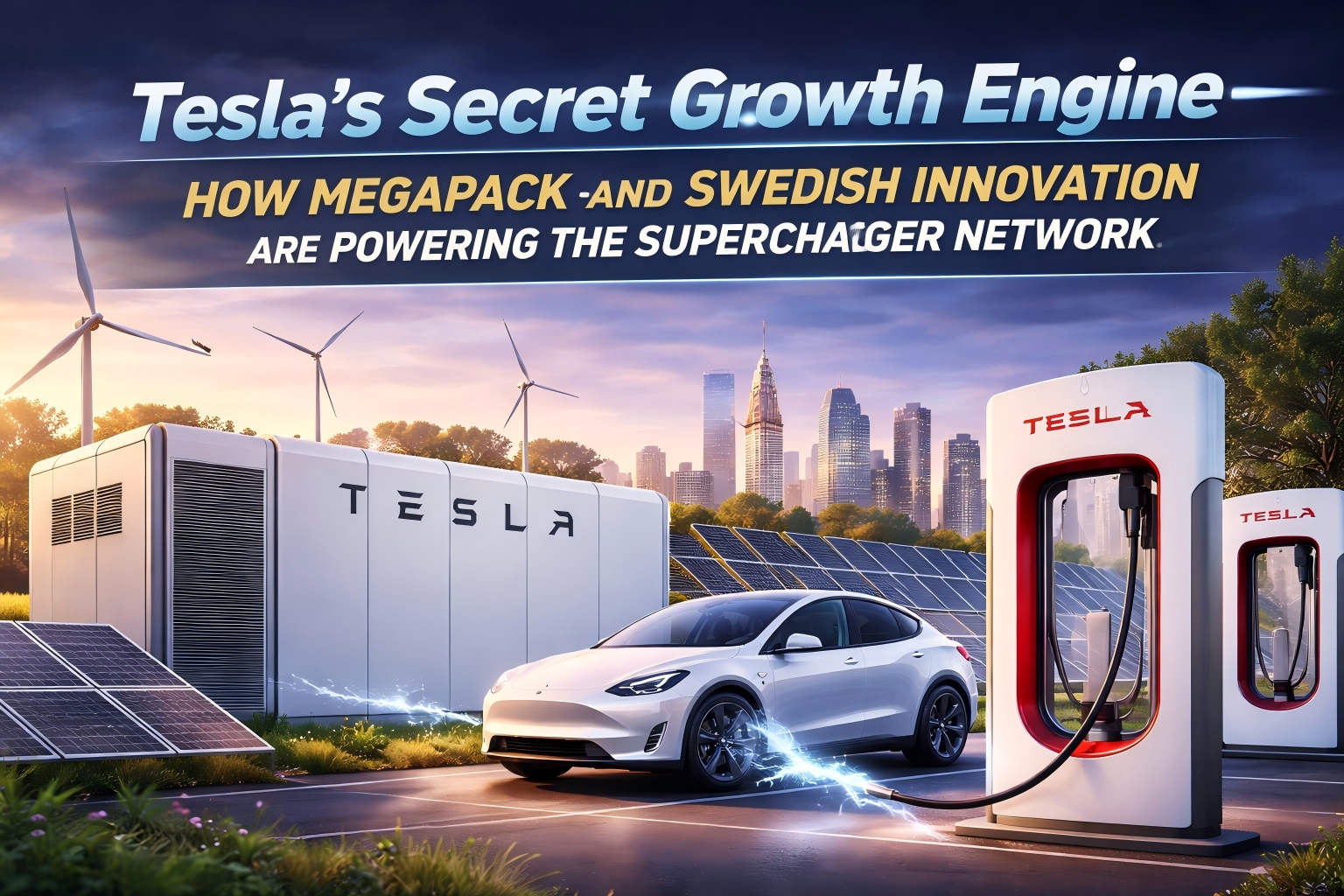
Introduction: The Silent Revolution
While the media obsesses over quarterly delivery numbers and FSD updates, a quieter, more profound revolution is happening inside Tesla. The company is rapidly transforming from a car manufacturer into a diversified energy juggernaut. In the first quarter of 2026, analysts project Tesla will deploy a record 14.4 GWh of energy storage—edging out the 14.2 GWh record set in Q4 2025.
This matters to you, the Tesla owner, more than you might realize. A robust Energy division means lower battery costs for your vehicle, a more stable grid for your Supercharger stops, and even the ability to sell electricity back to the grid from your home.
But perhaps the most fascinating story of 2026 comes from Sweden, where a bitter union blockade forced Tesla to innovate. The result? A Supercharger station powered entirely by Megapack batteries, operating completely off the grid. This is the story of how Tesla‘s energy division is not just securing the company’s future but is actively reshaping the ownership experience today.
Part One: The Megapack 3-A Technical Juggernaut
To understand the energy revolution, we must first look at the hardware. In late 2025, Tesla unveiled the Megapack 3, its next-generation utility-scale battery.
The Specifications
The Megapack 3 is a beast. It pushes energy capacity from 3.9 MWh to 5 MWh per unit in an 8.5-meter enclosure. It incorporates a larger battery module and a new 2.8-liter lithium iron phosphate (LFP) cell. It weighs around 39 tonnes, with 75% of its mass consisting of battery cells.
Efficiency and Design
Tesla has dramatically simplified the design. The new thermal management system uses the same heat pump found in your Model Y, resulting in 78% fewer connections. Fewer connections mean fewer failure points and lower maintenance costs. The system is optimized for up to 8-hour applications and operates in ambient temperatures from -40°C to 60°C.
The Megablock: Pre-Engineered Genius
Tesla also unveiled the Megablock, a pre-engineered system that combines four Megapack 3 units with a transformer and switchgear into a 20 MWh block. The results are staggering: installation times are cut by 23%, and construction costs are slashed by up to 40%. Tesla claims that a 1 GWh battery installation can be commissioned in about 20 business days.
Production Ramp
Tesla expects to begin production of the Megapack 3 in late 2026 at its new Houston Megafactory, which will boast an annual capacity of 50 GWh (roughly 10,000 units). This is supported by a new 7 GWh LFP cell plant in Nevada.
Part Two: The Swedish Miracle-Beating the Union Blockade
In Sweden, Tesla has been locked in a bitter labor dispute with the union IF Metall and sympathy organizations like Seko (the electricians’ union). These unions have blocked all new electrical grid connections for Tesla‘s Superchargers. On paper, this made the expansion of the Swedish Supercharger network impossible.
The Arlandastad Solution
Just before Christmas 2025, Tesla flipped the table. At a site in Arlandastad, outside Stockholm, Tesla launched a new Supercharger station that does not connect to the public grid at all. Instead, it is powered entirely by on-site Megapack batteries.
By bypassing the grid connection, Tesla circumvented the union’s blockade entirely. The station currently operates 8 charging stalls (a fraction of the planned 40, but operational nonetheless). It is believed that the Megapack is charged via private arrangements with nearby companies that already have grid access, a legal gray area that has infuriated the unions.
The Union‘s Fury
IF Metall has not taken this lying down. They have submitted a report to Sweden’s Energy Market Inspectorate, arguing that supplying electricity without a permit constitutes “illegal electricity trading.” They are also considering filing a police report. As of April 2026, the station remains operational, proving that a distributed energy system (Megapack) can function as a viable, independent micro-grid.
Why This Matters for You
This isn‘t just a labor dispute. It’s a proof of concept. If Tesla can build a functioning Supercharger station in a parking lot with no grid connection, it can build Superchargers anywhere. Remote highways, disaster zones, or regions with unstable grids are now viable. This innovation accelerates the build-out of the global Supercharger network for every owner.
Part Three: Virtual Power Plants (VPPs) -Your Car as a Power Plant
While Sweden showcases utility-scale innovation, Tesla is also empowering individual owners through Virtual Power Plants (VPPs).
The Texas and California Model
In Texas, Tesla already operates a VPP where Powerwall owners receive bill credits for sending stored energy back to the grid during high-demand events. In March 2026, Tesla won a license to supply power to households and businesses across England, Scotland, and Wales. Tesla Electric UK is expected to launch by Q3 2026.
Vehicle-to-Grid (V2G) Goes Live
Perhaps the most exciting development is the launch of true Vehicle-to-Grid (V2G) capability. In February 2026, Tesla announced the Powershare Grid Support Program. Starting with Cybertruck owners in select Texas markets (CenterPoint Energy and Oncor), owners can earn money by sending power back to the grid during high-demand events.
The Cybertruck‘s 123 kWh battery is massive—equivalent to approximately nine Powerwall units. Unlike traditional power plants that take minutes to ramp up, a V2G fleet can respond to grid stress with millisecond-level precision. California (PG&E, SCE, SDG&E) is the next phase of this rollout.
The Utilize Alliance
To accelerate this, Tesla partnered with Google and other firms in March 2026 to launch the Utilize Alliance. The goal is to use batteries, demand response, and VPPs to boost US grid utilization, which currently averages only 53% nationally.
Part Four: The Supercharger Network Revolution-V4 and Megachargers
The energy division‘s success is directly funding the expansion of the charging network.
V4 Superchargers (500 kW)
On January 23, 2026, Tesla announced the opening of an eight-stall V4 Supercharger site in Taylorsville, Utah, with speeds “up to 500 kW max.” This is double the power of the V3 cabinets (250 kW). The V4 also features longer, liquid-cooled cables that are easier to handle and support true Plug & Charge functionality. For European and US owners, this cuts charging stops in half.
Megachargers for the Semi (1.2 MW)
Tesla is also laying the groundwork for its Megacharger network to support the Tesla Semi (entering high-volume production in 2026). Tesla has listed 64 new US Megacharger locations as “coming soon,” including 18 in California and 17 in Texas. The Semi can now charge at 1.2 megawatts, adding 60% charge in about 30 minutes. A similar network is planned for Europe. This infrastructure will eventually trickle down to benefit passenger vehicle charging technology.
Part Five: Global Expansion-Europe and Australia
Tesla‘s energy dominance is not limited to the US and Sweden.
Europe
Harmony Energy launched a 99 MW/198 MWh Tesla Megapack project in Buckinghamshire, UK, the largest BESS in Europe. Across the continent, Tesla’s solutions are helping integrate intermittent solar and wind power, aiding compliance with strict EU renewable targets.
Australia
Australia has become a key market. One of the largest grid-forming battery projects in the country is powered by 444 Tesla Megapacks, providing 600 MW of power and 1.6 GWh of storage. Tesla has set a target of 4.5 GW of battery storage in Australia by the end of 2026. These massive deployments provide stability to grids that are increasingly dependent on solar and wind.
Part Six: What This Means for Your Wallet
How does a Megapack in Australia help you in Ohio or Germany?
-
Lower Battery Costs: The massive scale of LFP cell production for the Megapack 3 (billions of cells) drives down the cost of cells for the Model Y and Cybertruck.
-
Cheaper Supercharging: Megapacks allow Tesla to buy electricity at off-peak rates (nighttime), store it, and sell it at peak rates. This arbitrage lowers operating costs for the Supercharger network, keeping prices competitive.
-
Income for Owners: VPP programs in Texas, California, and soon the UK allow Powerwall (and soon, Cybertruck) owners to generate passive income by selling grid services.
-
Faster Network Expansion: The Swedish off-grid solution proves that Tesla can deploy chargers anywhere, regardless of local politics or grid bottlenecks. This means fewer “charging deserts” for owners.
Conclusion
Tesla in 2026 is no longer just an automotive stock. It is an energy infrastructure company. The Megapack 3 is a marvel of engineering that will underpin grids worldwide. The Swedish Arlandastad station is a testament to Tesla‘s relentless ingenuity in the face of adversity. And the launch of V2G and VPPs puts money directly back into the pockets of Tesla owners.
For the driver on the road, the benefits are tangible: cheaper batteries, faster V4 Superchargers, and a more resilient network. The “secret growth engine” isn‘t so secret anymore. It’s humming along in a Megapack near you, ensuring that the Tesla ecosystem remains decades ahead of the competition.
Frequently Asked Questions (FAQ)
Q: What is the Megapack 3?
A: Tesla‘s next-generation utility-scale battery. It stores 5 MWh of energy per unit, uses the same heat pump as your Model Y, and has 78% fewer connections for better reliability.
Q: How did Tesla build a Supercharger in Sweden without a grid connection?
A: They used on-site Megapack batteries. The station operates as a micro-grid, charged by private arrangements with nearby businesses, bypassing the union’s blockade of grid connections.
Q: Can my Tesla send power back to the grid (V2G)?
A: Currently, only the Cybertruck via the Powershare Grid Support Program in Texas (with California coming soon). Tesla has not yet enabled V2G for Model 3/Y.
Q: How does a Virtual Power Plant (VPP) save me money?
A: If you have a Powerwall (or eventually a Cybertruck), you can enroll in Tesla‘s VPP. During peak demand, Tesla will pull energy from your battery to sell to the grid and pay you bill credits for it.
Q: Are V4 Superchargers faster than V3?
A: Yes. V4 cabinets deliver up to 500 kW, double the 250 kW of V3. This can add hundreds of miles of range in 15 minutes.