
Introduction: The Dawn of Proactive Urban Safety
On March 17, 2026, Tesla quietly initiated a rollout that encapsulates the very essence of the software-defined vehicle revolution. Through the 2026.8 over-the-air (OTA) software update, the company announced the extension of its innovative "anti-dooring protection" feature to the Cybertruck, solidifying its status as a standard safety offering across its current lineup of passenger vehicles. For the uninitiated, this might seem like a minor convenience—a digital nudge to prevent a clumsy exit. However, for the urban cyclist, the delivery rider, the parent pushing a stroller past a line of parked cars, and the Tesla owner navigating the dense thoroughfares of cities from San Francisco to Berlin, this feature represents a monumental leap in proactive safety.
Chapter 1: The Mechanics of Digital Vigilance
1.1 Tesla Vision: The Unblinking Eye
At the heart of the anti-dooring protection system lies Tesla's unwavering commitment to a camera-centric philosophy, known as Tesla Vision. Unlike many legacy automakers that rely on a patchwork of ultrasonic sensors and radar, Tesla has bet its future on the idea that a sophisticated neural network processing high-definition video is the only path to generalized, human-like perception. The 2026.8 update is a powerful validation of this bet.
The system does not require a single new piece of hardware . Instead, it harnesses the computational power of the vehicle's onboard AI computer and the data streams from its existing side-repeater and B-pillar cameras. These cameras, already vigilant for lane changes and Autopilot functions, are now repurposed to maintain their watch even when the vehicle is parked and the driver has stepped away. This "always-on" sentinel mode represents a new frontier in vehicle safety, where the car's awareness does not power down with the ignition. The neural network, trained on millions of miles of real-world driving data, can differentiate between a stationary mailbox, a parked bicycle, and a cyclist approaching at 15 miles per hour. This level of granular perception is the critical foundation upon which the entire feature is built.
1.2 The Multi-Stage Intervention Protocol
The genius of the anti-dooring feature lies not just in its ability to detect a hazard, but in its carefully calibrated response protocol. The system is designed to be intuitive, effective, and respectful of driver intent, creating a seamless interaction between human and machine.
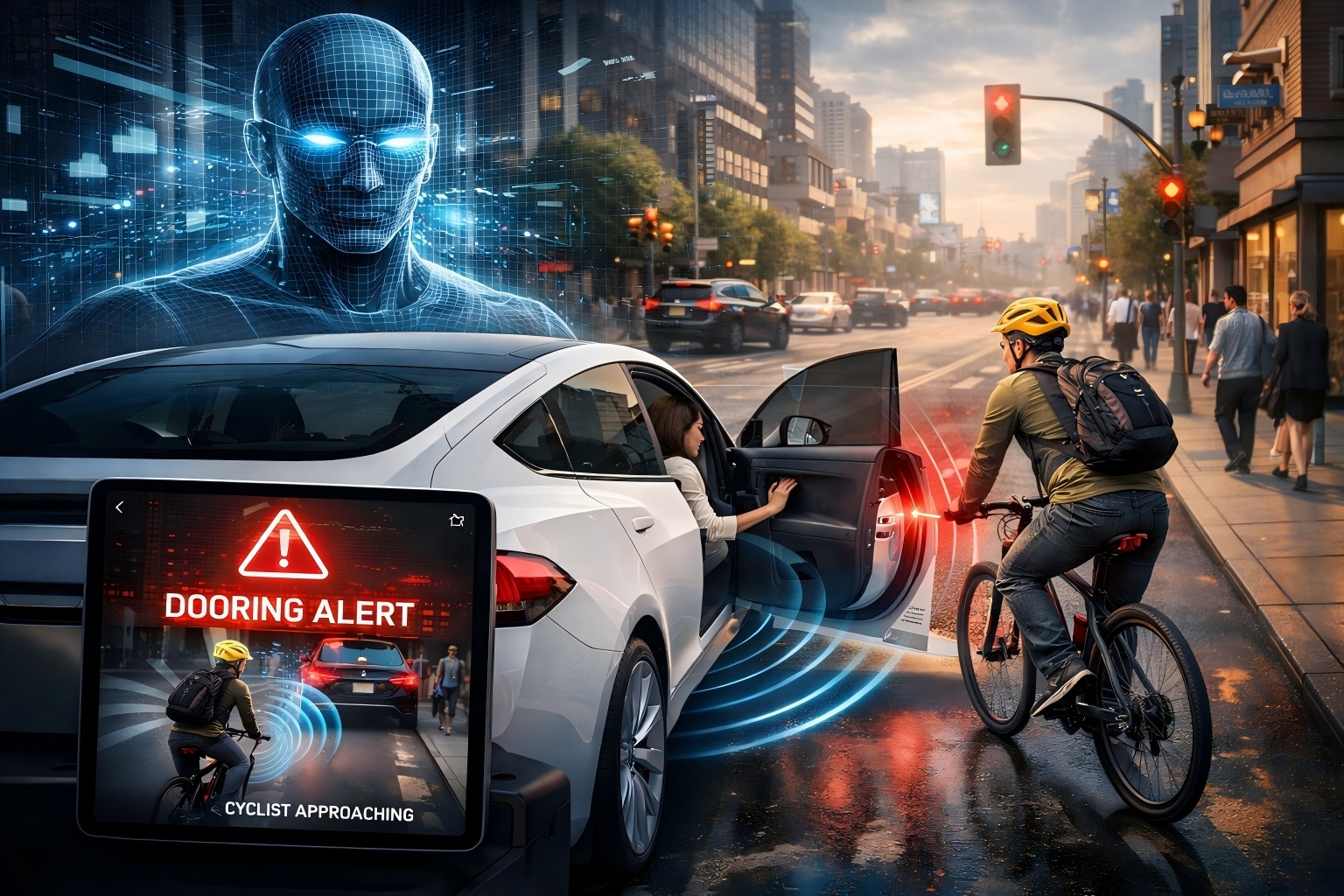
Stage 1: The Visual Cue. The moment an occupant touches the electronic door release button, the vehicle's computers spring into action. Within milliseconds, the neural network analyzes the live camera feeds. If an object classified as a cyclist, pedestrian, or moving vehicle is detected on an intercept course with the door's swing path, the first line of defense is deployed. The blind spot indicator light, typically located on the side mirror or the door's interior panel, begins to flash rapidly. This visual warning is designed to catch the occupant's peripheral vision, providing an immediate, instinctual cue that something is amiss.
Stage 2: The Audible Alert. If the visual cue is missed or ignored, or in situations where the hazard is imminent, the system simultaneously triggers an audible chime within the cabin . This sound is distinct from other vehicle alerts, designed to cut through music, conversation, or the general distractions of urban life. It serves as an unmistakable signal that a potentially dangerous action is about to occur, forcing a momentary pause in the occupant's exit routine.
Stage 3: The Physical Intervention. This is the most critical and innovative aspect of the feature. If the hazard persists, the system actively intervenes in the physical act of opening the door. Upon the initial button press, the electronic latch simply will not release . The door remains firmly closed, buying the crucial one to two seconds needed for the cyclist or pedestrian to pass safely. This forced delay is the digital equivalent of a co-pilot grabbing your arm before you step into traffic. It transforms the vehicle from a passive object into an active guardian.
1.3 The Intentional Override: Balancing Safety and Autonomy
Tesla's engineers were acutely aware of the need to avoid creating a hazard worse than the one they were trying to prevent. What if the warning is a false positive? What if the occupant needs to exit immediately due to an emergency inside the vehicle? The system elegantly addresses this with a simple, deliberate override mechanism. If, after receiving the visual and audible alerts, the occupant still intends to open the door, a second, firm press of the button will command the latch to release . This two-step process ensures that the system acts as a safeguard against absent-mindedness, not a cage that traps occupants in an emergency. It places the final authority in the hands of the human while ensuring that the decision to override is a conscious, deliberate one.
Chapter 2: The Scourge of Dooring: A Public Health Crisis on Two Wheels
2.1 Defining the Danger
To fully appreciate the value of this new feature, one must first understand the nature of the threat it neutralizes. "Dooring" is the term used when a vehicle occupant opens a door into the path of an oncoming cyclist, scooter rider, or pedestrian. The victim has virtually no time to react. The result is often a catastrophic collision, throwing the rider from their bike and, in many cases, into the path of moving traffic. It is a sudden, violent, and entirely preventable accident.
2.2 The Stark Statistics
The prevalence of dooring incidents in urban environments is alarmingly high, painting a picture of a persistent and under-reported public safety issue. Data from major metropolitan areas reveals the scope of the problem.
-
Urban Frequency: In Chicago alone, during 2011, there were 344 reported dooring crashes . This figure is staggering, accounting for approximately 20 percent of all bicycle crashes in the city that year. To put it another way, a dooring incident occurred, on average, nearly every single day in just one American city.
-
Consistent Threat: While the percentage has fluctuated slightly in subsequent years—dropping to 11 percent in 2014 before rising again—dooring consistently represents between 10 and 20 percent of all bike-related crashes in major cities across North America and Europe . This consistency underscores that it is not an occasional anomaly but a systemic risk inherent in the coexistence of parked cars and bike lanes.
-
National Scale: The problem extends far beyond city limits. A national analysis of emergency department data in the United States estimates that over a single decade, more than 17,000 dooring-related injuries were treated in hospitals . This figure, of course, only accounts for incidents that resulted in a hospital visit. Countless more minor injuries and near-misses go unreported, contributing to a climate of fear and danger for urban cyclists.
2.3 The Human Toll
Beyond the numbers, the human cost of dooring is profound. The physics of the collision dictate the nature of the injuries. A stationary car door presents an immovable object. A cyclist, weighing perhaps 150 pounds and traveling at 10-15 mph, is abruptly stopped. The injuries are often severe.
-
Fractures and Contusions: The most common injuries are fractures to the upper extremities as cyclists instinctively throw out their arms to protect themselves. Deep contusions and soft tissue damage from the impact with the door edge are also frequent.
-
Head Trauma: Perhaps the most devastating injuries are those to the head. If a cyclist is thrown from their bike and strikes their head on the pavement, the result can be traumatic brain injury, with lifelong consequences. Helmets offer protection, but they are not a panacea against the violent forces involved in such a crash.
-
Secondary Impacts: The most terrifying aspect of a dooring incident is the secondary impact. A cyclist knocked into a lane of moving traffic faces the immediate threat of being run over by a car, bus, or truck. This is where a severe injury can quickly become a fatal one.
By automatically intervening to prevent the door from opening, Tesla's system addresses the root cause of this cascade of potential injuries. It is a feature designed not just to protect the car's occupants from liability, but to actively shield the most vulnerable participants in our urban transportation ecosystem.
Chapter 3: The Cybertruck's Unique Mandate for Urban Safety
3.1 A Vehicle Out of Context?
The application of this technology to the Cybertruck is particularly noteworthy. The Cybertruck, with its angular, exoskeleton design, massive footprint, and construction from ultra-hard 30X cold-rolled stainless steel, presents a unique profile in urban environments. When it was first unveiled, critics were quick to question its compatibility with pedestrian and cyclist safety. Its high beltline creates substantial blind spots, and the sheer heft of its doors means that a dooring incident involving this vehicle could potentially cause far greater harm than one involving a smaller sedan.
3.2 Mitigating Inherent Risks
Tesla's decision to equip the Cybertruck with anti-dooring protection is a direct and powerful response to these concerns. It is an acknowledgment that with great size comes great responsibility. The system effectively bridges the gap between the Cybertruck's rugged, utilitarian design and the delicate, unpredictable nature of urban traffic.
-
Enhanced Blind Spot Monitoring: The vehicle's size makes its blind spots more dangerous. The anti-dooring system acts as a tireless digital spotter, monitoring areas that the driver simply cannot see .
-
Neutralizing Kinetic Force: By physically preventing the heavy stainless-steel door from swinging open into a cyclist's path, the system neutralizes the threat before it can materialize. It is a proactive measure that ensures the vehicle's imposing physicality does not translate into a greater danger to those around it.
3.3 A Conscientious Giant
This integration serves as a powerful counter-narrative to the idea that large pickup trucks are inherently incompatible with progressive, multi-modal urban planning. It demonstrates that with the right application of artificial intelligence and sensor technology, even the most imposing vehicles can be engineered to be conscientious and safe participants in the cityscape. The Cybertruck, equipped with this feature, is not just a powerful tool; it is a good neighbor.
Chapter 4: Synergizing with the Future of Urban Mobility
4.1 The Rise of Micro-Mobility
Cities across the United States and Europe are in the midst of a profound transformation. In an effort to combat climate change, reduce congestion, and promote public health, municipal governments are aggressively redesigning streetscapes to encourage micro-mobility. The installation of protected bike lanes, the expansion of pedestrianized zones, and the proliferation of bike-share and e-scooter programs are all aimed at reducing reliance on private automobiles. Amsterdam and Copenhagen have long been models for this approach, but cities like Paris, London, New York, and Seattle are rapidly following suit.
4.2 The Friction Point
However, as the density of bicycles and e-scooters increases, the interface between parked vehicles and active traffic lanes becomes a critical friction point. Protected bike lanes often run directly alongside rows of parked cars. This proximity, while efficient in terms of street design, creates the exact scenario where dooring is most likely to occur. Traditional driver education has attempted to address this through techniques like the "Dutch Reach"—a practice where drivers and passengers are taught to open the car door with their far hand, forcing their body to turn and look over their shoulder for oncoming traffic.
4.3 Technology as the Enforcer
While the "Dutch Reach" is effective in theory, it relies entirely on human vigilance and habit. It is a protocol that is easily forgotten in a moment of distraction. Tesla's anti-dooring protection bypasses human fallibility entirely. It hardwires the "Dutch Reach" concept into the vehicle's operating system, providing a foolproof, machine-guaranteed enforcement of safe exiting procedure. By doing so, it creates a seamless synergy between automotive technology and civic infrastructure. The car becomes an active participant in the city's safety network, automatically adapting to the presence of bike lanes and vulnerable road users. This is a crucial step toward the vision of truly smart, sustainable, and integrated urban transportation systems.
Chapter 5: Beyond Safety: The Legal and Financial Shield for Owners
5.1 Shifting the Burden of Liability
While the primary beneficiary of this technology is undoubtedly the cyclist or pedestrian who is spared a life-altering injury, the Tesla owner also gains a significant advantage: robust legal and financial protection. In the vast majority of jurisdictions worldwide, the legal responsibility for a dooring incident rests squarely on the person who opened the vehicle door. Drivers and passengers are legally obligated to ensure the path is clear before exiting.
5.2 Preventing the Lawsuit
A dooring accident can have devastating financial consequences for the at-fault driver. It can result in:
-
Expensive Liability Claims: Medical bills for the injured cyclist can quickly mount into the hundreds of thousands of dollars for surgeries, rehabilitation, and long-term care.
-
Costly Lawsuits: If the injuries are severe, the victim may file a personal injury lawsuit seeking damages for pain, suffering, and lost wages. These lawsuits are stressful, time-consuming, and expensive to defend, regardless of the outcome.
-
Increased Insurance Premiums: An at-fault accident of this nature will almost certainly lead to a significant and long-lasting increase in the driver's auto insurance premiums.
By automatically intervening to prevent the accident from happening in the first place, Tesla's anti-dooring system effectively insulates its owners from this entire cascade of potential legal and financial consequences. It transforms the vehicle from a potential liability into an active defender of the owner's legal and financial well-being. This dual-layered protection—safeguarding the public and the owner—adds immense intrinsic value to the vehicle.
Chapter 6: The Power of the Pivot: Community Feedback and OTA Evolution
6.1 A Feature Born from the Community
The rollout of this feature is also a testament to Tesla's unique relationship with its customer base and its ability to leverage their feedback. Requests for a system that could prevent dooring have been a consistent feature of Tesla forums and online communities dating back to at least 2018 . Owners, many of whom are also cyclists, understood the danger intimately and saw the potential in Tesla's camera suite to address it. By listening to this feedback and acting on it, Tesla has transformed a community-driven idea into a tangible, life-saving reality.
6.2 The Software-Defined Advantage
Perhaps the most remarkable aspect of this update is that it requires no service center visit, no new parts, and no cost to the owner. It is delivered wirelessly, overnight, while the car is parked in the owner's driveway. This is the power of the over-the-air update, the defining characteristic of the software-defined vehicle.
-
Continuous Improvement: Your car on the day you bought it is not the car you will own a year later. Tesla's fleet is constantly evolving, gaining new features, improved performance, and enhanced safety capabilities long after the initial purchase.
-
Democratizing Safety: By making this feature standard on all new Model 3, Model Y, and Cybertruck vehicles, Tesla is ensuring that the highest levels of safety technology are not locked behind a premium option package but are available to everyone . This philosophy of democratizing safety has the potential to have a compounding positive effect on overall traffic safety as more Teslas join the road.
6.3 The Future of OTA Safety
This feature is almost certainly just the beginning. As Tesla's neural networks become more sophisticated and its compute power increases, we can expect to see even more nuanced safety interventions. Future updates could potentially:
-
Integrate with Navigation: The system could use map data to know when the vehicle is parked next to a designated bike lane, increasing its sensitivity.
-
Predict Hazardous Scenarios: The AI could learn to recognize the patterns of an approaching cyclist who is swerving to avoid an obstacle, predicting a potential incursion into the door zone before it happens.
-
Back-Port to Legacy Vehicles: As the community has already requested, where hardware permits, this feature could potentially be extended to older Model S and Model X vehicles, further expanding its safety impact .
Conclusion: A Small Update with a Monumental Impact
The addition of anti-dooring protection to the Tesla Cybertruck via the 2026.8 software update is far more than a minor feature enhancement. It is a profound statement about the future of automotive safety. It represents a shift from passive crash protection to active, AI-driven accident prevention. It demonstrates that the most powerful safety innovations are no longer about stronger steel or more airbags, but about smarter software that can perceive, interpret, and intervene in the world around it.
By addressing the specific, persistent, and dangerous hazard of dooring, Tesla is not just protecting its owners from liability; it is actively safeguarding the most vulnerable members of our urban communities. It is a feature born from a vision-based philosophy, enabled by a vertically integrated technology stack, and delivered through the revolutionary power of the over-the-air update. For the cyclist pedaling through the bike lane, a Tesla parked on the side of the road is no longer a potential threat, but a vehicle with a digital sentinel, standing guard. For the owner, it is a quiet reassurance that their vehicle is working to protect them and everyone around them, even when it is sitting still. In the grand narrative of Tesla's mission to accelerate the world's transition to sustainable energy, this small update serves as a powerful reminder that true sustainability must also encompass safety, compassion, and a shared responsibility for the world we all inhabit.