
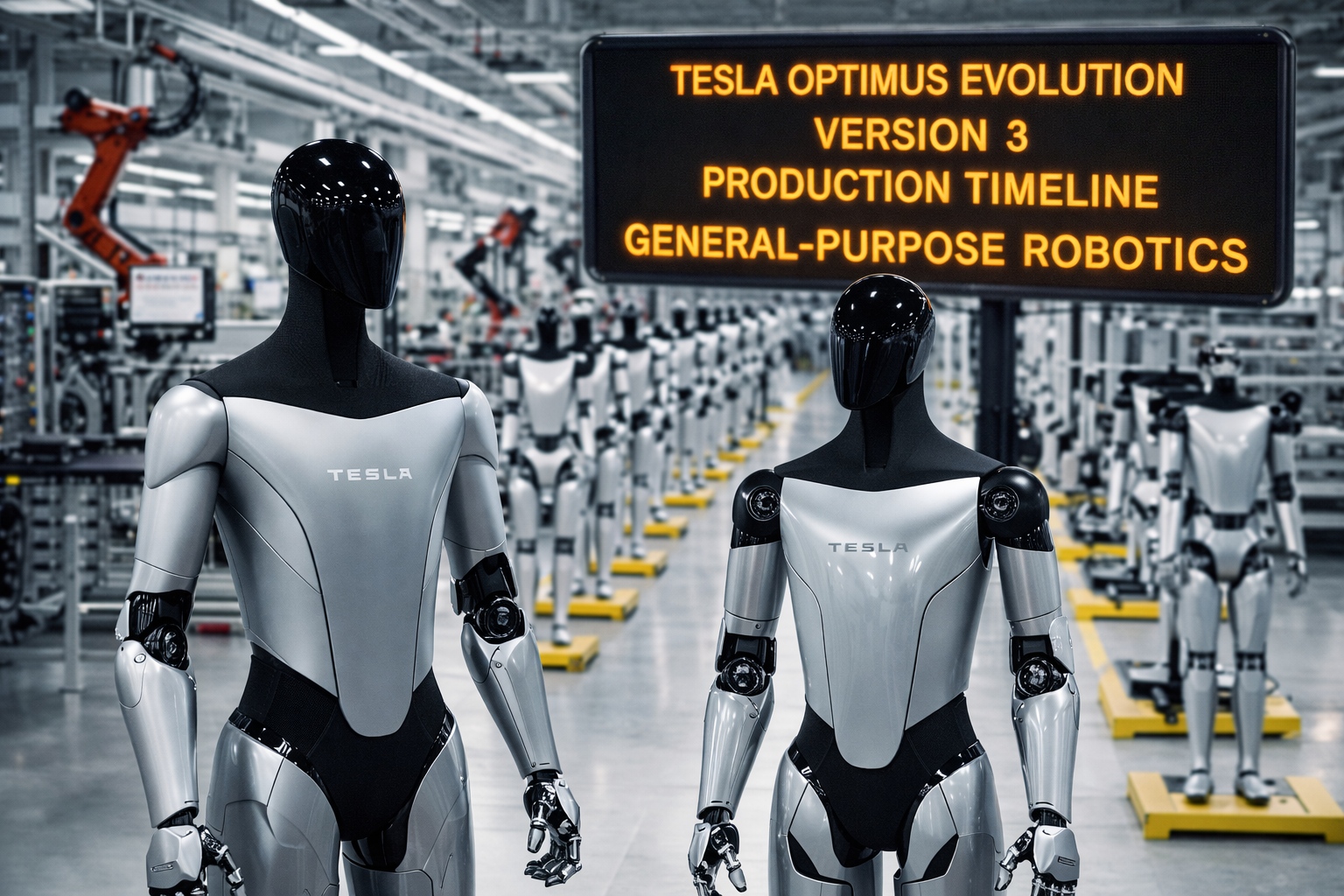
Introduction: The Robot That Builds Civilization
In a recent interview shared via industry analyst Sawyer Merritt, Elon Musk offered a characteristically ambitious vision for Tesla's humanoid robot: "Optimus will be by far the most advanced robot in the world, with nothing even close in terms of capabilities" . This claim, once dismissed as promotional exaggeration, now carries weight as Tesla prepares to begin production of Optimus Version 3 in mid-2026.
The Optimus program represents Tesla's conviction that the future of the company—and perhaps of civilization itself—depends not on cars but on robots. Musk has articulated a vision of "von Neumann machines": devices capable of building copies of themselves, enabling exponential growth in productive capacity. If Optimus can achieve the dexterity, intelligence, and reliability required for manufacturing and assembly tasks, it could eventually address labor shortages across industries while creating a new revenue stream larger than Tesla's automotive business.
This vision extends beyond physical robotics. On March 11, 2026, Musk announced a joint Tesla-xAI project called "Digital Optimus" or "Macrohard"—an AI system designed to emulate entire companies by combining Grok's reasoning with the ability to interact with computer interfaces . Digital Optimus would handle clerical and knowledge work while physical Optimus robots manage manual tasks, together forming a complete automation solution.
Section 1: Version 3 Production Timeline-Summer 2026 and Beyond
The most concrete news from recent weeks is the production timeline for Optimus Version 3. According to Musk's interview, shared by Sawyer Merritt on March 12, 2026, Tesla plans to start production on Optimus V3 this summer, with high-volume production targeted for next year .
1.1 Understanding the Production Phases
The transition from prototype to production involves several distinct phases, each with its own challenges and milestones:
Phase 1: Pilot Production (Summer 2026)
Initial production runs will generate relatively small numbers of Optimus units, likely measured in dozens or hundreds rather than thousands. These early production units serve multiple purposes:
-
Factory validation: Testing Optimus in Tesla's own manufacturing environment to identify real-world performance gaps
-
Process refinement: Proving and improving the production line itself
-
Supplier qualification: Ensuring component quality and consistency
-
Software iteration: Gathering data to train and refine neural networks
Musk's characterization of early production as "agonizingly slow" for both Cybercab and Optimus reflects the reality that "almost everything is new" . Tesla is not simply scaling an existing product; it is inventing manufacturing processes for a new category of machine.
Phase 2: Volume Ramp (2027)
High-volume production targeted for 2027 would represent a step-function increase in output. At this stage, Tesla would have validated both the robot design and the production process, enabling:
-
Economies of scale: Reducing per-unit costs through volume purchasing and automated assembly
-
Customer deployments: Supplying Optimus units to early customers beyond Tesla's own factories
-
Revenue generation: Beginning to recognize robotics revenue
Phase 3: Million-Unit Scale (2028+)
Industry observers note that Tesla is targeting million-unit-level production lines by the end of 2026 for initial capacity, with expansion to multi-million annual volumes thereafter . This scale would make Optimus one of the highest-volume robots in history, comparable to automotive production volumes.
1.2 The "Model 3 Moment" for Robotics
Analysts have characterized the Optimus V3 production start as the "Model 3 moment" for the humanoid robotics industry . This comparison is instructive:
The original Model 3, launched in 2017, represented Tesla's transition from low-volume luxury production to high-volume manufacturing. The "production hell" that followed tested the company's capabilities but ultimately established Tesla as a mass manufacturer. Similarly, Optimus V3 production will test whether Tesla can translate robotics prototypes into reliable, affordable products at scale.
The Model 3 comparison also suggests the investment required. Tesla's capital expenditures are projected to double to over $20 billion in 2026 , with a significant portion funding both Cybercab and Optimus production capabilities. Investors are tolerating near-term cash burn—Wall Street projects negative free cash flow of $5.19 billion—in expectation that these investments will yield future returns .
Section 2: Technical Breakthroughs in Version 3
While Tesla has not published detailed specifications for Optimus Version 3, information from engineering updates and Musk's statements provides insight into the capabilities that distinguish this generation.
2.1 Enhanced Dexterity: The New Hands
Recent teaser images shared by Tesla China on Weibo revealed Optimus with new hands that appear strikingly human-like in proportion and apparent capability . This upgrade addresses one of the most challenging problems in robotics: manipulation.
The human hand, with its 27 degrees of freedom, complex sensory feedback, and precise control, remains the gold standard for manipulation. Replicating this capability in a robot requires:
Actuator Innovation: Each joint requires an actuator—a motor and transmission—that is simultaneously powerful, precise, compact, and efficient. Tesla's approach, drawing on its experience with vehicle actuators and battery systems, aims to achieve human-level performance in a manufacturable package.
Sensory Feedback: Manipulation requires knowing not just where the hand is positioned but how much force it is applying, whether objects are slipping, and when contact occurs. Tesla's hands likely incorporate tactile sensors that provide this feedback to control systems.
Control Algorithms: Translating high-level commands ("pick up that object") into precise joint movements requires sophisticated control software. Tesla's neural networks, trained on human demonstration data, learn the mapping between task objectives and motor commands.
The new hands represent progress across all these dimensions. Observers note that Version 3's hands appear capable of the kind of fine manipulation—folding shirts, handling tools, assembling components—that previous generations could only approximate .
2.2 AI Integration: From Perception to Action
Optimus shares its AI architecture with Tesla's Full Self-Driving system, creating synergies that competitors cannot easily replicate. The same neural networks that interpret camera data for driving also enable Optimus to perceive and understand its environment.
Vision Models: Optimus uses Tesla's vision transformer architecture to process camera inputs, identifying objects, people, surfaces, and obstacles. Training on millions of miles of driving data provides a foundation for understanding the physical world.
Motion Planning: The same planning algorithms that navigate roads also plan robot movements, though with different constraints and objectives. Optimus must plan stable, collision-free movements in dynamic environments.
Task Execution: Higher-level reasoning about task sequences—first pick up the tool, then position it, then apply force—draws on models trained on human demonstrations and simulated experiences.
The Version 3 timeline suggests that Tesla has achieved integration of these components sufficient for initial deployment in controlled environments.
2.3 Actuation and Power Systems
Beyond intelligence and dexterity, Optimus must move efficiently and reliably. Version 3 incorporates advancements in:
Electric Actuators: Tesla's experience with motor design for vehicles translates directly to robot actuators. High-torque, efficient motors enable Optimus to lift, carry, and manipulate objects while managing heat and energy consumption.
Battery System: Optimus uses battery cells and pack technology derived from Tesla's vehicle programs, adapted for the form factor and thermal environment of a humanoid robot. The pack must provide sufficient energy for extended operation while fitting within the robot's torso.
Thermal Management: Generating power and motion produces heat that must be dissipated. Optimus incorporates cooling systems that maintain component temperatures during sustained operation.
Section 3: The xAI Partnership-Digital Optimus and Macrohard
On March 11, 2026, Elon Musk announced a significant expansion of the Optimus ecosystem: a joint Tesla-xAI project called "Digital Optimus" or "Macrohard" . This initiative bridges physical robotics with artificial intelligence, creating a comprehensive automation platform.
3.1 Understanding Digital Optimus
Digital Optimus is designed to automate knowledge work—the clerical, analytical, and operational tasks that occupy office workers. Musk explained the architecture:
"Grok is the master conductor/navigator with deep understanding of the world to direct digital Optimus, which is processing and actioning the past 5 secs of real-time computer screen video and keyboard/mouse actions" .
This description reveals a two-system architecture:
Grok as System 2 (Conscious Reasoning) : Grok, xAI's language model, provides high-level understanding and planning. It interprets tasks, develops strategies, and monitors execution—analogous to human conscious thought.
Digital Optimus as System 1 (Instinctive Action) : Digital Optimus handles rapid, routine interactions with computer systems. By processing screen video and simulating keyboard/mouse inputs, it can perform any task a human could perform on a computer—filling forms, updating records, generating reports, communicating with systems.
Musk offered an analogy: "Grok is like a much more advanced and sophisticated version of turn-by-turn navigation software. You can think of it as Digital Optimus AI being System 1 (instinctive part of the mind) and Grok being System 2 (thinking part of the mind)" .
3.2 Enterprise Automation at Scale
The potential applications of Digital Optimus span virtually every industry and function:
Accounting and Finance: Processing invoices, reconciling accounts, generating financial reports, monitoring transactions for anomalies.
Human Resources: Managing employee records, processing benefits enrollments, scheduling interviews, answering routine inquiries.
Customer Service: Responding to inquiries, updating accounts, processing requests, escalating complex issues to humans.
Operations: Monitoring systems, scheduling maintenance, tracking inventory, placing orders.
Compliance and Reporting: Generating regulatory filings, monitoring for compliance issues, maintaining audit trails.
Musk claims that Digital Optimus will "be capable of emulating the function of entire companies" . This suggests a platform that could eventually automate not just individual tasks but complete business processes, integrating across functions to operate enterprises with minimal human intervention.
3.3 Synergy with Physical Optimus
The true power of the combined platform emerges when Digital Optimus coordinates with physical Optimus robots:
Warehouse Operations: Digital Optimus manages inventory systems, receives orders, and dispatches physical Optimus units to pick, pack, and ship products.
Manufacturing: Digital Optimus schedules production, monitors quality data, and directs physical robots to adjust processes or perform maintenance.
Facility Management: Digital Optimus tracks environmental conditions, schedules cleaning and maintenance, and deploys physical robots for routine tasks.
Healthcare: Digital Optimus manages patient records and schedules while physical robots assist with patient care and facility tasks .
This integration creates a closed loop: physical operations generate data that informs digital planning, which in turn directs physical execution.
Section 4: Competitive Landscape and Market Position
Tesla is not alone in pursuing humanoid robotics. The competitive landscape includes established players and well-funded startups, each pursuing different approaches.
4.1 Key Competitors
Boston Dynamics, the veteran of advanced robotics, has demonstrated impressive capabilities with Atlas and other platforms. However, Boston Dynamics has historically focused on research and niche applications rather than mass production and commercial scaling.
Figure AI, backed by investments from OpenAI, Microsoft, and others, raised $675 million in 2024 to develop general-purpose humanoid robots . Figure has demonstrated capabilities in warehouse and logistics settings and is pursuing commercial deployments.
Agility Robotics, with its Digit robot, has focused specifically on warehouse and logistics applications, securing partnerships with major logistics operators.
Chinese Competitors: Companies including Unitree, Fourier Intelligence, and AGIBOT have deployed robots in warehousing and logistics scenarios, benefiting from China's manufacturing ecosystem and government support for robotics .
4.2 Tesla's Competitive Advantages
Despite intensifying competition, Tesla possesses several advantages that position Optimus favorably:
Vertical Integration: Tesla controls its entire supply chain for key components—batteries, motors, power electronics, and computing hardware. This integration enables cost optimization and design iteration that competitors reliant on third-party suppliers cannot match.
AI Training Infrastructure: Tesla's Dojo supercomputer and extensive data from its vehicle fleet provide training resources that competitors lack. The same neural network architectures that process driving data apply to robotics, enabling transfer learning.
Manufacturing Expertise: Tesla has repeatedly demonstrated ability to scale production from prototypes to high volume. The "production hell" experience of Model 3 taught lessons that apply to Optimus manufacturing.
Cost Structure: Musk has estimated a long-term price of approximately $20,000 per Optimus unit . At this price point, robots become accessible to mid-sized businesses and potentially consumers, massively expanding the addressable market.
Ecosystem Integration: The combination of physical Optimus with Digital Optimus and Grok creates a complete solution that competitors addressing only physical or only digital automation cannot match.
4.3 The NVIDIA Ecosystem
The broader robotics industry is benefiting from NVIDIA's investments in robotics platforms. At CES in January 2026, NVIDIA announced the commercial launch of its physical-AI core platform Jetson Thor . This platform provides computing hardware and software tools for robotics development, potentially accelerating innovation across the industry.
However, NVIDIA's approach differs fundamentally from Tesla's. NVIDIA provides components and tools for others to build robots; Tesla builds complete robots with vertically integrated technology. The NVIDIA ecosystem may enable faster entry for new competitors, but Tesla's integrated approach potentially offers superior optimization and cost structure.
Section 5: Industry Impact and Economic Implications
The arrival of capable humanoid robots at scale would transform industries and economies. Understanding these implications helps contextualize Tesla's investments and timeline.
5.1 Manufacturing Transformation
Manufacturing represents the most immediate and obvious application for humanoid robots. According to McKinsey & Company analysis, humanoid robots could automate up to 30 percent of repetitive tasks in factories by 2030, leading to cost savings exceeding $1 trillion globally .
Unlike fixed automation, which must be designed and installed for specific tasks, humanoid robots can adapt to changing production needs. A facility equipped with Optimus could reconfigure production lines by reprogramming robots rather than retooling equipment.
Early deployments will likely focus on:
-
Material handling: Moving components between workstations
-
Assembly: Performing repetitive assembly operations
-
Quality inspection: Examining products for defects
-
Packaging: Preparing finished goods for shipment
Tesla's own factories will serve as the initial testbed, providing real-world validation and generating data for continuous improvement .
5.2 Logistics and Warehousing
The logistics industry faces persistent labor shortages, particularly for repetitive tasks like order picking and package handling. Humanoid robots offer a solution that integrates with existing facility designs—unlike automated storage and retrieval systems that require facility modification.
Companies including DHL, FedEx, and Amazon have invested in robotics research, suggesting strong demand for solutions that can augment human workers. Optimus, if it achieves promised capabilities and price points, could address this market.
5.3 Healthcare and Elder Care
Musk has highlighted healthcare as a potentially transformative application for humanoid robots. In a recent interview, he noted that "highly dexterous, smart humanoid robots could give everyone access to better medical care," citing his own need for multiple neck surgeries as an example where robotic precision could help .
Healthcare applications span multiple categories:
Surgical Assistance: Robots with precise control and steady hands could assist surgeons, performing tasks requiring superhuman precision or endurance.
Patient Care: Robots could assist with routine tasks—turning patients, delivering supplies, monitoring vital signs—freeing healthcare workers for higher-value activities.
Rehabilitation: Robots could guide patients through physical therapy exercises, providing consistent assistance and detailed progress tracking.
Elder Care: As populations age, robots could help older adults maintain independence by assisting with daily tasks and monitoring health.
The World Health Organization projects global clinician shortages, making automation an attractive complement to human caregivers .
5.4 Economic and Workforce Implications
The widespread deployment of humanoid robots raises profound questions about employment, productivity, and economic organization.
Productivity Gains: Robots that perform routine tasks could significantly increase output per worker, potentially driving economic growth and higher living standards. Historical precedent suggests automation creates new categories of work even as it eliminates some existing jobs.
Labor Market Transformation: The nature of work would shift toward tasks requiring human creativity, problem-solving, and interpersonal skills. Jobs consisting primarily of routine physical tasks would decline.
Business Model Innovation: The combination of Digital Optimus and physical Optimus enables "robots-as-a-service" models, where businesses lease capability rather than purchasing capital equipment . This lowers barriers to adoption for smaller businesses.
Global Competition: Countries that successfully integrate robotics into their economies may gain competitive advantages in manufacturing and services, potentially shifting global trade patterns.
Section 6: Challenges and Risks
Despite progress, significant challenges remain before Optimus achieves widespread deployment.
6.1 Technical Challenges
Reliability: Robots operating in real-world environments must achieve reliability far exceeding laboratory prototypes. A robot that fails occasionally in testing becomes unacceptable when deployed in critical operations.
Safety: Robots working alongside humans must absolutely guarantee they will not cause injury. This requires robust sensing, conservative control, and failsafe mechanisms.
Generalization: Current robots excel at specific tasks but struggle with novel situations. Achieving human-like adaptability remains a fundamental research challenge.
Energy Efficiency: Humanoid robots must operate for extended periods on battery power. Improving energy efficiency while maintaining capability is an ongoing engineering challenge.
6.2 Production Challenges
Supply Chain: Scaling to million-unit volumes requires supply chains capable of delivering components at unprecedented scale for robotics.
Quality Control: Maintaining consistent quality across high-volume production requires robust manufacturing processes and testing.
Cost Reduction: Achieving the $20,000 price target requires aggressive cost engineering and economies of scale.
6.3 Regulatory and Ethical Challenges
Safety Certification: Regulatory frameworks for humanoid robots remain underdeveloped. Determining how to certify robots as safe for various applications will require collaboration between industry and regulators.
Data Privacy: Robots operating in workplaces and potentially homes will collect vast amounts of data. Ensuring appropriate privacy protections is essential for public acceptance .
Workforce Transition: The displacement of workers by automation raises ethical questions about how to manage transitions and ensure broad sharing of productivity gains.
Liability: When robots cause harm, determining liability—manufacturer, operator, software provider, or others—requires legal frameworks that do not yet exist.
The U.S. Federal Trade Commission has been monitoring AI ethics since guidelines were updated in 2022, emphasizing transparency in robotic deployments . Similar regulatory attention will likely expand as robots become more common.
Section 7: Timeline to Deployment
Based on current information, what timeline should businesses and consumers expect for Optimus deployment?
7.1 2026: Pilot Deployments
Following summer 2025 production start, initial Optimus units will deploy in Tesla's own factories . These pilot deployments serve multiple purposes:
-
Validating robot performance in real production environments
-
Identifying edge cases and failure modes
-
Training neural networks on factory operations
-
Demonstrating capability to potential customers
These early deployments will not generate significant revenue but will provide invaluable learning.
7.2 2027: Early Customer Deployments
With high-volume production targeted for 2027, Tesla may begin supplying Optimus to select customers outside its own operations. Early customers will likely include:
-
Strategic partners in logistics and manufacturing
-
Companies willing to co-develop applications
-
Research institutions studying human-robot interaction
At this stage, robots will still require significant oversight and support, but commercial relationships will begin generating revenue and feedback.
7.3 2028-2030: Scaling to Volume
As production scales toward million-unit annual volumes and robots prove their reliability, deployment will expand rapidly. Musk's vision of "affordable units under $30,000 by high-volume production in 2027" suggests that cost targets may be achievable in this timeframe .
7.4 2030+: Broad Adoption
By 2030, humanoid robots could be common in factories, warehouses, and logistics operations. Consumer applications—robots in homes—would likely follow as costs decline and capabilities mature.
Conclusion: The Von Neumann Moment
The Optimus Version 3 production announcement represents more than a corporate milestone. It signals the approach of what technologists call the "von Neumann moment"—the point at which machines gain the ability to build copies of themselves, enabling exponential growth in productive capacity.
Musk has articulated this vision explicitly: a robot that can mine raw materials, refine them into components, and assemble those components into new robots. Such a system could, in theory, expand civilization's productive capacity without human labor—building factories, infrastructure, and ultimately colonies on other worlds.
This vision remains distant. The Optimus V3 beginning production this summer will be a capable but limited machine, requiring human oversight and confined to structured environments. Yet each generation will improve, learning from data collected by its predecessors and benefiting from advances in AI, actuation, and energy storage.
For businesses, the arrival of capable humanoid robots at scale represents both opportunity and disruption. Companies that successfully integrate robots into their operations may achieve cost advantages that competitors cannot match. Workers will need to adapt to new roles alongside increasingly capable machines.
For society, the questions are even larger. How will we organize work when robots can perform most routine physical tasks? How will we distribute the productivity gains from automation? How will we ensure that the benefits of this transformation reach broadly rather than concentrating among those who own the robots?
Tesla's Optimus program does not answer these questions, but it makes them urgent. With production beginning this summer and volume targeted for next year, the future of robotics is no longer a distant speculation—it is a product entering manufacturing.
The gold Cybercabs at Giga Texas and the Optimus units soon to follow represent the same underlying thesis: that Tesla's mission to accelerate sustainable energy extends beyond transportation to the fundamental organization of work and production. Whether that thesis proves correct will depend on engineering execution, market adoption, and social adaptation. But the evidence accumulating in Tesla's factories suggests the experiment is truly beginning.
Frequently Asked Questions
When will Optimus Version 3 be available?
Production begins summer 2026, with high-volume production targeted for 2027. Initial units will deploy in Tesla's factories, with customer shipments following as capacity expands .
How much will Optimus cost?
Elon Musk has estimated a long-term price of approximately $20,000 per unit at high volume, though early units will likely cost more .
What can Optimus do?
Version 3 features enhanced dexterity with human-like hands, AI integration based on Tesla's FSD architecture, and the ability to perform repetitive tasks in structured environments. Capabilities will expand through over-the-air updates .
What is Digital Optimus?
Digital Optimus (also called Macrohard) is a joint Tesla-xAI project that automates knowledge work by combining Grok's reasoning with the ability to interact with computer screens and input devices .
Will Optimus replace human workers?
Optimizing for specific tasks, Optimus will automate routine physical work while creating new roles for supervision, maintenance, and higher-value activities. The net employment impact depends on how productivity gains are deployed.
Is Optimus safe for working alongside humans?
Safety is a primary design consideration, with multiple sensor systems, conservative control algorithms, and failsafe mechanisms. Regulatory approval processes will validate safety before widespread deployment .