
Introduction
On June 15, 2026, the world’s most celebrated electric vehicle charging network will undergo its most significant structural change since it first opened to non-Tesla vehicles. Tesla’s Supercharger network, long the silent backbone of the company’s dominance, is about to transform from a simple amenity into a fully tiered, dynamic-pricing ecosystem that affects everyone who plugs in. For Tesla owners across the United States and Europe, the shift is momentous. The days of a single, predictable per-kilowatt-hour rate supplemented by the occasional idle fee are ending. In their place comes a dual-tier membership architecture, time-of-use pricing, congestion surcharges that scale in real time, reservation pilots, and a deep integration with home energy billing.
The catalyst is straightforward. Over the past two years, Tesla has aggressively opened V4 Supercharger stalls to Ford, Rivian, Volvo, Polestar, Mercedes-Benz, and a growing roster of automakers that have adopted the North American Charging Standard or, in Europe, rely on the ubiquitous CCS2 connector with built-in compatibility. This expansion was a masterstroke for EV adoption but created genuine friction. Congestion at popular stations during peak hours has become a sore point, the “short cable” problem forced non-Tesla vehicles to occupy two stalls, and the pricing structure designed for a closed ecosystem began to feel archaic. The June 2026 membership overhaul is Tesla’s answer, and while it brings powerful new tools for Tesla owners, it also demands a new level of awareness and behavioral adaptation.
The Two-Tier Membership Model Explained
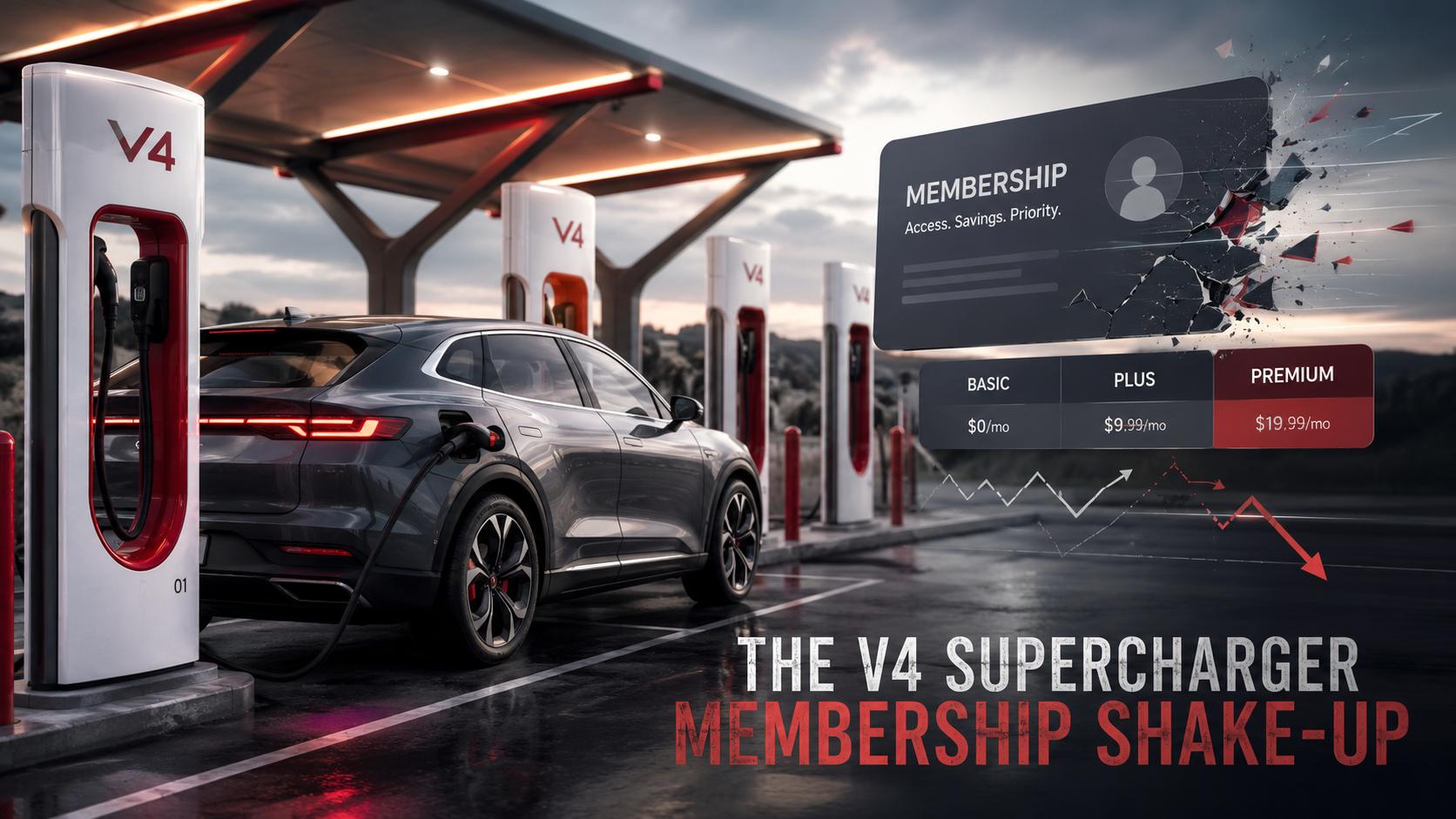
The core of the Supercharger network’s new identity is a clean split between Tesla Members and Non-Tesla Members. Every Tesla owner, by virtue of having a vehicle linked to a Tesla account, is automatically enrolled in the Tesla Membership tier at no additional monthly cost. This base tier provides access to Supercharging at a standard per-kilowatt-hour rate, which can vary by location and time of day, but it does not include the deepest discounts. Tesla owners can choose to upgrade to what Tesla is calling the Premium Charging Plan for a flat monthly fee of $9.99 in the United States and €8.99 in the eurozone and the UK. The Premium tier unlocks reduced off-peak rates, waives a portion of congestion surcharges in certain conditions, and provides access to the reservation feature at select pilot stations.
Non-Tesla EV drivers face a different landscape. They must purchase a Non-Tesla Membership at $12.99 per month or €11.99 in Europe to receive per-kilowatt-hour rates comparable to the base Tesla Member price. Without this membership, non-Tesla vehicles pay a significantly higher guest rate, which can be 25 to 40 percent above the member price depending on the region and time. The membership can be purchased directly through the Tesla app, and it is tied to a single vehicle identification number, preventing one membership from being shared across multiple non-Tesla cars in a household. This is a deliberate strategy to ensure that the network’s economics reflect usage intensity.
Perhaps the most talked-about component of the new structure is the evolution of the idle fee into what Tesla now calls Idle Fee 2.0. Under the old system, idle fees were a blunt instrument: a flat $1.00 or €1.00 per minute when a station was at 50 percent occupancy, rising to $2.00 or €2.00 when the station was completely full. The new system replaces this binary trigger with a dynamic congestion pricing algorithm. Idle Fee 2.0 starts at a baseline of $0.50 per minute when occupancy exceeds 60 percent and scales up linearly to a maximum of $2.00 per minute in the United States and €2.00 in Europe when the station reaches full capacity and a queue is detected via the vehicle’s camera-based stall monitoring. Critically, the fee applies equally to Tesla and non-Tesla vehicles. For Tesla owners, the Premium Charging Plan includes a ten-minute grace period beyond the completion of charging before idle fees begin accumulating, compared to a five-minute grace period for base Tesla Members. Non-Tesla Members receive the same five-minute window, while guest users have no grace period at all once charging stops.
Time-of-use pricing is the engine underneath the entire structure. Tesla has been quietly collecting utilization data across its global network for years, and the new rates reflect deep granularity. Peak periods are generally defined as 7:00 AM to 11:00 AM and 4:00 PM to 9:00 PM on weekdays, with variations based on local grid conditions and historical station traffic. Off-peak hours run overnight from 9:00 PM to 7:00 AM and during the midday trough from 11:00 AM to 4:00 PM on weekdays, plus most of the weekend. During peak periods, per-kilowatt-hour prices can be 30 to 50 percent higher than off-peak rates. Premium Tesla Members receive an additional discount during off-peak windows, typically 10 to 15 percent below the base member off-peak rate. The effect is a powerful incentive to shift charging behavior away from the most congested times.
Tesla Owner Pricing: Are You Paying More or Less?
To cut through the complexity, we modeled the cost of a typical 10 to 80 percent charging session for a 2026 Model Y Long Range equipped with the new 4680 Gen II battery pack, which has a usable capacity of approximately 75 kilowatt-hours. A 10–80 percent charge adds roughly 52.5 kilowatt-hours of energy. We examined three representative locations: a V4 Supercharger in Bakersfield, California; one in Birmingham, England; and one near Munich, Germany.
In Bakersfield, the previous flat rate was $0.42 per kilowatt-hour at most V4 stations, yielding a session cost of about $22.05. Under the new system, the base Tesla Member peak rate rises to $0.48 per kilowatt-hour, making the same peak session cost $25.20. However, an off-peak session for a base member drops to $0.34 per kilowatt-hour, costing $17.85. If the owner subscribes to the Premium Charging Plan, the off-peak rate falls further to $0.29 per kilowatt-hour, bringing the session cost down to $15.23. For an owner charging twice a week, the monthly cost at peak times would increase by roughly $25, but shifting both sessions to off-peak hours with Premium would save approximately $55 per month compared to the old flat rate, more than covering the $9.99 subscription fee and producing a net saving.
In Birmingham, the situation is nuanced by the United Kingdom’s higher electricity prices and the newly active UK Automated Vehicles Act, which has encouraged Tesla to route more capacity through V4 hubs. The previous typical rate was £0.48 per kilowatt-hour. The new base Tesla Member peak rate is £0.55, off-peak £0.39, and Premium off-peak £0.33. A 52.5-kilowatt-hour session under the old system cost £25.20. Under peak base pricing it climbs to £28.88, but a Premium off-peak session costs £17.33, representing a saving of over £7 per charge. Over a year of weekly charging, that is more than £360 saved. The financial logic clearly rewards owners who can delay their charging routines.
Near Munich, the dynamics are shaped by Germany’s high percentage of renewable energy during midday hours, which depresses wholesale electricity prices. The pre-change rate averaged €0.46 per kilowatt-hour. The new structure sets base peak at €0.52, base off-peak at €0.37, and Premium off-peak at €0.31. A full session cost moves from €24.15 under the old system to €27.30 at peak base, but falls to €16.28 at Premium off-peak. For the average German Tesla owner who charges predominantly at home and uses Superchargers for weekend getaways, the ability to schedule a Sunday morning off-peak top-up before returning home transforms the economics of long-distance travel.
It is essential to acknowledge that owners who cannot shift their charging behavior, such as those who rely on urban Superchargers because they lack home charging and must charge during evening peak hours, will see a tangible cost increase. Tesla’s data, shared in a pre-launch webinar for owner clubs, indicates that approximately 22 percent of Supercharger sessions in the US and 18 percent in Europe occur during peak windows for owners without off-street parking. For these owners, the Premium plan provides only the grace period benefit, not a significant rate reduction. The membership shake-up, therefore, is not a uniform win. It is a deliberate nudge to reshape demand and, in doing so, it creates winners and losers.
The treatment of free Supercharging miles from the referral program has been clarified in the June 2026 policy update. Existing miles balances are being converted to kilowatt-hour credits at a fixed ratio of 1 mile equals 0.25 kilowatt-hours. These credits are applied against the total energy drawn during a session before any monetary charge is calculated, and they never expire as long as the account remains active. However, they cannot be combined with the Premium plan’s off-peak discount; the system automatically applies credits first, which means that during an off-peak session the credits effectively save less money than during peak hours. Understanding this subtlety is important for owners with large accumulated balances.
Non-Tesla Congestion and the “Short Cable” Problem Solved
The physical layout of Supercharger stations has been a source of quiet frustration for Tesla owners since the network opened to other brands. The original V3 and early V4 Supercharger cables were designed specifically for the rear-left or front-right charge port placement of Tesla vehicles. When a Ford F-150 Lightning, Porsche Taycan, or Hyundai Ioniq 5 plugs in, its charge port location often forces the vehicle to park in a manner that occupies two designated Tesla stalls. This “short cable” problem has been a frequent complaint on owner forums, alongside the less tangible but deeply felt sense of losing an exclusive perk.
Tesla’s response has been a comprehensive hardware and software rollout. The latest V4 stalls, which now represent the majority of installations in 2026, are equipped with a 3-meter liquid-cooled cable that reaches any charge port position on any production EV without requiring the vehicle to straddle lines. At stations that still feature older stall configurations, Tesla has introduced designated bays clearly marked in the in-car navigation and on the stall itself as “Long-Cable Only” or “Tesla Priority.” A camera-based stall-parking detection system, running on the station’s local compute unit, identifies when a non-Tesla vehicle is incorrectly parked and can issue automated warnings through the Tesla app. Repeat offenders may have their membership suspended. For Tesla owners, the navigation system now routes you to a stall that minimizes adjacency conflicts, and the app displays real-time occupancy maps with vehicle type icons, so you can see whether the only available stall is next to a Rivian R1T that might crowd your space.
The pricing architecture itself is a congestion management tool. When a station reaches 80 percent occupancy, a surcharge of $0.10 per kilowatt-hour is automatically added to all sessions, Tesla and non-Tesla alike. This surcharge increases to $0.25 at 95 percent occupancy. For non-Tesla guest users, the surcharge is doubled, creating a powerful disincentive to use a heavily congested station unless absolutely necessary. Tesla owners who subscribe to Premium receive a 50 percent discount on these surcharges during off-peak hours, a benefit that effectively shields them from the worst of the congestion pricing during late-night road trips when stations near highways can randomly spike in usage due to unexpected events.
European stations face additional complexity. The Combined Charging System connector standard means that non-Tesla vehicles do not need adapters at V4 stalls in Europe, leading to higher non-Tesla utilization rates than in the US. Data from Fastned and IONITY suggests that interoperability has increased non-Tesla traffic at Tesla stations by 35 percent since full opening in 2025. The new membership structure is expected to moderate this growth by nudging casual non-Tesla users toward lower-cost membership plans and away from guest access, which currently accounts for 28 percent of non-Tesla sessions. For Tesla owners, the short-term pain of sharing is likely to ease as pricing signals rationalize demand.
Reservation and Queue Pilots
One of the most forward-looking elements of the June 2026 update is the introduction of a reservation pilot program at 50 stations in the Netherlands, 30 in California, and 20 in Florida. Tesla has long resisted reservations, arguing that a first-come, first-served model is simpler and that true fast charging should not require advance planning. The reality of highly congested corridors, such as the Amsterdam–Utrecht axis or the I-5 corridor between Los Angeles and San Francisco, has forced a rethink.
The reservation system works entirely through the Tesla app. A Tesla owner can reserve a specific stall at a participating station for a 10-minute window up to 30 minutes in advance. When the reservation is active, the stall’s status light changes to a reserved blue, and the screen displays the reservation holder’s license plate. A non-Tesla vehicle or another Tesla that plugs into a reserved stall receives a warning to disconnect within two minutes; failure to do so triggers an automatic penalty of $25 in the US or €20 in Europe, charged to the payment method on file. If a non-member guest vehicle occupies the stall, the penalty is higher, $50 or €40, and repeated violations lead to a station ban.
Reservations are free for Premium Tesla Members for up to four uses per month; additional reservations cost $2.00 each. Base Tesla Members can use the reservation feature for $4.00 per reservation. Non-Tesla Members pay $6.00. The fee is designed to prevent abuse while keeping the barrier low enough to actually reduce queue anxiety. Early data from the Netherlands pilot, which began quietly in April 2026, shows that queue times at peak hours dropped by an average of 8 minutes at participating stations, and utilization actually increased because the reduced uncertainty encouraged more drivers to plan stops.
Critically, the reservation system does not replace the first-come, first-served model for all stalls. At a typical pilot station, 30 percent of stalls are designated as reservable, with the remainder operating as walk-up. The app indicates which stalls are reservable, and the navigation system will suggest a reservation if it predicts that a station will be congested at your estimated arrival time. This hybrid approach respects the spontaneity that has always characterized road trips while providing a pressure valve for the most strained locations.
Billing Integration with Home Energy
The June 2026 update also marks the official launch of the Single Bill feature, which merges home charging, Supercharging, and third-party public charging into one monthly statement within the Tesla app. This integration is particularly powerful for owners who have adopted Tesla Electric, the retail electricity product available in select US states and, as of early 2026, in the United Kingdom, Germany, and the Netherlands.
Single Bill works by aggregating all energy flows associated with the vehicle. Your home Wall Connector’s consumption data, the Powerwall’s stored energy used for vehicle charging, Supercharger sessions, and partner network sessions through the Tesla charging network’s roaming agreements all appear as line items. At the end of the month, the app calculates the net cost, applies any solar export credits, and charges a single payment method. For US owners, this simplification is a matter of convenience. For European owners, it has regulatory significance. The EU’s Energy Efficiency Directive and the recast Electricity Directive require transparent billing that allows consumers to understand the source and cost of each kilowatt-hour. Tesla’s Single Bill complies by presenting a detailed breakdown including the carbon intensity of the grid energy used during each charging session, sourced from regional grid operator data.
Owners who have opted into Tesla Electric’s Virtual Power Plant program can see their vehicle charging effectively cross-subsidized by the revenue generated from their Powerwall’s grid services. In one compelling example, an Amsterdam-based owner with a 2026 Model Y, two Powerwall 3 units, and a 9-kilowatt solar array saw a July 2026 bill that showed a negative balance of €18 after all charging, home consumption, and VPP revenue were netted out. The Single Bill interface made the flow of money and electrons transparent: solar generation fed into the Powerwalls, the Powerwalls discharged into the car during the evening, and excess stored energy was sold back to the grid during the 7 PM peak, paying for the next day’s Supercharger session during a trip to Rotterdam. This level of granularity transforms the owner’s relationship with the car from a vehicle to be fueled into an actively managed energy asset.
Privacy and data handling have been addressed in the latest privacy policy update. Tesla confirms that public charging data shared with grid operators for demand management purposes is anonymized and aggregated. Individual session data remains tied to the owner’s account and is not sold to third parties. In Europe, this aligns with the General Data Protection Regulation’s requirements, and Tesla has appointed a dedicated Data Protection Officer for energy services in the EU. In the US, where privacy regulations are more fragmented, Tesla has adopted the California Consumer Privacy Act as its baseline standard for all states, giving owners the right to request deletion of charging data. The Single Bill feature includes a privacy dashboard that shows exactly what information is shared with utility partners and allows granular opt-outs.
Conclusion: Protecting the Best Charging Experience on Earth
Tesla’s Supercharger network remains the most reliable, densely distributed, and seamlessly integrated fast-charging solution on the planet. The June 2026 membership shake-up does not threaten that status. Rather, it reflects a mature network adapting to the realities of mass EV adoption and an open ecosystem. For Tesla owners, the message is nuanced but ultimately positive if you are willing to adjust.
The dual-tier structure rewards off-peak charging, which aligns with the fundamental physics of a grid that has excess capacity at night and during solar-rich midday periods. Premium membership, for those who can shift their routines, offers a genuine cost saving that can reduce annual road-trip charging expenses by 20 to 30 percent. Congestion pricing, while irritating when you are stuck at a packed station, is a necessary tool to ensure that the network remains usable for everyone. The reservation pilot, though limited in scope, is a promising acknowledgment that the future of high-density charging corridors requires some form of capacity reservation.
There are clear losers in this transition: urban owners who rely on Supercharging as their primary energy source and cannot avoid peak hours, Tesla drivers who resist the idea of subscriptions on principle, and non-Tesla guest users who will see significantly higher costs. Yet the network’s overall health depends on its ability to balance demand, and the alternative—unmanaged queues, rising frustration, and a degraded ownership experience—is far worse.
The most immediate action for every Tesla owner is straightforward. Open the Tesla app, navigate to the Charging section, and review your membership status. Ensure your payment method is current and consider whether the Premium Charging Plan’s mathematics make sense for your driving patterns. If you live near a pilot reservation station, familiarize yourself with the interface before you actually need it. Charge during off-peak hours when possible, and if you cannot, at least know the exact cost of your peak-time session so there are no surprises. The Supercharger network you love is evolving, but with a little engagement, you can emerge from this shake-up paying less, waiting less, and understanding more about the electrons flowing into your Tesla than ever before.
FAQ
Q: I have lifetime free Supercharging on my 2020 Model S. Does it still work at V4 stalls?
Yes, your lifetime free Supercharging privilege remains fully intact on all V4 Superchargers. You will not be subject to time-of-use rates, congestion surcharges, or membership fees when charging the vehicle with the free Supercharging benefit. Note, however, that Idle Fee 2.0 still applies if you remain plugged in beyond the grace period after charging is complete, even if the energy itself is free. The system will alert you via the app and in-car display when charging is finished, and you must unplug and move your vehicle to avoid charges.
Q: Can I buy the Tesla Membership for my partner’s non-Tesla EV through my account?
No. The Non-Tesla Membership is tied to a specific vehicle identification number and must be purchased through a Tesla account that is linked to that vehicle. Your Tesla owner account cannot extend the Tesla Membership benefits to a non-Tesla vehicle. However, you can create a separate account for your partner’s vehicle and purchase a Non-Tesla Membership there. Some household billing consolidation is possible if both accounts use the same credit card and billing address, but the memberships remain distinct.
Q: Why did I get charged an extra $5 in congestion fees when the station was half-empty?
Congestion fees under the new Idle Fee 2.0 and energy surcharge rules are calculated based on real-time station occupancy, not the number of available stalls at the moment you plug in. If the station experienced a sudden spike in utilization during your session—perhaps due to a batch of vehicles arriving simultaneously—the occupancy threshold may have been triggered while you were still charging, causing the surcharge to apply for a portion of your session. You can review the exact timing of surcharges in your charging session history within the app, where a timestamped record of station occupancy and fee accumulation is displayed.
Q: Will European Combined Charging System (CCS2) V4 stations work with an adapter for my older US-spec imported Model 3?
If you have legally imported a US-spec Tesla Model 3 with the North American Charging Standard charge port into Europe, you will need a CCS2 to NACS adapter to use European V4 Superchargers. Tesla officially sells a European CCS2 adapter for imported vehicles, but its availability is limited to specific service centers and online orders in countries where such imports are registered. Functionally, the adapter supports full V4 charging speeds. However, your vehicle’s built-in navigation may not automatically recognize all European Supercharger stations as compatible, so you should verify compatibility on Tesla’s online map before relying on a particular station. Note that your US-spec vehicle’s cellular connectivity may also be limited, potentially affecting plug-and-charge functionality, so keep a backup payment card linked to your account.
Q: Does the Premium Charging Plan auto-renew, and can I cancel anytime?
Yes, the Premium Charging Plan auto-renews each month, and you can cancel at any time through the Tesla app. If you cancel mid-month, your Premium benefits remain active until the end of the current billing period, and you will not be charged for the following month. There are no long-term contracts or cancellation penalties. Tesla has stated that the $9.99 or €8.99 price is introductory and may be adjusted, but any price change will be communicated with at least 30 days’ notice via the app and email.