
Introduction
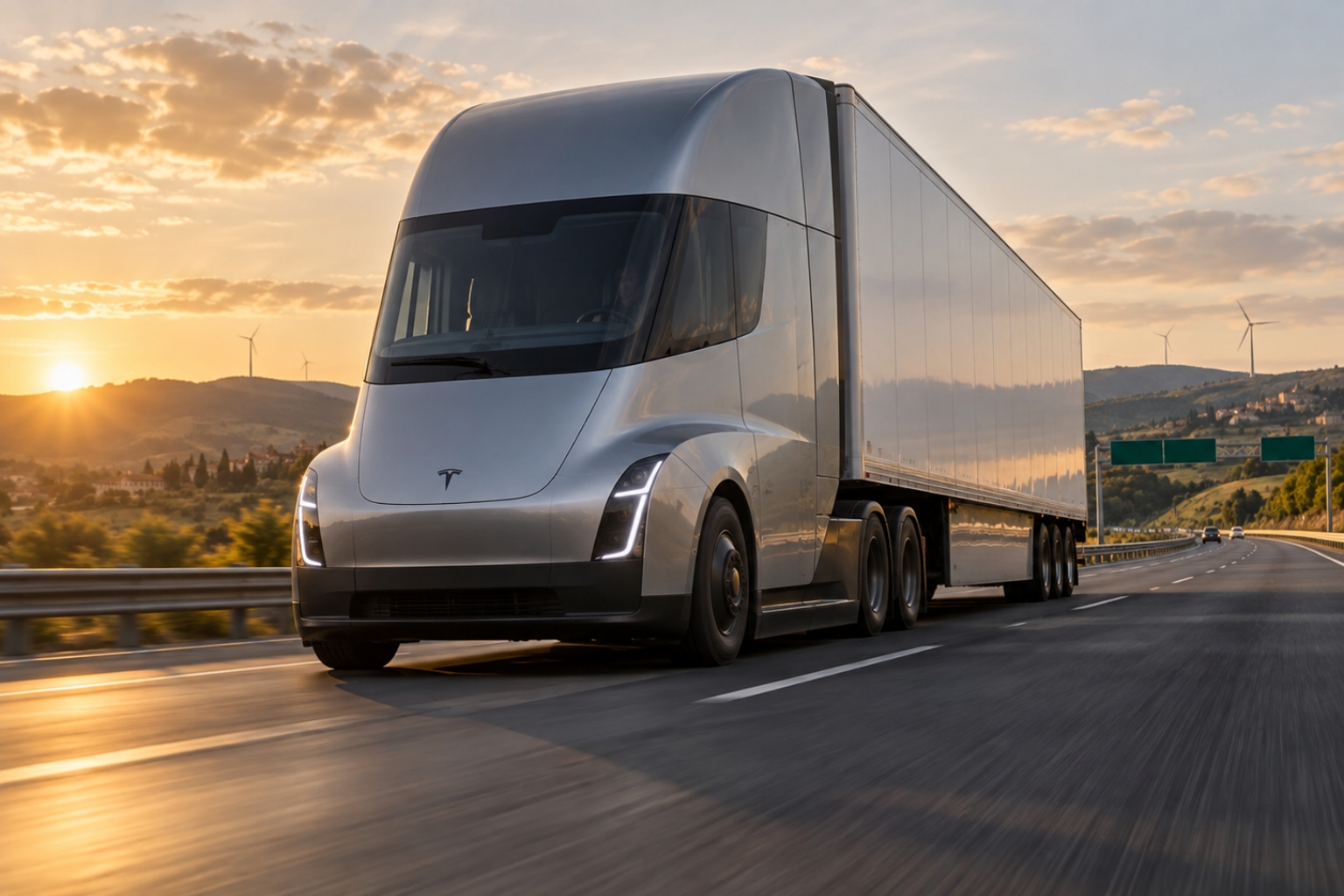
On September 15, 2026, at the IAA Transportation trade fair in Hannover, Germany, a silver-and-black tractor unit rolled onto the exhibition floor and quietly marked the end of a nearly decade-long wait. Tesla's Semi, the battery-electric heavy truck first unveiled in 2017 with a promised 2019 production date, had finally arrived on European soil. The European debut came with a clear message: Tesla is not content to sell sedans and SUVs. It wants to electrify the backbone of global freight.
The timing is significant. Europe's commercial vehicle market is the most competitive battery-electric truck arena in the world. Mercedes-Benz, Volvo Trucks, MAN, Scania, DAF, and Renault all have electric heavy trucks in production and on the road today. Tesla is not entering an empty field. It is entering a fight.
Chapter 1: What Tesla Revealed in Hannover — The European Semi Specifications
Tesla used its European debut to publish a set of figures that are simultaneously impressive and revealing. The European Semi will offer up to 550 kilometers (342 miles) of range at 40 tonnes fully loaded, with an energy consumption figure of approximately 1 kilowatt-hour per kilometer. Charging is handled through Tesla's Megacharger network at up to 800 kilowatts, recovering roughly 60% of range in 30 minutes — roughly the duration of a mandated driver rest break in the European Union. The truck carries a curb weight of 9,100 kilograms without trailer or cargo, and offers an electric power take-off (ePTO) of up to 25 kilowatts for onboard equipment such as lifting arms and compactors. The powertrain uses three independent electric motors mounted on the rear axles, delivering a combined output that Tesla quotes at 1,087 horsepower.
Those numbers require context. In the United States, Tesla advertises a Long Range Semi rated at 500 miles (805 kilometers) on an 822 kWh battery. The European figure of 550 kilometers is quoted at 40 tonnes fully loaded — a heavier gross weight than the 82,000-pound (37.2-tonne) rating Tesla uses for the US Long Range configuration. But the real tell is the curb weight. At 9,100 kilograms, the European Semi is lighter than the US Long Range truck (approximately 23,000 pounds) and lands right on the US Standard Range specification of under 20,000 pounds. A lighter truck almost always means a smaller battery pack. The 550-kilometer figure very likely reflects a standard-range battery configuration rather than the long-range pack that American customers can order.
Dan Priestley, Tesla's Semi program lead, confirmed as much at IAA. The truck destined for Europe "will closely resemble Tesla's standard-range Semi offered in North America," he told Transport Topics. The major technology components — frame rails, chassis, battery pack, drive axles — are the same across both markets. The primary differences are regulatory: lighting, mirrors, trailer interfaces, splash guards, and tachographs. Tesla has developed what Priestley calls a "global multimarket platform" that allows the company to take lessons from North American operations and apply them in Europe while allowing both markets to learn from each other.
Charging is the other notable gap between the two versions. Tesla quotes 800 kilowatts for the European Megacharger, recovering about 60% of range in half an hour. In the US, Tesla has demonstrated the Semi charging at 1.2 megawatts, pulling back roughly 70% in 30 minutes. The European figure is lower, but the efficiency figure of 1 kWh/km is roughly 1.6 kWh per mile — close to the real-world consumption that US fleets have logged. For European operators, the relevant question is not the peak charging rate but whether Megacharger infrastructure will exist in sufficient density along the freight corridors where the Semi is expected to operate.
Chapter 2: The Competitive Landscape — Europe Is Not an Empty Field
Tesla's European Semi enters a market where battery-electric heavy trucks are already a commercial reality, not a future promise. Mercedes-Benz has eActros 600 units operating in 15 countries. Volvo Trucks launched a new generation of electric models in April 2026. MAN, Scania, Renault, and DAF all have electric heavy trucks either in production or in advanced development. This is the most mature electric truck market in the world.
The range figures illustrate the competitive pressure. Volvo's FH Aero Electric Extended Range offers up to 700 kilometers. MAN's eTGX claims up to 660 kilometers in a 4×2 configuration and up to 720 kilometers in a 6×2 variant with a seventh battery pack, carrying 25 tonnes of payload. Mercedes' eActros 600 offers around 500 kilometers on a 600 kWh battery, while the new eActros Lowliner, designed for high-volume transport, carries 621 kWh for 560 kilometers at full load. Tesla's 550 kilometers at 40 tonnes is competitive on paper, but it is not a runaway lead. It is a solid entry in a crowded field.
Volvo's strategic focus is weight rather than range. The new FH Electric version can handle up to 80 tonnes of gross combination weight — a record for an electric truck — with 640 kWh of usable energy and approximately 450 kilometers of range at 64 tonnes. Megawatt Charging System (MCS) replenishes the battery from 20% to 80% in 36 minutes. For heavy-haul applications where payload capacity matters more than maximum range, Volvo is positioning itself as the truck that can do the heaviest work.
Mercedes-Benz, meanwhile, is leveraging its established service network and the eActros's early market presence. Having trucks operating in 15 countries is a meaningful advantage when a fleet operator is evaluating whether to bet on a new platform. Service centers, spare parts availability, and technician training all matter as much as the truck's specifications on paper.
Tesla's differentiation in this market is not range. It is the combination of Megacharger charging speed, the route-based charging scheduling software, and the dedicated service centers that Tesla says it will establish. Tesla also plans to build a dedicated charging network for Semi customers, with Priestley showcasing a map outlining at least 22 charging locations during the initial European rollout in 2027. "These are not just single stations with single posts," he told IAA attendees. Each location will feature megawatt charging equipment.
The 22-location figure is a starting point, not a finished network. Whether Tesla can build those locations on the timelines that European fleet operators require is one of the central open questions of the European Semi launch. Charging infrastructure is the bottleneck that every electric truck manufacturer faces. Tesla has an advantage in that it has already built a Megacharger network in the United States and understands the engineering and permitting challenges involved. But Europe presents different regulatory environments, different land availability, and different grid connection timelines. The 2027 delivery target is ambitious given that the charging network is still in the planning stage.
Chapter 3: The Einride Order — Why 500 Trucks in North America Matter for Europe
While the European Semi debut dominated headlines, the most commercially significant Tesla Semi story of 2026 happened on the other side of the Atlantic. In August, Swedish freight technology company Einride announced plans to deploy 500 Tesla Semi trucks across North America, serving Amazon and other shippers. It is the single largest order of the model to date, surpassing WattEV's 370-truck deal from May 2026, and it will triple Einride's own electric fleet from roughly 250 vehicles to around 750.
The deployment will roll out across freight corridors in California, Texas, New Jersey, Illinois, and Georgia over 24 months, starting in September 2026. At least 75 Tesla Semi trucks are planned to be in operation for Einride before the end of 2026, with the remaining units targeted for deployment by 2027, according to Einride CEO Roozbeh Charli. The trucks will be coordinated through Saga AI, Einride's fleet-optimization software, which has logged more than 19 million electric miles over seven years.
The financial scale is substantial. Tesla Semi pricing begins at approximately $290,000 per unit for the 500-mile range configuration, meaning a 500-truck order represents approximately $145 million in potential vehicle revenue. Einride quotes a figure of $800 million in "potential long-term annual recurring revenue under joint business plans," though that figure also appeared in Einride's H1 2026 report as unconverted pipeline rather than committed revenue. The financing structure of the arrangement remains partly opaque. Einride's press release states the deployment is "fully financed with third-party financing solutions," but no terms or specific lenders have been disclosed. That matters because Einride reported only $77 million in cash at the end of Q2 2026 — substantially short of the amount needed to acquire 500 Semis outright.
For Tesla, the Einride order is strategically important for reasons that go beyond revenue. Concentrating 500 trucks on fixed, repeatable corridors across five states is exactly the kind of density that makes Megacharger infrastructure investment viable. Tesla is running the same playbook it used with Uber Freight's Dedicated EV Fleet Accelerator Programme in September 2025: subsidizing Semi purchases and guaranteeing freight contracts to build corridor-level charging utilization. A single customer willing to commit 500 trucks to fixed routes creates a predictable, financeable charging demand profile that justifies building Megachargers at specific locations.
That model — anchor customer, fixed corridors, dedicated charging — is directly transferable to Europe. The lessons Tesla learns from Einride's North American deployment will inform how the company approaches European fleet operators. If the Einride rollout demonstrates that the Semi can deliver uptime and unit economics that support wider adoption, Tesla will have a credible case study to bring to European logistics companies. If the rollout stumbles, the European sales effort becomes significantly harder.
There is also a production caveat that deserves attention. Tesla's Semi program remains behind schedule. The company missed its 2026 volume production target due to bottlenecks in its 4680 battery cell technology, and its July shareholder update removed the earlier forecast for volume production in 2026. The high-volume Semi factory adjacent to Gigafactory Nevada, which began site work in 2023, is designed to build as many as 1,000 trucks per week — 50,000 annually — but is still ramping. Tesla began hosting carrier visits at the factory during the week of September 21, 2026, which suggests that customer-facing production is approaching. But until the 4680 bottleneck is resolved, the question of whether Tesla can deliver 500 trucks to Einride on schedule remains open.
Chapter 4: The Path to European Deliveries — 2027 and the Infrastructure Question
Tesla has confirmed that European customer deliveries will begin in 2027. That is the target date. It is not a guarantee. The company has not opened its European order book, has not published European pricing, and has not disclosed which battery configuration European customers will actually receive. The 9,100-kilogram curb weight suggests a standard-range or modified configuration for EU standards, but Tesla has not confirmed this. The company says that "commercial details will follow in the coming months."
The vehicle production plan for Europe has two possible paths. Dan Priestley confirmed that European Semi vehicles will be built at Tesla's Reno, Nevada, manufacturing plant, which is ramping toward full-scale production. However, Tesla has not ruled out building a truck assembly plant in Europe. CEO Elon Musk has previously said that Tesla will build the Semi at its Berlin factory. Whether European Semis are imported from Nevada or assembled locally will have significant implications for pricing, tariff exposure, and delivery timelines. Imported trucks face EU tariffs that could add tens of thousands of euros to the sticker price. Local assembly would avoid those tariffs but requires capital investment and a longer lead time to establish production.
The charging infrastructure question is even more pressing. Tesla has not disclosed where its European Megachargers will be located, how many will be built, or on what timeline. The company showcased a map of 22 planned charging locations for the North American rollout, but no equivalent map exists for Europe. Tesla offers customers two charging options: Megacharger high-power charging at up to 800 kilowatts for en-route charging during driver rest breaks, and a 120-kilowatt Basecharger system for slower depot charging, which can replenish the battery in approximately four hours. For fleet operators, the combination of en-route Megachargers and depot Basechargers could work, but only if the Megacharger network is dense enough along the corridors where trucks actually operate.
European freight corridors are different from their American counterparts. Distances are shorter, but traffic density is higher, delivery windows are tighter, and regulations — particularly on driver hours — are more strictly enforced. The 30-minute charging window that Tesla touts aligns neatly with EU mandated rest breaks, which is a genuine advantage. But a 30-minute charge that recovers 60% of range only works if the truck can reach a Megacharger within that window. If the nearest Megacharger is 200 kilometers off-route, the economics deteriorate quickly.
Tesla's route-based charging scheduling software is intended to address this by integrating charging stops into route planning and dispatch systems. If it works as advertised, it would allow fleet operators to schedule charging during mandatory rest periods without adding unproductive downtime. But the software is only as good as the charging network it relies on. Building that network in Europe — with 22 or more locations, megawatt-scale equipment, grid connections, and permitting — is a multi-year undertaking that has not yet begun in any visible way.
Conclusion
Tesla's European Semi debut at IAA Hannover was a milestone, not a victory. The truck is real, the specifications are competitive, and the 2027 delivery target is on the calendar. But Tesla is entering the most mature electric truck market in the world, against competitors who have been selling battery-electric heavy trucks for years, with service networks already in place, and with range figures that in some cases exceed Tesla's European offering. The 550-kilometer range at 40 tonnes is solid, but it is not exceptional. Volvo, MAN, and Mercedes all offer comparable or better range figures in configurations that matter to European operators.
What Tesla brings that no competitor can match is the combination of Megacharger charging speed, integrated route-planning software, and the scale of its battery manufacturing operation. If Tesla can build the European Megacharger network on schedule and deliver trucks with the uptime and unit economics that fleet operators require, the Semi has a credible path to commercial success in Europe. If the charging network lags, or if production bottlenecks persist, the 2027 delivery date becomes a promise rather than a plan.
The Einride order in North America provides the commercial proof point that Tesla needs. Five hundred trucks on fixed corridors will generate the operational data — uptime, energy consumption, maintenance costs, charging utilization — that European fleet operators will want to see before committing to their own orders. Tesla's European success may ultimately depend less on what happens in Hannover and more on what happens on the freight corridors of California, Texas, and Georgia over the next 12 months.
FAQ
Q: When will Tesla Semi deliveries begin in Europe?
A: Tesla has confirmed that European customer deliveries will begin in 2027. The company has not provided a more specific timeline, but it plans to run demonstration programs with prospective customers during the first half of 2027.
Q: How much will the Tesla Semi cost in Europe?
A: Tesla has not published European pricing. In the United States, the Semi begins at approximately $290,000 for the 500-mile range configuration. European pricing will likely be higher due to import tariffs unless Tesla establishes local assembly.
Q: What range does the European Tesla Semi offer?
A: Up to 550 kilometers (342 miles) at 40 tonnes fully loaded, with energy consumption of approximately 1 kilowatt-hour per kilometer. This is likely a standard-range configuration, not the long-range pack available in the US.
Where will Tesla build European Semis?
Tesla has confirmed that European Semi vehicles will initially be built at its Reno, Nevada, plant. The company has not ruled out building a truck assembly plant in Europe and Elon Musk has previously mentioned Berlin as a possible location.
What charging infrastructure will the European Semi use?
Tesla plans to deploy Megacharger stations at up to 800 kilowatts for en-route charging, recovering about 60% of range in 30 minutes. For depot charging, Tesla offers a 120-kilowatt Basecharger system that can replenish the battery in approximately four hours.
How does the European Semi compare to Volvo and Mercedes electric trucks?
Volvo's FH Aero Electric Extended Range offers up to 700 kilometers. MAN's eTGX offers up to 660-720 kilometers depending on configuration. Mercedes' eActros 600 offers around 500 kilometers. Tesla's 550 kilometers is competitive but not class-leading.
What is the Einride order and why does it matter?
Einride, a Swedish freight technology company, has ordered 500 Tesla Semi trucks for deployment across North America over 24 months starting in September 2026. It is the largest Semi order to date and provides Tesla with a large-scale commercial validation that will inform its European strategy.