
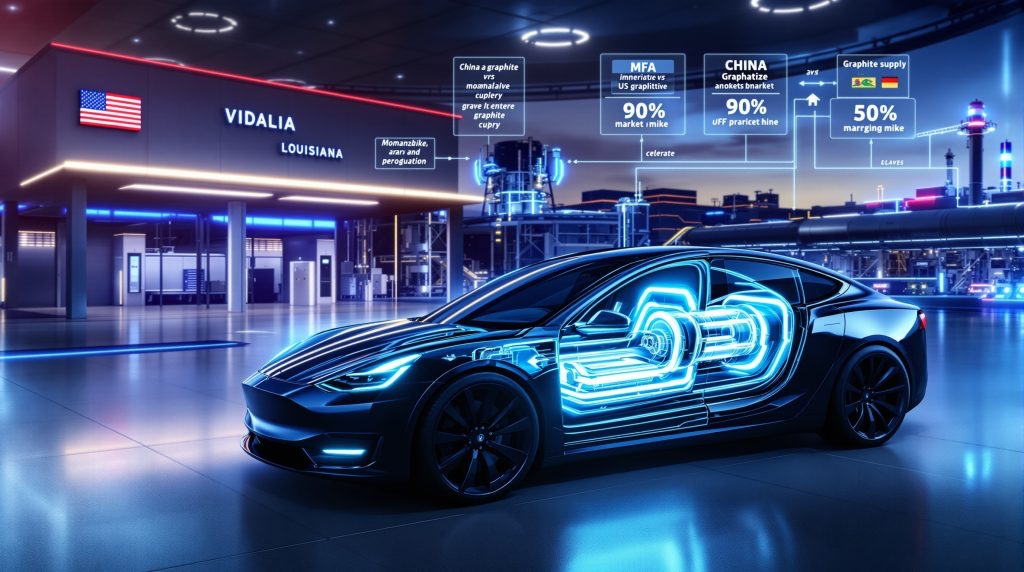
How Critical Battery Materials Are Shaping Tesla’s Future in the U.S. and Europe
Introduction: Why Graphite Has Become a Front-Line Issue for Tesla
In recent years, much of the public conversation around Tesla batteries has focused on lithium, nickel, and emerging technologies such as solid-state cells. However, graphite remains the single largest material component in a lithium-ion battery by weight, and it has quietly become one of Tesla’s most strategic vulnerabilities.
Today, Tesla’s decision to extend its graphite supply agreement with Syrah Resources highlights a broader reality: the global EV transition is no longer limited by demand or innovation alone—it is increasingly constrained by critical raw material availability, geopolitics, and industrial capacity.
For Tesla owners in the United States and Europe, this issue is far from abstract. Graphite supply directly affects:
-
Battery cost stability
-
Vehicle pricing and margins
-
Delivery timelines
-
Long-term battery performance and durability
This article explores why graphite matters, what Tesla’s latest supply decisions reveal, and how this challenge may shape Tesla vehicles over the next decade.
1. The Role of Graphite in Tesla Batteries
1.1 Why Graphite Is Essential to Lithium-Ion Cells
In nearly all modern lithium-ion batteries—including Tesla’s 2170, 4680, and LFP variants—graphite is used in the anode, the electrode responsible for storing lithium ions during charging.
Key reasons graphite remains dominant:
-
Excellent lithium intercalation stability
-
Long cycle life
-
Relatively low cost compared to experimental alternatives
-
Proven safety record in automotive applications
On average:
-
20–30% of a lithium-ion battery cell’s weight is graphite
-
A single Tesla vehicle can require 50–70 kg of battery-grade graphite
No commercially viable EV battery today operates entirely without graphite.
1.2 Natural vs Synthetic Graphite
Tesla, like most EV manufacturers, relies on two types of graphite:
Natural Graphite
-
Lower energy cost to produce
-
Limited high-purity sources
-
Often concentrated in geopolitically sensitive regions
Synthetic Graphite
-
Higher purity and consistency
-
Energy-intensive and expensive to manufacture
-
Heavily reliant on industrial processing capacity
Tesla uses a mix of both, depending on chemistry and performance requirements.
2. The Syrah Resources Agreement: What Changed and Why It Matters
2.1 Overview of the Syrah–Tesla Deal
Syrah Resources, an Australian mining and processing company, operates one of the world’s largest natural graphite deposits and has invested heavily in downstream processing capacity, including facilities aimed at supplying Western EV manufacturers.
Tesla’s agreement with Syrah is strategically important because it:
-
Reduces dependence on Chinese graphite supply chains
-
Supports U.S. and allied-country battery material sourcing
-
Aligns with regulatory incentives tied to domestic content
The recent extension of the supply deal deadline indicates Tesla’s willingness to prioritize long-term stability over short-term volume guarantees.
2.2 Why the Deadline Was Extended
Several factors contributed to the extension:
-
Slower-than-expected ramp-up of processing capacity
Battery-grade graphite requires extremely tight purity tolerances. -
Capital constraints and market volatility
Commodity markets remain sensitive to interest rates and global EV demand fluctuations. -
Regulatory alignment issues
Tesla must ensure compliance with U.S. and European battery sourcing regulations.
Rather than abandoning the partnership, Tesla chose patience—suggesting graphite security is a strategic, not transactional, priority.
3. The Global Graphite Supply Problem
3.1 China’s Dominance in Graphite Processing
While graphite is mined in multiple regions, over 60% of the world’s battery-grade graphite processing capacity is currently based in China.
This presents risks:
-
Export controls or trade restrictions
-
Pricing volatility
-
Strategic dependency for Western automakers
For Tesla, whose vehicles are sold globally and increasingly subject to local content rules, this concentration is problematic.
3.2 U.S. and European Supply Gaps
Despite political momentum, Western graphite supply chains face obstacles:
-
Long permitting timelines
-
Environmental review requirements
-
High capital costs for processing facilities
As a result, Tesla must balance:
-
Ideal geopolitical sourcing
-
Realistic industrial timelines
-
Competitive battery pricing
4. Regulatory Pressure and Incentives
4.1 U.S. EV Tax Credits and Battery Material Rules
In the United States, federal incentives increasingly depend on:
-
Where battery materials are sourced
-
Where they are processed
-
Whether supply chains involve “foreign entities of concern.”
Graphite is explicitly included in these requirements.
Failure to secure a compliant graphite supply can:
-
Disqualify vehicles from incentives
-
Increase effective purchase prices
-
Reduce competitiveness in key markets
4.2 European Union Battery Regulations
The EU’s battery framework adds:
-
Carbon footprint reporting
-
Ethical sourcing documentation
-
Recycling and lifecycle mandates
Tesla’s graphite strategy must now satisfy both economic and regulatory constraints, particularly for vehicles produced in Europe.
5. Impact on Tesla Vehicle Pricing and Availability
5.1 Cost Pressures and Margins
Graphite price fluctuations directly affect:
-
Cell production cost
-
Pack-level pricing
-
Vehicle margins
While Tesla has historically absorbed cost volatility better than competitors, sustained graphite constraints could:
-
Slow price reductions
-
Limit future cost-cutting strategies
5.2 Delivery Timelines and Production Scaling
Battery material shortages do not always cause visible shutdowns—but they can:
-
Cap production growth
-
Delay regional rollouts
-
Reduce flexibility across factories
For Tesla owners, this may manifest as:
-
Longer wait times for certain trims
-
Reduced availability of high-capacity battery variants
6. Tesla’s Long-Term Strategy: Beyond Traditional Graphite
6.1 Silicon-Enhanced Anodes
Tesla and its suppliers are actively researching silicon-graphite blends, which:
-
Increase energy density
-
Reduce the total graphite required per kWh
-
Introduce engineering challenges related to expansion and degradation
These technologies are already appearing in limited form, but full adoption remains years away.
6.2 Recycling as a Secondary Supply Stream
Battery recycling offers:
-
Domestic material recovery
-
Reduced environmental impact
-
Long-term cost stability
Graphite recovery is more complex than metals, but advances are accelerating. Tesla’s closed-loop ambitions increasingly include anode materials.
6.3 Vertical Integration Possibilities
While Tesla has vertically integrated battery manufacturing, full graphite integration remains unlikely in the near term due to:
-
Capital intensity
-
Environmental permitting hurdles
-
Long development timelines
Strategic partnerships remain the most realistic solution.
7. What This Means for Tesla Owners in the U.S. and Europe
For current and prospective Tesla owners, the graphite issue suggests:
-
Battery technology progress will be evolutionary, not sudden
-
Pricing stability depends as much on materials as software
-
Supply chain resilience is now a competitive advantage
Tesla’s transparency and proactive sourcing decisions position it better than many rivals—but challenges remain.
Conclusion: Graphite Is Tesla’s Quiet Bottleneck
While lithium and autonomy dominate headlines, graphite is one of Tesla’s most critical—and least discussed—constraints.
The extension of Tesla’s graphite supply agreement reflects:
-
A realistic assessment of global supply limitations
-
A strategic commitment to Western battery independence
-
A long-term view aligned with regulatory and sustainability goals
For Tesla owners, this is ultimately a positive signal: short-term complexity in exchange for long-term resilience.
Frequently Asked Questions (FAQ)
Q1: Will graphite shortages reduce my Tesla’s driving range?
No. Tesla will not compromise performance; supply challenges affect production planning, not vehicle capability.
Q2: Could this delay future Tesla models?
Potentially, but Tesla’s diversified sourcing strategy reduces the risk of major delays.
Q3: Is Tesla moving away from graphite entirely?
Not in the near future. Graphite remains essential, though its proportion may decrease over time.
Q4: Does this affect battery longevity?
Stable, high-quality graphite supply supports long battery life and consistent performance.