
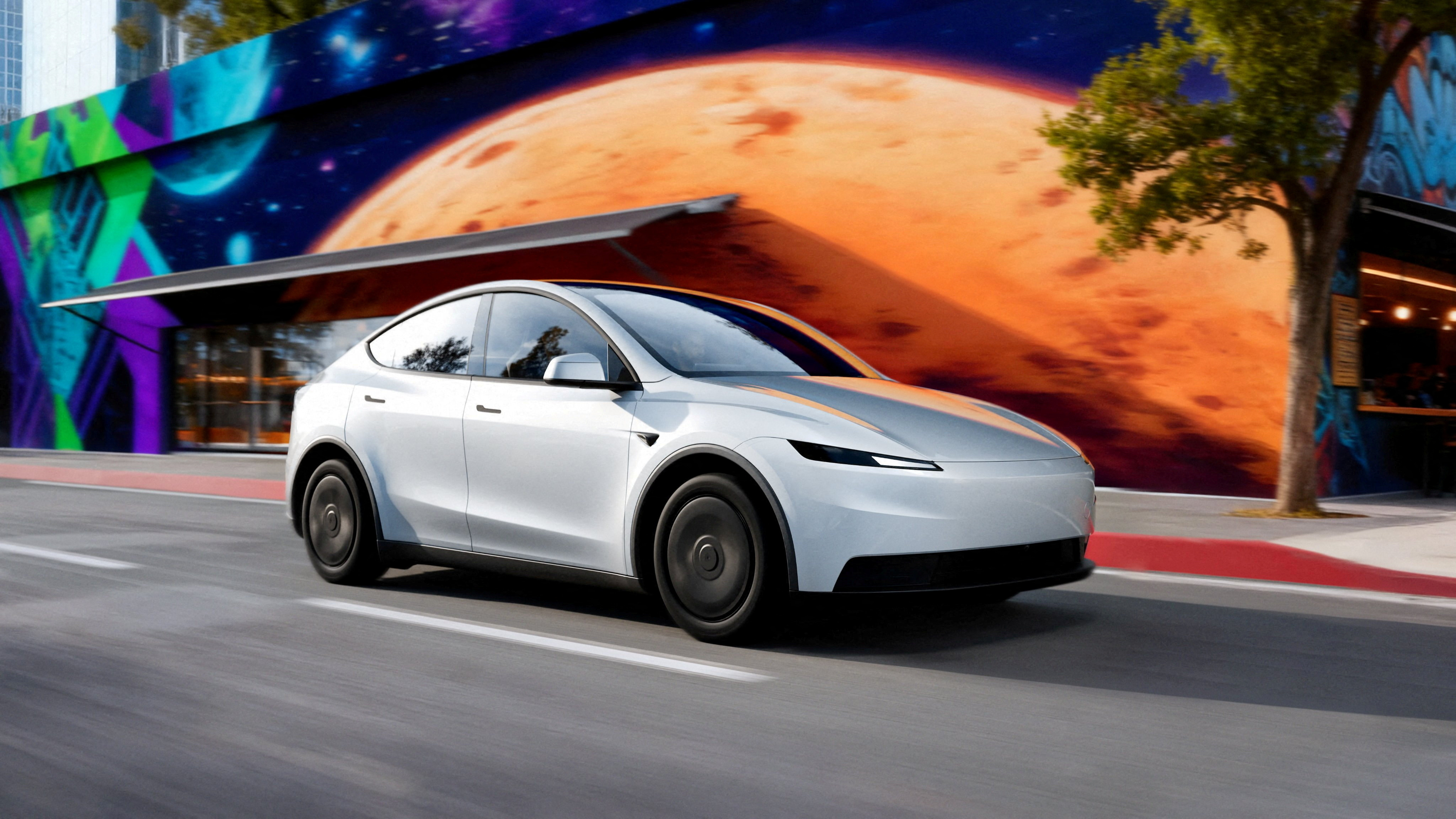
In October 2025, Tesla quietly rolled out a lower-cost “Standard” variant of its bestselling Model Y SUV in select European markets, with significantly pared-down features and pricing designed to revive demand in a region where Tesla has been facing sustained headwinds.
Given Tesla’s shrinking European foothold and intensifying competition from Chinese EV makers and legacy automakers, this move is more than just a new trim level — it may signal a strategic pivot toward a more volume-driven model in Europe. This article delves into the context, design trade-offs, market implications, and risks associated with Tesla’s “affordable Model Y” strategy in Europe, with a particular eye toward how it matters for European and American Tesla owners and prospective buyers.
We will proceed as follows:
-
The European EV market landscape and Tesla’s recent struggles
-
The product positioning, specification cuts, and cost structure
-
Manufacturing, supply chain, and rollout considerations
-
Market reactions, challenges, and competitive responses
-
Lessons and comparisons with the U.S. market
-
Strategic risks and forward outlook
-
Recommendations for owners and buyers
-
Conclusion
-
FAQ (frequently asked questions)
II. Market Context & Challenges in Europe
2.1 European EV Market Trends and Competitive Pressures
While the European market for battery electric vehicles (BEVs) has continued its overall upward trajectory in 2025, Tesla has struggled to stay in pace. Industry data show that many European countries are experiencing increasing penetration of EVs, but Tesla’s share and volume in Europe have been declining.
-
In May 2025, Tesla’s European market share dropped to just 1.2 %, down from 1.8 % a year earlier.
-
In April 2025, Tesla’s new registrations in key markets plunged—e.g. an 81 % drop in Sweden from the previous year.
-
Across many Western European markets, Tesla had five consecutive months of year-on-year sales declines.
-
Meanwhile, Chinese EV makers are gaining momentum: BYD recently outsold Tesla in Europe for the first time.
This landscape means that Tesla’s premium positioning is under pressure: consumers are more price-sensitive, alternatives are numerous, and margins are squeezed.
2.2 Tesla’s European Struggles
Tesla’s European struggles aren’t merely about rising competition:
-
Aging product lineup: Tesla hasn’t introduced a wholly new mainstream model since the Model Y launch in 2020, making its European offerings look stale relative to rapidly updated competitors.
-
Pricing disadvantages: European incentives, import duties, and competitive pricing by Chinese and European automakers put Tesla at a disadvantage, especially in lower-priced segments.
-
Brand / perception headwinds: Some European buyers have signaled discontent with Elon Musk’s public persona, politics, or controversies, potentially affecting brand sentiment in Europe.
-
Logistics & regulatory overheads: Import, homologation, and compliance costs are not trivial in Europe. Tesla’s ability to localize production (e.g., via Giga Berlin) helps, but the burden remains.
-
Discounting & incentives early: The refreshed Model Y launched earlier in 2025 soon saw financing incentives (e.g. 0 % financing) — an indicator of demand weakness.
Against this backdrop, Tesla’s decision to release a “stripped-down” Model Y Standard is strategically coherent: it attempts to address the price sensitivity of European EV buyers and reclaim lost volume.
III. Product Positioning & Configuration Trade-offs
3.1 Pricing & Market Coverage
Tesla offers the Model Y Standard at significantly lower price points in European markets to undercut some rivals. For example:
-
In Norway: around NOK 421,996 (~USD 41,714)
-
In Germany: ~€39,990 (~USD 46,300)
-
In Sweden: ~SEK 499,990 (~USD 52,521)
These prices are meaningfully lower than “premium” trims, and position the Model Y Standard into a more competitive pricing tier in the mid-EV segment.
Tesla also unveiled similarly more affordable versions of the Model 3 (starting at $36,990).
However, critics argue that prices remain too high to attract a truly broader mass market. Some commentaries note that a starting price below $30,000 (adjusted for incentives) is needed to tap mainstream buyers. Configuration Cuts & Feature Trade-offs
To reduce costs, the Model Y Standard avoids including or reduces many “premium” features. According to Reuters:
-
No standard Autosteer (i.e. autonomous lane-keeping) included
-
Reduced interior lighting
-
Fewer speakers
-
Fabric (cloth) seat covers instead of premium materials
-
Likely fewer luxury / comfort features or trim options
These cuts aim to preserve essential mobility and Tesla branding, while removing components whose absence few customers would deem deeply disqualifying.
Tesla’s own internal cost targets suggest the stripped-down variant is designed to cost ~20 % less to produce than the refreshed Model Y.
Nevertheless, the question becomes: to what extent will these reductions erode perceived value or alienate buyers accustomed to higher-end expectations?
3.3 Value Proposition & Consumer Appeal
The success of this version depends on hitting a sweet spot: delivering “enough Tesla” credentials at a much lower cost. The advantages:
-
Access to Tesla’s charging network, vehicle software stack, OTA updates
-
Proven battery / drivetrain reliability
-
Strong brand equity and resale potential (assuming the trim does not degrade brand perception)
But downsides include:
-
“Feature fatigue” — buyers may balk at missing Autosteer or premium touches
-
The risk of cannibalizing more expensive models
-
Possible reduced resale value or perception of “entry-level Tesla” stigma
Tesla’s gamble is that a lower price floor will attract volume buyers who might otherwise choose non-Tesla EVs — thereby improving network effects, brand loyalty, and economies of scale.
IV. Manufacturing, Supply Chain & Rollout Strategy
4.1 Production Location & Capacity Allocation
A critical decision is where to build or allocate units of this Standard variant. Given the importance of cost control and logistics, plausible strategies include:
-
Giga Berlin (Germany): As Tesla’s European manufacturing hub, Berlin could supply Western/Northern Europe markets, reducing import/transport costs and lead times.
-
Imports from U.S. / China plants: For markets farther afield, Tesla might import from the U.S. or China, although this adds complexity in tariffs, shipping, and regulatory adaptation.
-
Phased rollouts by region: Tesla’s 2025 rollout plan suggests that the Standard variant will first appear in Germany, Norway, and Sweden (not in RHD markets like UK or Ireland).
Tesla already teased the stripped-down version as being about 20 % cheaper to produce, with potential scale to ~250,000 units per year in the U.S. by 2026.
4.2 Supply Chain Simplification & Cost Control
To hit the cost reduction targets, Tesla likely leans heavily on:
-
Component simplification / standardization — fewer variants, lower TF of trim levels
-
Removal or downgrade of high-margin “luxury extras”
-
Supplier consolidation / renegotiation
-
Higher automation in assembly, especially for “value” trims
-
Logistics optimization to reduce overhead on parts distribution
Each reduction carries risk: less supplier flexibility, fewer buffer components, potential quality compromises.
4.3 Rollout Timing & Market Prioritization
Tesla plans to launch the new variant in Germany, Norway, and Sweden in November or December 2025.
Right-hand-drive markets like the UK and Ireland are excluded initially, presumably because they require different door / mirror / steering packaging that makes cost reduction harder.
Tesla must carefully manage launch timing so that demand does not collapse premium pricing and so that supply meets demand without large stock overhangs.
4.4 Risk Management & Quality Control
With aggressive cost cuts, risk factors increase:
-
Durability / reliability issues on downgraded components
-
Fit / finish defects
-
Customer complaints of “cheapened” experience
-
Warranty costs — Tesla must ensure that savings in production don’t get eaten by higher service costs or recalls
Maintaining perception of “Tesla quality” even in the Standard trim is critical; any major reliability failures could damage brand equity broadly.
V. Market Reactions & Competitive Landscape
5.1 Immediate Market Reaction & Shareholder Sentiment
Following the announcement of the cheaper models:
-
Tesla’s share price dipped ~3.6 % on the day.
-
Analysts and commentators expressed skepticism that the price cut is deep enough to meaningfully alter demand dynamics.
-
Some see it as a necessary defensive move in Europe, but not necessarily a winning aggressive strategy.
The mixed reaction suggests that while investors view it as strategically logical, they are uncertain about margin erosion and long-term viability.
5.2 European Consumer & Media Response
In Europe, media and EV enthusiasts responded with both optimism and caution:
-
Some praise Tesla’s courage to push into more accessible price territory
-
Others criticize that removing Autosteer, lightings, and premium touches makes the car less compelling
-
Comparisons with Chinese EVs often highlight that some Chinese models at similar or lower prices still include many features Tesla removed.
Consumer acceptance will depend heavily on expectations: many Tesla fans may balk at compromises, while new buyers might view the standard version as a reasonable entry into Tesla ownership.
5.3 Competitive Responses & Positioning
Tesla’s move isn’t happening in a vacuum. Key competitive dynamics include:
-
Chinese EV brands in Europe: BYD, Xpeng, Nio, and others offer feature-rich EVs with competitive pricing and fast innovation cycles.
-
European OEMs: Volkswagen, Renault, Stellantis brands are pushing into EV aggressively, often leveraging local incentives, dealer networks, and brand loyalty.
-
Other low-cost EV entrants: The pressure to drive down cost per vehicle is industry-wide; Tesla may find that multiple brands try matching or undercutting.
Tesla’s challenge is to maintain its differentiation (brand, software, Supercharger, OTA updates) while not losing ground on value.
5.4 Risks of Cannibalization & Brand Dilution
One risk is that the Standard variant eats into sales of higher-margin trims, eroding overall profitability. Tesla must calibrate trim differentiation (range, features) so that buyers self-select upward rather than “downgrade down.”
Another risk is brand dilution: if customers perceive the Standard trim as “cheap Tesla,” the premium model’s halo and perceived exclusivity could suffer. Tesla must preserve enough differentiation and exclusivity in higher trims.
VI. U.S. Market Contrast & Lessons for American Owners
6.1 U.S. Introduction of Standard Variants
In the U.S., Tesla already introduced Standard versions of the Model Y and Model 3 (starting around $39,990 / $36,990).
However, the U.S. market dynamics differ: tax incentives, scale, consumer expectations, and brand maturity allow Tesla more flexibility in trimming features while retaining appeal.
6.2 Key Differences Between U.S. & Europe Markets
-
Incentive structure: U.S. federal and state EV incentives can more strongly offset price differences
-
Consumer expectations: U.S. buyers may more readily accept feature cuts, while European buyers often compare more granularly among premium EVs
-
Network / infrastructure: Tesla’s U.S. Supercharger coverage is dense; European alternatives and charging fairy-coverage vary
-
Regulatory compliance: European homologation is stricter in many dimensions (safety, emissions, crash test). The Standard trim must still meet the same legal thresholds.
6.3 Implications for U.S. Tesla Owners / Prospective Buyers
For U.S. Tesla owners or buyers, the European Standard strategy serves as a canary in the coal mine:
-
If it succeeds in Europe, Tesla may accelerate its pursuit of lower-cost variants elsewhere
-
U.S. buyers may see more configurations with stripped features, and should weigh feature importance vs cost savings
-
Owners should monitor how Tesla treats service, software update parity, and resale for lower-trim versions as a bellwether for brand equity
VII. Strategic Risks, Scenarios & Forward Outlook
7.1 Risks That Could Derail the Strategy
-
Margin erosion: If cost cuts are insufficient or higher warranty / service costs erode savings
-
Quality or reliability issues: Failures in downgraded components could harm brand perception
-
Regulatory or homologation issues: Variants may run into compliance difficulties in certain markets
-
Cannibalization: Higher-trim models losing sales without net gain
-
Competitive retaliation: Rivals may slash pricing, add features, or deploy aggressive incentives
7.2 Scenarios: Success / Moderate / Fail
We can consider three broad scenarios:
-
Success scenario: Standard variant drives meaningful volume growth in Europe, helps stabilize Tesla’s European share, attracts new buyers, and over time lifts margins through scale.
-
Moderate outcome: Some incremental demand comes, but margins weaken and the move only partially offsets losses in other trims. The Standard trim becomes a niche “volume play.”
-
Failure scenario: The price cuts fail to stimulate demand, reimbursements / warranty costs exceed expectations, and negative perception undermines the brand; Tesla retracts or limits the Standard model.
7.3 Longer-Term Strategic Implications
-
Tesla may shift more toward a “volume + software” model, relying more on software, services, FSD, OTA, and less on hardware margins.
-
Future Tesla models may be more aggressively modular, allowing easier trimming or upgrades.
-
The “Tesla as premium EV for the many” narrative may evolve toward “affordable intelligent mobility brand.”
-
If the Standard variant succeeds, Tesla might localize more production or variants per region (i.e. more divergence rather than global uniformity).
VIII. Recommendations for Owners & Buyers
8.1 For Current European Tesla Owners
-
Monitor your vehicle’s trim and resale value; standard-variant buyers may change expectations of depreciation curves
-
Check whether existing higher-trim buyers expect features (e.g. lighting, sound, Autosteer) to be downgraded or to suffer cost compression
-
If considering upgrades (e.g. FSD), consider locking in before Tesla’s pricing policies shift
8.2 For Prospective Buyers in Europe
-
If you were on the fence, the Standard variant may reduce the barrier to entry
-
Evaluate which features you truly value: if missing Autosteer or fewer speakers are acceptable trade-offs, you may get good value
-
Consider timing: early orders may catch limited availability or launch discounts
-
Be cautious of resale expectations; check if the Standard version will maintain market value
8.3 For U.S. Buyers / Owners
-
Watch how Tesla treats the Standard trim’s software updates and long-term support — that is a proxy for how Tesla values “base trims”
-
Consider whether future U.S. trims will mirror European cost-cutting moves
-
Use Europe as a case study in trade-offs: evaluate whether you prefer “full-feature” Tesla or are willing to accept a leaner option for price discount
IX. Conclusion
Tesla’s launch of a lower-cost Model Y Standard variant in Europe is a bold, necessity-driven move. Facing shrinking market share, intensifying competition, and a premium positioning under pressure, Tesla is doubling down on volume rather than purely margin.
The trade-off is delicate: cost cuts must preserve the core Tesla value proposition. If the Standard variant delivers enough of the Tesla experience at an accessible price, it may succeed in reviving demand in Europe. But missteps in quality, perception, or margin could backfire.
For European and U.S. Tesla owners and prospective buyers, the strategy marks a turning point: Tesla is signaling that even its flagship models are subject to cost rationalization. Watching how this plays out in demand, service, software support, and resale will be critical. For now, the Standard Model Y is a test — of Tesla’s ability to compete in the “next tier” of the EV market without losing its premium soul.
X. FAQ (Frequently Asked Questions)
-
What are the main differences between the Standard and Premium Model Y?
The Standard variant omits or downgrades certain features: no built-in Autosteer as standard, reduced interior lighting, fewer speakers, fabric seats instead of premium materials, and likely fewer comfort / luxury touches. -
Does the Standard version compromise safety or structural integrity?
Tesla still must meet all regulatory safety and crash standards. The cost-cutting focuses on non-structural or optional features. That said, buyers should watch post-launch reliability reports. -
Will the Standard variant cannibalize sales of higher-end trims?
Yes, that is a risk. Tesla must manage differentiation so that higher trims maintain compelling upgrades (range, features) and don’t simply lose customers to the cheaper variant. -
Should I wait for the Standard version before buying a Tesla in Europe?
If you're price-sensitive and can accept fewer features, waiting may make sense. But if you need the advanced features now (e.g. Autosteer), the premium trims may still offer better value. -
Will the Standard variant affect resale value and software updates?
Possibly. Depreciation may be steeper if demand is weaker for base trims. Also, Tesla’s future software or feature support policies could favor higher-tier models — an area to monitor closely.