
Introduction: Software as the Soul of the Machine
In the automotive world of 2026, a car is no longer defined by its zero-to-sixty time or the leather on its seats. It is defined by its Operating System. Today, April 16, 2026, the rollout of Tesla OS 2026.2.3 and the advanced FSD v14.3 represents the pinnacle of this evolution. For Tesla owners in North America and Europe, this isn't just a software patch; it is a fundamental reconfiguration of how the vehicle perceives reality and interacts with its occupants.
The philosophy behind 2026.2.3 is what Tesla engineers call "Integrated Sentience." It is the bridge between passive safety features and active, intelligent decision-making. By moving beyond simple "If-Then" logic and embracing massive, unified neural networks, Tesla has turned the vehicle into a proactive guardian. Whether it is preventing a tragedy through Child Left Alone Detection or navigating a chaotic European roundabout with FSD v14, the car is finally starting to "think" like a human, but with the reaction time of a machine.
2. Child Left Alone Detection: A New Standard in Occupant Safety
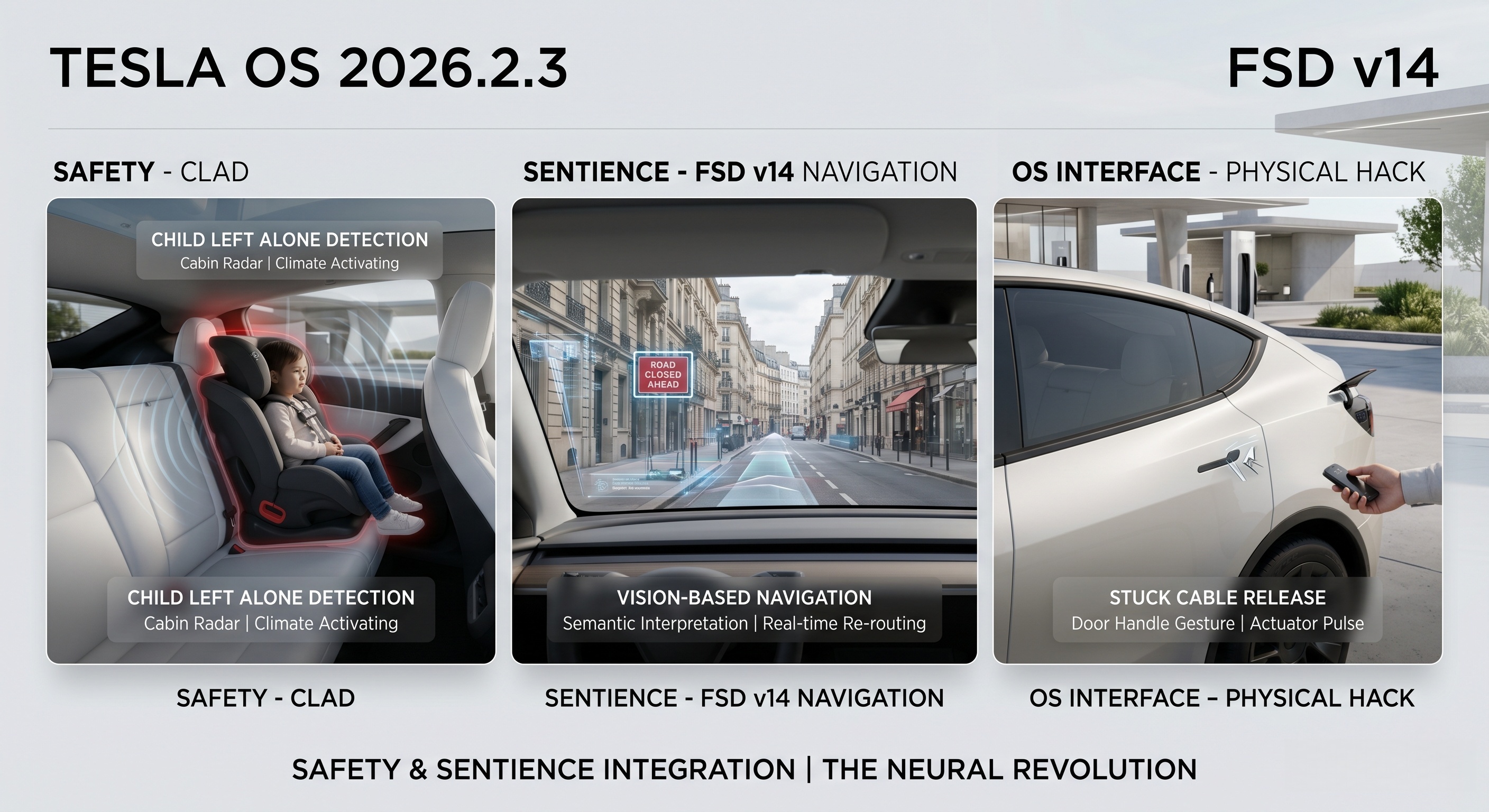
One of the most profound additions in the 2026 firmware is the Child Left Alone Detection (CLAD) system. Leveraging the ultra-high-resolution Cabin Radar and the AI4 interior camera, Tesla has created a safety net that is now active by default in all 2026-spec vehicles.
2.1 The Technical Mechanics of Detection
Unlike previous systems that relied on seat pressure sensors—which could be fooled by a heavy bag—CLAD uses micro-vibration analysis. The cabin radar is sensitive enough to detect the rhythmic rise and fall of a sleeping infant’s chest or the heartbeat of a pet.
When the vehicle is locked and the internal sensors determine that a "life form" remains inside without an adult present:
-
Phase 1 (15 Seconds): The car sends an "Urgent" push notification to the owner’s Tesla App.
-
Phase 2 (1 Minute): The car automatically activates Climate Control to a safe 21°C (70°F) to prevent heatstroke or hypothermia.
-
Phase 3 (Persistent): If the owner does not respond, the vehicle begins flashing its exterior LED lights and sounds a rhythmic, low-decibel alarm to attract nearby pedestrians without distressing the child.
2.2 Global Regulatory Alignment
In the European Union, where Euro NCAP has increasingly prioritized child presence detection, this feature has secured Tesla a "Platinum" safety rating for 2026. For US owners, it offers a layer of peace of mind that is unmatched by any legacy luxury brand, integrating seamlessly with "Dog Mode" and "Camp Mode."
3. The Physical Hack: Releasing Stuck Charge Cables via Door Handles
Tesla is known for removing physical buttons, but in 2026.2.3, they have "re-mapped" the physical hardware to solve a long-standing user pain point: the stuck charging cable.
3.1 The "3-Second Pull" Logic
In freezing climates—common in Northern Europe and the American Midwest—charging pins can occasionally freeze or sensors can become unresponsive, trapping the cable in the port. Previously, this required a manual release tug from inside the trunk or a call to roadside assistance.
Now, Tesla has introduced a secondary hardware-software handshake. If the vehicle detects a recognized key (phone or fob) within 1 meter:
-
The Gesture: Pull and hold the rear left door handle for exactly 3 seconds.
-
The Result: The car sends an emergency high-voltage pulse to the actuator to break any ice bond and physically retracts the locking pin.
This is a masterclass in Software-Defined Hardware. By repurposing the existing electronic door handle as a "soft button," Tesla has added a critical safety and convenience feature without changing a single part in the manufacturing line.
4. FSD v14: Transitioning to Truly End-to-End Neural Urban Navigation
While safety features grab headlines, the core of the 2026.2.3 update is Full Self-Driving (Supervised) v14.3. This is the version that finally merges "Routing" and "Vision" into a single neural network.
4.1 Vision-Based Navigation (VBN)
Before v14, Tesla vehicles used a "Map-Follower" approach. The car would see the road, but its navigation was dictated by a static GPS map. If the map was outdated or a road was closed for construction, the car would often get confused.
FSD v14.3 introduces Vision-Based Navigation. The car now "reads" the road like a human. If a "Road Closed" sign appears, the neural network doesn't wait for a GPS update; it perceives the pixels of the sign, interprets the semantic meaning, and re-routes in real-time. The vision system is now the primary source of truth, with the GPS serving only as a general suggestion.
4.2 The AI Compiler & MLIR Integration
Under the hood, Tesla has rewritten its AI compiler using MLIR (Multi-Level Intermediate Representation). This allows the FSD software to run with 30% less latency on the AI4 hardware. In a high-speed merge or a complex urban intersection in Paris or New York, those milliseconds are the difference between a smooth, human-like maneuver and a jerky, "robotic" correction.
5. The HW3 vs. HW4/AI4 Performance Gap in 2026
As of today, the "Great Split" in the Tesla fleet is becoming apparent. While Tesla remains committed to its existing owners, the physical limitations of the HW3 (Hardware 3) computer are being pushed to the brink.
5.1 The 10x Neural Growth
The neural networks powering FSD v14 on HW4 (AI4) vehicles are approximately 10 times larger in parameter count than those used in v12. This allows for significantly better "Nuance Reasoning"—the ability to predict if a pedestrian is about to step off a curb based on their body language.
5.2 FSD v14 "Lite" for HW3
To ensure that older Model 3s and Ys remain capable, Tesla is developing a "Lite" version of v14. This version uses "Knowledge Distillation," where the massive HW4 network "teaches" a smaller, more efficient network to perform nearly as well on HW3 hardware. While HW4 is the gold standard for 2026, the software optimization in 2026.2.3 ensures that the millions of HW3 cars on the road today still receive significant safety and smoothness upgrades.
Conclusion: Why Your Tesla Gets Better While Other Cars Age
The April 16, 2026 update is a reminder of the "Tesla Moat." While legacy manufacturers are still struggling to push basic infotainment updates over-the-air, Tesla is fundamentally altering the physics of how a car operates.
By integrating Child Left Alone Detection, a clever physical bypass for charging, and the v14.3 neural architecture, Tesla has proven that the car is a living organism. It learns, it adapts, and most importantly, it prioritizes the safety of those inside and around it. For the European and American owner, the message is clear: your vehicle is not just a tool; it is a partner that is becoming more sentient with every passing year.
FAQ
Q: Is "Child Left Alone Detection" available for older Teslas? A: Yes, if your vehicle is equipped with the interior cabin camera (Model 3/Y and 2021+ Model S/X). However, vehicles with the 2025+ Cabin Radar will have significantly higher detection accuracy for sleeping infants.
Q: How do I know if I have FSD v14.3? A: Go to Controls > Software on your touchscreen. You are looking for version 2026.2.9.6 or later. If you are in Europe, this may show as "Autopilot Features" pending full FSD regulatory approval in your specific country.
Q: Does the door handle trick work on all doors? A: No, the "Charge Cable Release" shortcut is specifically mapped to the rear left door handle (the one closest to the charging port) to ensure the user is physically present at the port when the release occurs.
Q: Can FSD v14 navigate in snow? A: V14.3 features a new "Weather-Denoising" layer in its neural network, which significantly improves lane-keeping and object detection in heavy rain and light snow.
Q: Is the age verification feature active now? A: The coding for age tracking has appeared in the 2026.8.6 shadow update. It is currently used for "Safety Profiling" but is expected to be a requirement for the Cybercab/Robotaxi launch later this year.