
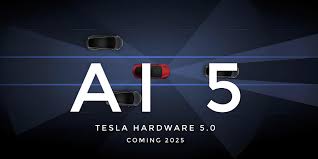
Tesla has refocused its semiconductor strategy around a next-generation in-house inference chip called AI5 (with AI6 planned as a follow-on), completing a key design review and signaling a major hiring push for silicon engineers. At the same time, Tesla has scaled back or wound down parts of its earlier Dojo wafer-scale supercomputer initiative, leaning instead on a more consolidated chip roadmap that mixes in-house design with select manufacturing partnerships. That shift is a strategic bet: vertically integrated silicon could deliver major latency, efficiency, and cost advantages for Full Self-Driving (FSD), Optimus humanoid robots, and future data-center needs — but it also introduces supply-chain, talent, and execution risks. This article breaks down what AI5 is likely to be, why Tesla changed tack away from Dojo, the manufacturing and partner picture, technical implications for vehicles and robots, the competitive landscape (NVIDIA/AMD/TSMC/Samsung), and what U.S. and European Tesla owners, investors, and regulators should watch next.
1 — Why this matters (intro)
Hardware shapes software capability. For Tesla’s ambitions — safer, lower-latency FSD on consumer cars, scalable robotaxi fleets, and humanoid robots (Optimus) — the right silicon architecture can be a true multiplier. Tesla’s AI strategy has long balanced bespoke in-house projects (Dojo) with off-the-shelf GPUs. The recent pivot toward AI5/AI6 as the focal point — paired with reports of Dojo being wound down and a public design-review milestone for AI5 — represents a major strategic inflection: the company is doubling down on tightly integrated, high-volume inference chips rather than a singular wafer-scale training supercomputer.
For Tesla owners and fleet operators, better inference chips mean faster reaction times, improved energy efficiency, and the possibility of richer onboard models that can run locally without constant cloud roundtrips. For investors, it touches margins, capital intensity, and the company’s competitive moat. For regulators and policymakers in the U.S. and Europe, it raises questions about supply-chain resilience, export controls, and the geopolitics of advanced semiconductors.
This piece walks through the technical and commercial layers of the AI5 story and explains what to watch next.
2 — A quick history: Dojo, in-house silicon, and why Tesla cares
Tesla’s Dojo program began as an ambitious effort to build a dedicated training supercomputer that could accelerate the company’s neural-network training for FSD and robotic control. The rationale was simple: custom hardware for training could, in principle, accelerate model iteration and reduce dependence on external GPU suppliers.
But Dojo ran into the classic tradeoffs of radical hardware projects: complexity, cost, and a long build cycle. As markets evolved and off-the-shelf accelerators (and third-party cloud options) matured, Tesla reassessed where to put its engineering bets. Instead of a singular, massive wafer-scale server approach, the company pivoted toward a converged chip strategy: design high-efficiency inference silicon (AI5) for fleets and robots while partnering for training capacity where appropriate (including chips from partners like NVIDIA/AMD for certain workloads and larger foundry deals for future generations).
Why inference matters more at scale: inference silicon sits at the point of action — the car or robot that must sense, predict, and act in milliseconds. Efficiency gains here pay off across energy, thermal design, and latency, all of which directly affect vehicle behavior and user experience. Training infrastructure matters too, but it can be more flexibly procured as a service or via partner fabs. That distinction helps explain why Tesla is focusing resources on AI5 and AI6 now.
3 — What is AI5 (what we know and what to expect)
Official product specs for AI5 remain proprietary, but recent public statements and reporting reveal key, credible facts and likely design goals:
-
Design review milestone: Tesla’s AI5 team has reportedly completed a successful design review, a major engineering milestone that clears a chip architecture to move to detailed implementation and tape-out phases. A successful design review suggests the basic microarchitecture, memory subsystem, and IO plans are internally validated.
-
Primary role — inference at the edge: AI5 appears targeted primarily at inference workloads — running neural networks in real time inside vehicles and robots with minimal latency and maximal energy efficiency. That differentiates it from chips intended primarily for large-scale training.
-
Performance targets: While raw numbers (TOPS, memory bandwidth) are not publicly confirmed, expectations are that AI5 will substantially improve inference performance per watt relative to Tesla’s previous in-vehicle compute, enabling larger networks or faster control loops.
-
Unified use cases: Tesla aims to deploy AI5 across multiple product lines — cars (FSD), Optimus robots, and possibly edge-level data center appliances — making the chip a central piece of a converged architecture.
Completing a design review is not the same as mass production, but it’s an essential gating step that indicates the architecture is mature enough to proceed to tape-out and foundry scheduling.
4 — Why Tesla wound down Dojo (and what that means)
Dojo’s aspiration — a wafer-scale training supercomputer — was technically audacious. But the project faced challenges that reportedly affected momentum: wafer-scale manufacturing complexity, memory and IO constraints, and the organizational overhead of building a wholly new data-center architecture.
Tesla’s pivot away from Dojo does not mean abandoning training capability; instead it reflects a reallocation of scarce engineering resources toward chips that can be produced at scale and deliver immediate fleet benefits. The practical tradeoffs that led to the decision include:
-
Execution risk and time to value: Building a new wafer-scale fabric and bringing it to reliable production is time-consuming and capital intensive; the opportunity cost of delaying inference improvements for cars could be large.
-
Talent and team churn: Reports indicate that some Dojo engineers left and that the lead of Dojo departed. Expertise loss hastens a strategic pivot toward projects with clearer near-term impact.
-
Ecosystem alternatives: Industry acceleration of GPU performance (NVIDIA/AMD) and cloud supply options provide viable training paths without the massive fixed capital and specialized fabrication that Dojo required.
In essence: Dojo’s wind-down frees up engineering firepower and budget for a chip strategy that can ship into millions of vehicles and robots — a pragmatic recalibration toward commercial execution.
5 — Manufacturing and partners: TSMC, Samsung, and foundry dynamics
Designing a chip is only half the battle; manufacturing at advanced nodes requires long lead times and tight foundry partnerships. The emerging picture for Tesla includes a mix of internal design and external foundry relationships:
-
TSMC for AI5 (likely): Industry reporting and analyst conjecture point to TSMC as the prime candidate to manufacture AI5 at a competitive node. TSMC’s leadership in advanced logic and proven yields makes it a natural fit for high-performance inference chips destined for mass automotive volumes.
-
Samsung for AI6 / capacity deals: Separately, news indicates Tesla arranged a multi-billion-dollar manufacturing relationship with Samsung for AI6 production in a later generation. Leveraging multiple foundries hedges capacity risk and aligns node choices (Samsung tends to be competitive on certain nodes and has capacity plans in places like Texas).
-
Foundry scheduling & volume constraints: Advanced nodes are capacity-constrained; getting favorable fab slots requires early commitments and significant capital. Tesla will likely book capacity well in advance, prioritizing high-volume runs for automotive qualification.
Key implication: the choice of foundry affects not only performance and power but also geopolitical exposure (export controls, fabs in certain countries) and supply continuity — a major consideration for both U.S. and European markets.
6 — Technical architecture: what Tesla needs from AI5
To justify in-house inference silicon, AI5 must deliver a set of technical benefits over general-purpose accelerators:
-
Latency & determinism: Autonomous control loops demand predictable, ultra-low latency. Small microsecond improvements can reduce braking distances or reaction times in edge cases. AI5’s architecture likely emphasizes short pipelines and local SRAM caches to minimize unpredictable memory stalls.
-
Power efficiency: Cars and robots are thermally constrained. Better TOPS/Watt means running larger nets without thermal throttling or needing heavier cooling systems. That improves uptime and reduces energy draw per mile.
-
Specialized operators & model support: Vehicle models often need custom ops (e.g., spatiotemporal filters, attention for vision stacks). AI5 may include hardware primitives optimized for Tesla’s neural architectures.
-
Integration with vehicle networks: A chip tightly integrated with Tesla’s vehicle CAN/central compute and sensor pipelines allows more efficient data movement and lower serialization overhead.
-
Security & safety features: Automotive safety needs include secure boot, redundant execution paths, and deterministic failover. AI5 must incorporate secure enclaves, ECC memory, and safety monitoring features that meet automotive ASIL requirements.
If AI5 meets these goals, it becomes a potent enabler for richer on-device perception and control — not just incremental speedups.
7 — Use cases: FSD, Optimus, and the convergence opportunity
FSD in cars
Onboard inference improvements enable Tesla to run larger, more context-aware models at higher frame rates. That can directly improve perception accuracy (fewer false positives/negatives), smoother trajectory planning, and more confident decision-making in complex urban scenes. For drivers, that translates to more reliable assisted driving and potentially expanded automated behaviors where regulation allows.
Optimus humanoid robots
Robots require fine-grained motor control and perceptual intelligence in real time. An efficient inference chip reduces the robot’s energy draw and increases onboard autonomy for tasks that can’t rely on consistent cloud connectivity. AI5’s universality across vehicles and robots could yield economies of scale and faster product iteration.
Edge data center / fleet appliances
A converged AI5 design that scales into small data centers or edge appliances lets Tesla run inference clusters locally (e.g., in curbside servers for robotaxi coordination) with reduced power and latency compared to general GPUs. This convergence is a strategic win if Tesla successfully implements it.
The risk: balancing the chip’s design to be both highly optimized for cars and flexible enough for robots/edge compute without bloating die area or complicating software support.
8 — Software & tooling: compilers, frameworks, and model migration
Chips aren’t useful without software stacks. Tesla will need:
-
Compiler infrastructure that maps its PyTorch/TensorFlow models down to AI5’s primitives efficiently.
-
Quantization and optimization toolchains to compress models while preserving accuracy.
-
Simulation environments and hardware-in-the-loop (HIL) tools for validating model behavior under different scheduling and thermal regimes.
-
OTA integration to ensure new model deployments can be tested in shadow mode before being activated in production cars.
The software burden is substantial: Tesla must build toolchains that hide hardware complexity from model developers to keep iteration velocity high. Historically, companies with matched hardware-software stacks (e.g., Google TPU) gained an edge; Tesla presumably hopes to replicate that benefit.
9 — Competition: NVIDIA, AMD, and the broader AI hardware ecosystem
Tesla’s AI5 ambitions place it in direct strategic competition, at least at a systems level, with existing leaders:
-
NVIDIA still dominates general-purpose AI training and inference across many use cases. Their automotive partners and software stack (NVIDIA DRIVE) are mature.
-
AMD / Xilinx are alternatives with attractive price/performance in some workloads.
-
Niche startups & incumbents (Cerebras, Graphcore, SambaNova) pursue unique architectures — but none yet match the combined software/vehicle data scale Tesla commands.
Tesla’s differentiator is fleet scale and domain specificity: if AI5 is narrowly optimized for Tesla’s models and deployment patterns, it can outperform generalist chips on critical product metrics (latency, power). However, NVIDIA and AMD benefit from broader software ecosystems and large foundry relationships — making Tesla’s path ambitious.
10 — Talent, hiring, and the silicon labor market
Designing and bringing a modern AI chip to market requires deep silicon talent: digital designers, analog/mixed-signal experts, SRAM architects, physical design engineers, and verification teams. Recent reports show Tesla publicly recruiting and Musk inviting engineers to join the silicon team — a necessary move given the talent intensity of advanced chip design.
Challenges include:
-
Competition for talent: Big tech and chip vendors aggressively recruit top candidates; startup poaching and counteroffers are common.
-
Retention and cultural fit: Advanced IC projects demand multi-year continuity. Previous reports of Dojo team departures highlight this fragility.
-
Verification and safety expertise: Automotive certification requires safety-critical verification (ASIL/DOT standards), which is a niche skill set.
Winning the talent war is as important as the design itself. Any significant attrition risks schedule slips or quality problems in production silicon.
11 — Regulatory & geopolitical considerations (U.S. and Europe)
Semiconductors are geopolitically sensitive. For Tesla’s AI5/AI6 strategy, the consequences include:
-
Export controls: Advanced AI chips and associated tooling can be subject to export restrictions. Tesla must ensure compliance as it markets products in Europe and elsewhere.
-
Supply-chain resilience: Relying on fabs in specific countries creates risk exposure to diplomatic or trade tensions. Dual-sourcing (TSMC + Samsung) mitigates some risk.
-
Automotive qualification: European and U.S. automotive regulators require rigorous safety and certification for any critical compute element. AI5 must be validated under automotive quality standards (ISO 26262, etc.).
-
Data residency & cloud interactions: If AI5 is used in edge/curb infrastructure, data flows across jurisdictions will raise EU privacy and cross-border transfer questions.
These regulatory factors influence where Tesla can deploy certain features (e.g., advanced driver assistance behaviors) and how quickly.
12 — Business implications: margins, unit economics, and product roadmaps
Why invest in custom chips? The potential business impacts include:
-
Improved margins at scale: A high-volume, lower-cost inference chip reduces per-vehicle compute cost and can improve gross margins over time if wafer economics and yields are favorable.
-
Product differentiation: Proprietary silicon can deliver unique features that differentiate Tesla’s vehicles and robots from competitors using commodity hardware.
-
Recurring revenue & services: If AI5 enables new subscription features (premium FSD behaviors, robot functions), it supports higher lifetime value per vehicle.
-
Capital intensity: Design, validation, and fab reservations require upfront investment and working capital — impacting cash flow near term.
The tradeoff: if AI5 misses performance or yield targets, the sunk costs could undercut near-term margins and slow feature rollouts.
13 — Risks and failure modes
A thoughtful assessment must include downside scenarios:
-
Tape-out or silicon bugs: Even after a successful design review, tape-out can reveal costly bugs that require respins and long delays.
-
Foundry delays or yield issues: Advanced nodes are finicky; poor yields inflate costs and delay mass deployment.
-
Talent loss and project friction: Losing key engineers can derail schedules.
-
Software integration difficulties: Without robust compilers and toolchains, models won’t fully exploit the hardware.
-
Regulatory blocks or export controls: Geopolitical shifts could restrict where certain chips or software can be used.
Mitigation requires conservative scheduling, dual sourcing, rigorous verification, and contingency budgets.
14 — What U.S. and European owners, operators, and policy makers should watch
For U.S. and European stakeholders, concrete indicators of progress include:
-
Production timeline milestones: public comments on tape-out, sampling, automotive qualification, and mass production dates.
-
Foundry commitments: formal announcements with TSMC, Samsung, or other fabs showing reserved capacity and node selection.
-
Software tooling releases: developer toolchains, SDKs, and model migration guides that demonstrate the chip’s operational readiness.
-
Independent benchmarks & third-party tests: as sample hardware becomes available, third-party inference benchmarks will be telling.
-
Supply chain disclosures & export compliance statements: transparency on where chips are made and shipment controls.
Owners should treat incremental improvements in FSD responsiveness as quality signals but remain cautious until broad fleet data demonstrates robust gains.
15 — Near-term timeline & plausible scenarios
A conservative timeline based on current public signals might look like:
-
Design review completed (now): move toward tape-out and physical implementation.
-
Tape-out & silicon validation (next 3–9 months): first silicon samples for internal test fleets and robot prototypes.
-
Automotive qualification & early production (late 2025–2026): pilot deployments in limited fleets, followed by broader rollouts as yields stabilize.
-
Full mass production (2026 onward): high-volume runs for vehicle integration and Optimus deployments.
Alternate scenarios compress or extend these dates depending on foundry slot availability, tape-out success, and regulatory qualification.
16 — Conclusion — the practical takeaway
Tesla’s AI5 initiative is a high-impact strategic bet: if executed well, it could offer Tesla an efficiency and latency edge that materially improves FSD behavior and powers novel Optimus capabilities. The company’s pivot away from Dojo and toward AI5/AI6 reflects a pragmatic focus on near-term, high-volume benefits over a singular training supercomputer vision.
However, the path is challenging: advanced chip projects are technically complex, talent-intensive, and supply-chain sensitive. Investors, owners, and policymakers should track production milestones, foundry commitments, sample benchmarks, and software readiness closely. For end users, the immediate practical benefit will be in smoother, more capable onboard assistance and improved robot behaviors — but those benefits will likely roll out gradually as production scales and regulators sign off.
In short: AI5 could be a real multiplier for Tesla — but only if the company navigates the classic hardware pitfalls and executes the manufacturing and software ecosystem flawlessly.
FAQ
Q1: Is AI5 already in cars today?
A: No. Reports indicate a design-review milestone has completed, but mass production and wide vehicle deployment require tape-out, foundry runs, qualification, and scaled manufacturing — steps that take months to a few years depending on outcomes.
Q2: Why not just use NVIDIA GPUs?
A: GPUs are general-purpose and extremely powerful, but custom inference silicon can be far more power and cost efficient for well-defined workloads. For vehicles and robots, the efficiency and latency advantages can be decisive.
Q3: Does winding down Dojo mean Tesla gives up on training?
A: Not at all. Tesla appears to be reallocating resources toward chips that deliver immediate fleet benefits while relying on more flexible training capacity solutions (including third-party GPUs and cloud/foundry partners) for heavy model training.
Q4: Could AI5 improve FSD significantly?
A: Potentially yes. Better onboard inference allows larger, faster models and lower latency decision loops — which can improve perception accuracy and responsiveness. But software models and data quality remain equally important.
Q5: What are the biggest risks to AI5’s success?
A: Silicon tape-out bugs, poor foundry yields, talent attrition, slow toolchain development, and regulatory or export constraints are the main risks.
Q6: What should European regulators care about?
A: Safety-critical validation, data residency for any edge compute, supply-chain resilience, and compliance with automotive safety standards are key issues for regulators and policymakers.