
Introduction
When the Tesla Model Y launched in 2020, it entered a market with few credible electric SUV competitors. Legacy automakers were years away from meaningful EV offerings, and Chinese manufacturers had not yet established a presence in Western markets. The Model Y capitalized on this advantage spectacularly, becoming the best-selling vehicle of any kind globally in 2023—a feat unprecedented for an electric vehicle.
Four years later, the competitive landscape has transformed beyond recognition. BYD has dethroned Tesla as the world's largest EV seller, posting a 165 percent surge in European sales in January 2026 alone. Xpeng's G6 is earning favorable comparisons to the Model Y in European press reviews. Zeekr, Nio, and a host of other Chinese brands have established showrooms in major European cities, offering vehicles that match or exceed Tesla's specifications at competitive price points.
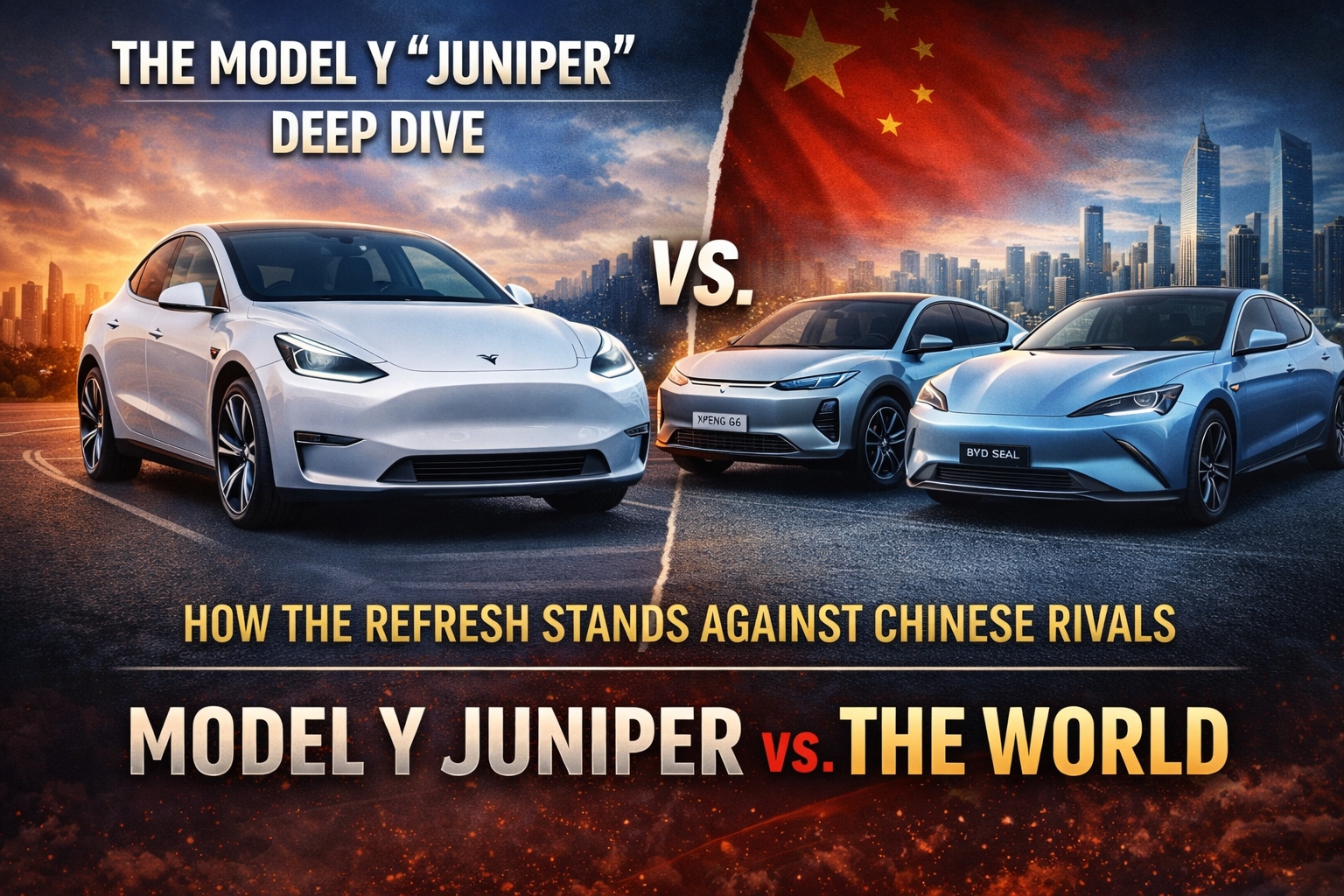
Against this backdrop, Tesla has finally delivered the long-awaited Model Y refresh, codenamed "Juniper." The updates address many of the complaints that have accumulated over the Model Y's production run: ride quality, noise insulation, interior comfort, and feature content. But the question confronting potential buyers is whether these incremental improvements are sufficient to maintain the Model Y's competitive advantage, or whether the market has simply moved beyond what Tesla offers.
Section 1: The Juniper Refresh — What's Actually New?
The Model Y Juniper represents Tesla's first significant update to its best-selling vehicle since its introduction. Unlike the typical automotive mid-cycle refresh, which might consist of minor styling tweaks and equipment adjustments, Juniper introduces substantive changes aimed at addressing the Model Y's most persistent criticisms.
Exterior Design Evolution
The Juniper refresh brings a revised front and rear fascia that aligns the Model Y more closely with Tesla's current design language. The most immediately noticeable change is the incorporation of light bars at both front and rear, echoing the design of the Cybertruck and updated Model 3. These light bars serve both aesthetic and functional purposes, providing a distinctive lighting signature while potentially improving visibility.
Aerodynamic improvements accompany the styling changes. Tesla has refined the underbody panels, wheel designs, and mirror shapes to reduce the drag coefficient. The result is a modest but meaningful improvement in efficiency, contributing to the updated range figures that vary by variant.
The Interior Transformation
The interior receives more substantial updates than the exterior. Tesla has addressed several long-standing owner complaints with targeted improvements:
Ventilated Seats: Perhaps the most requested feature in Tesla's history, ventilated front seats finally arrive with the Juniper refresh. For owners in warm climates, this addition alone may justify the upgrade. The perforated seat surfaces and integrated cooling fans provide comfort during summer driving that the previous seats could not match.
Acoustic Glass: Tesla has added acoustic glass throughout the cabin, significantly reducing wind and road noise at highway speeds. Early reviews suggest the improvement is substantial, transforming the Model Y from a vehicle criticized for noise to one that competes favorably with premium European offerings in terms of cabin serenity.
Ambient Lighting: A multi-color ambient lighting system has been integrated into the dashboard and door panels, creating a more premium atmosphere during night driving. While this addition is largely aesthetic, it addresses criticism that the Model Y's interior felt spartan compared to competitors.
Rear Passenger Screen: An 8-inch display has been added for rear-seat passengers, mirroring the feature introduced with the updated Model 3. This screen provides climate control adjustment and entertainment options, improving the experience for families and passengers.
Material Quality: Tesla has upgraded interior materials throughout, with softer touch points and improved fit and finish. The "closing the door" experience now feels more substantial, addressing criticism that previous models felt cheap despite their premium pricing.
Suspension and Ride Quality
The original Model Y earned a reputation for firm ride quality that, while enabling sharp handling, proved tiring on rough roads. The Juniper refresh introduces revised suspension tuning that prioritizes comfort without sacrificing the handling characteristics that Tesla owners appreciate.
The changes include:
Softer Spring Rates: The suspension uses revised spring rates that better absorb small imperfections without compromising body control.
Revised Damper Tuning: The dampers have been recalibrated to provide more progressive compression and rebound characteristics, smoothing the ride over rough surfaces.
Improved Bushings: Higher-compliance bushings in key suspension points isolate the cabin from road imperfections more effectively.
Early reviews suggest the changes are successful. The Juniper rides more like a premium European SUV than the previous generation, absorbing bumps that would have transmitted directly to passengers in earlier models.
Powertrain and Efficiency
Beneath the surface, Tesla has introduced what is described as a "fifth-generation permanent magnet motor" in the Juniper. This new motor design improves efficiency through reduced internal losses and optimized magnetic flux paths.
The efficiency improvements translate directly to range. According to Tesla's updated specifications:
Long Range AWD: EPA-estimated range of 327 miles (526 kilometers). This represents a modest improvement over the previous generation, achieved through both motor efficiency and aerodynamic refinements.
Long Range RWD: For markets where this variant is offered, WLTP range reaches 383 miles (approximately 616 kilometers).
Standard Range: Base models offer a WLTP range of approximately 314 miles (505 kilometers).
Charging performance remains class-leading, with peak charging rates of up to 250 kW at V3 Superchargers. The 10-80 percent charge time remains approximately 20-25 minutes, depending on conditions.
The FSD Standardization
Perhaps the most significant change for technology-focused buyers is the inclusion of Full Self-Driving (Supervised) as standard equipment on the Launch Series vehicles. This represents a substantial value addition, as FSD previously cost $8,000 as an option.
The FSD system in the Juniper benefits from the Hardware 4 platform, which provides additional computational headroom and improved camera hardware. While the system remains at SAE Level 2 (requiring constant driver supervision), its capabilities include:
Automatic lane changes on highways
Navigation on city streets
Traffic light and stop sign recognition and response
Urban driving with complex intersection navigation
Edmunds testing has noted that FSD stands out for handling complex urban maneuvers but is not flawless, with occasional misreads requiring driver intervention.
Section 2: The Competitive Landscape — China's EV Offensive
To evaluate whether the Juniper refresh is sufficient, one must understand the competitive environment it now faces. The Chinese EV manufacturers that barely existed in Western markets when the Model Y launched have become formidable competitors.
BYD: The New Global Leader
BYD's ascent has been nothing short of remarkable. In January 2026, while Tesla's European sales declined 17 percent, BYD delivered more than 18,000 vehicles in the region—a 165 percent increase over the previous year. The company has now recorded monthly sales increases every month since the European Automobile Manufacturers' Association began tracking its data last summer.
BYD's product lineup directly challenges Tesla across multiple segments:
BYD Seal: Often described as the "Model 3 killer," the Seal is a sleek sedan that competes directly with the Model 3. European reviews have praised its interior quality, ride comfort, and feature content. The Seal uses BYD's Blade Battery technology, which offers exceptional safety characteristics and thermal management.
BYD Atto 3: This compact SUV competes in the same segment as the Model Y, offering similar interior space at a lower price point. European buyers have responded enthusiastically to its combination of value and capability.
BYD Tang: A larger SUV that appeals to families needing three-row seating, competing with vehicles above the Model Y's price point.
BYD's advantages extend beyond individual models. The company is vertically integrated to a degree that rivals Tesla, manufacturing its own batteries (including the innovative Blade Battery), power electronics, and semiconductors. This integration provides cost advantages that translate to competitive pricing.
Xpeng: The Direct Challenger
Xpeng has positioned itself as perhaps the most direct challenger to Tesla's technology leadership. The company's G6 SUV has earned favorable comparisons to the Model Y in multiple European publications, with reviewers noting that Xpeng has studied Tesla's formula and executed it effectively.
Xpeng G6 vs. Model Y: The G6 closely matches the Model Y's dimensions and specifications. It offers a comparable range, similar performance, and a minimalist interior that clearly draws inspiration from Tesla. However, the G6 distinguishes itself with:
Lidar-based ADAS: Xpeng includes lidar sensors that enable more robust autonomous driving capabilities in certain conditions. The XNGP (Xpeng Navigation Guided Pilot) system has earned praise for its smooth operation and capability envelope.
800V Architecture: The G6 supports 800V charging, enabling faster charging speeds than the Model Y when connected to compatible chargers. This provides a meaningful advantage for long-distance travelers.
Interior Luxury: Xpeng has focused on interior material quality, offering soft-touch surfaces and premium finishes that exceed Tesla's current standards.
Localized Features: For European markets, Xpeng has invested in local mapping and feature adaptation, ensuring that its systems work effectively on European roads.
Zeekr and the Premium Push
Zeekr, a subsidiary of Geely (which also owns Volvo and Polestar), has entered the European market with a premium positioning that directly challenges Tesla's pricing.
Zeekr 001: This shooting brake-style vehicle offers unique styling and impressive specifications. With a 100 kWh battery option and dual-motor all-wheel drive, it competes at the top end of the Model Y's price range while offering distinctive design and premium appointments.
Zeekr X: A smaller SUV that targets urban buyers, the Zeekr X offers premium features in a more compact package, competing with the Model Y on value and features if not on size.
Zeekr benefits from Geely's manufacturing expertise and established European distribution channels through Volvo. This gives the brand credibility and service infrastructure that pure Chinese startups lack.
The Legacy Response
While Chinese brands have captured headlines, established European manufacturers have also improved their electric offerings significantly:
BMW iX1 and iX3: BMW's electric SUVs offer the brand's traditional strengths in driving dynamics and interior quality, combined with competitive electric powertrains. For buyers who value the BMW brand and dealer experience, these remain compelling alternatives.
Mercedes EQB and EQC: Mercedes has refined its electric SUV offerings, emphasizing luxury and comfort over outright performance or range leadership. The brand cachet remains strong in Europe.
Volkswagen ID.4 and ID.5: VW's electric SUVs benefit from the company's massive scale and dealer network. Recent updates have improved software and efficiency, narrowing the gap with Tesla.
Audi Q4 e-tron and Q6 e-tron: Audi's electric SUVs offer premium positioning and sophisticated interior design, appealing to buyers who find Tesla's minimalist approach lacking.
Section 3: Head-to-Head — Juniper vs. The Competition
With the competitive landscape established, a detailed feature-by-feature comparison reveals where Juniper excels and where it faces challenges.
Range and Efficiency
Juniper Long Range AWD: 327 miles EPA (526 kilometers)
Xpeng G6 Long Range: Approximately 350 miles CLTC (Chinese test cycle), which typically overstates range compared to EPA. European WLTP figures suggest a real-world range similar to or slightly below the Juniper.
BYD Seal (SUV variant): WLTP range up to 350 miles for certain variants, depending on battery configuration.
Analysis: Tesla maintains an advantage in real-world efficiency. The Model Y's consumption of approximately 14-18 kWh/100km in mixed driving remains class-leading. This efficiency advantage means that even with nominally similar battery capacities, the Model Y often delivers more usable range in real-world driving.
The Juniper's efficiency improvements from the fifth-generation motor and aerodynamic refinements maintain this advantage. Tesla's vertical integration—designing its own motors, power electronics, and battery packs—creates efficiency advantages that competitors struggle to match.
Verdict: Tesla wins on efficiency and real-world range consistency.
Charging Performance
Juniper: 250 kW peak charging, 10-80 percent in 20-25 minutes. Access to the Supercharger network, with over 50,000 stalls globally, seamless plug-and-charge functionality, and reliable operation.
Xpeng G6: 800V architecture enables up to 280 kW peak charging on compatible chargers, 10-80 percent in approximately 20 minutes. However, access to fast charging depends on third-party networks with varying reliability and payment complexity.
BYD Seal: 150-180 kW typical peak charging, slower than both Tesla and Xpeng, though Blade Battery chemistry enables consistent charging across a wide temperature range.
Analysis: While competitors match or exceed Tesla's peak charging speeds on paper, the Supercharger network remains Tesla's decisive advantage. The network's reliability, ease of use, and strategic placement make long-distance travel simpler in a Tesla than in any other EV. For European buyers, the Supercharger network's density and reliability provide peace of mind that third-party networks cannot match.
Verdict: Tesla wins on charging ecosystem, even if peak speeds are matched by competitors.
Autonomous Driving Capability
Juniper: FSD (Supervised) included as standard on Launch Series. Hardware 4 platform with camera-only sensing. Capabilities include highway and urban navigation with active driver supervision.
Xpeng G6: XNGP (Xpeng Navigation Guided Pilot) available as an option. Includes lidar sensors for redundant sensing. System capability includes highway and urban navigation, with European adaptation ongoing.
BYD Seal: Advanced Driver Assistance Systems (ADAS) comparable to Tesla's Autopilot, but without the urban navigation capabilities of FSD or XNGP.
Analysis: Tesla's advantage in autonomous driving lies in data scale and over-the-air updates. The FSD fleet has accumulated billions of miles of real-world driving data, training neural networks that improve continuously. However, for European buyers, this advantage is partially negated by regulatory constraints that limit FSD functionality compared to the United States.
Xpeng's lidar-based approach provides theoretical advantages in sensing redundancy and robustness, but the system's European adaptation is still maturing. European buyers should evaluate current capability rather than future promises.
Verdict: Tesla leads in the United States; the European picture is more complex, with both systems requiring driver supervision and neither achieving the autonomy Tesla has promised.
Interior Quality and Comfort
Juniper: Ventilated seats, acoustic glass, ambient lighting, upgraded materials. The refresh addresses previous complaints but maintains Tesla's minimalist philosophy.
Xpeng G6: Premium materials throughout, with soft-touch surfaces and meticulous fit and finish. Interior design is clearly inspired by Tesla but with more traditional luxury touches.
BYD Seal: Exceptional interior quality with premium materials and sophisticated design. BYD has focused on creating a luxurious environment that competes with established premium brands.
Zeekr 001: Perhaps the most luxurious interior in the segment, with high-quality materials and distinctive design elements that set it apart from Tesla's minimalism.
Analysis: The Juniper refresh closes the gap significantly. Ventilated seats address a long-standing omission, acoustic glass improves highway comfort, and ambient lighting adds nighttime ambiance. However, Chinese competitors have focused intensely on interior quality, and in many cases, their materials and fit and finish exceed Tesla's current standards.
The question is whether buyers value Tesla's minimalist approach or prefer the more traditional luxury offered by competitors. This is largely a matter of personal preference, but the range of choice has expanded dramatically.
Verdict: Chinese competitors lead on traditional luxury metrics; Tesla leads on minimalist design philosophy.
Pricing and Value
Juniper: Starting at $59,990 (approximately €55,000) for the Launch Series Long Range AWD. Standard range models start lower.
Xpeng G6: European pricing varies by market but typically undercuts Tesla by several thousand euros for comparable specifications.
BYD Atto 3: Significantly lower pricing than Model Y, positioning it as a value leader.
BYD Seal: Priced competitively with Model 3, often slightly lower for equivalent specifications.
Analysis: Tesla faces a pricing dilemma. The company's brand strength and Supercharger network allow it to command premium pricing, but Chinese competitors offer compelling alternatives at lower price points. BYD's vertical integration provides cost advantages that translate to aggressive pricing.
For European buyers, the value calculation depends on priorities. If the Supercharger network and brand cachet are paramount, the Juniper justifies its premium. If maximizing features for minimum cost is the goal, Chinese alternatives offer compelling value.
Verdict: Chinese competitors win on absolute pricing; Tesla wins on total cost of ownership when resale value and network access are considered.
Section 4: The European Market Reality
The competition between Tesla and Chinese manufacturers is playing out most intensely in Europe, where both sides have established strong footholds.
Sales Data: The Warning Signs
January 2026 sales data reveal the extent of Tesla's European challenge. According to ACEA data, Tesla sold just over 8,000 vehicles in Europe during January—a 17 percent decline from the previous year. This marks the 13th consecutive month of declining sales for Tesla in the region.
The decline is particularly concerning given the broader market context. Overall, electric vehicle registrations in Europe rose 13.9 percent during the same period. Tesla is losing share in a growing market—the classic definition of competitive weakness.
Meanwhile, BYD's European sales surged to 18,242 units in January, representing a 165 percent increase. The company has now established a sales rate that exceeds Tesla's in the region, a remarkable achievement given BYD's relatively recent entry into European markets.
The Factors Driving Decline
Multiple factors contribute to Tesla's European struggles:
Aging Lineup: The Model Y, despite the Juniper refresh, is fundamentally a design from 2020. While the refresh addresses many complaints, the underlying platform has been on the market for six years. Competitors offer newer designs that benefit from more recent engineering.
Limited Model Range: Tesla offers only the Model 3, Model Y, and (until recently) the higher-priced Model S and Model X. Chinese competitors offer diverse lineups that include sedans, SUVs of various sizes, and distinctive body styles like the Zeekr 001's shooting brake.
Brand Perception: Elon Musk's political involvement has affected brand perception in Europe, where his popularity has declined. For some European buyers, the CEO's public persona has become a deterrent to purchase.
Price Sensitivity: European buyers have embraced lower-cost Chinese EVs and hybrids, particularly from BYD. Tesla's premium pricing, while justified by its feature set, positions it above the price points where volume growth is occurring.
Feature Localization: Chinese competitors have invested in adapting their vehicles to European preferences, including mapping, charging compatibility, and regulatory compliance. Tesla's one-size-fits-all approach sometimes misses local nuances.
The Juniper Impact
The Juniper refresh arrives at a critical moment for Tesla's European operations. The updated vehicle addresses many of the complaints that have accumulated over the Model Y's production run, potentially recapturing buyers who might have looked elsewhere.
However, the refresh is unlikely to reverse Tesla's declining market share single-handedly. The competitive landscape has transformed too fundamentally for any single model update to restore Tesla's former dominance. Instead, the Juniper should be viewed as a necessary step to remain competitive—a defensive move rather than an offensive one.
Section 5: The Verdict — Is Juniper Enough?
After examining every aspect of the Juniper refresh and comparing it to the competitive landscape, we arrive at the central question: Has Tesla done enough?
The Case for "Yes"
For buyers who prioritize the factors that have always made Tesla compelling, the Juniper refresh enhances an already strong proposition:
The Supercharger Network: No competitor matches Tesla's charging infrastructure. For buyers who take long trips or lack home charging, this remains a decisive advantage.
Software and OTA Updates: Tesla's over-the-air update capability continues to set the standard. The vehicle improves over time, gaining features and capabilities long after purchase.
Efficiency Leadership: The Juniper's fifth-generation motor and aerodynamic refinements maintain Tesla's efficiency advantage. Lower consumption means lower operating costs and a more consistent real-world range.
Brand and Community: Tesla has built a passionate community of owners and enthusiasts. For buyers who value being part of this ecosystem, alternatives simply don't offer the same experience.
Resale Value: Despite competitive pressure, Tesla vehicles have historically held their value well. The Juniper refresh should maintain this advantage.
For these buyers, the Juniper refresh is more than enough—it's the best version yet of the vehicle they already wanted.
The Case for "No"
For buyers approaching the market without Tesla loyalty, the calculus looks different:
Feature Parity or Superiority: In many areas—interior luxury, ADAS features, charging speed on paper—competitors match or exceed the Juniper. The gap that once made Tesla the obvious choice has narrowed dramatically.
Price Advantage: Chinese competitors offer compelling alternatives at lower price points. For value-conscious buyers, the premium Tesla commands is increasingly difficult to justify.
Fresh Design: Competitors offer newer designs that haven't been on the market for six years. For buyers who value novelty and modernity, alternatives may be more appealing.
Choice and Variety: Chinese manufacturers offer diverse lineups that allow buyers to choose a vehicle that precisely matches their preferences. Tesla's two-model lineup (effectively) limits choice.
For these buyers, the Juniper refresh may not be enough to overcome the fundamental shift in the competitive landscape.
The Balanced Perspective
The most honest assessment acknowledges nuance. The Juniper refresh is a significant improvement that addresses genuine shortcomings. It makes an excellent vehicle even better. However, the competitive environment has changed so dramatically that "better than before" may not translate to "better than everyone else."
For buyers who value Tesla's core strengths—charging network, efficiency, software, community—the Juniper remains the best choice. For buyers who prioritize interior luxury, value pricing, or specific features that competitors offer, the alternatives are now compelling enough to warrant serious consideration.
The recommendation, therefore, is not "buy the Juniper" or "avoid the Juniper," but rather: test drive everything. Compare the Juniper to the Xpeng G6, the BYD Seal, and the Zeekr 001. Experience the differences firsthand. The answer will depend on your priorities, and for the first time in the Model Y's history, there is no single right answer.
Conclusion
The Model Y Juniper arrives at a moment of maximum competitive pressure. Tesla's European sales are declining in a growing market. Chinese competitors offer compelling alternatives at competitive prices. The era of Tesla's unchallenged dominance in the electric SUV segment is over.
The Juniper refresh itself is substantial and well-executed. Ventilated seats, acoustic glass, improved suspension, upgraded materials—these are not minor tweaks but meaningful improvements that address the complaints of millions of owners. The vehicle that emerges is genuinely better than its predecessor.
But "better than before" is not the relevant metric. The relevant metric is "better than the competition." And here, the answer is more complex than it would have been even two years ago. In some areas—charging network, efficiency, software—Tesla maintains advantages. In others—interior luxury, feature content, pricing—competitors have caught up or pulled ahead.
For Tesla, the Juniper refresh is necessary but not sufficient. Maintaining competitiveness will require ongoing investment in product development, charging infrastructure, and brand positioning. The company that disrupted the automotive industry must now defend its position against a new generation of disrupters.
For buyers, the Juniper refresh arrives as a welcome update to a vehicle that has earned its popularity. Whether it's the right choice depends on what you value. But for the first time, asking that question leads to genuinely different answers rather than a foregone conclusion. And that, perhaps, is the most significant change of all.
Frequently Asked Questions (FAQ)
Q: What are the key improvements in the 2026 Model Y Juniper?
A: The Juniper refresh introduces ventilated front seats, acoustic glass throughout the cabin for reduced noise, ambient interior lighting, an 8-inch rear passenger screen, revised suspension tuning for improved ride comfort, upgraded interior materials, aerodynamic refinements, and a fifth-generation permanent magnet motor for improved efficiency.
Q: What is the range of the 2026 Model Y?
A: Range varies by variant. The Long Range AWD achieves an EPA-estimated 327 miles (526 kilometers). European WLTP figures show up to 383 miles (approximately 616 kilometers) for the Long Range RWD variant. Standard range models offer approximately 314 miles (505 kilometers) WLTP.
Q: How does the Model Y Juniper compare to the Xpeng G6?
A: The Xpeng G6 offers comparable specifications with lidar-based ADAS, 800V charging capability, and a more luxurious interior at a slightly lower price point. The Model Y Juniper maintains advantages in charging network access, real-world efficiency, and over-the-air software updates. The choice depends on which factors matter most to the buyer.
Q: Why are Tesla sales declining in Europe?
A: Multiple factors contribute, including an aging lineup, intensifying competition from Chinese manufacturers like BYD (which posted a 165 percent sales increase in January 2026), CEO Elon Musk's declining popularity in Europe, and the absence of a more affordable EV model. The broader European EV market grew 13.9 percent in January, meaning Tesla is losing share in a growing market.
Q: Does the Model Y Juniper come with Full Self-Driving?
A: The Launch Series models include Full Self-Driving (Supervised) as standard equipment. The system provides highway and urban navigation capabilities with active driver supervision. It remains a Level 2 system requiring constant driver attention.
Q: How much does the 2026 Model Y cost?
A: In the United States, the Launch Series Long Range AWD starts at $59,990. In the UK, pricing ranges from £41,990 for the Standard RWD to £61,990 for the Performance variant. European pricing varies by market.
Q: Is the Model Y Juniper eligible for EV incentives?
A: Eligibility depends on local regulations. In most European markets, the Model Y qualifies for applicable EV incentives, though specific amounts vary by country and region. Buyers should check local incentive programs for current information.
Q: When will the Model Y Juniper be available for delivery?
A: The Launch Series vehicles are entering production now, with deliveries beginning in early 2026. Other variants will follow throughout the year. Delivery timing varies by market and configuration.