
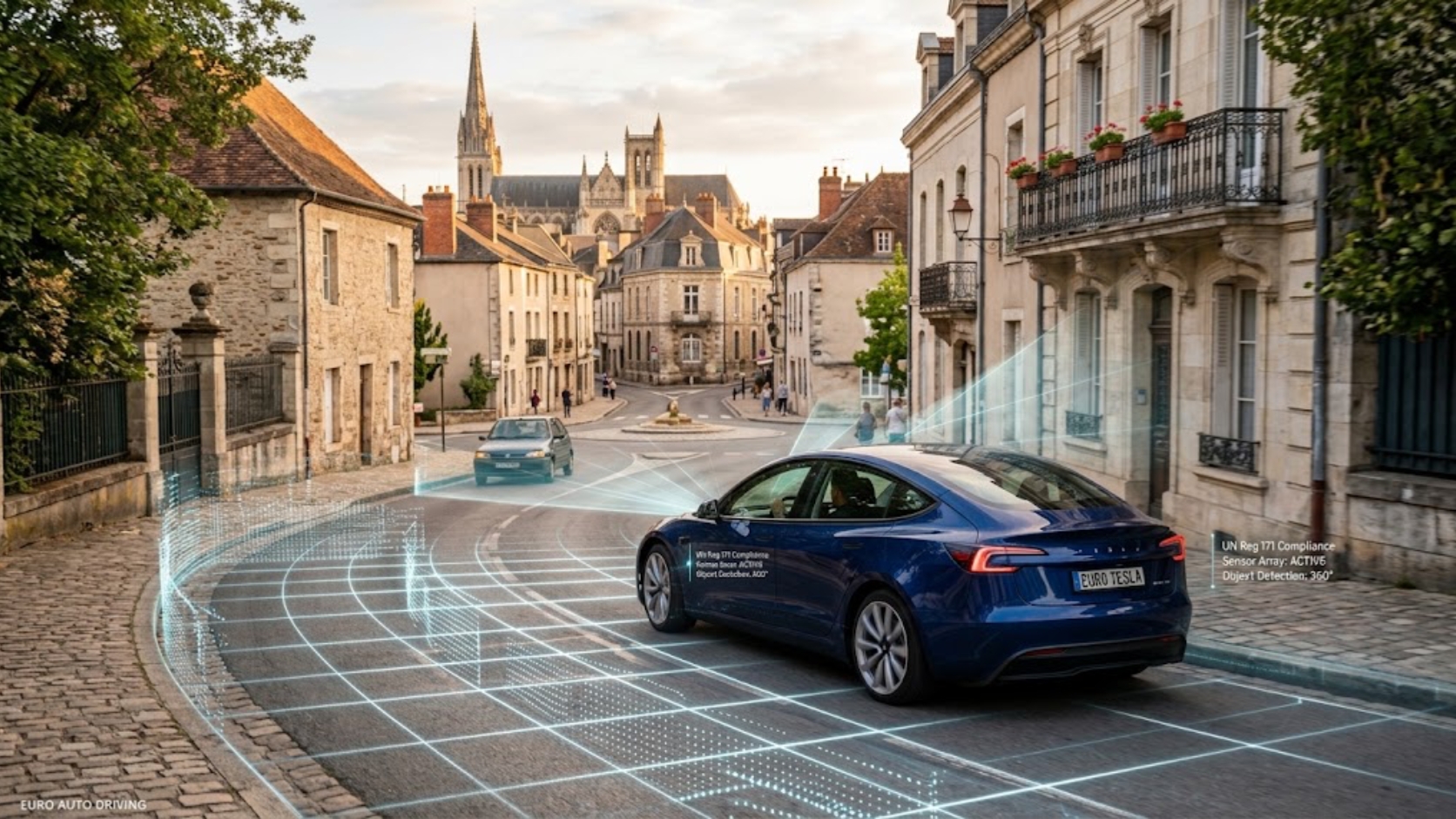
Introduction: The European Frontier for Tesla Autonomy
For years, Tesla owners across North America enjoyed rapid iterations of Full Self-Driving (FSD) Beta and Supervised builds, while drivers across the European Union and the United Kingdom remained constrained by legacy Driver Assistance Systems (DAS) directives. The discrepancy was not due to hardware deficiencies or lack of fleet telematics, but rather the regulatory frameworks of the UNECE (United Nations Economic Commission for Europe).
With the rollout of UNECE Regulation 171 governing Driver Control Assistance Systems (DCAS), the path for advanced SAE Level 2 hands-on, eyes-on autonomy has cleared across the European continent. As test fleets log millions of validation kilometers from the autobahns of Germany to the roundabouts of the Netherlands and the Alpine passes of Switzerland, European Tesla owners are entering an era of software-driven transit.
2. The Regulatory Framework: UN Reg 171 vs. US Standards
The operational envelope of autonomous driver assistance in Europe is strictly codified compared to North America's performance-based self-certification model.
-
Type Approval via Anchor Regulators: Initial regulatory clearance was spearheaded through the Dutch vehicle authority (RDW), establishing a precedent that permitted cross-border interoperability across participating EU member states.
-
Mandatory Attentiveness Post-Drive Audits: Unlike North American firmware, European builds incorporate post-trip attentiveness grading. The in-cabin neural network actively monitors gaze vectors, head posture, and phone distraction, generating an objective trip report card.
-
Speed and Lateral Acceleration Caps: UN Reg 171 sets parameters on lateral acceleration during automated lane transitions, requiring the software to execute maneuvers with higher radius curves and longer signaling buffers than those seen on US freeways.
3. Neural Network Adaptation Under HW4 / AI4
The deployment of European FSD (Supervised) relies on Tesla's AI4 computing platform, utilizing vision-only neural networks trained specifically on the unique urban topographies of European roads.
Tesla's edge-case training datasets in Europe encompass over 2.2 million kilometers across 19 countries, validating everything from cobblestone lane detection to narrow historic alley navigation.
4. Ownership Dynamics, Pricing, and Cross-Border Driving
Tesla has modified its commercial and operational framework to match European regulatory environments:
-
Subscription-Only Model: Moving away from large upfront purchases, Tesla has transitioned FSD to a flexible monthly subscription across key European markets.
-
Geo-Fenced Operational Boundaries: When crossing between approved countries (e.g., from the Netherlands into Belgium or Germany), FSD maintains continuous operational capabilities. If a vehicle enters a non-approved jurisdiction, the system gracefully steps down to standard Traffic-Aware Cruise Control and Autosteer.
-
Mandatory Educational Modules: European owners must complete an in-app interactive tutorial and safety assessment before the software unlocks on the vehicle display.
Conclusion: Transatlantic Autonomy Outlook
The harmonization of neural-network-based vision systems with strict European automotive safety regulations proves that vision-only Level 2 automation can adapt to dense, historic, and multilingual transit corridors. As regulatory bodies continue to review long-term safety telematics, the European expansion provides a blueprint for scalable autonomy worldwide.
Frequently Asked Questions (FAQ)
Q: Can Hardware 3 (HW3) vehicles in Europe run FSD Supervised?
A: Initial European approvals under UN Reg 171 are targeted at vehicles equipped with the Hardware 4 (AI4) computer suite due to the higher inference speeds required for real-time edge monitoring. Support for earlier architectures remains subject to further optimization.
Q: How does FSD handle European roundabouts?
A: The system treats multi-lane roundabouts as dynamic merging zones, monitoring traffic flow to select entry gaps, navigating the correct perimeter lane, and executing prompt right-hand turn signals upon departure.
Q: What happens if I receive a low attentiveness score?
A: Low attentiveness scores generate immediate in-cabin alerts and can lead to a temporary lockout of the system if driver intervention thresholds are repeatedly breached.