
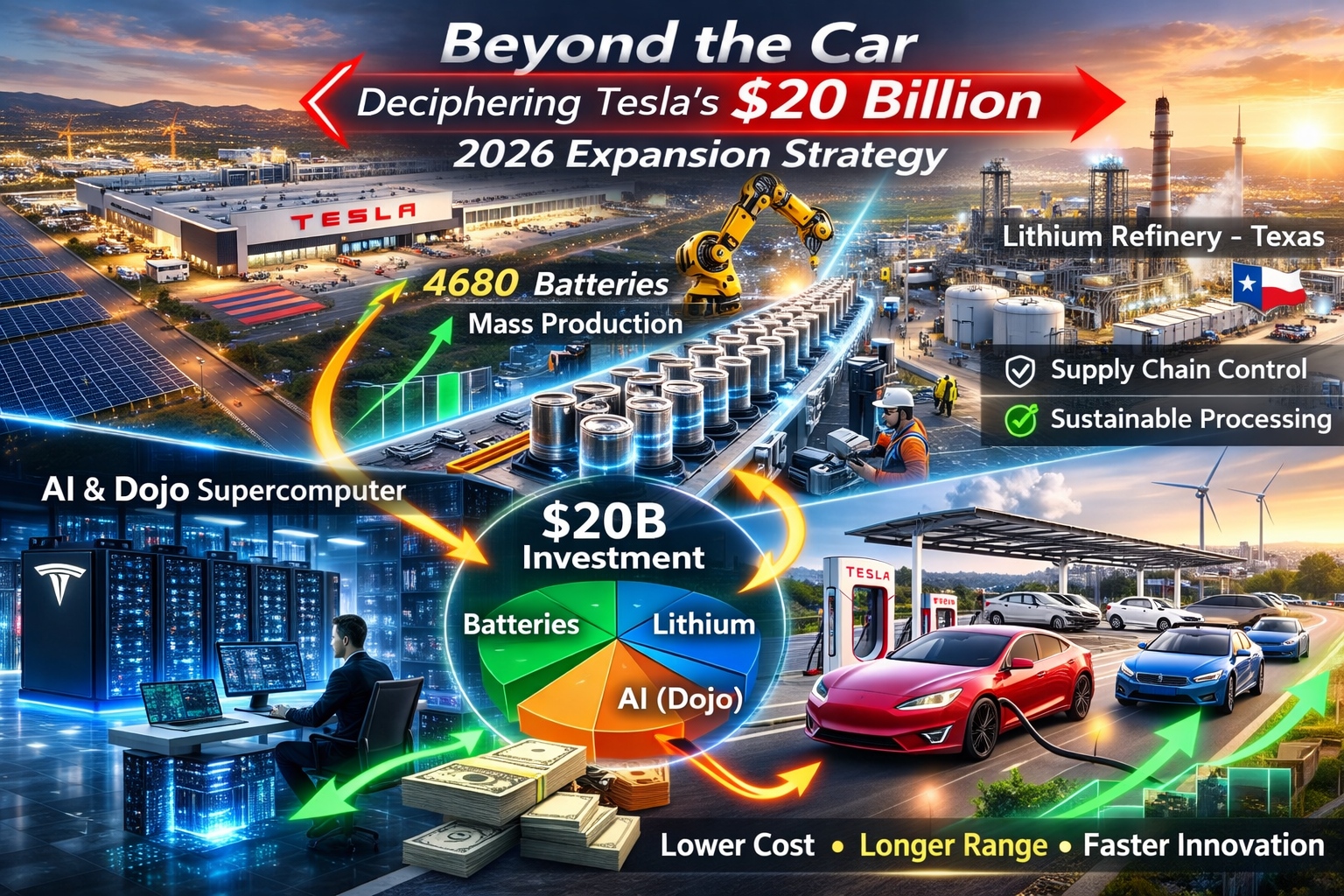
Introduction: The Most Ambitious Investment Year in Tesla's History
When Tesla released its fourth-quarter 2025 earnings on January 29, 2026, the numbers told a story that surprised even seasoned Wall Street analysts. The company reported full-year revenue of $94.8 billion, a modest 2.93% decline from the previous year, with net income dropping more sharply to $3.79 billion—a 46.5% decrease. On the surface, these figures might suggest a company in retreat. Global deliveries had fallen to 1.636 million vehicles, marking the second consecutive year of declining sales volumes.
Yet beneath these headline numbers lies a far more ambitious story. Tesla simultaneously announced that it expects capital expenditures to exceed $20 billion in 2026—more than double what Wall Street had anticipated and a dramatic jump from the roughly $8.5 billion spent in 2025. This represents the single largest investment year in the company's history, surpassing the previous peak of $11.3 billion in 2024.
For Tesla owners in the United States and Europe, this $20 billion question matters profoundly. The charging stations you'll use on your next road trip, the software updates that will arrive on your screen, the battery technology in your next Tesla, and even the long-term resale value of your current vehicle will all be shaped by where this money flows.
Section 1: The Strategic Context—Why Tesla Is Reinventing Itself
1.1 The End of the "Growth at All Costs" Era
To understand where Tesla is investing, we must first understand why. The company's 2025 performance, while still generating positive cash flow, revealed structural challenges in the traditional automotive business. Vehicle deliveries declined 9% in 2025 following a similar drop in 2024, marking the first back-to-back annual sales declines in Tesla's history. Competition from Chinese manufacturers, particularly BYD, intensified dramatically, with BYD surpassing Ford in global sales rankings and putting pressure on Tesla's market position.
More fundamentally, the electric vehicle market itself matured. Early adopters had largely been converted, and the mass market presented different challenges: price sensitivity, charging infrastructure concerns, and more demanding expectations around vehicle quality and longevity. In the United States, policy shifts under the Trump administration—including the elimination of federal EV tax credits in favor of auto-loan interest deductions—further complicated the demand environment.
1.2 Musk's "Fundamental Shift" Declaration
On the Q4 2025 earnings call, Elon Musk made explicit what had been implicit for years: Tesla is no longer primarily an automobile company. "We're making very, very big investments," Musk told analysts, outlining a future centered on artificial intelligence, robotics, and energy infrastructure. The company formally revised its mission statement to "building a world of abundance," moving away from the original goal of accelerating sustainable transport.
Andrew Rocco, an analyst with Zacks Investment Research, captured the moment succinctly: "This quarter officially marks the fundamental shift from EV company to an all-in bet on robotaxi, energy, and Optimus. It looks like they're almost ready to tear off the Band-Aid on the EV business and go full in on autonomy".
This shift explains the magnitude of the 2026 capital plan. Tesla is not simply building more car factories; it is constructing entirely new industrial capabilities that span AI compute infrastructure, humanoid robotics, upstream lithium processing, and next-generation battery manufacturing.
Section 2: Pillar One—AI Compute Infrastructure (The Brain)
2.1 The Cortex 2 Cluster and Texas Supercomputer Expansion
The single largest destination for Tesla's 2026 capital spending is artificial intelligence compute infrastructure. According to Tesla Vice President Grace Tao, the AI training center located in Texas has already invested over $10 billion, and 2026 will see "substantial additional investment". This facility, known as the Cortex 2 cluster, is designed to support all of Tesla's AI-related applications, including Full Self-Driving model training, Optimus robotics development, and the unified "world model" that will eventually underpin both.
By early 2026, Tesla aims to more than double the local compute capacity at the Texas facility when measured in H100-equivalent terms. This expansion is not incremental; it represents a step-function increase in the company's ability to train neural networks on the massive datasets generated by its global fleet.
2.2 The xAI Partnership and Grok Integration
In a move that deepened ties between Musk's corporate empire, Tesla announced in January 2026 that it had reached an agreement to invest $2 billion in xAI, Musk's artificial intelligence startup, as part of xAI's latest funding round. The two companies also entered into a "framework agreement" to "enhance Tesla's ability to develop and deploy AI products and services into the physical world".
This partnership has already borne fruit for Tesla owners. The Grok chatbot, developed by xAI, has been integrated into Tesla vehicles across multiple markets, with recent rollouts in Australia and New Zealand following launches in the US and Europe. For owners, Grok represents more than a novelty—it is the first visible manifestation of Tesla's AI-first strategy, transforming the vehicle cabin from a static environment into an interactive, conversational space.
2.3 Custom Silicon: AI5, AI6, and Dojo 3
Tesla's AI infrastructure investments extend beyond purchasing NVIDIA GPUs. The company is deepening its custom silicon efforts, with plans to bring its AI5 autonomous driving inference chip to market in 2027, followed by AI6 in 2028. These chips are designed specifically for Tesla's neural network architectures, potentially offering performance and efficiency advantages over general-purpose alternatives.
Additionally, Tesla plans to restart development work on the Dojo 3 chip in 2026, targeting applications in "space AI computing"—a reference to the extreme computational demands of training foundation models for robotics and autonomy. Dojo represents Tesla's long-term bet on vertical integration in AI hardware, reducing dependence on external suppliers while potentially unlocking new capabilities.
2.4 What This Means for Owners
For Tesla owners in the US and Europe, this AI infrastructure build-out translates directly into tangible improvements. Every FSD update that arrives on your screen is trained on clusters like Cortex 2. The more computing Tesla deploys, the faster neural networks converge, the more scenarios the models encounter during training, and the more capable the final software becomes. The $10 billion+ Texas facility is, in effect, a factory that produces intelligence rather than vehicles—and that intelligence flows directly to your car over the air.
Section 3: Pillar Two—Robotics and the Fremont Transformation
3.1 The End of Model S and X Production
Perhaps the most emotionally charged decision in Tesla's 2026 plan was the discontinuation of the Model S and Model X. These were the vehicles that established Tesla as a serious automaker—the Model S proving that electric cars could be luxurious and fast, the Model X demonstrating that practicality and innovation could coexist. Yet by 2025, these models represented a tiny fraction of Tesla's volume, with a combined annual capacity of just 100,000 units at the Fremont factory.
The decision to end production was driven by simple economics. Maintaining dedicated assembly lines for low-volume, complex vehicles consumed capital and floor space that could be better deployed elsewhere. The Fremont factory will now be repurposed to produce the Optimus humanoid robot, with the line conversion already underway.
3.2 Optimus: From Prototype to Production
Tesla's goal for Optimus is audacious: achieve a production capacity of 1 million units annually, with the first phase of manufacturing expected to come online by the end of 2026. The company has begun upgrading the Model S/X production lines, with more extensive renovations planned throughout 2026 to support full-scale Optimus assembly.
For owners, the immediate relevance of Optimus may seem abstract. But consider the economics: if Tesla successfully commercializes humanoid robotics, the Fremont factory transitions from producing vehicles with thin margins to producing robots with potentially much higher margins. That profitability, in turn, funds continued investment in vehicle technology, Supercharger expansion, and software development. Optimus is not a distraction from Tesla's automotive mission; it is a financial enabler of it.
3.3 The Cybercab Commitment
Alongside Optimus, Tesla continues to invest heavily in its dedicated robotaxi vehicle, the Cybercab. According to Grace Tao, core production lines at the US factory are "basically complete," with most of theInitial investment occurring in 2025. However, 2026 will see continued investment to ensure that Cybercab achieves "successfulmass production".
The Cybercab represents Tesla's bet that dedicated autonomous vehicles—designed from the ground up without steering wheels or pedals—will ultimately outperform retrofitted passenger cars in robotaxi service. Tesla has already launched initial unsupervised robotaxi operations in Austin, with plans to expand to Dallas, Houston, Phoenix, Miami, Orlando, Tampa, and Las Vegas in the first half of 2026. For owners in these cities, the Cybercab rollout may soon make autonomous ride-hailing a practical reality.
3.4 European Implications
While the Cybercab and Optimus production is centered in the United States, European owners should pay attention to these developments for two reasons. First, successful commercialization in the US typically precedes international expansion; Tesla has already begun the regulatory process to certify vehicles like the Semi for European roads. Second, the financial health generated by new product lines supports continued Supercharger investment in Europe, where Tesla is actively hiring for commercial charging roles and planning Megacharger deployments.
Section 4: Pillar Three—Energy Storage and the 100 GW Ambition
4.1 Megapack, Powerwall, and the Energy Business Trajectory
Tesla's energy storage business has quietly become one of its most consistent growth stories. In 2025, Energy storage capacity reached 46.7 GWh, a 48.7% year-over-year increase that set a new company record. The Shanghai Megafactory, designed to produce 10,000 Megapack units annually, had already manufactured 2,000 units by the end of 2025, with products exported to Europe and Australia.
For 2026, Tesla plans to "continue increasing energy storage manufacturing investment, further enhance overall production capacity and delivery capabilities". This expansion is driven by surging global demand for grid-scale battery storage, as utilities and corporations seek to integrate renewable energy and stabilize electricity grids.
4.2 The Lithium Refinery: Vertical Integration Upstream
Perhaps the most underappreciated element of Tesla's 2026 capital plan is the lithium refinery under construction in Texas. By moving upstream into raw material processing, Tesla aims to secure supply chains and reduce exposure to volatile lithium prices. This facility is part of a broader strategy to control more of the battery value chain, from mining inputs to finished cells.
For European owners, this investment matters because it supports Tesla's ability to scale battery production globally. Batteries sourced from Texas or Shanghai ultimately flow into vehicles sold in Europe, and stable raw material costs help insulate vehicle prices from commodity market gyrations.
4.3 The 100 GW Solar Vision
During the Q4 earnings call, Musk also outlined an ambitious solar energy Objective: building 100 GW of photovoltaic manufacturing capacity. While details remain sparse, this target signals that Tesla views solar as a complementary business to storage, creating integrated clean energy systems for homes, businesses, and utilities.
For owners with Powerwalls or solar roofs, this expansion could mean more integrated energy products, better software for managing home energy, and potentially lower equipment costs as scale drives efficiency.
Section 5: Pillar Four—Global Manufacturing Upgrades
5.1 Capacity Utilization and Efficiency Gains
Tesla's existing factories already possess substantial installed capacity. The Fremont facility can produce up to 550,000 Model 3/Y units plus 100,000 Model S/X units annually. Shanghai's capacity exceeds 950,000 Model 3/Y vehicles. Berlin can produce over 375,000 Model Y units, and Texas has capacity for 250,000 Model Y vehicles plus 125,000 Cybertrucks. In total, Tesla's installed capacity exceeds 2.35 million vehicles annually.
The challenge for 2026 is utilization. With deliveries running below capacity, Tesla must either boost demand or rationalize production. The 2026 capital plan addresses this by investing in "hardware automation levels and software capabilities simultaneously" to make the entire manufacturing system "more efficient, intelligent, andPossess stronger capabilities for large-scale replication".
5.2 The 2 Million Delivery Threshold
Several analysts project that Tesla could exceed 2 million deliveries in 2026, driven by the ramp of the more affordable models (more affordable model) that entered initial production in mid-2025. This lower-priced vehicle expands Tesla's addressable market and could help fill factory capacity. However, execution risks remain: Tesla must navigate intense competition, particularly from Chinese automakers, and maintain pricing discipline without resorting to aggressive discounting.
Section 6: Pillar Five—Charging Network Expansion
6.1 Continued Supercharger Build-Out
Tesla's 2026 capital plan includes sustained investment in charging infrastructure, with a focus on "continuously expanding the charging network's coverage and gradually opening it to more automakers". This dual mandate—growth plus open—reflects Tesla's evolving role as both a private network for owners and a public utility for the broader EV ecosystem.
By the end of 2025, Tesla operated approximately 8,182 DC fast-charging stations and 77,682 connectors worldwide, delivering about 6.7 terawatt-hours of electricity during the year. In the United States alone, Tesla accounted for roughly 52% of all DC fast-charging ports—more than 37,000 stalls. This dominance gives Tesla enormous leverage in shaping the North American charging landscape.
6.2 V4 Supercharger Rollout and 500 kW Speeds
A major focus of 2026 charging investment is the continued deployment of V4 Supercharger cabinets. Unlike earlier V4 installations, which were limited to V3 power levels, true V4 cabinets capable of delivering 500 kW to passenger vehicles are now entering service. In January 2026, Tesla opened its first 500 kW site in Taylorsville, Utah, featuring eight stalls with pricing ranging from $0.27–0.37 per kWh for Tesla owners.
These new cabinets offer several advantages. They support voltages between 400 and 1,000 V, enabling faster charging for 800 V vehicles like the Cybertruck, Porsche Taycan, and Hyundai Ioniq 5. Each cabinet can power up to eight stalls—double the capacity of previous generations—reducing site footprint and simplifying deployment. Tesla claims the V4 cabinet hardware delivers three times the power density at a lower cost while improving reliability.
6.3 Megacharger Preparations for Europe
For European owners, perhaps the most significant charging news in early 2026 is Tesla's preparation for Semi Megacharger deployment. David Forer, Tesla's Senior Project Developer for Charging, announced on LinkedIn that the company is hiring a dedicated Business Development lead for Commercial Charging in Central Europe, based in Munich. This role will focus on closing large-scale deals across Tesla's commercial charging portfolio, including both Supercharging and Megacharging.
Megachargers are designed to deliver up to 1.2 MW of power—far beyond even the 500 kW V4 Superchargers—making them suitable for long-haul trucking operations. While the Semi itself is currently operating only in the United States, Tesla has been working to certify the vehicle for European roads since at least late 2024. The hiring push suggests that Tesla anticipates European Semi deployments within a timeframe that requires charging infrastructure preparation now.
Section 7: Pillar Six—The xAI Investment and Strategic Alignment
7.1 The $2 Billion Commitment
Tesla's $2 billion investment in xAI, announced in the Q4 earnings statement, represents both financial commitment and strategic alignment. The investment takes the form of preferred shares in xAI's latest funding round, and the accompanying framework agreement formalizes collaboration between the two Musk-led companies.
7.2 Grok Integration Deepens
For Tesla owners, the most visible outcome of this partnership is Grok. The chatbot has already been integrated into vehicles in multiple markets, and deeper integration is likely forthcoming. As Tesla's AI infrastructure expands, Grok could evolve from a conversational novelty into a genuine interface for vehicle control, navigation, and information access.
7.3 Potential Semiconductor Manufacturing
The xAI agreement also includes discussions about "potentially building a semiconductor manufacturing facility". If realized, this would represent another layer of vertical integration, giving Tesla control over chip fabrication to complement its design capabilities. For owners, this could accelerate the pace of hardware innovation and reduce dependence on external suppliers.
Conclusion: What the $20 Billion Bet Means for Tesla Owners
Tesla's 2026 capital expenditure plan is the most ambitious in the company's history, but its ambition is not random. The investments cluster around three core themes: artificial intelligence (compute infrastructure, xAI partnership, custom silicon), robotics and automation (Optimus, Cybercab, factory upgrades), and energy infrastructure (storage manufacturing, lithium refining, charging networks).
For owners in the United States and Europe, this investment thesis translates into tangible outcomes over the next several years:
Better Software: The $10 billion+ Texas AI cluster will train increasingly capable FSD models, making your car smarter with every update.
New Products: The affordable model entering production in 2025–2026 will expand Tesla's lineup, while Cybercab and Semi create new mobility and freight options.
More Charging Options: V4 Superchargers with 500 kW capability will reduce charging times, and Megacharger preparation in Europe signals that heavy-duty electric transport is coming.
Financial Sustainability: By diversifying into higher-margin businesses (robotics, energy storage, AI services), Tesla reduces its dependence on automotive sales, potentially stabilizing the company through industry cycles.
The $20 billion question is not whether Tesla will spend the money—the balance sheet, with nearly $44 billion in cash and equivalents, can clearly support it. The question is whether execution will match ambition. Tesla has missed timelines before, and the path from capital allocation to owner benefit is rarely straight. But for owners who believe in Tesla's long-term trajectory, 2026 may be remembered as the year the company placed its biggest bet—and began building the infrastructure to win.
Frequently Asked Questions
Q1: Will my current Tesla benefit from the AI infrastructure investments?
Yes. The neural networks that power FSD, Autopilot safety features, and even cabin features like Grok are trained on Tesla's AI clusters. More compute capacity means faster training, more scenario coverage, and ultimately more capable software delivered to your vehicle via over-the-air updates.
Q2: Should I worry about parts availability for my Model S or X now that production has ended?
Tesla has committed to supporting legacy vehicles with parts and service. The discontinuation of production does not mean discontinuation of support. However, owners should expect that over very long time horizons, parts availability may become more challenging—a reality for any discontinued vehicle from any manufacturer.
Q3: When will 500 kW V4 Superchargers be widely available in Europe?
Tesla has begun deploying V4 cabinets globally, but the pace varies by region. In Europe, Tesla is actively hiring for charging roles and preparing for Megacharger deployments, suggesting that V4 expansion is underway. However, widespread availability of 500 kW charging depends on local grid capacity, permitting, and installation timelines.
Q4: What is the "more affordable model" and when can I buy it in Europe?
Tesla has confirmed that initial builds of a more affordable model occurred in mid-2025, with volume production planned for late 2025 and into 2026. European availability typically follows US launches by several months due to certification requirements and shipping logistics. Specific pricing and timing have not been announced.
Q5: How does the xAI investment affect my Tesla's features?
The most direct effect is Grok, the conversational AI assistant now rolling out to vehicles. Over time, deeper integration between xAI's language models and Tesla's vehicle systems could enable more natural voice control, better route planning, and enhanced cabin experiences.
Q6: Will the Optimus robot ever be available for personal use?
Tesla has not announced consumer availability plans for Optimus. The initial focus is on industrial applications, where robots can perform repetitive tasks in factory settings. Consumer versions, if developed, are likely years away.
Q7: How does US policy under the Trump administration affect Supercharger expansion?
The elimination of federal EV tax credits and changes to charging infrastructure funding could slow overall EV adoption, but Tesla's network is partially insulated by its existing scale and multi-brand strategy. Opening Superchargers to other automakers generates revenue that supports continued build-out regardless of policy tailwinds.
Q8: What does "world model" mean in Tesla's AI context?
A "world model" is a unified AI system that understands the physical world well enough to predict outcomes and plan actions. For Tesla, this means a single neural network architecture that can handle driving, robot navigation, and potentially other physical tasks. The Texas AI cluster is designed to train such models.