
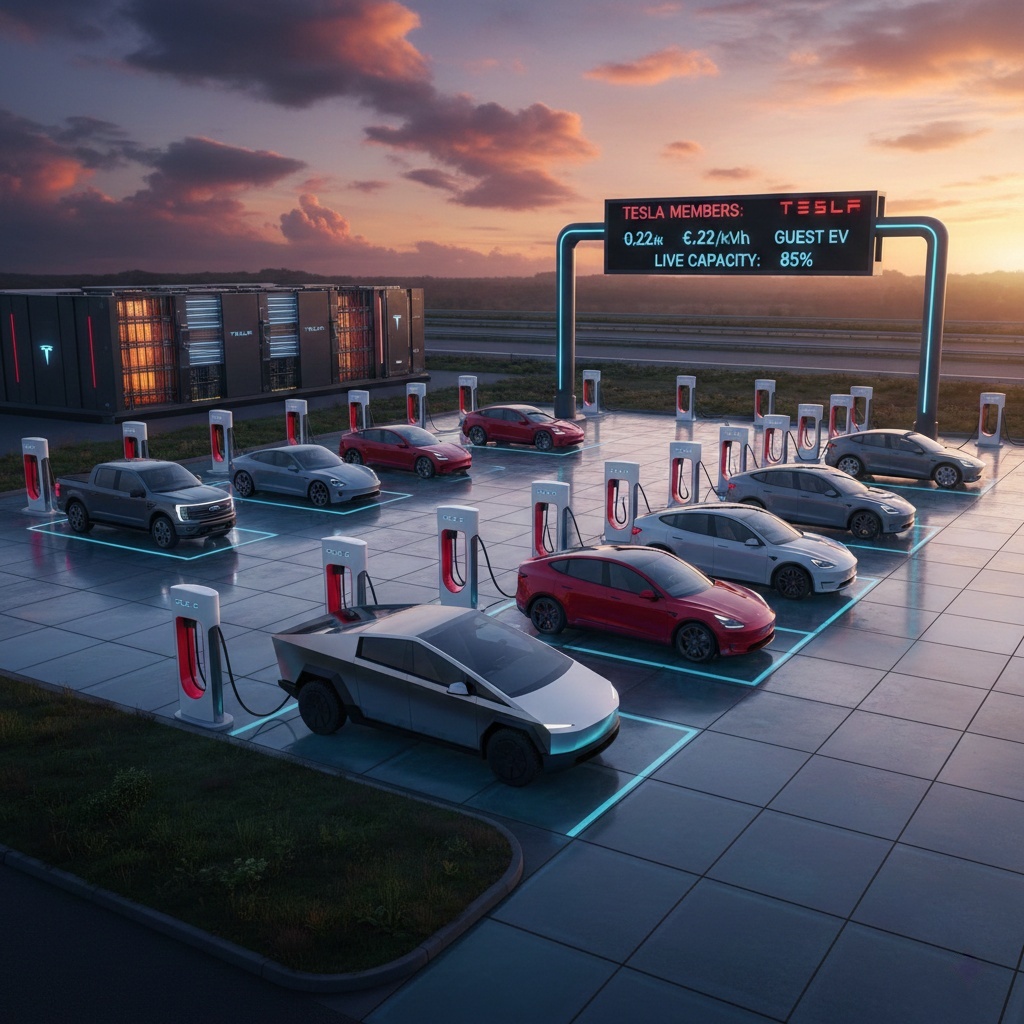
I. The V5 Revolution: Engineering the 500kW Frontier
The rollout of Supercharger V5 represents the most significant hardware leap in a decade. While V3 and V4 focused on reliability and cable length, V5 is built for raw, high-voltage power.
1. Breaking the 500kW Barrier
V5 is designed to natively support 1000V architectures, a necessity for the heavy-duty demands of the 2026 vehicle lineup.
-
Peak Power Output: While V3 was capped at 250kW, the V5 cabinets can deliver sustained bursts of 500kW for passenger vehicles and up to 1.2 Megawatts for the Tesla Semi.
-
Ultra-Thin Liquid-Cooled Cables: V5 features a new generation of "immersion-cooled" cables. Despite handling nearly double the current of V4, the cable is lighter and more flexible, using a proprietary coolant that achieves 2.5x higher current density.
-
Charging Curve Optimization: For the Model Y "Juniper" and Cybertruck, the V5 can add 200 miles of range in just 10-12 minutes, effectively making the "bathroom break" longer than the "charging break."
2. The Universal Dispenser
In Europe and North America, V5 posts are standardizing the "Magic Dock 2.0." This integrated adapter allows non-NACS vehicles to charge without the driver needing to carry a bulky third-party adapter. In 2026, the software handshake between a Ford F-150 Lightning or an Audi Q4 e-tron and a Tesla V5 post is as seamless as a "Plug & Charge" session for a Model 3.
II. The NACS Tsunami: 2026 as the Industry Standard
The "North American Charging System" (SAE J3400) is no longer a Tesla-exclusive feature; it is the industry benchmark.
1. The Entry of Luxury and Legacy Brands
As of this month, Stellantis (Jeep, RAM, Dodge) and Porsche have officially begun delivering vehicles with native NACS ports in the North American market.
-
The Porsche Impact: With the 2026 Taycan utilizing Tesla's 1000V V5 cabinets, luxury owners are seeing charging speeds that rival—and often exceed—the Porsche-exclusive charging lounges.
-
The European Shift: While Europe maintains the CCS2 physical plug, the backend communication protocols have converged. Tesla’s V5 posts in Europe now utilize ISO 15118, allowing for seamless biometric and vehicle-linked payments for all major European EV brands.
2. The "Host" Strategy
Tesla is increasingly partnering with major retailers like Walmart, BP Pulse, and Hilton to deploy V5 "Supercharger Hubs." These aren't just 4-stall outposts; they are 40-stall megaplexes equipped with Megapack energy storage to buffer the grid during peak hours.
III. Managing the Crowd: AI and Dynamic Pricing
With millions of non-Tesla EVs now accessing the stalls, congestion management has become Tesla’s primary software challenge in 2026.
1. Live Occupancy Pricing
Tesla has expanded its Live Pricing model to over 2,000 high-demand sites across the US and Europe.
-
Supply and Demand: Prices now fluctuate in real-time based on current occupancy and "predicted arrival" data from the Tesla navigation fleet.
-
Congestion Fees: To ensure throughput, Tesla has moved beyond simple "idle fees." In 2026, if a station is over 90% capacity, a "High State-of-Charge Fee" applies to any vehicle charging above 80%, incentivizing drivers to move on once they have enough range to reach their next destination.
2. The "Energy Flywheel"
By 2026, Tesla Charging has become a massive revenue generator. By using Megapacks at Supercharger sites, Tesla buys electricity when it’s cheap (mid-day solar or late-night wind) and sells it at a premium during peak hours. This "Energy Flywheel" allows Tesla to keep prices lower for Tesla owners while extracting high margins from the general public.
IV. Conclusion: The Infrastructure Moat
The narrative that "the competition is coming" for Tesla’s charging network has been inverted. In 2026, the competition is subscribing to it. The V5 Supercharger is the hardware manifestation of Tesla’s dominance—a reliable, ultra-fast, and universally compatible system that makes every other charging network look like a relic of the early EV era.
For the Tesla owner, the network remains the strongest reason to stay within the ecosystem. While the stalls are busier, the sheer density of the 80,000+ stall network ensures that even in the most remote parts of the Scottish Highlands or the American Midwest, a V5 plug is never more than 50 miles away.
V. FAQ: The 2026 Charging Guide
Q: Can I use the V5 500kW speed with my 2021 Model 3? A: Your vehicle will still be limited by its internal 400V battery architecture (roughly 250kW). However, V5's improved power cabinets ensure that you maintain that peak speed longer, reducing your total charging time by about 10-15%.
Q: Is it true that NACS is now the standard in Europe too? A: No. Europe continues to use the CCS2 plug due to regulatory standards. However, the V5 European posts use a much longer, cooled cable that reaches the ports of all European EV brands effortlessly.
Q: How does "Live Pricing" affect my road trip budget? A: Your Tesla navigation system will show the "Expected Price" for your arrival time. If a station is predicted to be busy, the car might suggest an alternative station 5 minutes away that is 30% cheaper.
Q: Do non-Tesla owners pay more? A: Yes. Tesla maintains a tiered pricing structure. Tesla owners (and those with a monthly Supercharging Membership) pay a lower per-kWh rate than "guest" vehicles.
Q: What is a "Supercharger Diner"? A: Launched in 2025 in Los Angeles and now expanding to major European hubs, these are flagship sites featuring 24/7 diners, movie screens, and lounges, turning the 15-minute charge into a premium hospitality experience.