
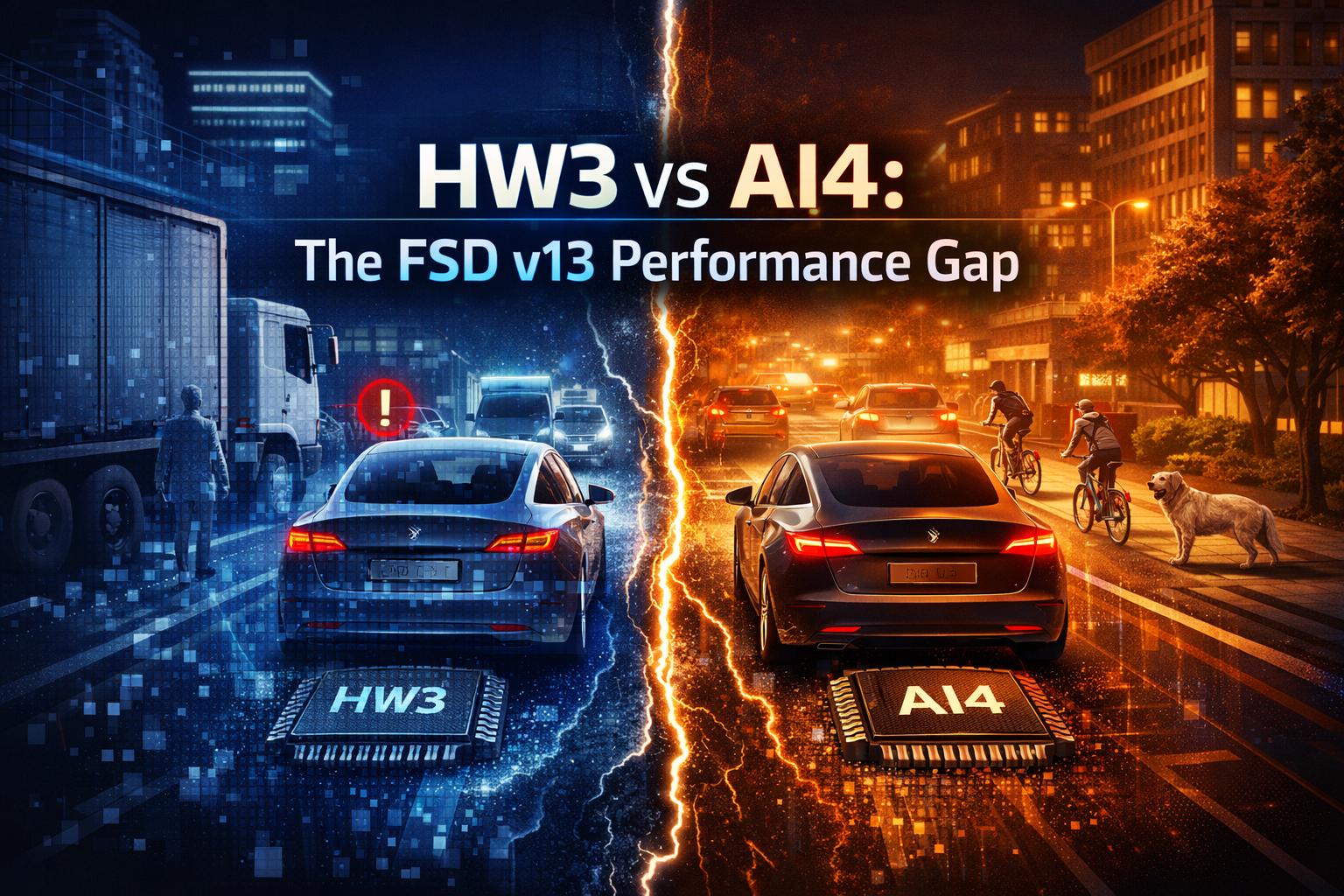
1. Introduction: The 2026 Paradigm Shift
As of March 26, 2026, the Tesla ecosystem has officially entered a new era of autonomous capability. With the wide-scale deployment of Firmware 2026.8, which contains the long-awaited FSD v13 software stack, the conversation among owners has shifted from "when will it arrive" to "how well does it run on my hardware?"
FSD v13 represents the most significant architectural overhaul since the move to end-to-end neural networks in v12. It introduces "Temporal Intelligence," giving the car a sense of object permanence that was previously impossible. However, as the initial excitement of the March rollout settles, a harsh technical reality is emerging: the performance gap between Hardware 3 (HW3) and the newer AI4 (Hardware 4) platforms is no longer just a minor delay—it has become a structural divide. Today, we decode the data to see if this gap is a permanent hardware ceiling.
2. Temporal-Voxel Architecture: The "Object Permanence" Leap
The core innovation of v13 lies in its move toward a "Temporal-Voxel" transformer model. To understand why this matters for your daily drive in London or Los Angeles, we have to look at how the car "thinks."
2.1 Moving Beyond Static Frames
In previous versions, the AI’s memory was relatively shallow. If a pedestrian walked behind a parked truck, the occupancy network would occasionally "forget" the pedestrian for a fraction of a second until they reappeared. This often led to jerky braking or hesitant acceleration.
-
The 15-Second Buffer: V13 utilizes a 15-second temporal buffer. The car now maintains a persistent 3D "memory" of every object in its environment, even when they are temporarily occluded.
-
Predictive Reasoning: By understanding the history of an object's movement, the car can now "anticipate" where a cyclist or a pet will reappear, leading to much smoother, human-like deceleration.
2.2 Unified Brain: The Death of the Highway Stack
V13 officially retires the last remnants of the legacy C++ "highway stack." The car now uses the same fluid, neural-network logic to merge onto a 75 mph Autobahn as it does to navigate a tight San Francisco alleyway. This unified approach has eliminated the "transition jerk" that owners often felt when moving from city streets to highways.
3. The Hardware Divide: HW3 vs. AI4
While v13 is technically compatible with HW3, the fleet data gathered since the March rollout indicates a clear "compute ceiling" has been reached for older silicon.
3.1 Quantization vs. Native Precision
The primary issue is one of mathematical "shorthand."
-
AI4 (Hardware 4): Features significantly higher NPU (Neural Processing Unit) throughput and runs v13 natively in high-precision FP16. This allows for incredibly granular detection of distant objects and complex textures.
-
HW3 (Hardware 3): To fit the massive v13 neural nets onto the aging 2019-era chips, Tesla’s AI team must employ INT8 Quantization. By shrinking the model to fit HW3's smaller memory bandwidth, "quantization noise" is introduced. In real-world driving, this manifests as the "micro-hesitations" HW3 owners report at complex unprotected left turns—the car is literally "second-guessing" its compressed data.
3.2 Perception Frequency and Resolution
The difference in "eyesight" is equally stark. AI4 vehicles (like the Model 3 Highland and Model Y Juniper) process full 5-megapixel feeds at a native 36 frames per second (fps). HW3 is physically limited by its 1.2-megapixel sensors and lower RAM, forcing the AI to "guess" details of distant hazards in low-light or high-glare conditions.
4. Safety Monitoring and Regulatory Compliance
To satisfy the latest 2026 mandates from the NHTSA and the European RDW, v13 includes a new "Safety Shield" Logging System.
-
Redundant Logic: AI4 has the processing headroom to run a secondary "Safety Kernel" in the background that double-checks the primary path’s logic in real-time.
-
Camera Cleaning Alerts: V13 is significantly better at recognizing when a camera is occluded by dirt or rain. On AI4, the system can "fill in the blanks" using the temporal buffer; on HW3, it is more likely to trigger a "Degraded Performance" alert and hand control back to the driver.
5. Conclusion: A Permanent Class Divide?
FSD v13 is a miracle of engineering—it is the version that finally makes "Supervised" driving feel relaxed. However, it also definitively exposes the limits of 2019 hardware. While HW3 remains a safe and capable driver, the "Unsupervised" future—the world of the Cybercab and true Robotaxis—clearly belongs to AI4 and the upcoming AI5.
For the Tesla enthusiast, the message of March 2026 is clear: Software can do wonders, but hardware eventually dictates the limits of the AI's "soul."
FAQ: Navigating the v13 Hardware Split
Q: Will Tesla offer a Hardware 4 retrofit for HW3 cars?
-
A: Officially, no. Elon Musk has confirmed that the wiring harnesses, power requirements (16V vs. 12V), and camera form factors are physically incompatible. A retrofit would involve replacing the car's entire "nervous system."
Q: Why does my HW3 car feel "hesitant" on v13 compared to v12?
-
A: This is likely due to the "Quantization" mentioned above. Because the car is processing a more complex model on older hardware, it adopts a more conservative "safety buffer," leading to slower starts at green lights and more cautious lane changes.
Q: Does v13 improve the "Autopark" feature?
-
A: Yes. V13 introduces "High-Fidelity Vision Park" for all vehicles, but AI4 owners will notice significantly smoother steering inputs and faster space detection thanks to the higher-resolution cameras.