
Introduction
Picture this: you are cruising down a German autobahn at 130 kilometers per hour. Up ahead, a police car sits silently on the shoulder — no flashing lights, no warning signals, just a stationary vehicle that any attentive human driver would instinctively give a wide berth. Your Tesla detects it. The system smoothly decelerates, executes a clean lane change, and glides past with the kind of unhurried confidence that normally takes a human driver years to develop. Then it returns to cruising speed as if nothing happened.
This is not a hypothetical scenario. It is exactly what multiple Tesla owners across North America have been documenting since late May 2026, when Full Self-Driving (Supervised) version 14.3.2 began rolling out globally. The update — built on software version 2026.2.9.9 and later refined in 2026.2.9.10 — represents something more significant than a routine over-the-air patch. It marks a moment where Tesla‘s neural network has begun to internalize the unwritten rules of the road: the subtle, instinctive behaviors that distinguish an experienced driver from someone merely following traffic regulations.
The significance of this moment extends far beyond a single software version number. Tesla has now crossed 10 billion cumulative miles driven with Full Self-Driving engaged worldwide. That is a staggering figure — more than 3.7 billion of those miles were accumulated in complex urban environments, and the fleet is currently adding roughly 29 million new miles every single day. Elon Musk himself declared in January 2026 that “roughly 10 billion miles of training data is needed to achieve safe unsupervised self-driving.” That threshold has now been breached. Yet true autonomy remains elusive, and the gulf between supervised brilliance and unsupervised reliability continues to define Tesla‘s most ambitious project.
Chapter 1: What v14.3.2 Actually Does — Human-Like Driving, Quantified
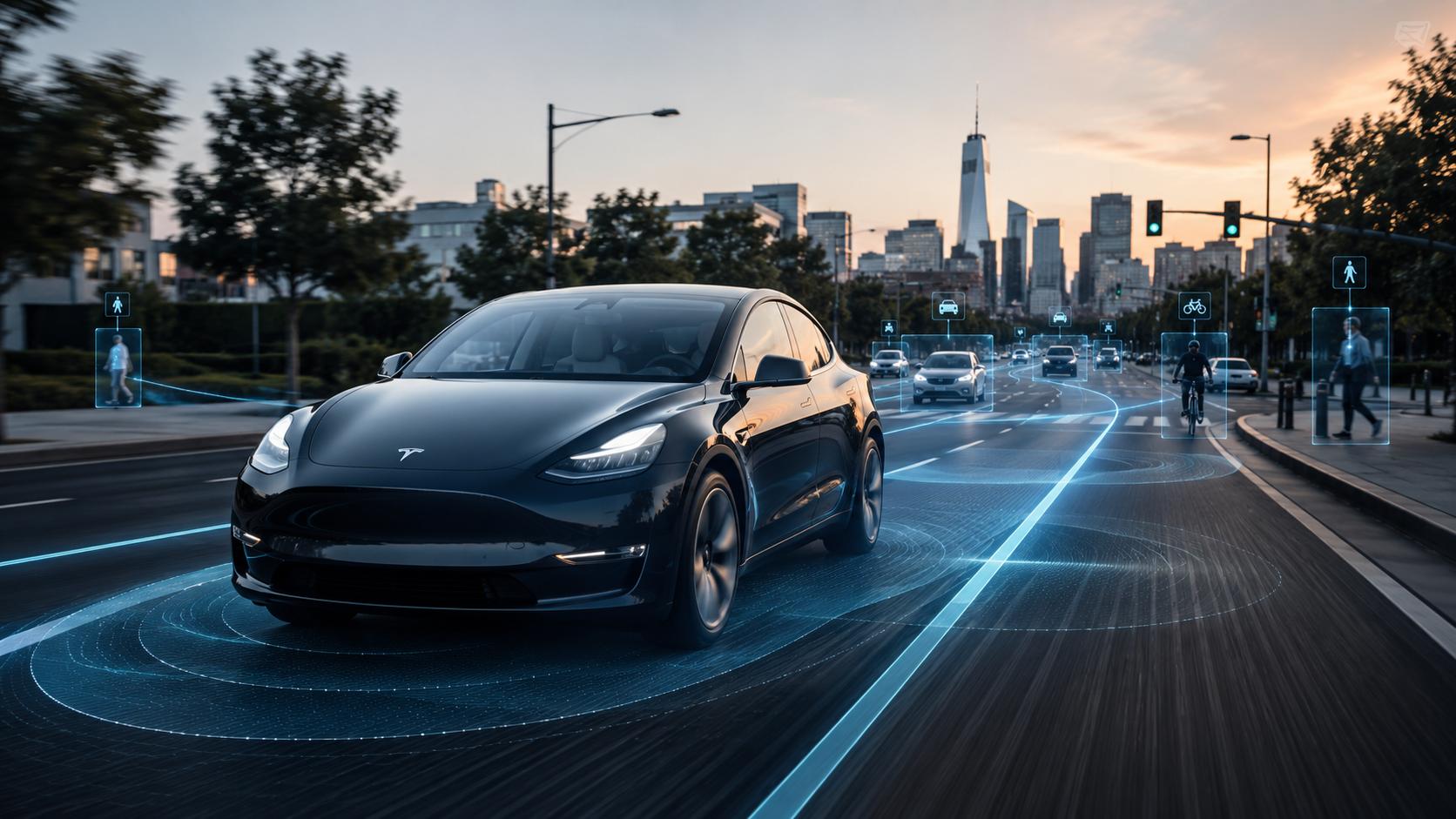
The headline feature of FSD v14.3.2 is easy to describe but difficult to engineer: the system now handles static roadside obstacles with a degree of naturalness that owners are calling “eerily human.” When the vehicle‘s vision system identifies a parked police car, a broken-down passenger vehicle, or a road maintenance truck on the shoulder, the system performs a rapid environmental assessment, initiates deceleration, and executes a smooth, stable lane change — all without the jerky hesitation that characterized earlier versions.
This capability did not emerge from a single line of new code. It is the product of an end-to-end neural network that has been trained on a vast corpus of real-world human driving data. The system has learned not only to follow explicit traffic rules but also to recognize and replicate the unwritten conventions that govern actual driving behavior. Most human drivers, for instance, instinctively reduce speed and move away from the fast lane when passing a vehicle stopped on the shoulder. This behavior is not codified in any driver‘s manual, but it is nearly universal among experienced motorists. Tesla’s neural network has now absorbed that pattern and turned it into a default response.
The update‘s official release notes confirm the technical underpinnings. The reinforcement learning (RL) stage of FSD neural network training has been upgraded, resulting in improvements across a wide variety of driving scenarios. The neural network vision encoder has been enhanced, improving recognition in rare and low-visibility conditions, strengthening three-dimensional geometry understanding, and expanding traffic sign recognition capabilities. Perhaps most significantly, the AI compiler and runtime have been rewritten from the ground up using MLIR (Multi-Level Intermediate Representation), yielding a 20 percent faster reaction time and accelerating the model iteration cycle.
These architectural improvements cascade into a long list of behavioral refinements. Unnecessary lane biasing has been mitigated. Minor tailgating behaviors have been reduced. The system now handles unusual objects — including items extending, hanging, or leaning into the roadway — with greater reliability. Emergency vehicle response has been enhanced, as has recognition of school buses and right-of-way violators. Traffic light handling at complex intersections with compound lights, curved roads, and yellow-light stopping scenarios has been refined through training on hard reinforcement learning examples sourced directly from the Tesla fleet. Even small animal detection has improved, with RL training focused on harder examples and additional rewards for proactive safety behaviors.
One of the most noteworthy architectural changes is the unification of the AI model across three previously separate domains: Full Self-Driving, Actually Smart Summon, and the Robotaxi stack. This means the same neural network logic that guides a consumer Model Y through highway traffic now also powers the vehicles Tesla is testing in its Austin robotaxi fleet. The implications for software consistency and validation efficiency are substantial.
On the user experience side, v14.3.2 introduces a new post-disengagement feedback menu. When a driver takes over from FSD, the system now prompts them to select a reason — lane selection error, speed control issue, navigation problem, or other categories. This structured feedback loop feeds directly into Tesla‘s training pipeline, allowing engineers to prioritize edge cases based on real-world frequency and severity. It is a small interface change with enormous data-collection consequences.
The update also improves parking-related behaviors. Spot selection is more decisive. Maneuvering execution is smoother. Parking location pin prediction has been enhanced and is now displayed on the map with a dedicated P icon. The system also handles temporary sensor or system degradations more gracefully, maintaining control and automatically recovering without requiring driver intervention — reducing unnecessary disengagements.
Taken together, these improvements represent a version that feels qualitatively different from its predecessors. Owners on forums and social media have described the experience as “more confident,” “less robotic,” and “finally trustworthy on highway stretches.” But beneath the user experience lies a technical transformation that deserves closer examination.
Chapter 2: The Neural Network That Thinks Like a Driver
To understand why v14.3.2 feels different, it is necessary to understand what changed under the hood. The v14.3 series — which began rolling out in April 2026 — represents one of the most significant architectural overhauls in FSD history. The defining characteristic of this generation is the completion of Tesla‘s end-to-end neural network architecture: the final 300,000-plus lines of hand-written C++ code that controlled vehicle actuation have been removed and replaced with neural network outputs.
In previous versions, Tesla’s autonomous driving stack operated in three stages. First, a neural network handled perception — identifying objects, lane lines, traffic signs, and other elements from camera feeds. Second, another neural network managed path planning — determining where the vehicle should go based on the perceived environment. But the third stage — translating that plan into specific steering angles, throttle inputs, and brake pressure — still relied on traditional control logic written by human engineers. That logic, comprising more than 300,000 lines of C++, was exhaustive but inherently brittle. No matter how many rules engineers wrote, there were always edge cases that fell through the cracks.
With v14.3, Tesla eliminated that final dependency on hand-coded rules. The entire pipeline — from camera photons to steering actuator commands — now flows through a single end-to-end neural network. This is sometimes called a “one-stage end-to-end architecture.” The system no longer needs to be told “if red light, then stop.” Instead, it learns what to do by absorbing millions of examples of human drivers handling red lights in every conceivable context — rushing through a late yellow, creeping forward to get a better view of cross traffic, stopping smoothly versus abruptly. The model internalizes these patterns and reproduces them.
To support this more demanding architecture, Tesla increased the neural network‘s parameter count by approximately tenfold compared to the previous generation, reaching roughly 3 billion parameters. A larger model can store more diverse driving patterns — unusual intersection geometries, non-standard traffic signage, complex construction zone layouts — that were previously beyond the capacity of smaller networks. This is why v14.3.x versions demonstrate markedly improved performance in rare and edge-case scenarios.
The compiler rewrite is equally significant. Tesla rebuilt its AI compiler and runtime from scratch using the MLIR framework. MLIR allows the compiler to retain higher-level structural information about the computational graph, making it easier to identify operations that can be merged, data that can be reused, and instruction sequences that can be streamlined. The result is a 20 percent reduction in latency from camera capture to actuation command. At highway speeds, those milliseconds translate into real safety margins.
Another innovation introduced in v14.3 is explicit spatiotemporal memory — the model can now retain contextual information for approximately 3 to 5 seconds. Earlier versions made decisions primarily based on the current frame, which could lead to behaviors that seemed forgetful: a vehicle that just merged ahead might not be properly accounted for, or a pedestrian who disappeared momentarily behind an obstacle might be treated as gone. With 3 to 5 seconds of memory, the system can track short-term dynamics — the acceleration profile of a leading vehicle, the trajectory of a crossing pedestrian, the status of a traffic light that was yellow a moment ago — and make decisions with temporal coherence.
Finally, the unification of the FSD, Actually Smart Summon, and Robotaxi models deserves emphasis. Previously, these three applications ran on related but separate neural network stacks. Now they share a single model. A vehicle summoned across a parking lot uses the same core decision-making logic as one navigating a complex urban intersection. This consolidation not only simplifies development but also means that every mile driven in any mode contributes to improving the entire system.
The combination of end-to-end architecture, tenfold parameter expansion, MLIR compiler optimization, spatiotemporal memory, and model unification creates a system whose decision-making process is fundamentally more holistic than anything Tesla has deployed before. It is the technical foundation upon which the human-like behaviors observed in v14.3.2 are built.
Chapter 3: The Data Engine — 10 Billion Miles and What They Mean
On May 5, 2026, Tesla updated its FSD safety page with a number that had been anticipated for months: the global fleet of FSD-equipped vehicles had surpassed 10.03 billion cumulative miles driven with Full Self-Driving engaged. Of that total, more than 3.7 billion miles were accumulated in city driving — the most challenging domain for autonomous systems. The fleet is currently adding approximately 29 million miles per day, a rate that continues to accelerate as more vehicles join the network and existing owners drive more.
The 10-billion-mile figure carries symbolic weight because Elon Musk himself made it the explicit threshold for unsupervised autonomy. In January 2026, after Tesla missed its end-of-2025 target for unsupervised FSD deployment, Musk stated that “roughly 10 billion miles of training data is needed to achieve safe unsupervised self-driving.” The implication was clear: once that data milestone was reached, the system would be ready for the next step.
The milestone has now been achieved. Yet unsupervised FSD for consumer vehicles remains unavailable. Tesla has pushed the timeline to the fourth quarter of 2026 at the earliest, and even that projection comes with heavy caveats. The company has missed every autonomous driving deadline Musk has set over the past decade, and skepticism about the latest timeline is widespread.
Why did 10 billion miles not trigger the anticipated breakthrough? The answer lies in the distinction between data quantity and data quality — and in the nature of the safety challenge itself. Tesla‘s fleet generates an enormous volume of driving data, but the vast majority of those miles are uneventful highway cruising. Highway driving is statistically the safest driving domain, with far fewer interactions per mile than urban environments. A mile on a straight interstate highway provides less useful training signal than a mile navigating a dense city center with pedestrians, cyclists, intersections, and unpredictable human behavior.
Tesla’s safety methodology has drawn criticism from independent experts. The company reports one major collision per 5.3 million miles under FSD (Supervised), compared to one per 660,000 miles for the average U.S. driver — a ratio that suggests FSD is dramatically safer than human driving. However, Tesla uses different counting methods than the NHTSA data it compares against, making direct comparisons problematic. Furthermore, Tesla‘s own Austin robotaxi fleet — which logged approximately 800,000 miles through February 2026 — reported 14 crashes to NHTSA, yielding a crash rate approximately four times the average human-driven rate in similar urban conditions. This discrepancy between fleet-wide statistics and supervised urban operation highlights the challenge: real-world urban autonomy remains significantly more difficult than the aggregate numbers suggest.
The comparison with Waymo is instructive. Waymo, which operates true Level 4 driverless vehicles with no human behind the wheel, has accumulated over 127 million miles of fully autonomous driving. The company reports 90 percent fewer serious injury-causing crashes and 82 percent fewer airbag deployments than human drivers across those miles. Waymo’s vehicles operate in 10 cities and are targeting 1 million weekly rides with their sixth-generation system. The critical difference is that Waymo takes full legal responsibility for the driving task, while Tesla‘s system — even in its most advanced form — remains a Level 2 driver-assistance feature that requires constant human supervision.
Tesla’s data advantage is real and formidable. No competitor can match the scale of Tesla‘s real-world data collection fleet — millions of consumer vehicles gathering scenarios from every conceivable driving environment. But data alone does not solve the safety validation problem. The fundamental question that no mileage counter can answer is: when is the system actually ready to assume full responsibility for the driving task? That question is as much legal and regulatory as it is technical, and it represents the true barrier between where FSD is today and where it needs to go.
Chapter 4: The Hardware Puzzle — When Clean Lenses Become a Prerequisite for Autonomy
On May 26, 2026, the United States Patent and Trademark Office granted Tesla patent No. 12,636,684 for a technology described as a “Lens Cleaning System.” Filed in May 2025, the patent details an automated system designed to dispense cleaning fluid onto a camera lens and clear it with a dedicated wiper assembly. The language describes a self-contained solution for maintaining the optical clarity of the camera sensors that form the backbone of Tesla’s Autopilot, FSD, and Optimus platforms.
The patent may seem like a minor engineering detail, but it addresses one of the most fundamental vulnerabilities in Tesla‘s camera-only approach to autonomous driving. If a camera lens becomes obscured by mud, snow, insect residue, or road grime, the entire perception pipeline is compromised. For a human driver with a dirty windshield, the solution is simple: activate the wipers and washer fluid. But for an autonomous vehicle operating without a human occupant, there is no one to notice the obstruction and no mechanism to clear it — at least, not until now.
The timing of the patent grant is significant because camera washers are already appearing on Tesla’s operational robotaxi fleet. In January 2026, the first Model Y robotaxi units in Austin were spotted with washer nozzles on their side repeater cameras, with video evidence showing fluid being squirted and rinsed away. The integration of cleaning hardware into production robotaxi vehicles suggests that Tesla recognizes camera cleanliness as a prerequisite for safe unsupervised operation — a prerequisite that consumer vehicles with AI4 hardware currently lack.
This raises a critical question for the millions of Tesla owners who purchased their vehicles with the expectation of eventual full autonomy. Tesla has long maintained that vehicles equipped with Hardware 4 (AI4) would be capable of unsupervised Full Self-Driving. But if unsupervised operation requires camera cleaning systems that current vehicles do not have, will those owners receive retrofit kits? Or will the promise of full autonomy require new hardware that existing vehicles cannot accommodate?
The lens cleaning patent is not the only hardware consideration shaping the autonomy timeline. HW3 vehicles — which represent a substantial portion of the existing Tesla fleet — face even more fundamental limitations. With 8GB of memory and 144 TOPS of computing power, the HW3 computer lacks the capacity to run the full v14.3 neural network. Tesla has confirmed that HW3 vehicles will receive a “Lite” version of the software by the end of June 2026, using model distillation and quantization compression to preserve core functionality while sacrificing some high-resolution processing capability. But Musk has explicitly acknowledged that HW3 vehicles will never be capable of running unsupervised FSD. For the approximately 3,000 HW3 owners who have organized collective action demanding either refunds or free hardware upgrades, the lens cleaning patent adds another layer to an already contentious issue: even if their computers could be upgraded, would their cameras need to be upgraded too?
The Optimus connection is also worth noting. The same lens cleaning technology described in the patent applies to Tesla‘s humanoid robot, which relies on camera-based vision for navigation and manipulation. A robot designed to operate in factories, homes, and unpredictable environments needs its “eyes” to remain clear regardless of conditions. The dual applicability of the patent — to both vehicles and robots — underscores Tesla’s broader ambition to solve vision-system reliability as a platform-level problem.
For current Tesla owners, the hardware situation is nuanced but not hopeless. The v14.3.2 software continues to improve the supervised driving experience on existing hardware. The lens cleaning system will likely appear first on dedicated robotaxi vehicles like the Cybercab, where fully unsupervised operation is the design intent from the start. For consumer vehicles, the path to unsupervised autonomy may be longer and may require hardware modifications — but the supervised system that owners can use today continues to get meaningfully better with each update.
Chapter 5: The Global Chessboard — FSD‘s Regulatory Journey
While Tesla’s engineering teams refine neural networks in California and Texas, a parallel battle is unfolding in regulatory chambers across Europe and beyond. The outcome of this battle will determine where — and when — Tesla‘s most advanced driver-assistance features become available to paying customers.
The European regulatory landscape has been among the most challenging for Tesla to navigate. As of May 2026, Full Self-Driving in any form remains unavailable to consumers on European public roads. The European Union’s vehicle approval framework, governed by UNECE regulations, imposes stricter requirements on automated driving systems than the comparatively permissive U.S. regime. Lane-change maneuvers, for instance, are subject to specific constraints on lateral acceleration and execution time that earlier FSD versions struggled to meet.
Yet progress is being made. Tesla‘s CFO Vaibhav Taneja stated during the first-quarter 2026 earnings call that the company is well positioned to secure EU-wide approval for FSD (Supervised) during the current quarter. The Netherlands has already emerged as an early mover, with reports indicating that Dutch authorities are prepared to grant FSD approval ahead of broader EU action. Other member states are watching closely, and a domino effect is possible once the first major European market opens its roads to the system.
The 93,000 miles of autonomous driving accumulated by Model Y vehicles within the confines of Giga Berlin’s private factory grounds may play a subtle but important role in this regulatory process. Every newly assembled Model Y at the German facility activates FSD and drives itself from the end of the production line to the outbound logistics lot — navigating factory pathways, yielding to forklifts and pedestrians, and parking itself in the delivery staging area. The route is entirely on private property, requiring no regulatory approval. Yet it demonstrates that the system can operate reliably in European conditions — with European road markings, European weather patterns, and European infrastructure — even if the formal approval process is still ongoing.
The contrast between Tesla‘s regulatory strategy and Waymo’s is instructive. Waymo has pursued a city-by-city approach, working closely with local authorities to secure permits for driverless operations in specific geographic areas. This methodical strategy has yielded operations in 10 U.S. cities, with Miami and Atlanta in the pipeline. Tesla, by contrast, is pursuing a software-driven approach that aims for regulatory approval at the national or supranational level — deploying once, deploying everywhere. The Waymo approach has the advantage of being proven and operational today. The Tesla approach, if successful, would scale far more rapidly.
In North America, the regulatory situation is more favorable but still complex. FSD (Supervised) is available across the United States and Canada, and the system continues to improve with each update. The key regulatory question on the continent is not whether FSD can operate in supervised mode, but when — and under what conditions — it can transition to unsupervised operation. That transition will require not just technical readiness but also a liability framework that Tesla has not yet publicly addressed. Who is responsible when an unsupervised Tesla causes a collision? The answer to that question will shape the commercial and legal architecture of the robotaxi business.
For Tesla owners and prospective buyers, the regulatory timeline matters in concrete terms. A European driver considering an FSD subscription wants to know whether the features they are paying for will be available during their ownership period. An American owner with a vehicle purchased years ago on the promise of future autonomy wants to know whether regulatory approval will align with hardware capability. These are not abstract policy questions; they are consumer questions with real financial implications.
Chapter 6: From v14 to v15 — The Road Ahead
What comes after v14.3.2? The answer is already taking shape in Tesla‘s engineering pipeline, and it points toward a future where the gap between supervised and unsupervised driving begins to close — though not necessarily on the timeline that optimists might hope for.
Musk has described v14.3 as the “final puzzle piece” needed for unsupervised FSD. The v15 generation, expected to begin rolling out in late 2026 or early 2027, is expected to deliver a comprehensive software architecture overhaul with safety levels that approach the threshold for removing human supervision. But the company has made clear that widespread deployment of unsupervised FSD will only occur after major architectural improvements have been completed and thoroughly validated.
The upcoming improvements listed in the v14.3.2 release notes provide a roadmap of what Tesla‘s engineers are prioritizing. Expanded AI reasoning capabilities — moving beyond destination handling to encompass all driving behaviors — is first on the list. Pothole avoidance, a feature that has been promised for years and remains conspicuously absent, is also slated for a future update. Improvements to the driver monitoring system, including better eye gaze tracking, enhanced handling of eyewear, and higher accuracy in variable lighting conditions, are in development. These monitoring improvements are particularly important from a regulatory perspective, as robust driver monitoring is a prerequisite for higher levels of automated driving under both U.S. and European frameworks.
The timeline for unsupervised FSD on consumer vehicles remains uncertain. Musk has indicated the fourth quarter of 2026 at the earliest, with the rollout likely to be geographically limited at first — starting with states that have favorable regulatory environments, such as Texas, before expanding to other regions. But Tesla has a long history of missed autonomy deadlines, and external observers are appropriately skeptical. The gulf between a supervised system that drives impressively well 99 percent of the time and an unsupervised system that can be trusted with human lives 100 percent of the time is vast, and crossing it requires not just engineering progress but also a safety validation framework that the industry as a whole is still developing.
For owners, the practical question is whether to buy FSD outright or subscribe monthly. At $99 per month, the subscription model offers flexibility: you can experience the latest capabilities without making a multi-thousand-dollar commitment, and you can cancel if the system does not meet your expectations. The outright purchase locks in a price but ties the value of that purchase to Tesla‘s ability to deliver on its autonomy promises — promises that have repeatedly been delayed. For most owners in 2026, the subscription model appears to be the more prudent choice.
The broader competitive context is also worth watching. Waymo continues to expand its driverless operations with a methodical, safety-first approach that contrasts sharply with Tesla‘s rapid-iteration philosophy. Chinese automakers are pushing advanced driver-assistance systems into production at aggressive price points, often with more sensor redundancy than Tesla‘s camera-only approach. The autonomous driving race is far from decided, and the winning strategy may not be the one that generates the most headlines.
Conclusion
FSD v14.3.2 represents a genuine step forward in the long and winding journey toward autonomous driving. The system‘s ability to handle static roadside obstacles with human-like smoothness, its unified AI architecture spanning consumer and robotaxi applications, and its 20 percent faster reaction times are all meaningful achievements. The 10-billion-mile milestone is a testament to the scale of Tesla’s data engine — a resource no competitor can replicate.
Yet the distance between here and unsupervised autonomy remains substantial. The hardware challenges — from lens cleaning to HW3 compatibility — underscore that even the most sophisticated software depends on physical systems that must work flawlessly in the messy, unpredictable real world. The regulatory landscape, particularly in Europe, adds layers of complexity that no amount of neural network training can shortcut. And the safety validation question — how do you prove a system is safe enough to take full responsibility for human lives? — remains the central unsolved problem of the entire autonomous driving industry.
For Tesla owners and enthusiasts, v14.3.2 is best understood as both a milestone and a waypoint. It makes the daily driving experience better, safer, and more enjoyable. It demonstrates that Tesla‘s approach — camera-only, data-driven, vertically integrated — can produce genuinely impressive results. But it is not the arrival. The destination — a world where your Tesla can drive itself while you read, work, or sleep — is still somewhere down the road. v14.3.2 brings that world a little closer, and in the meantime, it makes the journey considerably more interesting.
FAQ
Q: Is FSD v14.3.2 the same as unsupervised Full Self-Driving?
No. FSD v14.3.2 remains a supervised driver-assistance system. The driver must maintain full attention on the road and be prepared to take over at any moment. Unsupervised FSD — where the vehicle assumes full responsibility for the driving task — has not yet been released for consumer vehicles. Tesla‘s current timeline targets Q4 2026 at the earliest for initial unsupervised deployment, and even that date is subject to regulatory approval and safety validation.
Q: What are the most noticeable improvements in v14.3.2 compared to earlier versions?
The most widely reported improvement is the system’s ability to handle static roadside obstacles — police cars, broken-down vehicles, maintenance trucks — with smooth, human-like deceleration and lane changes. Other notable improvements include 20 percent faster reaction times, reduced unnecessary lane biasing, reduced tailgating, better handling of unusual objects extending into the roadway, improved parking spot selection, and a new post-disengagement feedback interface.
Q: Will my HW3 Tesla receive the v14.3.2 update?
Full v14.3.2 is designed for HW4 (AI4) vehicles. Tesla has confirmed that HW3 vehicles will receive a “Lite” version by the end of June 2026, using model compression techniques to preserve core functionality within HW3‘s hardware limitations. However, Elon Musk has acknowledged that HW3 vehicles will never be capable of running unsupervised FSD. Approximately 3,000 HW3 owners have initiated collective action seeking refunds or free hardware upgrades.
Q: When will FSD be available in Europe?
Tesla CFO Vaibhav Taneja has indicated that the company expects to secure EU-wide approval for FSD (Supervised) during Q2 2026. The Netherlands appears to be the most advanced market in the approval process. However, the exact timing depends on individual member state regulatory processes, and consumers should monitor official announcements for country-specific availability.
Q: What is the lens cleaning patent, and why does it matter?
Patent No. 12,636,684 describes an automated system that dispenses cleaning fluid onto a camera lens and clears it with a wiper assembly. This technology is critical for unsupervised autonomous driving because obscured cameras can compromise the entire perception system. Camera washers have already been spotted on Tesla robotaxi vehicles in Austin. It remains unclear whether existing AI4 vehicles will be eligible for a retrofit of this hardware.
Q: Should I subscribe to FSD monthly or buy it outright?
At $99 per month, the subscription model offers flexibility to experience the latest capabilities without a large upfront commitment. The outright purchase locks in a price but ties value to Tesla‘s ability to deliver unsupervised autonomy — a promise that has been repeatedly delayed. For most owners in 2026, the subscription model offers a better risk-reward balance.
Q: How does Tesla’s FSD compare to Waymo‘s autonomous driving system?
Waymo operates true Level 4 driverless vehicles with no human behind the wheel in 10 U.S. cities, takes full legal responsibility for the driving task, and reports 90 percent fewer serious injury-causing crashes than human drivers. Tesla’s FSD remains a Level 2 supervised system that requires constant human attention. Tesla has a massive data advantage — over 10 billion miles of real-world driving data — but has not yet demonstrated the ability to operate safely without human supervision in complex urban environments.