
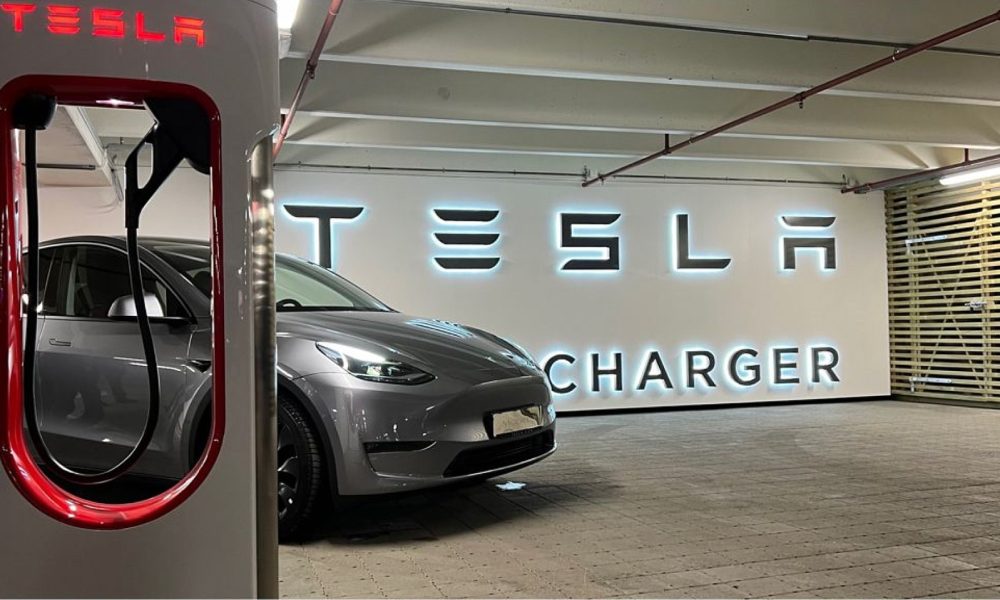
Tesla’s Supercharger evolution in 2025 — a hardware leap to V4 cabinets plus a strategic opening of the network to non-Tesla EVs via NACS and adapters — is changing how owners plan trips, how networks compete, and how drivers (Tesla and non-Tesla) experience fast charging on major routes. If you own a Tesla or plan to buy one in the US or Europe, this affects charging speed, station availability, payment, and trip planning now — and it’ll matter even more next year.
Introduction — Why chargers, not cars, are the next frontline in the EV race
Most conversations about EVs focus on range, battery chemistry or software updates. But increasingly, the charging network — how fast you can refill on a road trip and how predictable that stop is — determines real-world usability. Tesla built the original Supercharger advantage: a dense, reliable fast-charging network that made long-distance trips comfortable for owners. In 2025 Tesla is playing a different game: faster hardware (V4 cabinets), payments built into the stalls, longer cables and—crucially—opening many Supercharger sites to non-Tesla EVs (via NACS ports and adapters). That combination changes the economics and behavior of road travel for both Tesla drivers and the broader EV market.
This article breaks down what V4 does, how Tesla’s “Open Network” works, how NACS adoption by other automakers matters, and the practical steps owners in the US and Europe should take to avoid surprises and benefit from the shift.
Part 1 — What is Supercharger V4? The hardware leap explained
V4 in plain English
V4 is Tesla’s fourth-generation Supercharger architecture. Compared to V3 (the widely deployed 250 kW-era cabinets), V4 is engineered to deliver much higher peak power and to support modern vehicle electrical architectures — specifically the 400–1000 V range that newer EVs and commercial vehicles use. When fully deployed in its cabinet form, Tesla claims V4 can support up to ~500 kW per stall for passenger vehicles and much higher output for heavy vehicles like a Semi (in the megawatt range per site).
Why 500 kW matters (and when it doesn’t)
Higher peak power reduces the time needed to add range, but only if the vehicle can accept the power. Very few passenger EVs today can sustain 500 kW; the early user of the higher V4 peak is Tesla’s Cybertruck and several next-generation platforms. For most Model 3 / Model Y owners, the real-world improvement over V3 will often be incremental unless the vehicle’s charging curve and battery chemistry can take advantage of the extra power. Still, V4 changes the future-proofing equation: it allows Tesla to serve commercial vehicles, allow faster top-up for high-voltage platforms, and support denser charging sites without major electrical rework.
Practical V4 features you’ll notice
-
Faster potential charging where vehicle architecture supports it (faster for some high-voltage vehicles).
-
Longer cables and better ergonomics (makes plugging in non-Tesla vehicles easier).
-
On-post payment terminals and native CCS/NACS connectors at some sites — this removes the need to use a phone app at the stall and speeds up non-Tesla access in Europe.
-
Denser cabinets (more stalls per cabinet) to increase capacity at a single site.
Part 2 — The Open Network and NACS: what’s opened, what’s not
What “open to other EVs” actually means
In 2024–2025 Tesla began a staged opening: certain Supercharger stations are flagged as “Open to NACS” in the Tesla app. That means non-Tesla cars that have NACS ports or a certified NACS adapter can plug in and charge at those stations. Tesla’s public support page lists eligible locations and provides instructions for non-Tesla drivers. The opening is selective and gradual, not universal overnight.
Why NACS matters
NACS (North American Charging Standard) started as Tesla’s proprietary connector. In 2023–2025, many automakers announced transitions toward NACS in North America (either via adapters or native ports). That makes it easy for non-Tesla EVs to use Tesla infrastructure without cumbersome mechanical adapters or slow charging. Automaker adoption reduces adapter friction and helps standardize the experience across brands.
Who already has access and who’s coming (summary)
-
Early access / adapters: Ford, Rivian, some Hyundai/Kia models, Volvo/Polestar, and others have programs for adapters or NACS ports on certain 2025+ models. Many models will require an adapter for earlier vintages; new models are increasingly announced with native NACS ports.
-
Station availability: Tesla filters the Supercharger map to show stations open to non-Tesla EVs; by mid-2025 a few dozen sites and several hundred stalls are visible as open, with many more added weekly as V4 and port upgrades roll out. Expect a dynamic, rapidly changing map.
Part 3 — How this shift affects Tesla owners (direct impact)
The pros
-
Network scale & reliability remain a plus — Tesla’s Supercharger network is still the world’s largest fast-charging network with tens of thousands of stalls, and expansion continues: Tesla reported thousands of new stalls in Q2 2025 alone. That scale benefits Tesla owners with consistent route coverage.
-
Faster sites for high-voltage vehicles — V4 enables higher-power charging where supported, meaning some Tesla owners (especially Cybertruck owners and those with future high-voltage platforms) can see noticeably shorter long-distance stops.
-
Improved amenities and ergonomics at upgraded sites — longer cables, payment terminals, and more stalls reduce the friction of charging during travel.
The cons / user concerns
-
More traffic at popular Supercharger hubs — opening the network and adding more access options will increase utilization at convenient highway sites, rising the risk of queues during peak travel times. Tesla’s own messaging and pilot programs for utilization-based pricing attempt to manage that, but owners should expect evolving congestion patterns.
-
Pricing changes — Tesla has begun piloting dynamic or utilization-based pricing to better manage busy locations. That could mean higher costs at congested sites for owners without a subscription/membership model (where available). If you’re used to predictable pricing, pay attention to live rates.
-
Adapter and compatibility hiccups — during transitions, adapter shortages, varying charging speeds and software display quirks have been reported by some non-Tesla users. While this mostly affects non-Tesla drivers, owners should be prepared for occasional unusual occupancy or slowed flows as networks adapt.
Part 4 — What non-Tesla drivers should know (and why this benefits Tesla owners indirectly)
How non-Tesla EVs access Superchargers today
-
Native NACS port: increasingly, 2025+ models from major automakers come with NACS built in — plug in and charge.
-
Adapter route: if your car uses CCS (the common European/US standard for non-Tesla), you can use a certified NACS adapter on vehicles that support one; in many jurisdictions manufacturers supply adapters or sell them separately. Expect availability and varying speeds depending on your vehicle’s hardware.
Pricing & membership options for non-Tesla drivers
Tesla is experimenting with subscription-style access or discounted membership pricing for frequent non-Tesla users in some markets — a monthly fee in exchange for owner-equivalent per-kWh pricing at participating stations. This is part of how Tesla monetizes wider access while maintaining lower utilization pain for its owners. Pricing and membership availability vary by country.
Why this ultimately helps Tesla owners
A larger, well-managed network creates greater confidence in long-distance EV travel for all drivers — accelerating adoption and increasing station throughput overall. Over time, the benefits of scale (more cabinets, more stalls, higher utilization making deployment economics better) can justify even more rapid network growth — which is good for Tesla drivers. That said, short-term congestion and pricing experiments mean there’s a transition window where owners will need to adapt.
Part 5 — US vs Europe: regional differences you must watch
North America (US & Canada)
-
NACS adoption: many US automakers have publicly committed to NACS or adapter programs in North America; that means more non-Tesla vehicles will plug in without adapters as 2025 models roll out. Tesla is actively showing which North American stations are “Open to NACS.”
-
V4 rollout & speeds: in North America, Tesla is deploying V4 infrastructure tailored to support high-voltage vehicles and to increase stall density. Expect continued expansion along major travel corridors.
-
Payment & app integration: Tesla’s mobile app remains the primary interface in many locations, but on-post payment terminals are expanding to speed non-Tesla transactions. Pilot dynamic pricing is also being trialed at select sites.
Europe
-
CCS legacy + CCS transition: Europe historically embraced CCS (Combo) for non-Tesla networks; Tesla has been adding CCS connectors or adapters on V4 sites in Europe to permit native plugging for non-Tesla cars there. Several V4 rollouts in Europe include CCS hardware and contactless payment terminals.
-
Payment & interoperability: European drivers expect contactless payment and roaming interoperability (e.g., Plug & Charge, roaming via ubitricity & other protocols). Tesla is adapting sites to meet these expectations with local payment terminals and app/infotainment updates.
-
Regulatory push: EU policymakers strongly encourage interoperability; that regulatory environment favors multi-protocol stations and quicker standard harmonization, which should help non-Tesla access become more seamless in Europe.
Part 6 — Trip planning, etiquette, and practical tips for owners (US & Europe)
You won’t regret spending five minutes planning — here’s how to avoid the common pain-points.
1) Use the Tesla app and trip planner (and double-check filters)
Always filter the Tesla Supercharger map to show “Open to other EVs” when relevant. For Tesla owners, the route planner will typically predetermine the best Supercharger stops — but during busy periods, manually checking station occupancy and alternative stops (or scheduling earlier/later charging windows) saves time.
2) Be flexible on charging top-up amounts
Especially at busy sites, avoid waiting for a “full” charge. Top-up to a level that safely gets you to the next charge point (or to 80% if your vehicle’s charging curve slows significantly). This shortens your own dwell time and reduces station congestion for others.
3) Watch dynamic pricing & membership options
If your region has a subscription option for non-Tesla access or a membership for predictable pricing, evaluate the math. Frequent long-distance travelers might save money with a subscription; infrequent users probably won’t. For Tesla owners, usage remains generally cheaper, but congestion fees and demand pricing pilots can change the calculus.
4) Respect chargers and stay nearby
Don’t block a charger after finished charging. Many Superchargers charge idle fees; those fees are both a behavioral nudge and a revenue tool to discourage loitering. If you need to eat or rest, move your vehicle to a parking spot and free the stall.
5) Prepare for mixed-connector sites in Europe
Some V4 sites in Europe include CCS and NACS hardware or adapters. Know your car’s connector and adapter status before arrival; if you need an adapter, bring one or confirm that your manufacturer provides one.
Part 7 — Charging economics, congestion management, and Tesla’s playbook
How Tesla monetizes access
Opening the Supercharger network to non-Tesla drivers introduces new revenue streams: pay-per-use payments from third-party users, subscription plans for frequent users, and the ability to monetize idle time or congestion through higher utilization-based prices. This monetization helps fund network expansion and maintenance, accelerating deployments. Tesla is piloting dynamic pricing and membership constructs in select markets as a way to balance fairness and profitability.
Congestion management tools
-
Utilization-based/peak pricing: charge more during busy periods to disincentivize peak-time topping and encourage off-peak charging. Pilots are already active at a handful of sites.
-
Idle fees: penalize vehicles that remain plugged after charging completes, to free up stalls. Tesla has used idle fees for years and may adapt levels for mixed-user sites.
-
Site densification: V4 cabinets can power more stalls per site (and higher power) so Tesla can add capacity without completely redoing electrical infrastructure. That’s a long-term fix to crowding.
Will opening Superchargers ruin the Tesla owner experience?
Short-term friction is real — more users means more competition for stalls. But Tesla’s playbook appears to be: grow capacity fast (more stalls and V4 cabinets), add behavioral pricing to manage peak demand, and capture revenue from non-Tesla users to accelerate further growth. If Tesla executes, long-term coverage and reliability should improve for owners — though the transition can feel bumpy.
Part 8 — Real-world examples & the state of deployment (what’s live today)
V4s in China & Europe — early sites you can visit
Tesla has already brought V4 units online in some markets. For example, V4 sites are active in China (Shanghai, Zhejiang, Gansu and Chongqing among early sites), and several high-capacity V4 sites with contactless payments have opened in Germany and elsewhere in Europe. These early deployments demonstrate the increased power, new cables, and payment terminals that make non-Tesla charging practical.
Network scale & growth numbers (quick snapshot)
Tesla continues to expand aggressively: in Q2 2025 Tesla reported adding thousands of new Supercharger stalls and delivering terawatt-hours of energy through the network — reinforcing that this remains Tesla’s fastest-growing infrastructure business. Globally the network counts tens of thousands of Supercharger stalls, and Tesla continues to add sites at a rapid clip.
Sites to watch
-
High-capacity highway hubs: large multi-stall V4 installations near major motorways in Germany and France. These are often the first to include contactless payment and CCS compatibility.
-
Tourist/amenity-focused sites: upgraded Superchargers near amenities (lounges, restaurants) are becoming more comfortable for longer waits.
Part 9 — What to watch next (6–12 months outlook)
-
More automakers shipping cars with native NACS — as this accelerates, the need for adapters fades and station throughput becomes simpler. Watch major OEM release schedules for 2025–2026 models.
-
V4 density ramp — expect more V4 cabinets and larger sites in high-traffic corridors; these reduce queues if deployed where drivers need them.
-
Pricing experiments — dynamic and utilization-based pricing pilots will expand; owners should follow local trial results to understand cost implications.
-
Interoperability & roaming standards — EU rules and industry pressure favor smoother roaming across networks (Plug & Charge and contactless), so expect better in-car station browsing and payment in Europe soon.
-
Third-party charging competition — Electrify America, Ionity and other networks will react to Tesla’s opening by improving station density, pricing and performance, which benefits drivers across the board. Keep an eye on local networks’ counter moves.
Conclusion — Practical bottom line for Tesla owners in US & Europe
Tesla’s V4 and the Open Network together mark a transitional year for EV charging. For owners:
-
Expect faster hardware and better amenities at upgraded sites (good).
-
Expect more users at convenient hubs, and experiments in pricing to shape behavior (manage expectations).
-
Plan trips proactively, be flexible on top-up levels, and monitor station filters in the Tesla app to avoid surprise queues.
If you’re a Tesla owner who rarely uses Superchargers, the changes are mostly positive (more capacity on the horizon). If you're a frequent long-distance traveler, invest a little time in trip planning and be ready to try alternative stops or off-peak charging to save time and money.
FAQ
Q: Will V4 make my Model 3/Y charge much faster?
A: Not necessarily. V4 raises the maximum station capability (up to ~500 kW in cabinet form), but your vehicle’s battery and BMS determine the actual charging curve. Most current sedans and crossovers won’t see a 2× improvement — gains are most notable for very high-voltage platforms and future models.
Q: Are Superchargers now usable by non-Tesla cars everywhere?
A: No. Access is selective and expanding. Tesla shows stations open to non-Tesla owners in the app and is gradually enabling more sites. Availability differs by country and by site hardware (some sites require an adapter or have CCS ports in Europe).
Q: Will opening the network make Superchargers crowded for Tesla owners?
A: In busy corridors, congestion risk increases. Tesla is responding with more stalls, V4 densification and pricing tools to manage demand — but expect a transition period with local variability.
Q: How much will charging cost at an Open-to-NACS Supercharger?
A: Pricing varies by country and site. Tesla typically keeps Supercharging relatively affordable vs. some third-party networks, but dynamic or utilization-based pricing can increase costs at busy times. Check the Tesla app for live pricing or local site signage.
Q: Do I need to carry a NACS adapter for non-Tesla sites in Europe/US?
A: If your vehicle does not have a native NACS port, you will need an adapter for NACS-only stations. In Europe many V4 sites include CCS variants or CCS-compatible dispensers — check station details before you go