
Introduction
For the modern electric vehicle (EV) owner, the "gas station" is a relic of the past, but the "charging hub" is the cornerstone of the future. On this day, March 9, 2026, the industry is buzzing with the latest developments at a dusty desert exit in Yermo, California. What was once a simple pit stop on the Interstate 15 corridor between Los Angeles and Las Vegas is about to become the site of the world's most massive charging complex: Eddie World 2.
With plans officially filed for over 400 V4 Supercharger stalls, Tesla is not just expanding a network; it is redefining the logistics of long-distance travel. For your audience of high-net-worth Tesla owners in Europe and North America, this isn't just about "more plugs." It is about a fundamental shift in energy delivery, 1000V architectures, and the transition of the Supercharger network into a multi-billion dollar "Charging-as-a-Service" powerhouse.
Chapter 1: The Engineering of V4 – 500kW and Beyond
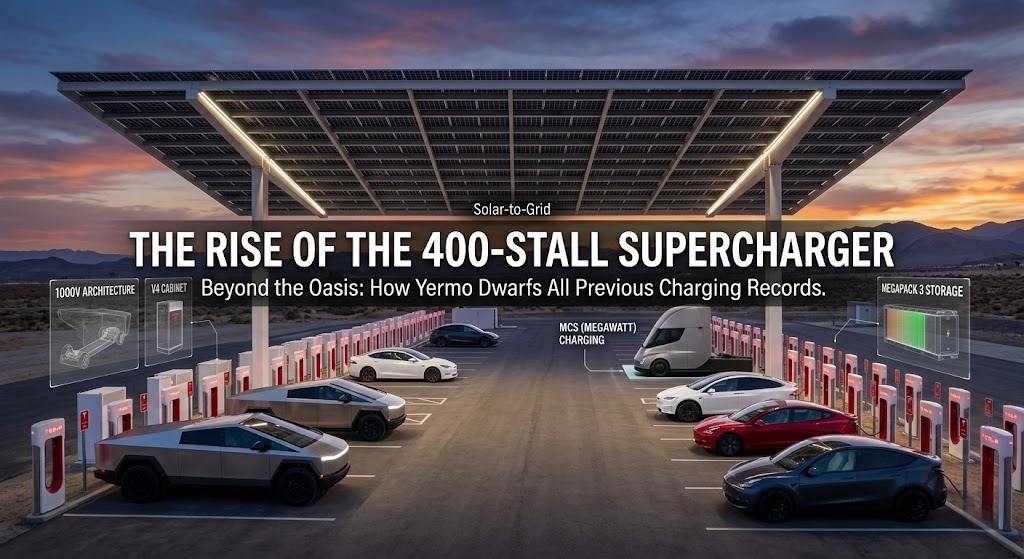
The 400-stall Yermo site is built entirely on Tesla’s V4 Cabinet architecture, which officially transitioned from pilot to mass deployment earlier this year. To understand why this matters, we must look under the hood of the new power electronics.
1.1 The 1000V Leap
Legacy V3 Superchargers were primarily 400V systems, optimized for the Model 3 and Model Y. However, the 2026 fleet—including the Cybertruck, the refreshed "Project Redwood" compact, and high-performance rivals like the Porsche Taycan—utilizes 800V to 1000V architectures. The V4 cabinet supports a voltage range of 180V to 1000V DC, allowing vehicles to pull massive power without the thermal bottlenecks that plagued older stations.
1.2 500kW for Cars, 1.2MW for Semis
The V4 dispensers at Eddie World 2 are rated for a peak output of 500kW per stall for passenger vehicles. For a Cybertruck owner, this means adding 200 miles of range in roughly 12 to 15 minutes. Even more impressive is the dedicated HGV (Heavy Goods Vehicle) section. Integrated into Phase 1 of the Yermo expansion are pull-through stalls equipped with the Megawatt Charging System (MCS), capable of delivering 1.2MW to the Tesla Semi, ensuring that the backbone of California’s freight can recharge during a mandatory 30-minute driver break.
Chapter 2: The Multi-Phase Strategy of Eddie World 2
Building 400 stalls at once would crush any local power grid. Tesla’s solution is a six-phase rollout that serves as a blueprint for future "Mega-Hubs" in Europe, particularly along the German Autobahn and the UK’s M1.
2.1 Phase 1: The 72-Stall Foundation
Construction on Phase 1 begins later this year, introducing 72 V4 stalls. This phase focuses on immediate congestion relief for the L.A.-to-Vegas weekend rush. Unlike traditional chargers tucked in the corner of a parking lot, these are arranged in high-throughput "drive-in" rows, minimizing the time spent maneuvering trailers or bike racks.
2.2 Scalability and the DC Busbar
One of the technical secrets revealed in the Yermo filings is the removal of the DC busbar between cabinets. Each V4 cabinet now powers eight stalls directly. This "isolated block" design improves reliability; if one cabinet fails, only eight stalls go down, rather than an entire row. This modularity allows Tesla to add 50 to 100 stalls at a time as demand justifies, without digging up the entire site’s electrical backbone.
Chapter 3: Microgrids, Solar, and the "Megapack" Moat
A site with 400 stalls can exceed 50 MW of peak power demand. To put that in perspective, that is enough to power a small city. Tesla cannot rely solely on the utility grid for this.
3.1 The On-Site Energy Buffer
The Yermo site will feature a massive installation of Megapack 3 units. These batteries serve two critical functions:
-
Peak Shaving: During mid-day when electricity prices are high, the station pulls from the Megapacks rather than the grid.
-
Grid Stabilization: During peak travel holidays (like Thanksgiving or Coachella), the Megapacks provide a "buffer," allowing 400 cars to charge simultaneously without causing a local blackout.
3.2 Solar Canopies: The Ownership Perk
For the premium Tesla owner, the experience is enhanced by massive solar canopies covering the stalls. Not only do these provide shade in the 110°F Mojave heat, but they also contribute roughly 1.5 GWh of clean energy annually to the site’s operations, lowering Tesla’s "cost of goods sold" for electricity.
Chapter 4: The Business of NACS Universalism
The Yermo project marks a milestone in Tesla's "Supercharger for Business" program. This site is not just for Teslas.
4.1 Non-Tesla Integration
With the North American Charging Standard (NACS) now the de facto industry standard, vehicles from Ford, GM, Rivian, and BMW will make up an estimated 30% of the traffic at Eddie World 2 by 2027. Tesla is capitalizing on this through tiered pricing. While Tesla owners enjoy discounted rates ($0.27–$0.37/kWh), non-Tesla owners pay a premium ($0.38–$0.52/kWh), turning the charging network into a high-margin "toll road" for the entire EV industry.
4.2 The Retail Ecosystem
The "charging experience" is evolving. Plans for the site include:
-
A 10,100 sq. ft. Cracker Barrel and a 4,300 sq. ft. McDonald's.
-
Luxury lounge areas with high-speed Starlink Wi-Fi.
-
Dedicated "Pet Relief" zones and "Kid Zones." Tesla understands that a 15-minute charge is a 15-minute retail opportunity.
Conclusion: The Supercharger Moat
As Tesla winds down production of its legacy Model S and X flagships in 2026 to focus on AI and Robotics, the Supercharger network is emerging as its most defensible asset. Competitors can build cars, but they cannot easily build a 400-stall, 1000V, Megapack-backed infrastructure at scale. The Yermo "Eddie World 2" project is the first of many. For the European market, expect to see similar "Giga-Hubs" appearing at the Port of Rotterdam and along the Scandinavian EV corridors by the end of 2026.
Frequently Asked Questions (FAQ)
Q: Can non-Teslas use all 400 stalls at the Yermo site? A: Yes. All stalls are V4 units with longer cables and NACS-to-CCS compatibility (via "Magic Dock" or adapters), designed to accommodate the charging ports of any EV brand.
Q: How does the 1MW charging work for the Tesla Semi? A: The site uses the specialized Megawatt Charging System (MCS) connector. While the cable is thicker and liquid-cooled, the power is drawn from the same V4 cabinet array that feeds the passenger car stalls, balanced dynamically by Tesla’s site controller.
Q: Why is Yermo the chosen location for the world's largest station? A: Yermo sits on the I-15, the primary artery for millions of travelers between Southern California and Las Vegas. It is one of the highest-utilization charging corridors in the world.
Q: Will this station support Vehicle-to-Grid (V2G)? A: While the V4 cabinets are hardware-capable for bi-directional charging, Tesla currently uses the on-site Megapacks for grid management rather than pulling power from customer car batteries.