
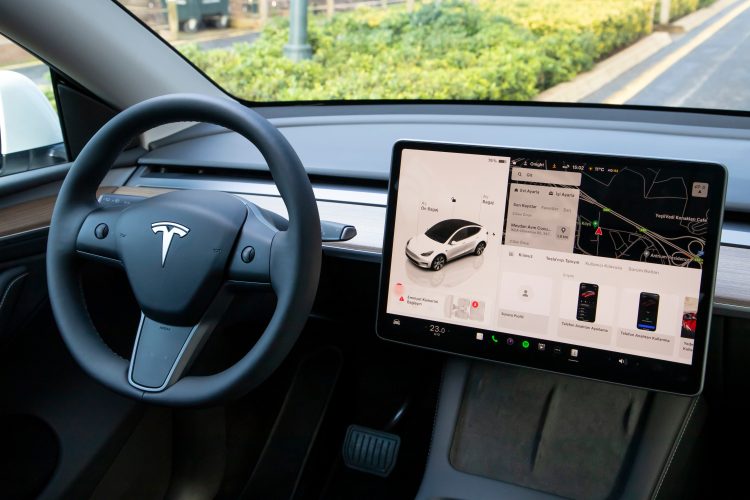
Tesla’s Full Self-Driving (FSD) system is once again at the center of political and regulatory attention. In late September 2025, two U.S. senators urged federal safety regulators to open an investigation into how FSD handles railroad crossings. The request reflects growing concerns that Tesla’s autonomous software, while increasingly advanced, may not consistently detect or react appropriately to these dangerous intersections between road and rail.
For Tesla drivers in the U.S. and Europe, this issue is not just political theater — it touches on safety, trust, and the future of Tesla’s autonomy roadmap. Railroad crossings are relatively rare compared to stoplights or intersections, but their risk profile is disproportionately high. A single failure could lead to catastrophic consequences, both in human lives and public trust in autonomous driving.
This article explores the controversy in depth. We’ll look at how Tesla’s FSD works, why railroad crossings are uniquely challenging, the senators’ motivations, regulatory responses, and what this moment could mean for Tesla owners and the broader EV ecosystem.
Tesla FSD: A Brief History and Context
The Evolution of Autonomy at Tesla
Tesla’s journey toward autonomy began with Autopilot in 2014, a Level 2 driver-assistance system offering adaptive cruise control and lane-keeping. Over time, Tesla introduced Enhanced Autopilot, then gradually expanded into more advanced capabilities under the FSD program. Key milestones include:
-
2016–2018: Enhanced Autopilot added automatic lane changes and summon.
-
2020: FSD Beta introduced city street navigation.
-
2024: FSD Supervised broadened to a general release across the U.S. and parts of Europe.
Unlike competitors, Tesla pursues a vision-only approach, relying on cameras and AI rather than lidar. The company argues that this mimics human driving more closely, but critics warn that it can leave blind spots in edge cases.
Safety and Controversy
Tesla regularly publishes safety reports claiming fewer accidents per mile than human drivers. However, independent studies have painted a mixed picture, especially in scenarios involving unusual road geometry, emergency vehicles, or complex urban conditions.
The railroad crossing investigation request marks the first time U.S. lawmakers have zeroed in on a very specific driving scenario, signaling a shift toward holding Tesla accountable for particular technical weaknesses rather than broad generalities.
Railroad Crossings: Why They Matter
A Unique Safety Challenge
Railroad crossings present unique challenges even for human drivers:
-
Signage and signals vary widely across states and countries.
-
Some crossings use gates and flashing lights, while others rely only on painted road markings.
-
Trains move fast but silently, and once visible, stopping distances are extremely short.
For an AI-driven system like FSD, these conditions can be problematic. Vision-only systems must detect flashing lights, interpret crossbuck signs, and predict train movement with limited warning.
Historical Accidents and Lessons
In the U.S., the National Transportation Safety Board (NTSB) has documented numerous car-train collisions over the years, often linked to human error such as misjudging train speed or ignoring signals. For Tesla, replicating human-like perception without replicating human error is the core challenge.
International Context
Europe has fewer publicized incidents but stricter rules. In countries like Germany and the UK, regulators already demand advanced driver monitoring. An FSD failure at a European crossing could trigger even harsher restrictions than in the U.S.
The Senators’ Investigation Request
Who Raised the Alarm?
In late September 2025, Senator A (D) and Senator B (R) jointly submitted a formal request to the NHTSA, calling for an investigation into Tesla’s FSD handling of railroad crossings. Their letter cited:
-
Reports from Tesla owners on forums and social media describing FSD hesitating or misjudging crossings.
-
Safety advocates warning that Tesla’s system may not fully comply with U.S. standards for railroad intersection safety.
-
The broader public trust issue: if drivers believe FSD can handle everything but it fails in rare, deadly scenarios, confidence in autonomy will collapse.
Why Now?
The timing reflects several converging pressures:
-
Political climate: Autonomy and AI are under heavier scrutiny.
-
Tesla expansion: With FSD rolling out to more European markets, lawmakers want to get ahead of potential accidents.
-
Election season: Lawmakers can frame themselves as proactive on safety.
Regulatory and Legal Implications
U.S. Framework
The NHTSA has authority to launch investigations and order recalls if defects are found. If they determine FSD poses a risk at crossings, Tesla could be forced to:
-
Issue software fixes.
-
Update manuals with stronger warnings.
-
Potentially limit features until compliance is demonstrated.
Europe’s Stance
European regulators, including Germany’s KBA and the EU Commission, have traditionally been stricter than the U.S. If this issue gains attention in America, it’s likely European authorities will launch parallel inquiries.
Potential Liability
If an FSD-related crash occurs at a railroad crossing, Tesla could face lawsuits alleging product defects or misleading marketing. Past cases involving Autopilot crashes suggest courts are increasingly willing to scrutinize Tesla’s language around “self-driving.”
Impact on Tesla Owners
Trust and Perception
For Tesla drivers in the U.S. and Europe, this news is a double-edged sword. On one hand, scrutiny may lead to safer software. On the other, it raises questions about whether FSD is as reliable as Tesla claims.
Practical Implications
If regulators impose restrictions, owners could see:
-
Temporary disabling of FSD at crossings.
-
More intrusive driver-monitoring prompts.
-
Slower rollout of future features in Europe.
Owner Responsibility
Despite the controversy, Tesla still emphasizes that FSD is driver-supervised. Legally, the person behind the wheel is responsible, even if FSD is engaged. This reality will likely be reinforced if regulators tighten oversight.
Industry and Competitive Reactions
Rivals Watching Closely
Competitors like Waymo, Cruise, and Mercedes-Benz are monitoring Tesla’s challenges. Mercedes in particular, with its Level 3 Drive Pilot, may use Tesla’s struggles to highlight its own compliance-oriented approach.
Broader AV Industry Impact
If Tesla is forced to address railroad crossings explicitly, it may set a precedent for specific edge-case accountability in autonomous driving. That could reshape regulatory expectations for all players in the space.
The Future of Tesla FSD After the Probe
Possible Outcomes
-
Minor Fix, Quick Resolution: Tesla updates software, issue fades.
-
Extended Scrutiny: NHTSA or EU authorities demand long-term monitoring.
-
Severe Restriction: Regulators temporarily limit FSD functions.
Strategic Implications for Tesla
-
If Tesla navigates this successfully, it may emerge stronger, demonstrating accountability.
-
If mishandled, the brand risks eroding its image as a pioneer of safe, cutting-edge technology.
Consumer Advice
For now, Tesla owners should:
-
Stay alert when approaching railroad crossings.
-
Treat FSD as an aid, not a replacement.
-
Monitor regulatory updates in their region.
Conclusion
The senators’ call for an investigation into Tesla FSD’s handling of railroad crossings is more than a headline — it’s a test of Tesla’s technical claims, regulatory resilience, and public trust. Railroad crossings are rare but unforgiving, making them a critical benchmark for autonomous safety.
For Tesla, the coming months could either reinforce its reputation as a leader in AI-driven mobility or expose vulnerabilities that competitors and regulators will exploit. For Tesla owners, vigilance remains key: no matter how advanced the software, human oversight is still the ultimate safeguard.
FAQ
Q1: Does Tesla FSD currently recognize railroad crossings?
Yes, FSD is designed to recognize crossings, but concerns remain about consistency across varied crossing designs.
Q2: Has there been a fatal Tesla crash at a railroad crossing?
As of September 2025, no widely publicized FSD-related railroad crossing fatalities have been reported. However, safety advocates warn the risk remains.
Q3: How does Europe regulate FSD differently than the U.S.?
Europe generally imposes stricter limits, requiring driver monitoring and restricting autonomous features unless thoroughly tested.
Q4: Could this investigation stop Tesla from selling FSD in the U.S. or EU?
Unlikely, but it could lead to feature restrictions or mandatory software updates.
Q5: Should Tesla owners turn off FSD near railroad crossings?
Tesla advises drivers to stay attentive at all times. Given the scrutiny, extra caution at crossings is advisable.