
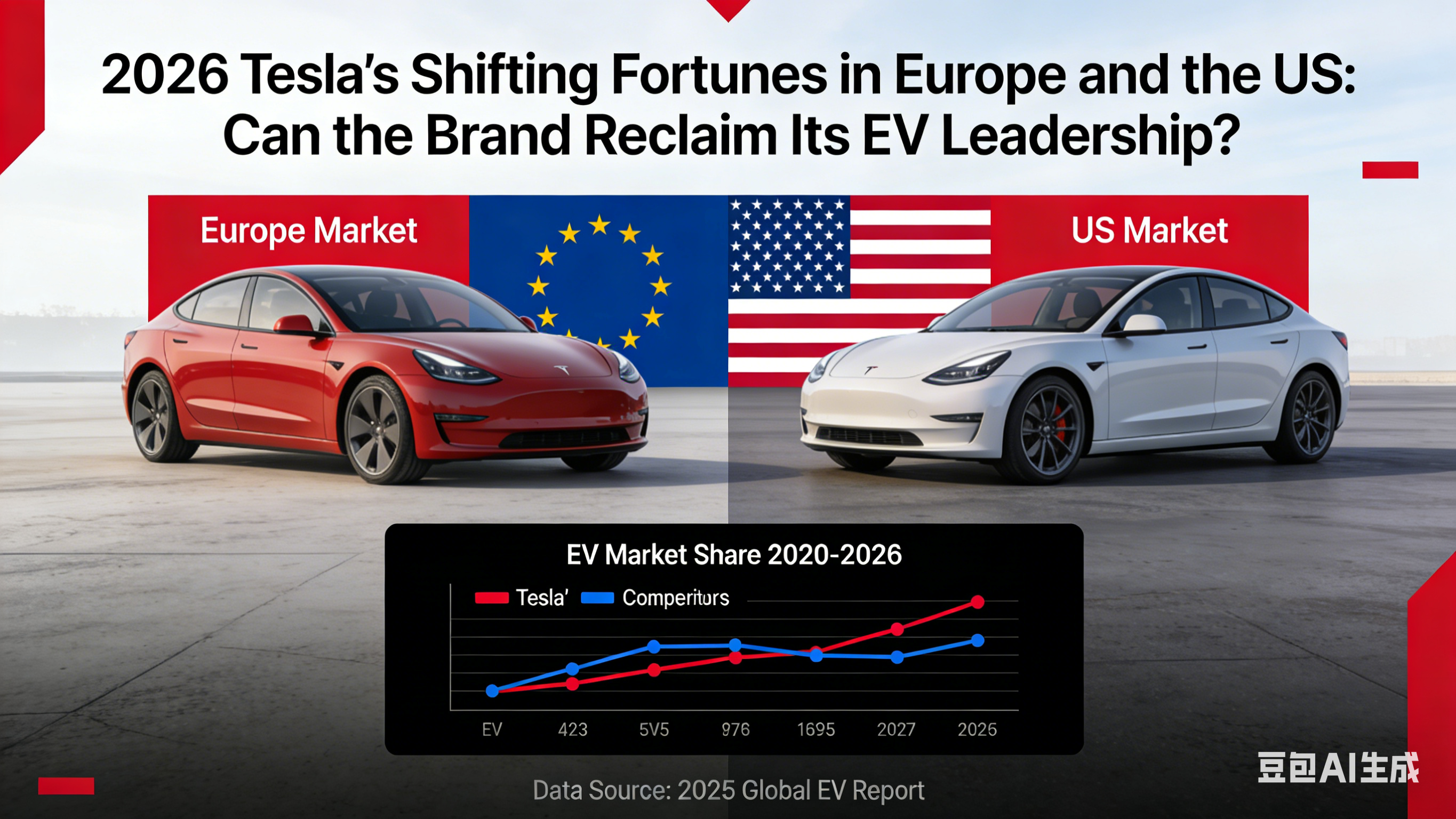
Tesla’s position in Europe and the US is shifting from “unquestioned EV leader” to “strong but challenged incumbent,” and that change matters a lot for how owners and potential buyers think about the brand today. In this article, we will unpack what is happening in the data, why Europe is moving faster than the US in turning away from Tesla, and what it means for drivers on both sides of the Atlantic.
Introduction: From Dominance to Pressure
For most of the 2010s and early 2020s, Tesla was practically synonymous with electric vehicles in the US and Europe. It offered an unmatched range, a unique brand identity, and a charging network that rivals simply did not have. That combination allowed Tesla to dominate EV registrations in many Western markets, especially with the Model 3 and Model Y.
By early 2026, however, that picture looks more complicated. In Europe, Tesla has lost its crown as the top seller of fully electric vehicles to Volkswagen, which now leads the region’s BEV sales. At the same time, Tesla is seeing steep registration drops in some of its most mature European markets, even while EVs overall continue to grow. In the US, Tesla is still the most visible EV brand and retains strong absolute sales, but it is facing slowing growth, heavier competition, and more skeptical investors.
This is not a collapse story; it is a maturation story. Tesla is no longer the only serious EV option. That shift forces the company to adjust its strategy, and it forces owners and shoppers to rethink how they evaluate the brand going forward.
Europe 2026: A Sharp Slowdown in Key Markets
The Numbers: Where Tesla Is Losing Ground
Recent registration data across a dozen European countries for January 2026 shows a mixed but overall negative picture. Total Tesla sales in those twelve markets fell from 6,925 vehicles in January 2025 to 5,351 in January 2026—a drop of about 23%, while overall EV adoption in Europe continued to rise.
The most concerning declines are in Tesla’s earlier “strongholds”:
-
United Kingdom
-
January 2025: 1,450 registrations (5% EV share)
-
January 2026: 714 registrations (2.5% EV share)
-
Result: 51% drop in volume, halving its EV share in a single year.
Separate data cited for the UK shows an even steeper percentage decline when using a slightly different dataset (647 registrations, down more than 57% year-over-year), but the message is the same: Tesla’s presence in Britain has weakened sharply.
-
-
Netherlands
-
January 2025: 927 registrations (8.1% share)
-
January 2026: 303 registrations (4.3% share)
-
Result: 67% drop in volume and a collapse in share in one of Europe’s most EV‑friendly markets.
-
-
Norway
-
January 2025: 687 registrations (7.5% share)
-
January 2026: 83 registrations (2.9% share)
-
Result: 88% volume drop in the country that was once cited as a Tesla showcase.
-
-
Switzerland
-
January 2025: 239 registrations (7.7% share)
-
January 2026: 68 registrations (2.2% share)
-
Result: 72% decline in sales, with share falling more than five percentage points.
-
In Denmark and Portugal, unit sales held roughly flat but market share still slipped as competitors grew faster, indicating that Tesla is not keeping pace even where volumes are stable.
At the same time, there are bright spots:
-
Italy
-
Sales increased 77% year-over-year (from 406 to 710), with market share rising from 6.2% to 7.7%.
-
-
Spain
-
Registrations rose 70% (from 269 to 458), and market share jumped from 4.7% to 6.4%.
-
-
Finland
-
Sales surged 286% (58 to 224 vehicles), with market share reaching 9%.
-
-
Sweden
-
Sales grew 30%, though overall EV growth kept Tesla’s share nearly flat.
-
Viewed together, the pattern is clear: Tesla is losing momentum in mature, high-income Northern European markets where early adopters already own EVs and where competition has intensified. It is holding its own or growing in some Southern and smaller markets where the EV transition is still earlier in the curve.
Volkswagen Takes the European EV Crown
The loss of the number-one BEV seller position in Europe is symbolically powerful and strategically important. In 2025, Volkswagen’s battery-electric sales in Europe rose 56% versus 2024, reaching about 274,278 units, while Tesla’s registrations fell 27% to roughly 236,357. This shift did not happen because EV demand suddenly dried up; EV registrations across Europe actually rose about 29% year-over-year, far outpacing the roughly 2.3% growth in total car sales.
Volkswagen’s advantage in Europe is not just one brand. It operates a portfolio that includes VW, Audi, Skoda, Cupra, and Porsche, each targeting different segments and tastes, from affordable hatchbacks to premium performance vehicles. That allows Volkswagen to saturate European niches with models tailored to local preferences and price points, something Tesla has not yet matched with its comparatively narrow lineup.
The fact that the Model Y remained Europe’s most-registered single vehicle (around 150,000 units in 2025) but still saw registrations fall about 28% year-over-year underscores the issue. Tesla is increasingly reliant on two core models that many buyers now view as “familiar” rather than irresistibly new.
United States: Still Strong, But Showing Cracks
In the United States, Tesla’s situation is different. The company still commands a dominant share of the EV market, and its brand remains synonymous with electric performance for many consumers. But there are early signs that the easy growth phase is over.
Slowing EV Growth and Price Pressure
US EV sales are still growing, but the pace has slowed from earlier double-digit surges. Several automakers have scaled back or reprioritized EV investments, citing softer-than-expected demand in some segments and concerns over profitability. Tesla reacted to these dynamics in 2023–2025 with repeated price cuts on the Model 3 and Model Y, which supported volumes but squeezed margins.
By early 2026, Tesla’s share price had fallen more than 5% year-to-date, with early gains driven by optimism around robotaxis and AI giving way to broader tech-sector selloffs and worries about core EV margins. For investors, this raises questions about the sustainability of aggressive price competition; for owners, it indirectly feeds into concerns about residual values and the brand’s long‑term financial strength.
Rising Competition on Home Turf
US competition is intensifying from multiple directions:
-
Traditional automakers (Ford, GM, Hyundai-Kia, Toyota, and others) are rolling out more competitive EVs, especially in crossovers, pickups, and SUVs.
-
EV‑focused brands like Rivian and Lucid are carving out premium and adventure niches.
-
Chinese brands have not yet penetrated the US as they have in Europe, but concerns about future import competition and tariffs loom in the background.
These rivals are learning quickly from Tesla’s formula—software-centric design, OTA updates, integrated charging—but adding their own strengths in build quality, ride comfort, and dealer networks. Tesla’s advantage is no longer a decade-wide gap; it is a narrowing lead.
Why Europe Turned So Quickly: Structural and Cultural Drivers
The speed and severity of Tesla’s European slowdown require more than a purely competitive explanation. Several structural and cultural factors are converging at once.
Policy and Subsidy Shifts
European governments were early leaders in incentivizing EV adoption through generous purchase subsidies, tax advantages, and company-car incentives. In the early wave, Tesla benefited greatly because it had compelling products ready while competitors were still catching up.
As more automakers now offer compliant, fully electric models, the policy environment has shifted in three key ways:
-
Subsidies are being refocused from direct manufacturer advantage toward broader consumer and infrastructure support.
-
Eligibility criteria are broader, so more brands now qualify for similar incentives Tesla once enjoyed relatively alone.
-
Environmental and industrial policy are converging, meaning policymakers are more inclined to favor solutions that also support local manufacturing and jobs, where European brands have an edge.
In markets like the UK, Norway, and the Netherlands, once EV penetration reaches a certain threshold, governments have also started reducing or restructuring subsidies, which reduces the price advantage of EVs, including Tesla’s, and pushes buyers to think more about brand and ownership experience rather than just “EV vs combustion.”
Local Brands Fight Back with Tailored Products
Volkswagen’s ascendancy is the clearest example of how European incumbents are leveraging their strengths: a broad portfolio, deep dealer and service networks, and an understanding of local tastes. Models like the ID series are designed from the ground up with European urban density, parking constraints, and driving patterns in mind.
The Barchart analysis highlights Tesla’s limited European lineup—essentially the Model 3 and Model Y—and notes that these vehicles are starting to feel dated compared to newer rivals. While Tesla has introduced more affordable “Standard” versions of both, they have not produced the expected sales boost, partly because many buyers see them as compromised on value relative to similarly priced competitors.
Moreover, Tesla’s vehicles are physically larger than the compact hatchbacks and city cars that dominate many European streets. The article points out that a smaller, more affordable model (sometimes referred to as “Model 2” or “Model Q”) could be crucial in addressing this mismatch, tapping into the segment that vehicles like the Dacia Sandero have dominated. Without such a product, Tesla is effectively competing from the mid-size segment downward, not from the city-car segment upward.
Brand Image and Political Context
In Europe’s political and cultural environment, brand perception is deeply intertwined with perceived social responsibility. Tesla has historically benefited from being framed as a climate-conscious disruptor, but that narrative is under pressure.
According to the Barchart piece, Tesla has faced consumer backlash in Europe over CEO Elon Musk’s support for far-right parties on the continent. Analysts cited in that article argue that this has damaged the brand and that the recovery process could be slow and incomplete. For a significant portion of European buyers, especially in urban and progressive regions, this political association clashes with their self-image as environmentally and socially conscious consumers.
Combined with concerns over build quality, labor relations, and communication style, these political factors erode some of the intangible premium that Tesla once enjoyed, especially when viable alternatives now exist.
Tesla’s Strategic Options: Beyond Price Cuts
Tesla’s response will determine whether current trends become a long-term loss of share or a temporary reset. The data suggests that simple price cutting is not enough; more structural moves are required.
Expanding and Refreshing the Product Lineup
The first challenge is product age and variety. Analysts note that Tesla’s lineup in Europe is narrow and increasingly perceived as aging versus fresh competitors.
Key strategic options include:
-
Major refreshes of Model 3 and Model Y: Not just cosmetic changes, but substantial updates to interior materials, NVH (noise, vibration, harshness), infotainment, and driver assistance behavior. This would counter the “stale lineup” narrative and give existing owners a compelling upgrade path.
-
Introducing a smaller, cheaper model: A compact hatch or small crossover designed specifically for European streets could unlock a much larger segment of the market. A vehicle leveraging a lower-cost “Cybercab” platform, as discussed in some reports, could serve both as a consumer model and a future robotaxi base, aligning short-term market needs with long-term autonomy ambitions.
Without these moves, Tesla risks being pigeonholed as a two-model brand in a market that values diversity and tight segmentation.
Doubling Down on Software and FSD
On the software side, Tesla still has a potential ace: Full Self‑Driving (FSD). At the World Economic Forum in Davos, Elon Musk suggested that Tesla could win regulatory approval in Europe for its driver‑supervised FSD system as early as February, with Dutch regulator RDW expected to play a key role. Once approved in the Netherlands, there is a path for other EU countries to recognize the exemption, enabling an earlier rollout ahead of a formal EU‑wide decision.
If Tesla can successfully deploy supervised FSD in Europe:
-
It reinforces the brand’s tech-forward image, shifting the conversation from “dated hardware” to “advanced software.”
-
It opens up a recurring revenue stream via FSD subscriptions, lessening dependence on vehicle margins.
-
It differentiates Tesla from competitors whose driver-assistance systems are more conservative and often geo‑limited.
However, success here depends on execution, regulatory trust, and user experience. If FSD behaves inconsistently in dense European cities, or if high‑profile incidents occur, it could backfire and worsen the brand’s regulatory and public perception issues.
Rebuilding the European Brand
Barchart’s analysis suggests that Tesla’s damaged image is not something that can be repaired quickly and that analysts warn of a long path to recovery. A more localized, neutral, and professional PR strategy tailored to Europe is one proposed solution.
Concrete steps could include:
-
Establishing stronger local communication teams that engage with European media, regulators, and consumer groups in their own languages and cultural frames.
-
Emphasizing safety, sustainability, and reliability in marketing, rather than focusing solely on performance and disruption.
-
Separating, as much as feasible, the corporate brand voice from highly polarizing personal statements by leadership, particularly in political contexts.
If Tesla fails to adjust its communication strategy, it risks leaving brand reputation entirely at the mercy of external commentary and social media narratives.
Implications for US and European Tesla Owners
For current and prospective owners, Tesla’s shifting market position raises practical questions: What does this mean for my car’s value, my service experience, and my long‑term confidence in the brand?
Residual Value and the Used Market
In Europe, a combination of lower new‑car prices, more competition, and slowing Tesla registrations in some markets will likely compress residual values relative to the 2020–2022 period. The CleanTechnica analysis already shows that in some mature EV markets, Tesla’s share has dropped sharply, which can alter buyer psychology in the used market.
However, several factors can support the use of Tesla values:
-
The Supercharger network still offers a uniquely convenient long‑distance experience, particularly in countries where public charging is patchy.
-
Regular over‑the‑air updates improve software, efficiency, and sometimes features over time, extending perceived vehicle “freshness.”
-
If FSD or other paid software options are transferable, they can add meaningful value to a used car relative to similarly priced competitors.
In the US, Tesla residuals will also be influenced by price cuts and new competitors, but the brand’s larger market share and charging ecosystem may preserve stronger relative values for longer.
Service, Parts, and Long-Term Support
Tesla’s financial health remains solid: it has a large market capitalization and diversified revenue streams that now include energy storage and AI/robotics projects. This reduces the risk that short‑term European slowdowns translate into abrupt service retrenchment.
Nonetheless, the company faces execution challenges:
-
As the global fleet grows, Tesla must continue scaling service centers, mobile service, and parts logistics.
-
In European markets where new sales are cooling, the business case for additional service infrastructure may be weaker, raising concerns about future quality and accessibility of support.
Owners should monitor local announcements around new or expanded service centers and pay attention to wait times for appointments and parts. These are better indicators of long‑term support than quarterly stock moves.
How Owners Should React Today
For existing owners:
-
A short‑term drop in registrations or a change in European market share does not alter the intrinsic mechanical or software quality of the car you already own.
-
It may reduce the resale value you can expect in two or three years compared with earlier boom times, but that effect will vary widely by country, model, and mileage.
For potential buyers:
-
A more competitive market often makes this a good time to buy in terms of price and choice.
-
You should weigh not just Tesla’s current pricing but also the total cost of ownership, including electricity prices, insurance, local subsidies, and service access in your region.
Conclusion: A Mature Phase, Not the End of the Story
Tesla’s 2026 reality in Europe and the US is complex. It has lost its first‑mover monopoly and now faces tough competition from both European incumbents and Chinese entrants in some markets. In key European countries, registrations have dropped sharply, and Volkswagen has overtaken Tesla as the region’s top BEV seller. At the same time, Tesla is still growing in other parts of Europe, retains a dominant position in the US EV market, and continues to invest heavily in software, autonomy, and energy.
The crucial question is not whether Tesla can instantly reclaim lost share in Europe; it is whether the company can stabilize its performance, refresh its lineup, repair its brand, and execute on its software and FSD ambitions. For owners and shoppers, the most productive stance is not panic but clarity: understand where Tesla truly stands, recognize the risks and opportunities in your specific market, and make decisions based on your own use case rather than on headlines alone.
FAQ
Q1: Is Tesla still a safe bet compared to new EV brands in Europe?
From a product and infrastructure perspective, Tesla remains a relatively safe choice in Europe: it offers proven vehicles, a large installed base, and one of the most mature fast-charging networks. However, in several countries, its market share is declining, and buyers should compare local service availability, incentives, and competing models before deciding.
Q2: How will Tesla’s sales slowdown in Europe affect my car’s resale value?
Lower new‑car demand and aggressive pricing can put downward pressure on used values, particularly in markets like the UK, Norway, the Netherlands, and Switzerland where registrations have fallen sharply. On the other hand, strong charging infrastructure and software updates can support residuals relative to non‑Tesla EVs, especially where competing charging networks are weaker.
Q3: Should US owners worry about Tesla’s service quality as the brand scales?
The bigger risk for service quality is execution strain, not immediate financial weakness. Tesla’s market cap and diversified business lines suggest it has resources to keep investing in service and infrastructure, but owners in both the US and Europe should watch local center openings, appointment lead times, and parts availability as practical indicators.
Q4: Will Tesla’s future focus more on software than on hardware?
Tesla is clearly positioning itself as more than a hardware company, with growing emphasis on FSD, AI, and robotics. That does not mean hardware becomes irrelevant, but it does suggest that future differentiation—and profit—will increasingly come from software capabilities, autonomy, and integrated energy solutions rather than just from the physical car.
Q5: How should I interpret TSLA stock swings as an owner, not an investor?
Stock volatility often reflects investor debate over long‑term growth, margins, and new business lines like robotaxis and AI. As an owner, the more relevant questions are whether Tesla is maintaining strong cash flow, investing in service and infrastructure, and continuing to support your model with updates; day‑to‑day share price moves are less important than those fundamentals.