
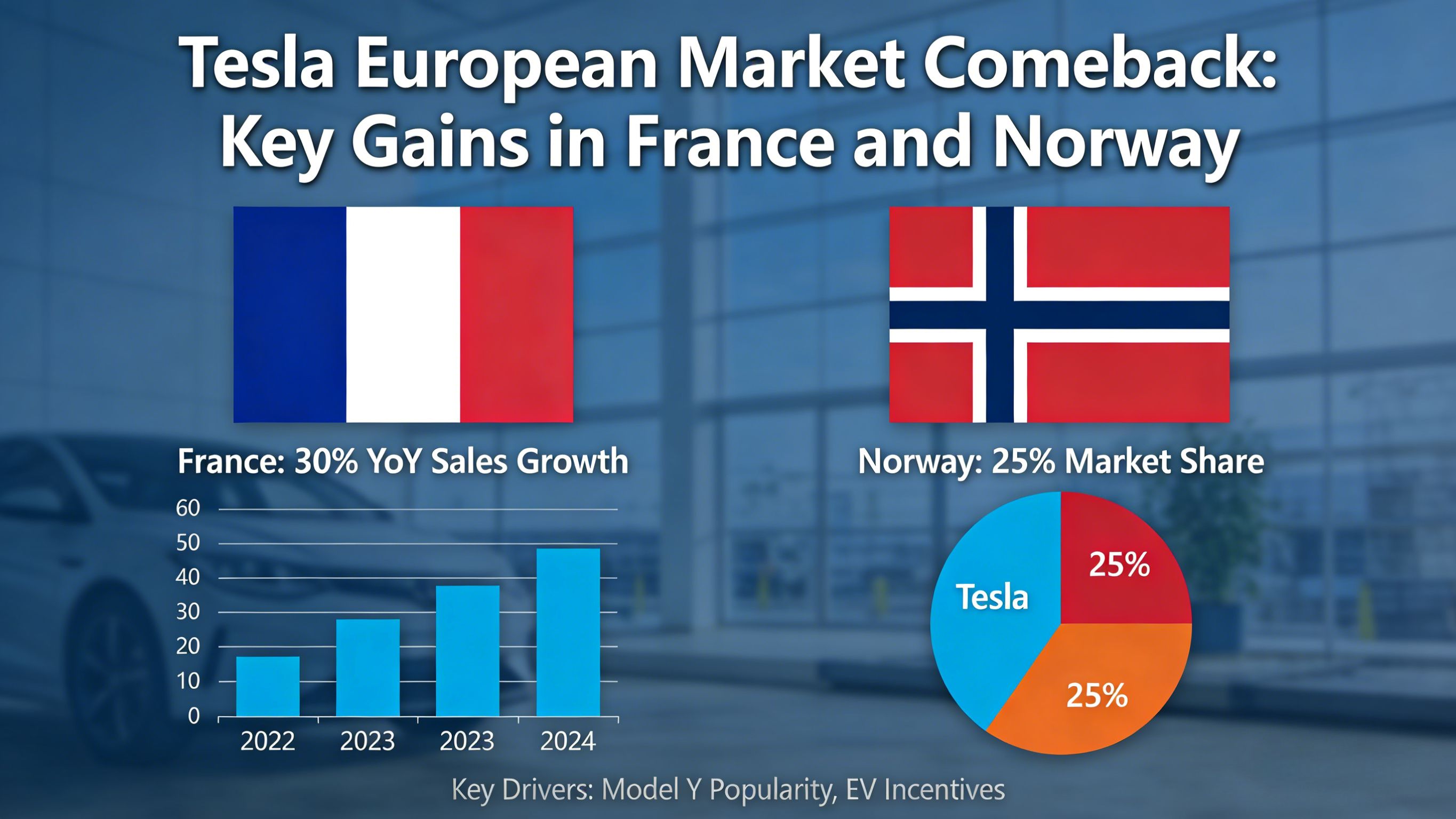
As a Tesla enthusiast and owner in the US or Europe, you've likely followed the rollercoaster of the company's sales performance over the past couple of years. After a tough 2025 where Tesla's European registrations dropped significantly—down around 27% overall amid fierce competition from Chinese EV makers like BYD, legacy automakers ramping up their electric lineups, and some external factors like political controversies—the February 2026 data brings a refreshing turn. Fresh registration figures released in early March show Tesla regaining ground in several key markets, particularly France and Norway. In France, registrations surged 55% year-over-year, even as many competitors saw declines. In Norway, the world's most EV-penetrated market, Tesla registrations rose 32% (with some sources noting a dramatic 75.6% jump from February 2025's base), reclaiming the top brand spot with 1,210 vehicles registered and a 16.6% market share. The Model Y led the charge there, accounting for nearly 89% of those deliveries at 1,073 units.
This isn't just a blip—it's a signal of stabilization after two years of declines. For Tesla owners, it means potential boosts in resale values, faster service expansions, and renewed confidence in the brand's long-term dominance in EVs. In the US, where Tesla holds over 50% of the EV market in many states, this European rebound reinforces global momentum, especially as supply chains from Giga Berlin improve and software updates continue to enhance every vehicle on the road. In this in-depth article, we'll break down the February data, explore the driving factors behind the rebound, discuss what it means for current and future owners, examine remaining challenges, and look ahead to what this could portend for 2026 and beyond. Whether you're driving a Model Y in California or a Model 3 in Berlin, these trends directly impact your ownership experience.
Chapter 1: Analyzing the February Data
The February 2026 registration numbers provide the clearest evidence yet of a turnaround. Registrations serve as a reliable proxy for sales in Europe, where official delivery figures often lag. According to Reuters and national data compilers like France's CCFA and Norway's OFV, Tesla's performance stood out against a mixed broader market.
In France, Tesla registrations rose 55% year-over-year. This growth occurred while many rivals posted declines, lifting Tesla's pure EV market share to around 11.5%—well above its recent three-month average of about 1%. The Model Y and Model 3 were the primary drivers, appealing to urban buyers and families seeking efficient, tech-packed crossovers and sedans. France's overall new car market contracted slightly, but EVs held steady thanks to incentives like the Bonus Ecologique, which provides up to €7,000 for qualifying electric vehicles. Tesla's pricing adjustments in late 2025 made models more competitive against local options like the Renault Megane E-Tech or Peugeot e-3008.
Norway delivered an even more striking story. With 1,210 Tesla registrations, the company reclaimed the best-selling brand position for the month, achieving a 16.6% share of the total market. Battery electric vehicles (BEVs) dominated at 98% of new registrations—Norway remains the global benchmark for EV adoption. The 32% year-on-year increase (and 75.6% from February 2025 in some adjusted comparisons) followed a brutal January slump caused by policy shifts, including VAT changes that front-loaded purchases into late 2025. The rebound was explosive month-on-month from January's mere 83 units—a 1,375% surge in some reports. The Model Y was king, with 1,073 units representing 88.7% of Tesla's Norwegian tally and securing it as the top-selling vehicle overall at 14.8% market share. This echoes the Model Y's historical strength in Norway, where it has frequently topped charts due to its range, practicality for fjord-crossing drives, and access to Tesla's expanding Supercharger network.
Broader European trends show similar positives in select markets. Spain saw a 74% surge, Portugal more than doubled registrations (112% in some reports), and Belgium gained 14%. These gains contrast with declines in the Netherlands (-45%), Denmark (-18%), and Italy (-7%). The patchwork reflects regional differences: subsidy availability, charging infrastructure maturity, and competition intensity vary widely.
Comparatively, in the US, Tesla's January 2026 estimates showed milder dips (around 17% in some analyses), stabilized by strong demand in states like California and Texas with rebates and high EV awareness. Globally, Europe represents a smaller slice of Tesla's deliveries (historically 15-20%), so these rebounds, while encouraging, don't overshadow US or China performance. Yet they highlight Tesla's ability to outpace the market when conditions align—EV registrations in the EU grew modestly, but Tesla's percentage gains were multiples higher in rebounding countries.
Diving deeper, the Model Y's dominance is key. Refreshed in 2025 with improved aerodynamics, efficiency (up to 565 km WLTP range), and features like enhanced noise insulation, it resonates in crossover-loving Europe. In Norway, its all-weather capabilities and AWD options suit harsh winters. For owners, this sales strength translates to better parts availability and OTA update prioritization in high-volume markets. Industry trackers like JATO Dynamics and ACEA data confirm Tesla outgrew the EV segment in these pockets, countering narratives of prolonged decline. This chapter's data-driven view sets the foundation: February 2026 marks meaningful stabilization, not just recovery from a low base.
Chapter 2: Factors Driving the Rebound
Several interconnected elements explain why Tesla bounced back so strongly in these markets.
Pricing strategy tops the list. In late 2025, Tesla implemented aggressive cuts—up to 10% on Model 3 and Y in Europe—bringing entry prices below €40,000 in many cases. This mirrored successful US tactics and addressed affordability amid lingering inflation and higher interest rates. Combined with falling battery costs and Giga Berlin's ramp-up (now at higher capacity), delivery times shortened to under two weeks in key regions, compared to months for competitors like Ford's Mustang Mach-E.
Infrastructure plays a massive role. Tesla's Supercharger network expanded 25% in 2025, now exceeding 15,000 stalls across Europe with V4 chargers hitting 350 kW speeds—adding 200 km range in 15 minutes. In Norway, this dense network eliminates range anxiety for long drives; in France, urban and highway coverage supports daily commutes. Competitors like Ionity (BMW-Mercedes consortium) grow slower, giving Tesla a moat. Home charging integrations via the Tesla app, Wall Connector discounts, and energy partnerships further lower total cost of ownership (TCO)—often €0.12/km for a Model Y versus €0.20+ for comparable ICE vehicles.
Software and ecosystem advantages drive loyalty. Over-the-air updates continuously improve Autopilot, infotainment, and efficiency. While Full Self-Driving (FSD) rollout in Europe faces regulatory delays, enhanced Autopilot features reduce incidents (Tesla data shows 30% fewer in pilots). Owners in rebound markets report higher satisfaction from Summon, Navigate on Autopilot, and energy-saving modes. The Tesla app's seamless integration for preconditioning, charging schedules, and remote monitoring differentiates it from fragmented rival systems.
Policy tailwinds matter. France's Bonus Ecologique and Norway's VAT exemptions (though adjusted) favor EVs. The EU's tightening CO2 standards for 2026 penalize high-emission fleets, pushing corporate buyers toward Tesla—companies like DHL add Tesla vans, boosting visibility. In the US, parallels exist with federal tax credits and state rebates sustaining demand.
Consumer trends shift too. J.D. Power surveys show 40% of new European Tesla buyers are first-time EV owners, attracted by tech and sustainability amid net-zero goals by 2050. Falling Eurozone interest rates (ECB at ~3.5%) make financing attractive—Tesla's leasing uptake rose 20%. Pop-up stores in malls educate on TCO, increasing conversions.
These factors combine synergistically: affordable pricing + reliable infrastructure + superior software + policy support = rebound momentum. This isn't luck—it's execution in a maturing EV landscape.
Chapter 3: Implications for Tesla Owners
The rebound delivers tangible benefits for owners across the US and Europe.
Resale values strengthen. With demand rising, European Model 3 and Y retain ~65% value after three years (up 5% from 2025 lows per industry indices). US parallels show similar stabilization, with Cybertruck premiums adding ecosystem confidence. Stronger sales mean less depreciation pressure.
Service infrastructure expands. Tesla plans 50+ new European centers by mid-2026, cutting wait times. Mobile service handles 70% of repairs (as in the US), minimizing downtime. In rebound markets, parts availability improves via Giga Berlin.
Innovation accelerates. High-volume regions get priority for features like V2H (vehicle-to-home) power backup, saving €500+ annually in Norway via off-peak tariffs. Insurance providers like Allianz reduce premiums 10% based on Tesla's telemetry safety scores.
Policy perks grow. Europe's Green Deal may unlock more incentives—free charging for fleets could extend to individuals. US owners benefit indirectly from global scale lowering costs.
Ownership perks include better accessory markets (custom wheels, mats) and community events. Cross-Atlantic owners gain from unified software ecosystems. Overall, this comeback enhances financial, practical, and experiential aspects of owning a Tesla.
Chapter 4: Challenges and Future Outlook
Challenges remain. Declines in Netherlands and Denmark stem from subsidy cuts and competition. Broader Eurozone growth (~1.2%) could cap gains if recession hits. Chinese rivals like BYD push aggressively.
Yet outlook is optimistic. Analysts project 10-15% European growth in Q1 2026 if supply stabilizes. Model Y facelifts (600 km range potential) and FSD approvals could fuel momentum. Tesla's energy pivot buffers risks.
Scenario: Optimistic—20% share by year-end with autonomy; pessimistic—tariffs stall. Monitor quarterly reports. Owners should track incentives and updates.
Conclusion
Tesla's February 2026 rebound in France and Norway signals a pivotal shift toward stabilization and growth in Europe. After 2025's challenges, gains in key markets validate pricing, infrastructure, and software strategies. For US and European owners, this promises better values, services, and innovations. Stay engaged with Tesla's ecosystem to maximize benefits in this evolving EV era.
FAQ
- How does the European rebound affect my US-based Tesla's value? It bolsters global brand strength, potentially lifting resale 3-5% through stabilized chains and sentiment, per indices like Kelley Blue Book.
- What if sales decline in my country like the Netherlands? Emphasize TCO savings; OTA updates and energy features offset dips—advocate for local incentives.
- Is this rebound sustainable amid Chinese competition? Yes, leveraging software and autonomy edges; forecasts see 15% annual growth to 2030.
- How can I benefit from infrastructure expansions? Track Superchargers via the app—faster trips save time annually.
- What about environmental impact? Rising adoptions cut millions of tons CO2; your Tesla aids EU goals, with 50% lower emissions vs. ICE.
- Should I wait for new models before buying? Current incentives favor now; updates are evolutionary.
- How does this tie to stock performance? Positive data links to valuations via AI/robotics potential.