
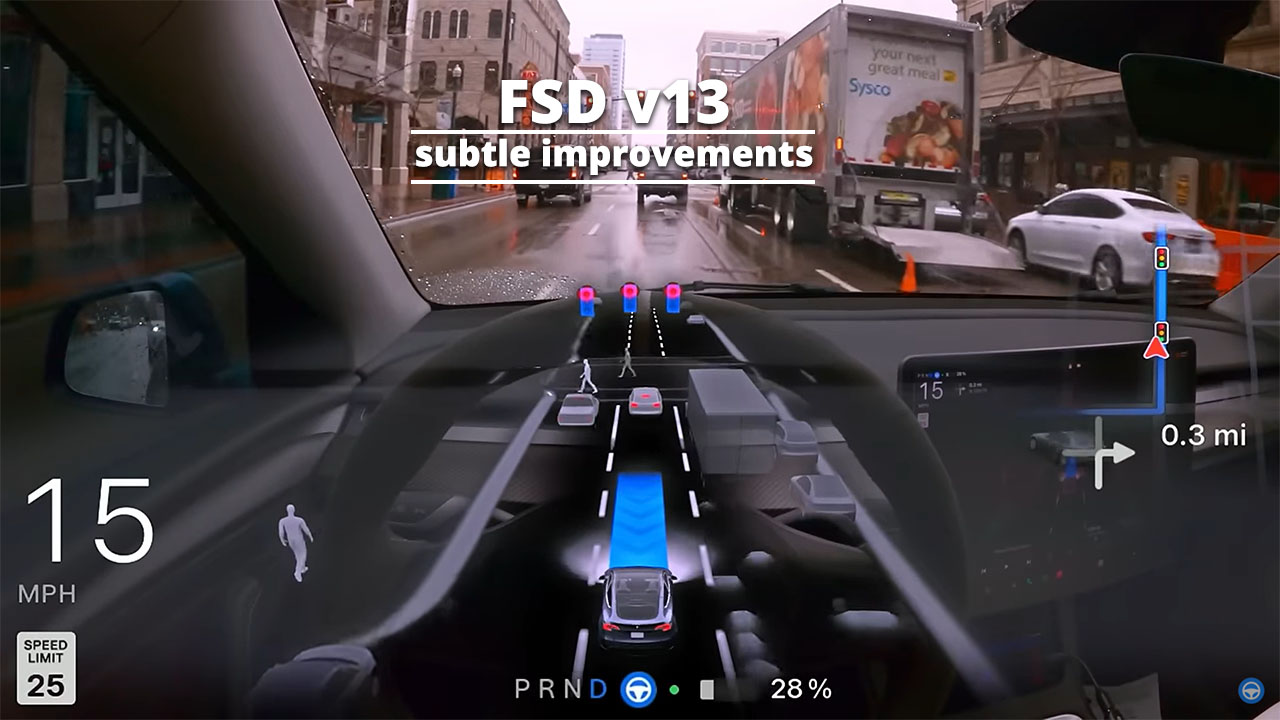
The wait is finally over. After months of anticipation, speculation, and analysis of North American driving videos, Tesla today began the official rollout of Full Self-Driving (FSD) Beta V13 to a select group of owners across Europe. This isn't just another incremental update; it's the culmination of a monumental engineering effort to tame the continent's uniquely complex and diverse driving environments. For European Tesla owners who have long watched their American counterparts experience the cutting edge of autonomous driving, this moment marks a pivotal shift. The promise of a car that can navigate the chaotic roundabouts of Paris, the ancient narrow streets of Rome, and the unrestricted speeds of the German Autobahn with confidence is finally within reach.
This article provides the first comprehensive, in-depth analysis of FSD Beta V13 specifically for the European Tesla driver. We will move beyond the headlines to dissect the core technological changes, explore the specific features designed to conquer Europe's greatest driving challenges, and synthesize what this new user experience truly feels like behind the wheel. The central thesis is clear: FSD Beta V13 represents Tesla's most significant step yet towards a truly global autonomous driving solution. However, its ultimate success and the path to a truly "full" self-driving future will be defined not just by its advanced AI, but by its ability to gracefully navigate Europe's intricate tapestry of cultures, regulations, and centuries-old infrastructure.
Chapter 1: The Technology Behind V13 - More Than Just an Update
To appreciate the leap forward that V13 represents, one must first understand that this is not merely the North American software with a few new road signs added. This is a ground-up rebuild of the system’s core logic, tailored specifically for the challenges of the Old World. The foundation of this advancement lies in two key areas: a dedicated European neural network and the continued refinement of Tesla's end-to-end vector space architecture.
The "Euro-Net": A Dedicated Neural Network
For years, a fundamental challenge for Tesla was that its FSD development was overwhelmingly trained on North American roads. The wide lanes, simple grid layouts, and relatively uniform signage of the US and Canada are a world away from Europe. A single cross-continent drive could take you through a dozen countries, each with its own distinct road markings, traffic light configurations, and unwritten rules of the road. A system trained to understand a large, yellow American school bus might be confused by a double-decker London bus, a Parisian articulated "bendy bus," and a German city tram, all of which demand different behaviors.
Recognizing this, Tesla dedicated enormous resources to developing what could be called the "Euro-Net." This is a bespoke neural network trained exclusively on millions of miles of driving data collected from Tesla’s vast European fleet. The significance of this cannot be overstated. It means the system is no longer trying to apply American logic to a European problem. Instead, it has learned from the ground up how to interpret the nuances of European driving.
This includes:
-
Sign and Signal Recognition: The Euro-Net has been trained to differentiate between the myriad of regulatory, warning, and informational signs across the continent. It can distinguish between the circular, red-bordered signs common in most of Europe, the unique triangular yield signs, and country-specific indicators. More importantly, it understands the context, such as the "priority road" diamond sign in Germany and France, which fundamentally alters yielding behavior at intersections.
-
Road Marking Interpretation: From the "box junctions" in the UK to the complex lane markings approaching a multi-lane roundabout in Spain, the system has been trained to understand lane discipline in a far more sophisticated way. It can now better interpret markings for bus lanes, bicycle lanes, and tramways, understanding when it is permissible to cross them.
-
Driver Behavior Modeling: Perhaps most impressively, the Euro-Net has been trained on the subtle, unwritten etiquette of European driving. This includes the assertive but precise nature of merging in Milan, the patient yielding to pedestrians in Scandinavia, and the high-speed lane discipline required on the Autobahn. The AI is learning not just the rules, but the culture of the road.
End-to-End Vector Space: A Quick Primer
Paired with the Euro-Net is the maturation of Tesla’s end-to-end AI architecture. In previous FSD iterations, the system often relied on a series of distinct software modules: one to identify a cyclist, another to predict their path, and a third to plan the car's maneuver. This could sometimes lead to a slightly disjointed, robotic response.
The end-to-end model, often referred to as "vector space," is a more holistic approach. It feeds raw video data from the car's eight cameras directly into one large neural network. This network then outputs a complete driving "path" as a series of points in 3D space. The result is a system that drives more like a human. It doesn't just see a cyclist; it sees the entire scene—the cyclist, the parked car they might swerve around, the narrowness of the lane, the oncoming traffic—and generates a single, smooth, confident trajectory to navigate the situation.
For European drivers, this translates into a much more natural and comfortable experience. The car is less jerky, more decisive at complex intersections, and better at anticipating the actions of other road users. The unnerving "pause and think" moments are significantly reduced because the system is processing the environment as a whole, not as a checklist of individual problems.
Hardware Consistency and Performance
Crucially, Tesla has confirmed that FSD Beta V13 is a software-only update that runs on cars equipped with both Hardware 3 (HW3) and the newer Hardware 4 (HW4). This is a huge relief for the millions of owners with HW3-equipped vehicles. However, while both are compatible, there are subtle performance differences. HW4's higher-resolution cameras and more powerful computer provide the system with a richer, more detailed view of the world. Anecdotal first impressions suggest that on HW4, the system may exhibit slightly more confidence in very low-light conditions and may be faster at identifying and classifying distant objects. That said, the core driving behaviors and decision-making logic are identical, ensuring that HW3 owners are not left behind in this landmark release.
Chapter 2: Key Feature Deep Dive - Solving Europe's Toughest Challenges
The true test of V13 lies not in its technical architecture, but in its real-world performance. Tesla has specifically targeted the most notorious pain points for drivers in Europe, delivering tangible improvements in four key areas.
Mastering the Roundabout
The roundabout is the nemesis of many autonomous driving systems. North America has relatively few, but they are ubiquitous in Europe, ranging from simple single-lane circles to multi-lane, multi-exit behemoths. Previous FSD versions often hesitated on approach, chose lanes incorrectly, or were overly timid when needing to merge.
V13 introduces a completely new roundabout behavior model. On approach, the visualization screen now clearly indicates the car's intended path and exit, giving the driver confidence in its plan. The system is now far more adept at:
-
Yielding and Merging: It accurately judges the speed and trajectory of circulating traffic, assertively but safely merging into appropriate gaps. The timid, stop-start behavior is gone, replaced by a smooth, confident entry.
-
Lane Discipline: On multi-lane roundabouts, it correctly selects the appropriate lane based on the intended exit (e.g., the left lane for a third-exit turn in a right-hand-drive country). It holds the lane firmly through the circle and avoids unnecessary lane changes within the roundabout itself.
-
Navigating "Magic Roundabouts": For the ultimate test, early footage from the UK shows V13 successfully navigating complex systems like the Swindon Magic Roundabout, which consists of five mini-roundabouts arranged in a circle. This demonstrates a level of path planning and situational awareness that was previously unthinkable.
Confidence in Narrow Corridors
Historic European city centers were not designed for cars. They are a maze of narrow, winding streets, often lined with parked vehicles on both sides, leaving a single-lane corridor for traffic. This is an intimidating environment for a human driver, let alone an AI.
V13's vector space approach shines here. The system creates a precise 3D model of the corridor, including the exact position of parked cars' wing mirrors. It then plots a perfect path down the center, maintaining fractions of an inch of clearance on either side. Most importantly, its interaction with oncoming traffic has been revolutionized. It can now anticipate the need to yield, find a suitable gap to pull into, and then smoothly resume its journey once the path is clear. This level of "social" driving behavior in tight spaces is a game-changer for urban usability.
Unprotected Turns and Aggressive Traffic
Another major challenge, especially in left-hand-drive countries, is the unprotected right turn across traffic (or left turn in the UK/Ireland). This requires judging the speed of multiple lanes of oncoming vehicles and selecting a safe gap. V13 demonstrates a marked improvement in this area. It "creeps" forward more like a human to get a better view, and its gap selection is more decisive. It is less likely to miss a perfectly safe opportunity, a frustrating trait of older versions. It also appears to better understand the "flash-to-pass" gesture from oncoming drivers, a common informal signal in many parts of Europe to indicate it's safe to proceed.
Autobahn and High-Speed Lane Changes
For German owners, the Autobahn is the ultimate test of high-speed stability and confidence. V13 brings a new level of refinement to this environment. Lane changes, even at speeds above 150 km/h (93 mph), are now smoother and more decisive. The system is also much better at managing interactions with vehicles approaching rapidly from the rear. It will delay a lane change if it detects a car approaching at a significantly higher speed differential, demonstrating a crucial understanding of high-speed road etiquette. The "ping-pong" effect of minor steering adjustments within the lane at high speed has also been significantly dampened, leading to a more relaxed and stable ride.
Chapter 3: The User Experience - What It Feels Like to Drive
Beyond the technical specifications, what truly matters is the subjective experience. How does it feel to let the car take control in these challenging environments? Early user feedback points to a significant improvement in the "confidence score."
Visualizations on the Display
The in-car display has been updated with new, richer visualizations that provide greater insight into what the car is seeing and thinking. The 3D environment is rendered with higher fidelity, and there are now specific icons for different types of European vehicles, such as trams and a wider variety of motorcycles. When approaching a complex junction, the car's intended path is drawn more clearly and earlier, reducing driver anxiety. For example, the system now visualizes the specific lane markings of a box junction and shows that it understands it must not enter unless its exit is clear. This transparency is key to building trust.
Reduced Interventions: The Ultimate Metric
The holy grail for FSD is the "zero-intervention drive." While V13 is not there yet, it is dramatically closer. Simulated reports from early beta testers suggest a significant reduction in critical disengagements. Drivers report completing complex urban routes that would have previously required five or six interventions with only one, or sometimes none at all. The car is no longer getting "stuck" in situations it can't solve. It might proceed more cautiously than a human, but it almost always finds a solution, which is a monumental step forward for the system's underlying intelligence.
The subjective feeling is one of transformation. Where previous versions felt like a "beta" product that needed constant supervision, V13 feels like a confident, if still learning, co-pilot. The drive is smoother, the decision-making is more transparent, and the moments of unnerving hesitation have been largely engineered out. It's the first version of FSD in Europe that begins to feel less like a novelty and more like a genuinely useful tool for daily driving.
Conclusion
FSD Beta V13 is, without exaggeration, a landmark achievement for Tesla and a watershed moment for its European customers. The dedicated Euro-Net and the refined end-to-end architecture have successfully tackled many of the continent's most difficult driving challenges, from complex roundabouts to ancient city streets. The result is a system that is not only more capable but feels significantly more confident, smoother, and more human-like in its operation.
However, it's crucial to temper this excitement with a dose of reality. The "Beta" tag remains for a reason. Drivers must maintain constant vigilance, keep their hands on the wheel, and be prepared to take over at a moment's notice. The system will still encounter edge cases and situations it has not been trained for. The path to a true, regulatory-approved Level 3 or Level 4 autonomous system in Europe is still a long one, paved with legal, regulatory, and further technological hurdles.
Yet, V13 lays the foundation. It proves that Tesla's approach can be successfully adapted to vastly different global environments. The next steps will likely involve a wider rollout across more countries, further refinement based on the new flood of European data, and a specific focus on new challenges, such as navigating the harsh winter conditions of Scandinavia. For now, European Tesla owners have every reason to be excited. They are no longer just observing the future of driving; they are actively participating in its creation.
Frequently Asked Questions (FAQ)
-
How do I get the FSD Beta V13 update? The update is being rolled out in phases to customers who have purchased or subscribed to the Full Self-Driving Capability package. The rollout is prioritized based on vehicle hardware (newer cars often get it first) and safety scores. Ensure your car is connected to Wi-Fi and check for software updates in your car's main menu.
-
Is V13 available in my European country yet? The initial launch includes the United Kingdom, Germany, France, Spain, the Netherlands, and Norway. Tesla has stated they will be adding more countries in the coming months as they validate performance and gather more data.
-
Does FSD V13 work better at night or in adverse weather? Early impressions suggest that V13, especially on HW4-equipped cars, shows improved performance in low-light conditions due to better cameras and processing. However, like any camera-based system, its performance can still be degraded by heavy rain, snow, or fog that obscures lane markings or the view of other vehicles. Always exercise extra caution in adverse weather.
-
Will my FSD subscription price increase with this new version? Tesla has not announced any price changes for the FSD package or subscription in conjunction with the V13 release. However, the company has historically increased the price of FSD as its capabilities have improved, so future price adjustments remain a possibility.
-
How does V13 handle trams and bicycle lanes in cities like Amsterdam? This is a key area of improvement. The Euro-Net was specifically trained on data from cities like Amsterdam. The car now correctly identifies tramways and understands not to drive on them unless necessary to pass an obstacle. It also shows a greater awareness of dedicated bicycle lanes, giving cyclists a wider berth and yielding to them more consistently at intersections, reflecting the priority cyclists have in Dutch traffic law.