
Introduction:
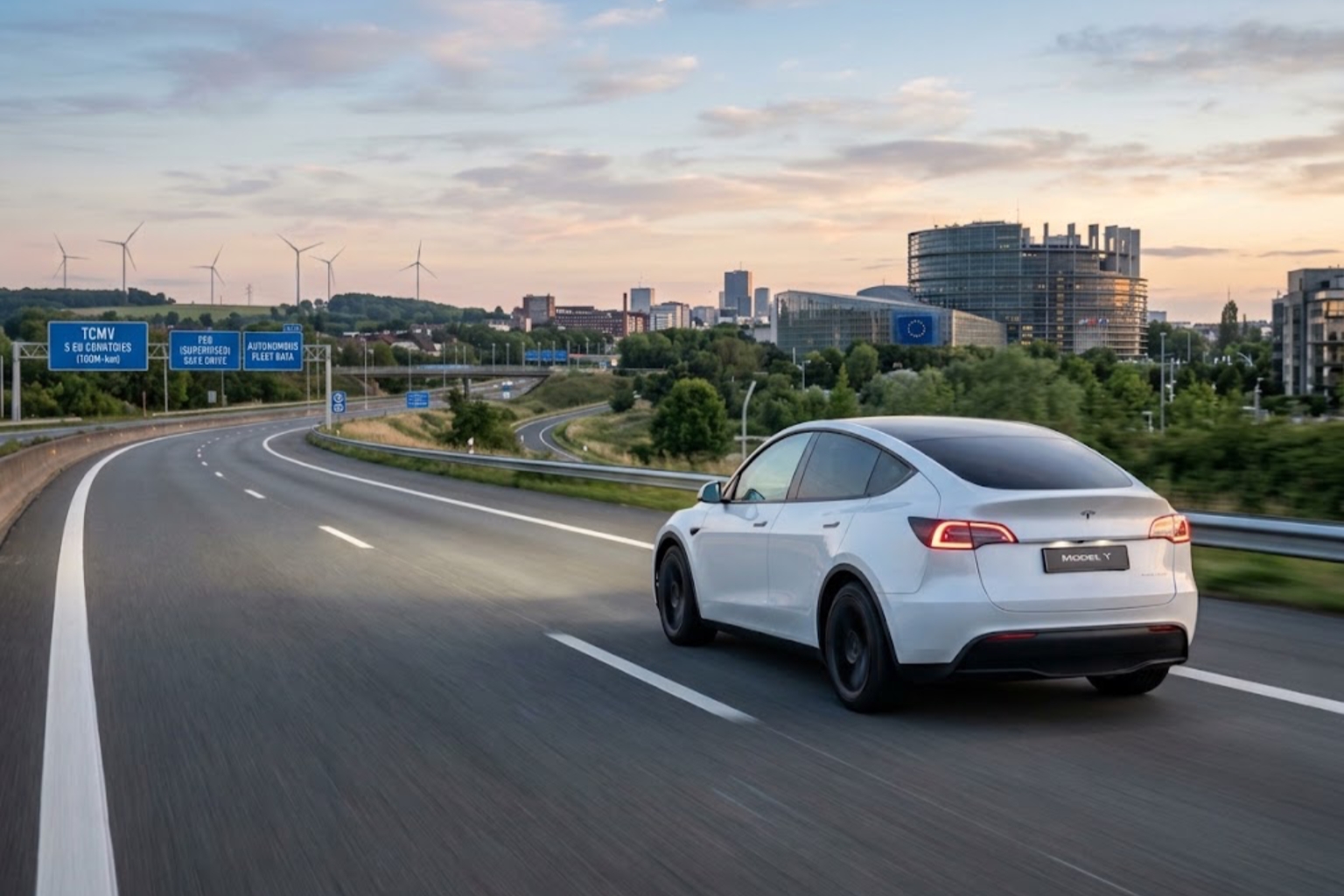
The regulatory debate surrounding autonomous driving in the European Union has reached a watershed moment. Following the historic provisional type approval granted by the Netherlands Vehicle Authority (RDW) earlier this year, five forward-looking European nations—the Netherlands, Belgium, Denmark, Estonia, and Lithuania—have permitted Full Self-Driving (Supervised) on public roadways. Now, as the European Commission’s Technical Committee on Motor Vehicles (TCMV) prepares for an all-encompassing qualified-majority vote scheduled for early October, Tesla has officially published an extensive empirical dataset.
Comprising over 100 million cumulative kilometers driven by consumer-owned vehicles in those five member states, this dataset provides the definitive statistical backbone for Tesla's argument: FSD (Supervised) is ready for continental deployment across the European Single Market. For hundreds of thousands of European Tesla owners who have purchased or subscribed to the FSD package, the upcoming vote represents the end of an agonizing wait governed by strict United Nations Economic Commission for Europe (UNECE) constraints.
Chapter 1: The 100-Million-Kilometer Safety Dossier: An Empirical Deep Dive
The core of Tesla’s submission to the European Commission and member state transport ministries is grounded in operational telemetry gathered between April and late August. Unlike closed-track testing or micro-fleet trials, this data reflects real-world European road environments: narrow Dutch roundabouts, wet Belgian motorways, Danish cycling corridors, and Baltic suburban arterials.
The headline metric from the filing indicates that vehicles operating with FSD (Supervised) active were 4.1 times less likely to be involved in a collision compared to manually operated Tesla vehicles traversing identical jurisdictions.
-
Highway Operating Scenarios: Over approximately 62 million highway kilometers, FSD-engaged vehicles recorded just 3 minor incidents, none resulting in severe injury or structural compromise to other vehicles.
-
Urban and Complex Arterials: Non-highway roads accounted for 9 reported low-speed fender-benders, against 490 reported incidents during manual driving across comparable mileage segments.
-
Driver Interventions and Disengagements: The mean distance between critical disengagements in European urban centers improved significantly, driven by local road rule adaptations introduced in the recent v14 neural network builds.
European regulators, led by the Dutch RDW, have faced intense public and parliamentary scrutiny regarding transparency. By releasing key benchmark evaluations publicly, Tesla aims to neutralize allegations that vehicle safety validation is occurring behind closed doors, countering pushback from domestic legacy manufacturing associations in Germany and France.
Chapter 2: Regulatory Mechanics: UNECE DCAS and the October TCMV Vote
To understand why this safety dossier is critical, one must grasp the legal framework governing automated driving systems in Europe.
-
UN Regulation 171 (DCAS): The UNECE World Forum for Harmonization of Vehicle Regulations (WP.29) established driver control assistance systems (DCAS) standards to govern Level 2 systems capable of hands-on lane changes, navigation-guided merging, and roundabout navigation.
-
Article 39 Exemption Procedure: Because Tesla's end-to-end vision neural networks do not fit neatly into traditional deterministic software verification rules, the Dutch RDW utilized the Article 39 exemption framework of EU Regulation 2018/858. This allows temporary national approval while seeking collective approval from the bloc.
-
The Qualified Majority Hurdle: For FSD (Supervised) to achieve pan-European mutual recognition, the TCMV requires a qualified majority: at least 15 of the 27 EU member states, representing a minimum of 65% of the total EU population. While smaller and digitally progressive nations have embraced the software, heavyweights such as Germany (represented by the KBA) and France have maintained a highly cautious approach, citing driver-attentiveness validation and edge-case predictability.
Chapter 3: What This Means for European Tesla Owners
The implications of the pending regulatory decision will alter the day-to-day utility and resale value of Tesla vehicles throughout the continent.
-
Hardware Segmentation: Vehicles built with Hardware 4 (AI4) will receive the primary high-parameter model updates instantly upon regulatory clearance. Older Hardware 3 (HW3) vehicles will receive a distilled neural network variant, raising questions about whether feature parity will remain long-term.
-
Cabin Camera Monitoring Strictness: Unlike in the United States, where steering wheel nudges have been partially de-emphasized in favor of strict infrared cabin eye-tracking, EU regulations mandate a dual-confirmation loop. Drivers will encounter stricter lockout timers if they avert their gaze from the road for more than 2.5 seconds.
-
Subscription Model Rollout: Widespread approval will pave the way for Tesla to launch monthly FSD subscriptions across major European markets, mirroring the North American $99/month pricing structure and phasing out the costly lump-sum purchase that many EU drivers hesitated to buy.
Conclusion
Tesla’s release of 100 million kilometers of European operational safety data shifts the burden of proof back to skeptical regulators. If the TCMV ratifies mutual recognition in October, millions of European Tesla owners will finally experience continuous end-to-end driving assistance, transforming the competitive landscape of the continent's EV market.
Frequently Asked Questions (FAQ)
-
Q1: Can I legally activate FSD (Supervised) in Germany or France today?
No. As of today, FSD (Supervised) is legally permitted only in the Netherlands, Belgium, Denmark, Estonia, and Lithuania. Other EU nations remain restricted until their national transport bodies or the TCMV issue a formal directive.
-
Q2: Does FSD approval mean the car can drive itself without my supervision?
No. European approval strictly applies to SAE Level 2. The human driver remains legally liable at all times, must maintain continuous visual attention, and must be prepared to intervene immediately.
-
Q3: Will my HW3 Model 3 or Model Y support European FSD when approved?
Yes, but via an optimized software path (v14.1 Lite architectures). Full parameter multi-camera models require the enhanced compute throughput of AI4.
-
Q4: How does EU FSD handle European roundabouts and cycle paths?
The v14 European neural networks have been retrained specifically on local intersection topologies, yielding confident deceleration and yielding behaviors for bicycles and pedestrians, which previously triggered phantom slowdowns under older Autopilot stacks.