
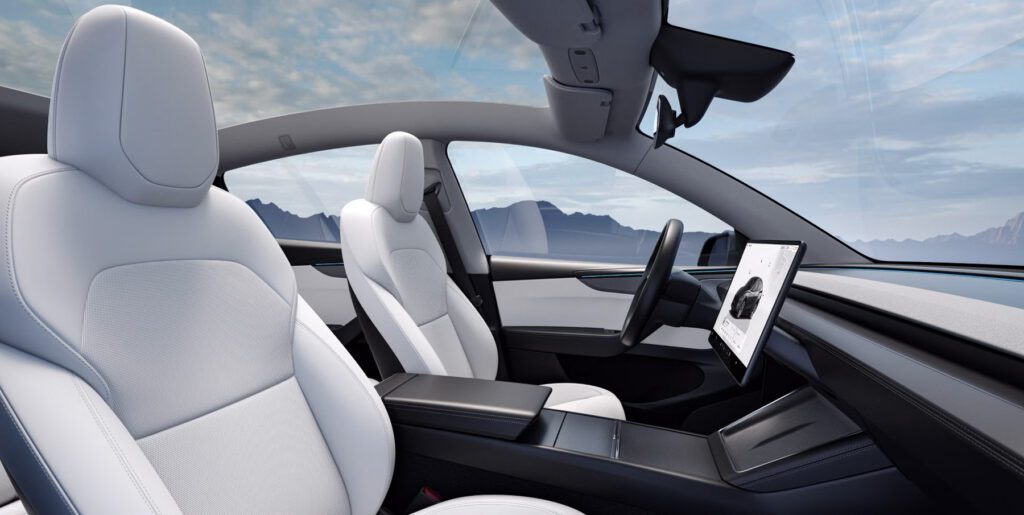
In the world of automotive design, Tesla has always been the arch-minimalist. From the moment the original Model 3 debuted with its stark dashboard, dominated by a single screen, the company declared war on buttons, knobs, and clutter. Now, with the release of the updated Model 3 "Highland" and the imminent arrival of its SUV sibling, the Model Y "Juniper," Tesla is doubling down on this philosophy. This is not a radical, ground-up redesign, but a deliberate and calculated evolution that refines the cabin's ambiance while pushing the boundaries of minimalist control even further.
These updates have ignited passionate debate among owners and critics alike. The introduction of premium materials, ambient lighting, and ventilated seats has been met with near-universal praise. However, the controversial decision to eliminate the control stalks for turn signals and drive selection has many questioning if Tesla has finally taken minimalism a step too far. This article provides a detailed, owner-centric review of the new interior, analyzing every significant change in materials, technology, and ergonomics. We will explore the learning curve of a stalkless world and deliver a final verdict on whether this refresh truly enhances the daily driving experience or sacrifices usability at the altar of simplicity.
Chapter 1: The Elephant in the Room - Life Without Stalks
Let's address the most talked-about and divisive change first: the complete removal of the steering column stalks. For a century, drivers have used a stalk for turn signals and another for gear selection. Tesla has deleted them both, and adapting to the new method is the first major hurdle for any new owner.
-
The New Controls Explained
The new system relocates these critical functions to two different places.
-
Turn Signals: These are now two haptic buttons on the left side of the steering wheel. A press of the top arrow-button activates the right signal; the bottom button activates the left. The buttons provide a slight vibration as feedback. A full press activates the signal until you complete a turn; a half-press activates it for a three-flash lane change.
-
Drive Selector: The traditional P-R-N-D stalk is gone. The primary method for selecting a gear is now a slider on the left edge of the central touchscreen. You slide your finger up for Drive, down for Reverse. Park is a button at the top. This is supplemented by physical P-R-N-D buttons in the overhead console, near the hazard light button, as a mandatory backup.
-
The "Smart Shift" Failsafe
Tesla anticipated that drivers might forget to use the screen-based shifter. To counter this, they introduced "Smart Shift." When you first get in the car and press the brake pedal, the car uses its cameras and sensors to predict your intended direction. If it's facing a garage wall, it will pre-select Reverse. If it's parked on the street with a clear path forward, it will pre-select Drive. The selection appears on the screen, and the driver simply confirms it by tapping the accelerator. In most common scenarios, like pulling out of a driveway or a parking space, Smart Shift aims to eliminate the need to interact with the shifter at all.
-
The Learning Curve: Honesty and Muscle Memory
There is no sugarcoating it: for the first few hours or days, the new system feels alien. Reaching for a phantom stalk to signal a turn is a common experience. The most challenging scenario, cited by many early users, is navigating a roundabout. This requires you to signal while actively turning the steering wheel, meaning the haptic buttons are no longer in their default position. It requires a new level of cognitive load and hand-eye coordination.
However, the vast majority of owners report that after a week or two of consistent driving, a new muscle memory forms. The thumb naturally finds the signal buttons without looking. Smart Shift handles most of the gear-selection work. The process moves from being a conscious, awkward action to a subconscious, natural one. The learning curve is real and can be steep for some, but it is not insurmountable.
-
The Rationale: Why Did Tesla Do This?
Tesla's official reasoning is threefold. First, cost reduction and manufacturing simplification. Removing the stalks, their associated wiring, and the "clock spring" mechanism in the steering column eliminates dozens of parts, saving money and making the assembly process faster and less prone to failure. Second, the pursuit of ultimate minimalism. A clean steering column is aesthetically pleasing and aligns with their design ethos. Third, a bet on the future. In a world of true Full Self-Driving, stalks are redundant because the car handles signaling and shifting. This design moves the car closer to that eventual reality. From a user perspective, the validity of these reasons is a matter of personal preference, weighing the clean aesthetic against the initial ergonomic challenge.
Chapter 2: A More Premium Ambiance
While the stalkless design is a point of function, the rest of the interior updates are a clear and undeniable move upmarket in terms of form and feel. The cabin of the new Model 3/Y is a far more luxurious and serene place to be.
-
Upgraded Materials and a Wraparound Design
The difference in material quality is immediately apparent. Hard, scratchy plastics have been significantly reduced. The dashboard and door panels are now trimmed in a high-quality woven textile or a soft-touch Alcantara-like material, depending on the chosen interior color. This material flows seamlessly from the dash into the doors, creating a wraparound "cockpit" effect that feels cohesive and upscale. The fit and finish are noticeably tighter, with more consistent panel gaps, addressing a long-standing criticism of earlier models.
-
Customizable Ambient Lighting
A standout new feature is the configurable ambient lighting. A thin, elegant LED light strip runs along the top of the dashboard and continues into the front and rear door panels. Controlled from the center screen, this system offers a full spectrum of colors. You can set it to a single static color to match your mood, or have it change dynamically. More importantly, it's integrated with the vehicle's systems. For example, it can glow red on one side if the Blind Spot Warning system detects a vehicle, providing an intuitive, peripheral visual alert. This transforms lighting from a mere decorative element into a functional piece of the human-machine interface.
-
Acoustic Glass and a Quieter Ride
One of the most praised improvements is the dramatic reduction in cabin noise. Previously, only the front side windows used dual-pane acoustic glass. In the refreshed models, all glass—including the rear windows and the rear windscreen—is acoustic. This, combined with improved door seals and additional sound-deadening material throughout the chassis, results in a remarkably quiet cabin. Wind and road noise are significantly muted, making conversations easier, reducing driver fatigue on long journeys, and allowing the upgraded sound system to truly shine.
-
Ventilated Front Seats: A Welcome Relief
A long-requested feature has finally arrived: ventilated front seats. The new seats feature a perforated design that allows cool air to be gently blown through the cushion and backrest. Controlled via the touchscreen, this feature is a godsend in hot climates, preventing the sweaty-back syndrome common with leather or vegan leather seats on a summer day. It's a premium feature that brings the Model 3/Y in line with luxury competitors.
Chapter 3: Tech and Ergonomic Enhancements
Beyond the ambiance, the refresh includes several key technology and ergonomic upgrades that improve the daily experience for all passengers.
-
The Rear Passenger Screen
Family buyers will rejoice at the addition of an 8-inch touchscreen for rear passengers, located on the back of the center console. This screen is a dedicated control and entertainment hub. Rear passengers can now adjust their own climate controls (air flow and temperature), turn on their seat heaters, and, most importantly, control media. They can stream video from services like Netflix and YouTube or control the music playing through the car's main sound system. This is a game-changer for keeping children entertained on long trips and adds a touch of executive-class luxury.
-
Improved Center Console and Connectivity
The center console has been completely redesigned for better usability. The old sliding lid is gone, replaced by a more conventional armrest that lifts to reveal a much deeper and more practical storage bin. The dual wireless phone chargers have been re-engineered for more reliable connections and better cooling, and they are now housed under a felt-lined surface that reduces phone sliding. Furthermore, the car is now equipped with more powerful 65W USB-C ports, capable of charging a laptop or tablet at high speed.
-
Upgraded Sound System
The standard sound system has been improved, but the premium system in the Long Range and Performance models has received a significant boost. It now features 17 speakers (up from 14), including two subwoofers and two amplifiers. The speaker placement has been optimized, and the system has been custom-tuned for the new cabin's quieter acoustics. The result is a richer, more immersive audio experience with deeper bass, crisper highs, and a more defined soundstage.
Chapter 4: The Verdict - An Upgrade or a Step Back?
So, what is the final judgment on this refreshed interior? The answer depends heavily on who is asking.
-
For the Existing Owner: Is it worth upgrading from a 2021 Model 3? If your primary frustrations with your current car are road noise and a cabin that feels a bit spartan, the answer is a resounding yes. The leap in perceived quality, the quietness, and features like ambient lighting and ventilated seats create a vastly more premium experience. The stalkless design is the main caveat, and it's recommended to take an extended test drive to see if you can adapt to it.
-
For the New Buyer: For someone new to the brand, this interior sets a new standard for tech-minimalism. It makes the cabins of many competitors, with their scattergun approach to buttons and screens, feel dated and cluttered. When cross-shopping against a BMW i4 or Polestar 2, the Tesla's interior feels like it's from five years in the future. The initial learning curve of the controls is a valid concern, but the clean, quiet, and feature-rich environment is a powerful and unique selling proposition.
-
Living with the Changes: New owners should give themselves a grace period. Trust in Smart Shift. Consciously practice using the signal buttons in an empty parking lot. Customize the ambient lighting to your taste. Once the new controls become second nature, the benefits of the quieter, more comfortable, and more luxurious cabin come to the forefront.
Conclusion
The interior refresh of the Model 3 and Model Y is a confident and bold statement from Tesla. It is a masterful execution of refinement, elevating the cabin's ambiance to a level that can now genuinely compete with established luxury brands. The upgraded materials, tomb-like quietness, and thoughtful new features like the rear screen and ventilated seats represent a massive leap forward in comfort and livability.
The elimination of the stalks will forever remain a polarizing choice. It is a trade-off, sacrificing decades of established muscle memory for manufacturing efficiency and aesthetic purity. While it presents a real, tangible learning curve, it is not an insurmountable one. For most users, it will become the new normal within weeks. When viewed as a complete package, the overwhelming improvements in quality, comfort, and technology far outweigh the ergonomic relearning required. The new interior re-solidifies the Model 3 and Y's position not just as leaders in EV technology, but as creators of a truly modern and desirable driving environment.
FAQ Section
-
What happens if the touchscreen freezes? How do I change gears? Tesla has built in physical redundancy. In the overhead console, near the hazard light and dome lights, there are physical P, R, N, and D buttons. These serve as a backup gear selector in the rare event the main touchscreen becomes unresponsive.
-
Are the haptic steering wheel buttons difficult to use with gloves on? Yes, this can be a challenge. The haptic buttons rely on the driver's ability to feel their position and the subtle feedback. Thick winter gloves can numb this sensation. In very cold climates, pre-heating the cabin or using thinner, touchscreen-compatible gloves is recommended.
-
Can I turn off the ambient lighting completely? Yes. Through the lighting controls on the center screen, you can adjust the brightness of the ambient light all the way down to zero, effectively turning it off if you prefer a darker cabin at night.
-
Is the new interior available as a retrofit for older models? No. The changes are far too extensive. The new dashboard, door panels, seats, center console, and underlying wiring harnesses are completely different. This is a factory-level update and cannot be retrofitted onto older vehicles.
-
How does the new "Smart Shift" feature work in a parallel parking situation? Smart Shift is primarily designed for the initial gear selection. During multi-point maneuvers like parallel parking, you will use the slider on the touchscreen to quickly and easily shift between Drive and Reverse as needed. Many find the screen slider faster for this rocking motion than a traditional stalk.