
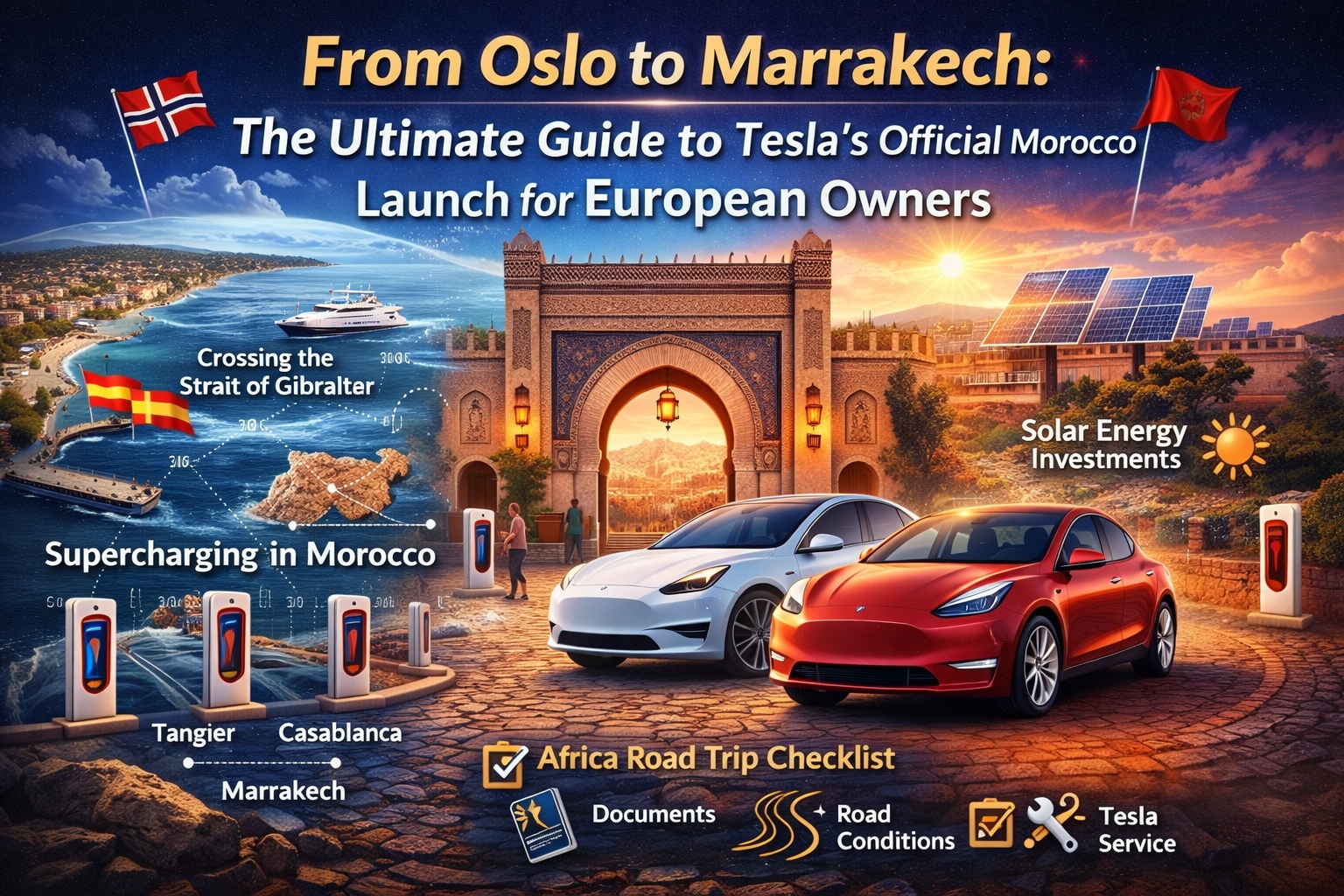
Introduction
In March 2026, Tesla made an announcement that will reshape how European owners think about road trips. The company confirmed that its mass-produced vehicles will officially go on sale in Morocco starting mid-2026, marking the first time Tesla vehicles are available through official channels in an African country . The initial lineup will include the Model 3 and Model Y, with full warranty coverage, authorized dealers, and complete after-sales support .
For European Tesla owners, this is more than a business expansion. It's an invitation. The dream of driving from Oslo to Marrakech—crossing continents, cultures, and climates in an electric vehicle—has just become significantly more practical. Morocco has long been a destination for adventurous European travelers, but until now, taking a Tesla meant navigating uncertain support, unofficial imports, and the anxiety of being far from service centers.
Why Morocco? The Strategic Gateway
Morocco's selection as Tesla's first official African sales market is no accident. The country sits at the crossroads of Europe and Africa, separated from Spain by just 14 kilometers of the Strait of Gibraltar. This geographic proximity means that for European owners, Morocco is the most accessible African destination—a short ferry ride from the continent's southern tip.
But geography is only part of the story. Morocco has been quietly building one of Africa's most progressive energy policies, with ambitious targets for renewable energy adoption. The country hosts one of the world's largest solar power plants, the Noor Complex near Ouarzazate, and has been actively encouraging electric vehicle adoption . This alignment with Tesla's mission makes Morocco a natural beachhead for African expansion.
The numbers tell a compelling business story. In 2025, Morocco's new car market reached 235,000 vehicles, a 33% increase year-over-year . While fuel vehicles still dominate with over 95% market share, the growth trajectory and policy support create fertile ground for EV adoption .
Compare this to South Africa, Africa's largest automotive market with 598,000 new vehicles sold in 2025 . South Africa's market is roughly 2.5 times larger than Morocco's, and Tesla already has an energy presence there—Powerwall and Powerpack systems have been available for years, with Powerwall 3 currently on the market . But South Africa's distance from Europe and different regulatory environment make Morocco the logical first step for vehicle sales.
The Existing Foundation: Superchargers and Community
One of the most fascinating aspects of Tesla's Morocco launch is that it doesn't start from zero. For years, European Tesla owners have been driving their vehicles across the Strait of Gibraltar for holidays, creating an unofficial but vibrant Tesla community in Morocco .
Tesla recognized this early. The company installed Superchargers in strategic locations to serve these visiting owners, long before any official sales presence existed. Today, Morocco's Supercharger network includes stations in key cities and along major travel routes:
-
Tangier: The primary entry point for ferry traffic from Spain, with Superchargers conveniently located near the port.
-
Casablanca: Morocco's largest city and economic capital, with multiple charging locations.
-
Rabat: The political capital, connected to the network.
-
Marrakech: The tourism heart of Morocco, with Superchargers serving the thousands of European visitors who flock to the city annually.
-
Fes: The cultural and historical center, increasingly accessible to EV travelers.
Beyond Superchargers, a thriving grey market has existed for years, with Moroccans importing Teslas through unofficial channels and creating their own support networks . These early adopters have formed communities, shared knowledge, and demonstrated that Teslas can thrive in Moroccan conditions—from the humid coast to the desert heat.
The official launch builds on this foundation. Authorized dealers will now provide warranty service, parts availability, and professional support that the grey market could never guarantee . For visiting European owners, this means peace of mind: if something goes wrong in Marrakech, there's now an official channel for help.
Planning Your Transcontinental Journey
The Ferry Crossing
Every欧洲-to-Morocco Tesla adventure begins with the same step: crossing the Strait of Gibraltar. The primary route is from Algeciras, Spain to Tangier Med, Morocco's largest Mediterranean port. Several ferry companies operate this route, with crossings taking approximately one hour for fast ferries or up to two hours for conventional vessels.
Practical considerations for EV owners:
-
Booking: Reserve your crossing in advance, especially during peak summer months when tourist traffic surges. Some ferry companies now offer online booking with vehicle specifications, allowing you to indicate that you're driving an electric vehicle.
-
Charging before departure: The Algeciras area has multiple Supercharger and destination charger locations. Arrive with a high state of charge—while the ferry crossing itself consumes negligible energy, you'll want a full battery upon arrival in Morocco.
-
Documentation: Ensure you have your vehicle registration, proof of insurance that covers Morocco (more on this below), and passports for all occupants. The border crossing at Tangier Med is generally efficient but can experience delays during peak periods.
Insurance and Legal Requirements
Your European auto insurance may not automatically cover Morocco. Most policies require specific notification or an add-on for跨洲 travel. Contact your insurer at least two weeks before departure to arrange coverage.
Key requirements:
-
Green Card: An international insurance certificate that proves you have coverage. Many European insurers issue these automatically for Morocco, but confirm in writing.
-
Vehicle registration: Carry your original registration document (V5C in the UK, Zulassungsbescheinigung in Germany, etc.). Some border officials may ask to see it.
-
Customs: For EU-registered vehicles, temporary importation for tourism is generally straightforward. The maximum stay is typically 90 days, after which more complex procedures apply.
Charging Strategy
Morocco's Supercharger network is well-placed for the classic tourist route, but distances between stations can be larger than what European owners are accustomed to. The primary corridor connects Tangier, Rabat, Casablanca, and Marrakech, with extensions to Fes and other destinations.
Sample charging stops on the classic route:
| Segment | Distance | Charging Recommendation |
|---|---|---|
| Tangier Med to Tangier city | 50 km | Arrive with high charge from Spain; top up in Tangier if needed |
| Tangier to Rabat | 250 km | Supercharger in Rabat |
| Rabat to Casablanca | 90 km | Supercharger in Casablanca |
| Casablanca to Marrakech | 240 km | Supercharger in Marrakech |
Beyond the Supercharger network, destination charging is growing. Many riads and hotels in tourist areas have installed wall connectors, recognizing the increasing number of EV travelers. Apps like PlugShare are active in Morocco, with user-contributed information about available chargers.
Road Conditions and Driving Culture
Driving in Morocco is different from driving in Europe. The major highways (autoroutes) connecting Tangier, Rabat, Casablanca, and Marrakech are excellent—modern, well-maintained, and comparable to European motorways. Tolls apply and can be paid in cash or by card.
Once you leave the autoroutes, conditions vary. Rural roads may have uneven surfaces, occasional potholes, and less predictable lighting. In cities, traffic can be dense and driving styles more assertive than what many Europeans are used to. Pedestrians, cyclists, and horse-drawn carts share the road in some areas.
Adaptation tips:
-
Expect the unexpected: Animals, pedestrians, and vehicles may appear suddenly. Drive defensively.
-
Night driving: Rural roads outside cities may be unlit. Reduce speed and increase following distance after dark.
-
Roundabouts: Moroccan roundabouts function similarly to European ones, but lane discipline can be looser. Approach with caution.
-
Police checkpoints: Random police checks are common, especially near city entrances. Always carry your documents and be prepared to stop.
The Experience: What Awaits You
Tangier: The Gateway
Your first Moroccan city will likely be Tangier, a port city with a rich history as the "Gateway to Africa." The medina (old city) cascades down hills toward the sea, offering narrow alleyways, bustling markets, and cafes where you can sip mint tea while watching ferries cross the strait.
The Tangier Supercharger location makes a convenient first stop. From here, you can explore the city before continuing south. The drive from Tangier to Rabat along the A1 autoroute takes about two and a half hours, with Mediterranean views on one side and rolling hills on the other.
Rabat and Casablanca: The Political and Economic Capitals
Rabat, Morocco's capital, offers a more relaxed pace than Casablanca. The Hassan Tower, an incomplete minaret from the 12th century, and the nearby Mausoleum of Mohammed V are essential stops. The city's oceanfront promenade is perfect for a stroll after charging.
Casablanca, just 90 kilometers south, is Morocco's largest city and economic engine. The Hassan II Mosque, with its minaret soaring 210 meters above the Atlantic, is one of the few mosques in Morocco open to non-Muslim visitors. The city's vibe is more商业 than touristy, but the art deco architecture in the city center rewards exploration.
Marrakech: The Jewel of the South
For many travelers, Marrakech is the destination. The "Red City" pulses with energy—snake charmers in Jemaa el-Fnaa square, labyrinthine souks selling everything from carpets to spices, and tranquil gardens hidden behind ancient walls.
The Marrakech Supercharger location puts you within easy reach of the city center. From here, you can explore:
-
The Medina: A UNESCO World Heritage site, packed with history and commerce.
-
Bahia Palace: A 19th-century masterpiece of Moroccan architecture.
-
Majorelle Garden: Once owned by Yves Saint Laurent, a serene escape of blue buildings and exotic plants.
-
The Atlas Mountains: Visible from Marrakech on clear days, and accessible for day trips.
Beyond the Classic Route
For owners with more time and adventurous spirit, Morocco offers much more. The road south from Marrakech leads to the Atlas Mountains, with passes that challenge even experienced drivers. Beyond the mountains lies the Sahara, where the dunes of Merzouga and Zagora await. The coastal road from Casablanca south to Essaouira offers ocean views and the chance to visit the Portuguese-influenced port city.
Each of these destinations presents charging considerations. While Superchargers may not yet reach every corner, destination charging is expanding, and the growing EV community shares information about available options.
The Future: What Morocco Means for African EV Adoption
Tesla's Morocco launch is unlikely to be an isolated move. The company has signaled that this is an "important starting point for evaluating regional potential". South Africa, with its larger market and existing Tesla energy presence, is an obvious candidate for future expansion.
The Moroccan launch also creates a template for how Tesla might approach other emerging markets: build charging infrastructure first, serve visiting owners, nurture a community, then Official introduce sales and service. This gradual approach minimizes risk while building brand awareness and loyalty.
For African EV adoption more broadly, Tesla's entry matters. Major brands entering a market accelerate infrastructure development, policy support, and consumer confidence. The fact that Chery's Omoda and Jaecoo brands have sold over 20,000 vehicles in South Africa since 2023, including plug-in hybrid models, demonstrates that African consumers are ready for electrified transportation. Tesla's presence will likely accelerate this trend.
Conclusion
The road from Oslo to Marrakech is more than a route—it's a statement. It says that electric vehicles are not limited by geography, that the Supercharger network can span continents, and that Tesla owners can explore the world without compromise.
With the official Morocco launch in mid-2026, that statement becomes reality. European owners can now plan transcontinental adventures with confidence, knowing that warranty coverage, parts availability, and professional support await on the African side. The unofficial community that has kept Teslas running in Morocco for years will be joined by official infrastructure, creating the best of both worlds.
Whether you're planning your first跨洲 trip or considering a longer stay, Morocco offers a compelling destination. From the medinas of Tangier to the souks of Marrakech, from Atlantic beaches to Saharan dunes, the country rewards those who venture south. And now, thanks to Tesla's latest expansion, you can make the journey in the vehicle you already love.
FAQ
Q: When exactly will Tesla start selling cars in Morocco?
A: Tesla has announced that sales will begin in mid-2026. Specific dates have not been released, but the company indicates that Model 3 and Model Y will be the first models available through official channels .
Q: Can I drive my European Tesla to Morocco now, or should I wait for the official launch?
A: You can drive to Morocco now. The Supercharger network is already operational and has been serving visiting European owners for years. The official launch adds warranty coverage and service support, but doesn't change the ability to visit. If you're planning a trip before mid-2026, you can proceed with confidence—just ensure your insurance covers Morocco.
Q: Are the Superchargers in Morocco compatible with all European Tesla models?
A: Yes. Moroccan Superchargers use the same connectors as European stations. All European Teslas can charge without adapters. The network was installed specifically to serve European visitors and local owners .
Q: How much does charging cost in Morocco?
A: Pricing varies by location and time of day. Generally, Moroccan Supercharger rates are comparable to Southern European prices, though currency fluctuations can affect the exact cost. Payment is handled through your Tesla account just as in Europe.
Q: What happens if my Tesla needs service while I'm in Morocco?
A: Before mid-2026, service options are limited to the unofficial community and independent mechanics. After the official launch, authorized dealers will provide warranty service and parts. For serious issues, you may need to coordinate with European service centers, though the official launch will improve this significantly .
Q: Is it safe to drive a Tesla in Morocco?
A: Morocco is generally safe for tourists, and driving is no exception. Exercise normal precautions: lock your vehicle when parked, don't leave valuables visible, and be alert in unfamiliar areas. The major tourist routes are well-traveled and regularly patrolled.
Q: Will Tesla expand to other African countries after Morocco?
A: Tesla has not announced specific plans, but South Africa is an obvious candidate given its market size and Tesla's existing energy business there. The Morocco launch is explicitly described as an evaluation of regional potential .