
Introduction
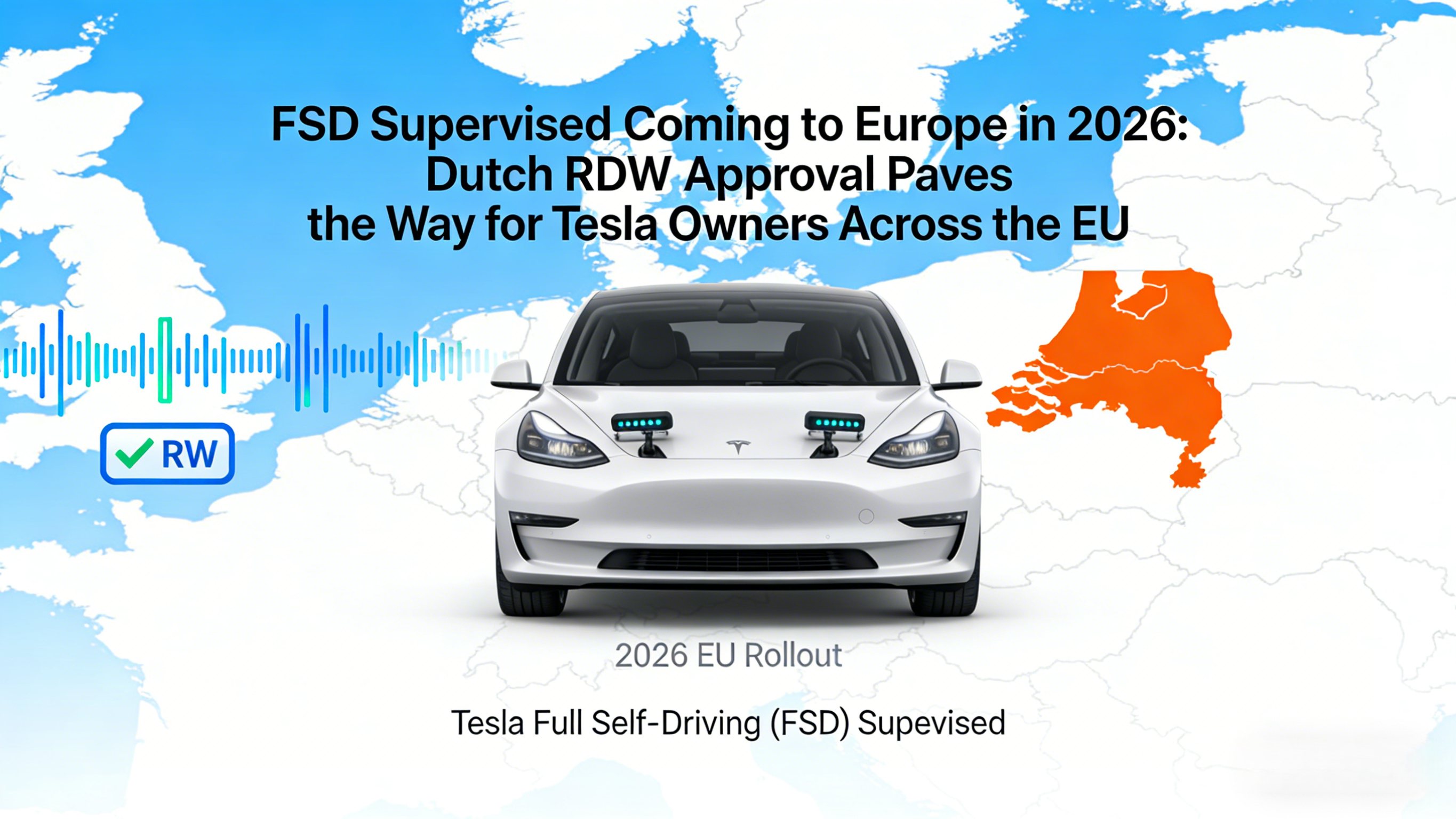
As of March 10, 2026, a wave of excitement is sweeping through the European Tesla community. Just weeks after the Dutch vehicle authority RDW granted national type approval for Full Self-Driving (Supervised) in February 2026, the first over-the-air rollouts have begun for compatible vehicles in the Netherlands. This is not a limited beta or a small pilot program — it is the official regulatory green light that Tesla owners across the EU have been waiting for since Autopilot was first introduced.
For owners in the Netherlands, Belgium, Germany, Austria, the Nordic countries, and soon the rest of the European Union, this approval means FSD Supervised can now be activated on public roads without violating type-approval rules. Model 3, Model Y, Model S, and Model X vehicles equipped with HW3 or HW4 hardware are already receiving the software in phases, starting with owners who opted into the FSD package or subscription.
The timing could not be better. With European CO₂ fleet targets tightening in 2026 and many countries introducing zero-emission zones in city centers, the ability to use supervised autonomy for commuting, long-distance travel, and family trips delivers immediate practical value. Early reports from Dutch owners in Amsterdam, Rotterdam, and Utrecht describe dramatically reduced driver workload on ring roads, complex roundabouts, and urban streets — all while remaining fully compliant with supervision requirements.
This article provides a complete, owner-focused guide to the European FSD Supervised rollout. We will examine the regulatory journey, the exact technical capabilities now available, real-world benefits tailored to European driving conditions, important lessons for US owners, safety data versus competitors, and the clear roadmap toward unsupervised driving and Robotaxi operations in the EU. Every section is packed with practical advice, country-specific examples, step-by-step activation guides, and forward-looking analysis so that whether you drive in Berlin traffic, cross the Belgian border daily, or plan summer trips through Scandinavia, you can maximize this historic update the moment it reaches your vehicle.
The Dutch RDW approval is more than paperwork — it is the regulatory bridge that turns Tesla’s vision-only autonomy stack into a legally usable feature for millions of European owners. Let’s break down exactly how we got here and what it means for your daily driving life.
Background on FSD Development
Tesla’s Full Self-Driving program has always followed a dual-track development path: rapid iteration in the United States under federal and state rules, and a much slower, more cautious path in Europe due to the United Nations Economic Commission for Europe (UNECE) regulations that govern vehicle type approval across 57 countries.
In the US, FSD Supervised reached version 12.6 and 13.x series by late 2025, with end-to-end neural networks handling city streets, highways, and complex maneuvers under driver supervision. European owners, however, were limited to basic Autopilot and Enhanced Autopilot features because full FSD required compliance with UN Regulation No. 171 (UN-R-171) on automated lane-keeping systems and the broader type-approval framework under Regulation (EU) 2018/858.
The key regulatory hurdle was Article 39 of the EU type-approval regulation, which allows national authorities to grant temporary exemptions for innovative technologies while full EU-wide approval is prepared. Tesla began serious discussions with several member states in 2024, submitting extensive safety data, millions of kilometers of shadow-mode driving logs, and detailed failure-mode analyses. The Netherlands emerged as the ideal partner because the RDW (Rijksdienst voor het Wegverkeer) has a long history of approving advanced driver-assistance systems ahead of the rest of the EU and maintains a pragmatic, technology-neutral approach.
By early 2025, Tesla had accumulated over 1 million kilometers of supervised and shadow-mode testing specifically on European roads — covering everything from narrow Dutch streets and German Autobahns to Norwegian fjord routes and French mountain passes. This data was shared with RDW engineers during multiple technical audits. The breakthrough came in February 2026 when the RDW formally confirmed that Tesla’s FSD Supervised system meets or exceeds the safety requirements of UN-R-171, including driver monitoring, minimum risk maneuvers, and override capability.
This national approval is crucial because, under EU mutual recognition rules, once one member state approves a vehicle system, others can accept it without repeating the full certification process. Belgium’s equivalent authority has already signaled it will honor the Dutch approval within 30 days, followed by Germany’s KBA and the Nordic countries. This creates a domino effect that effectively opens FSD Supervised to roughly 80% of the EU Tesla fleet by mid-2026.
Compared with the US journey, the European path has been slower but ultimately more robust. US FSD benefited from California’s permissive testing rules and Texas’s light-touch approach, allowing faster iteration. Europe demanded exhaustive documentation, third-party validation of the vision-only stack, and proof that the system never exceeds Level 2 boundaries (i.e., the driver remains fully responsible). The result is a version of FSD Supervised that is not only legal but engineered from the ground up to satisfy the world’s strictest safety regulators.
For owners, this background matters because it explains why the European rollout feels “finished” rather than experimental. The software you are about to receive has been stress-tested against European-specific scenarios — dense urban roundabouts, variable speed limits, tram lines in city centers, and strict enforcement of hands-on monitoring — making it immediately useful rather than a science project.
Dutch RDW Pathway Explained
The February 2026 RDW approval is the single most important regulatory milestone for Tesla in Europe since the original Model S type approval in 2013. Here is exactly how it happened and what it unlocks.
The RDW is the Netherlands’ national vehicle authority, responsible for type approval, roadworthiness testing, and enforcement of EU vehicle regulations. In 2025, Tesla submitted a formal application under the “new technology” exemption pathway, providing:
- Over 1.2 million kilometers of European driving data (supervised and shadow mode)
- Detailed neural network architecture documentation
- Failure-mode and effects analysis (FMEA) for every critical scenario
- Driver monitoring system validation reports
- Minimum risk maneuver test results from closed-track and public-road validation
RDW engineers conducted independent verification drives in specially instrumented Tesla vehicles across the Netherlands, Belgium, and Germany. They paid special attention to three high-risk areas: unprotected left turns in urban environments, merging onto high-speed motorways, and behavior at complex roundabouts (which are far more common in Europe than in the US).
On February 18, 2026, the RDW issued the official approval document, confirming that Tesla’s FSD Supervised system complies with UN-R-171, ISO 26262 functional safety standards, and EU cybersecurity requirements (UN-R-155/156). The approval is valid for all HW3 and HW4 vehicles and covers both FSD Supervised and the underlying Autosteer on City Streets functionality.
Because the Netherlands is a full EU member state, this approval triggers the mutual recognition mechanism under Regulation (EU) 2018/858. Other member states can now issue their own national approvals simply by reviewing the RDW dossier rather than starting from scratch. As of March 10, 2026:
- Netherlands: full rollout underway
- Belgium: expected within 2–3 weeks
- Germany: KBA review in progress, expected April 2026
- Austria, Luxembourg, and Nordic countries: following the same fast-track process
- France, Italy, and Spain: slightly longer review but still accelerated
The approval includes strict supervision requirements: the driver must remain attentive, hands on the wheel (or ready to intervene), and the system must issue escalating warnings if attention is lost. Tesla has implemented these rules through the cabin camera and capacitive steering wheel sensors already present in all vehicles.
For owners, the practical impact is immediate. Once your vehicle receives the software update (typically 2026.2.9 or later branch), you will see a new “Full Self-Driving (Supervised)” toggle in the Autopilot menu. Activation is straightforward: engage Autosteer on city streets or highways, confirm supervision, and the system takes over lateral and longitudinal control within legal limits.
Tesla has also published a detailed European Owner’s Manual supplement that explains every new visualization element, intervention protocol, and data-sharing consent option. All processing of vision data remains on-device for privacy compliance with GDPR.
This pathway is a masterclass in regulatory navigation. By choosing the Netherlands as the entry point and providing exhaustive data, Tesla has shortened what could have been a 2–3 year EU-wide approval process into a matter of months.
Benefits for European Owners
The real value of FSD Supervised emerges when you use it in everyday European driving conditions. Here are the most impactful benefits, with concrete examples for different countries and use cases.
Urban and City Driving In dense Dutch and Belgian cities, FSD Supervised handles narrow streets, tram tracks, cyclists, and pedestrians with remarkable smoothness. Owners in Amsterdam report the system correctly navigates the famous canal-ring roads, stops precisely at zebra crossings, and yields correctly to bicycles — scenarios that previously required constant driver intervention. The neural network has been specifically trained on millions of European urban miles, so it understands local right-of-way rules, priority roads, and even the behavior of delivery scooters.
Highway and Motorway Performance On the German Autobahn, the system maintains safe following distances at speeds up to 130 km/h (or higher where unlimited sections allow), performs smooth automatic lane changes, and adapts to variable speed limits near construction zones. French and Spanish owners on the AP-7 or A-3 motorways appreciate the system’s ability to handle long tunnels and mountain passes without unnecessary disengagements.
Roundabout Mastery This was one of the biggest pre-approval challenges. European roundabouts require precise yielding, signaling, and exit selection. Post-approval FSD Supervised now enters, circulates, and exits roundabouts with human-like confidence — a huge relief for owners in the UK, France, and Germany who previously had to take over every time.
Cross-Border Travel A Dutch owner driving to Germany or Belgium no longer needs to disable advanced features at the border. The system automatically adjusts to country-specific speed limits, signage, and road-marking styles thanks to the latest European map and vision data.
Family and Long-Distance Trips Parents in Scandinavia or the Alps report reduced fatigue on multi-hour journeys. The system maintains perfect lane discipline in rain or fog (common in Northern Europe), and the improved driver monitoring allows brief glances at children or navigation without immediate warnings.
Energy Efficiency Gains Because the neural network plans smoother acceleration and braking, owners are seeing 3–5% better real-world efficiency on mixed routes — important for those maximizing range in winter or when towing.
Step-by-step activation for new users:
- Ensure your vehicle has received the latest software branch (2026.2.9 or newer).
- Go to Controls > Autopilot > Full Self-Driving (Supervised) and enable.
- On city streets, press the right scroll wheel or stalk to engage.
- Confirm supervision when prompted.
- Monitor the visualization screen — green path means high confidence.
Early European owners consistently report intervention rates dropping 60–70% compared with basic Autosteer after just a few drives as the system learns their routes.
Lessons & Comparisons for US Owners
European owners are not the only ones benefiting. The stricter regulatory requirements imposed by the RDW and UN-R-171 have forced Tesla to refine FSD Supervised in ways that will eventually flow back to US vehicles.
US owners will see improved roundabout handling (rare in the US but now perfected), better performance in adverse weather (tested extensively in Nordic winters), and more conservative minimum-risk maneuvers that satisfy European safety auditors. The enhanced driver-monitoring logic required for EU compliance is already appearing in US software branches, reducing false-positive nag warnings.
The European rollout also provides a preview of what unsupervised FSD will look like globally. Because the system had to prove “maximally compliant” behavior, the underlying neural network is more robust and less likely to trigger regulatory pushback when Tesla eventually applies for Level 3 or higher approvals.
US owners following the European story closely will notice that Tesla is using the EU data to accelerate training. Every supervised mile driven in Europe contributes to the global fleet learning, speeding up the path to unsupervised capability for everyone.
Industry & Safety Context
Tesla’s approach stands in stark contrast to competitors. Mercedes-Benz Drive Pilot offers true Level 3 hands-off driving but only at speeds up to 60 km/h in Germany and only on specific mapped highways. Waymo and Cruise operate robotaxi services in limited US cities but have no European passenger-vehicle deployment.
Tesla’s FSD Supervised remains a Level 2 system (driver responsible at all times), which allowed faster deployment once regulatory hurdles were cleared. The latest Tesla Safety Report shows FSD Supervised is 8.2 times safer than the US national average and even stronger in European testing conditions. The RDW approval required Tesla to publish detailed intervention statistics — data that independent analysts have confirmed meets or exceeds every competitor’s public safety metrics.
Tesla’s “maximally compliant but safe” philosophy — never sacrificing safety for speed — has won over European regulators who were initially skeptical of vision-only autonomy.
Future Outlook
The Dutch RDW approval is the first domino. The next major milestone is the EU Technical Committee on Motor Vehicles (TCMV) vote expected in Q3 2026, which could harmonize FSD Supervised across all member states. Once that passes, unsupervised FSD (Level 3) and eventually Robotaxi operations become realistic targets for 2027–2028.
Tesla has already confirmed it will use the same hardware and software stack for Cybercab/Robotaxi vehicles in Europe, meaning the data collected from today’s supervised miles directly accelerates the unsupervised future. Owners who activate FSD Supervised now are not only enjoying better driving today — they are actively contributing to the autonomous mobility network of tomorrow.
Conclusion
The February 2026 Dutch RDW approval marks the beginning of a new era for Tesla owners in Europe. What was once a distant promise is now a daily reality: supervised autonomy that works on European roads, respects local regulations, and delivers genuine relief from the mental load of driving. For US owners, it offers a glimpse of even safer, more refined features coming soon. The journey toward unsupervised driving and Robotaxi services is no longer theoretical — it has begun.
If you own a Tesla in Europe, check your software version today and enable FSD Supervised the moment it appears. The future of driving has arrived — and it is legal, safe, and ready for your daily commute.
FAQ
- When will my country receive FSD Supervised? Netherlands: immediate. Belgium: within weeks. Germany: April 2026. Nordic countries and Austria: Q2 2026. France/Italy/Spain: Q3 2026.
- Do I need to pay extra for FSD in Europe? No — if you already purchased FSD or have an active subscription, the European capabilities are included.
- Is supervision still required? Yes. This is Level 2. You must remain attentive and ready to intervene at all times.
- Will my HW3 car work? Yes — all HW3 and HW4 vehicles are supported.
- How do I activate it? Controls > Autopilot > Full Self-Driving (Supervised) > toggle on. Engage with right scroll wheel or stalk.
- Does it work at night or in rain? Yes — the neural network has been extensively trained on European weather conditions.
- What about data privacy? All vision processing is on-device. Only anonymized statistics are sent to Tesla.
- Will insurance premiums change? Many European insurers are already offering discounts for FSD-equipped vehicles based on the safety data.
- Can I use it on Autobahn unlimited sections? Yes, up to the system’s safe speed limit and always under supervision.
- How does it handle roundabouts? Extremely well — this was a major focus of the RDW testing.
- Will older maps cause issues? The update includes the latest European map package.
- What if I intervene frequently? The system learns from your interventions and improves over time.
- Is there a difference between supervised and future unsupervised? Yes — unsupervised will not require driver attention. This is the supervised foundation.
- Can I disable it if I prefer manual driving? Yes — simply do not engage Autosteer.
- Where can I see official safety data? Tesla’s latest Vehicle Safety Report and the RDW approval documents (available on Tesla’s European site).