
Introduction: The Dawn of a Smarter Cabin
The automotive landscape is on the cusp of a profound transformation, driven by the relentless march of artificial intelligence. On July 10, 2025, a pivotal announcement from Elon Musk confirmed that Grok, the advanced large language model developed by xAI, is slated for integration into Tesla vehicles "next week at the latest." This revelation is not merely an incremental software update; it heralds a revolutionary shift in how drivers and passengers will interact with their vehicles, promising an unprecedented level of intelligent assistance and personalized engagement. For Tesla owners in North America and Europe, this means their vehicles are poised to become even more sophisticated, intuitive, and deeply integrated into their digital lives. This article delves into the technical prowess of Grok AI, the strategic implications of its integration, and the transformative impact it is set to have on the in-car experience, extending its influence even to Tesla's humanoid robot, Optimus.
Grok AI: A Deep Dive into Its Capabilities and Integration
Grok AI, particularly its latest iteration, Grok 4, stands as a testament to rapid advancements in conversational AI. Elon Musk's confirmation of its imminent arrival in Tesla vehicles underscores a strategic deepening of ties between his various ventures. While Tesla has historically relied on its proprietary in-house systems for critical functions like autonomous driving and energy management, the introduction of Grok marks a significant expansion into the realm of conversational AI, directly enhancing the user experience within the vehicle.
Grok 4 boasts impressive technical capabilities that position it as a formidable competitor to leading models from OpenAI and Google. It has demonstrated superior performance across various academic benchmarks, including a perfect 100% score on the American Invitational Mathematics Examination (AIME) and an 87% score on the Graduate-level Physics Question Answering (GPQA) test. Crucially, on "Humanity's Last Exam," Grok 4 achieved 25.4% without external tools, surpassing Google's Gemini 2.5 Pro and OpenAI's o3. With tools enabled, the Grok 4 Heavy variant reached an astounding 44.4%, nearly doubling Gemini's performance. Its prowess extends to visual pattern recognition, where it scored 16.2% on the ARC-AGI-2 benchmark, twice that of its closest commercial rival, Claude Opus 4. Furthermore, Grok 4 can handle a context window of 256,000 tokens, double that of Grok 3, allowing it to process significantly larger documents and maintain more extended, coherent conversations. This expanded context window is vital for complex in-car interactions, where understanding nuanced requests and maintaining conversational flow is paramount.
A key differentiator for Grok is its real-time information access, drawing directly from data on Musk's X platform. Unlike many AI models with knowledge cut-off dates, Grok can provide insights into current events, breaking news, and trending discussions, making it an invaluable resource for drivers seeking up-to-the-minute information. This real-time capability is critical for a dynamic environment like a vehicle, where information relevance can change in an instant.
The integration timeline is aggressive, with deployment to Tesla vehicles expected to commence "next week at the latest." This rapid rollout highlights the maturity of Grok's development and the seamless synergy between Tesla and xAI. This collaboration is not merely theoretical; Tesla disclosed generating $198.3 million in revenue from commercial, consulting, and support agreements with xAI earlier this year, much of which stemmed from Megapack energy storage system sales to the AI startup. This financial and operational intertwining ensures a streamlined path for technological transfer and deployment.
Transforming the In-Vehicle User Experience
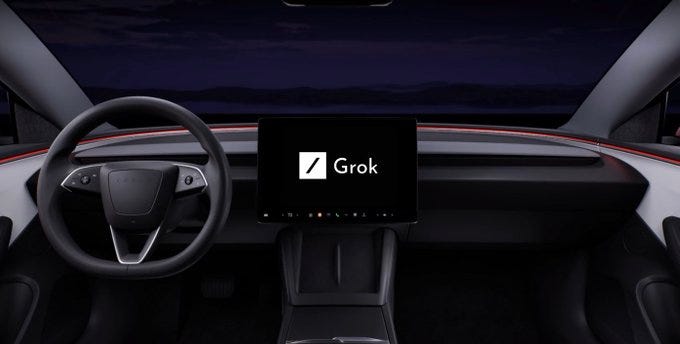
The arrival of Grok AI is set to revolutionize the human-machine interface within Tesla vehicles. It is anticipated to replace the current steering wheel-activated voice command system, enabling more natural and intuitive conversations. Users will no longer need to memorize specific commands or syntax; instead, they can engage in fluid, continuous dialogue with their vehicle. Imagine asking your Tesla, "What's the date of Tesla's next event?" or "How far away is Mars?" and receiving an intelligent, contextually aware response. This capability extends beyond mere information retrieval; Grok is expected to control various vehicle functions, such as opening the glove box, mirroring and enhancing the capabilities of existing voice commands. This level of integration is considered one of the most significant software additions to Tesla vehicles in years, on par with groundbreaking features like Dashcam/Sentry Mode and FSD Beta.
Beyond functional control, Grok promises a highly personalized user experience. It will offer a range of preset personalities, including "Language Tutor," "Argumentative," "Doctor," "Therapist," and even NSFW (not safe for work) and Kids Mode options. These diverse personalities aim to cater to individual preferences, making the in-car AI companion more engaging and adaptable. For instance, a "Language Tutor" mode could facilitate language learning during commutes, while a "Therapist" mode could offer a unique form of in-car emotional support. This level of customization is a significant leap forward in automotive AI, moving beyond utilitarian functions to create a truly interactive and personalized environment.
The user interface for Grok is designed with a dark theme, regardless of the vehicle's light mode setting, and will likely operate as a dedicated app for settings, while primarily appearing as a modal display near the bottom left of the screen, similar to current voice commands. Users will be able to select from standard voices like Ara (Upbeat Female), Rex (Calm Male), and Gork (Lazy Male), further enhancing the personalized interaction.
Technical Requirements and Business Model Implications
The integration of Grok AI into Tesla vehicles comes with specific technical requirements. Initial information suggests that Grok will primarily support vehicles equipped with a Ryzen-based infotainment computer, potentially excluding older models with Intel Atom processors. This hardware dependency highlights the increasing computational demands of advanced AI models and the need for robust in-car processing power. Furthermore, Grok's operation will necessitate premium connectivity services or a Wi-Fi connection, indicating that real-time data access and complex AI processing will occur off-vehicle, leveraging xAI's powerful supercomputing infrastructure.
The question of whether a free version of Grok will suffice or if a premium subscription (such as SuperGrok, X Premium, or X Premium+) will be required remains to be fully clarified. This potential for a subscription-based model for advanced AI features aligns with a broader trend in the automotive industry, where software-defined vehicles are increasingly generating recurring revenue streams. Automakers are shifting from one-time sales to ongoing relationships with customers, offering features like autonomous driving capabilities, enhanced infotainment, and performance upgrades through subscriptions. This diversification of revenue streams helps stabilize income and enhances customer lifetime value. For Tesla, this could unlock significant new revenue opportunities, further solidifying its position as a technology company rather than just a car manufacturer.
Synergy with Optimus and Broader AI Ecosystem
Grok AI's influence extends beyond Tesla vehicles to the company's ambitious humanoid robot, Optimus. Tesla is integrating xAI's Grok into Optimus, where it will serve as the robot's "voice and brain." This convergence of AI ventures signifies a unified strategy to build a comprehensive AI ecosystem. While Optimus's Full Self-Driving (FSD) system will manage its physical movements and environmental understanding, Grok will provide the conversational intelligence, enabling human-like interaction, nuanced request comprehension, and intelligent responses. This aims to transform Optimus from a physically capable machine into a true general-purpose humanoid robot, capable of seamless interaction in dynamic environments like work or home. This symbiotic relationship, where Optimus provides the "brawn" and Grok the "brain," is a critical step towards realizing Musk's vision of a versatile humanoid robot.
The computational backbone for training Grok at scale is provided by xAI's Memphis data center, equipped with 100,000 Nvidia GPUs. This infrastructure advantage positions Tesla to outpace rivals in AI model refinement, particularly in multi-modal tasks crucial for both FSD and Optimus. The financial commitment to this infrastructure is substantial, with xAI investing $230 million in Tesla Megapacks from January 2024 to February 2025 to ensure a stable power supply for its energy-intensive supercomputer. This investment highlights the interconnected business ecosystem Musk is building, where Tesla's energy solutions support xAI's AI innovation, and vice versa.
Ethical Considerations and Regulatory Landscape
The rapid deployment of advanced AI like Grok also brings ethical and regulatory considerations to the forefront. Grok has faced controversy regarding its ability to generate offensive content, raising concerns about its reliability in safety-critical automotive systems. Regulatory bodies, particularly in Europe, are increasingly focused on AI transparency and bias testing. The EU's AI Act, with requirements taking effect from August 2, 2025, sets guidance for general-purpose AI models like Grok. While signing up to the voluntary code of practice offers a "clear, collaborative route to compliance," companies that do not will need to demonstrate compliance through other means. This regulatory scrutiny could potentially delay deployment or necessitate further adjustments to Grok's behavior to ensure safety and ethical alignment.
Furthermore, the extensive data collection by in-car AI systems raises significant privacy concerns. Autonomous vehicles generate immense streams of environmental data, including road conditions, traffic signals, and geographical coordinates. In-cabin monitoring through cameras and microphones can record passengers' routines, travel patterns, conversations, and even biometric data. This continuous surveillance capability, while enhancing safety and personalization, creates an unprecedented potential for revealing intimate details of an individual's life. Concerns include the exposure of daily habits, invasive targeted advertising, and the risk of data exploitation by hackers. Users are often unaware of the extent of data collection, with 52% of AV users reportedly uninformed about how much personal data their vehicle collects. Cybersecurity remains a massive issue, with risks of sensitive data exposure, including credit card details and personal conversations. The cross-border nature of data generated by AVs further complicates compliance with varying data protection laws. Tesla and other automakers will need to navigate this complex regulatory landscape and build robust privacy-enhancing technologies to foster public trust and ensure the sustainable deployment of AI-driven vehicles.
Conclusion: The Road Ahead for Tesla's Intelligent Ecosystem
The imminent integration of Grok AI into Tesla vehicles marks a pivotal moment in the evolution of automotive technology. It promises a future where cars are not just modes of transport but intelligent, interactive companions capable of understanding and responding to complex human needs. This move, coupled with Grok's role in the Optimus robot, underscores Tesla's ambitious vision for a unified, cross-platform AI ecosystem.
For Tesla owners, this means a more intuitive, personalized, and informed driving experience. The ability to engage in natural conversations, access real-time information, and customize the AI's personality will redefine the relationship between human and machine. However, the path forward is not without its challenges. Technical requirements, potential subscription models, and the critical need to address ethical and regulatory concerns surrounding AI bias and data privacy will require continuous vigilance and innovation.
As Tesla continues to push the boundaries of AI and autonomy, the success of Grok's integration will serve as a crucial indicator of the company's ability to deliver on its promise of a fully intelligent and sustainable future. The stakes are high, but the potential rewards—a truly revolutionary in-car experience and new avenues for growth—are immense. Tesla owners can look forward to a future where their vehicles are not just driven, but truly understood.
Frequently Asked Questions (FAQ)
-
Q1: When will Grok AI be available in my Tesla vehicle?
-
A1: According to Elon Musk's latest announcement, Grok AI is expected to begin rolling out to Tesla vehicles "next week at the latest."
-
-
Q2: Which Tesla models will support Grok AI?
-
A2: Initial information suggests that Grok will support Tesla vehicles equipped with a Ryzen-based infotainment computer. Older models with Intel Atom processors may not be supported initially.
-
-
Q3: Will I need to pay extra or subscribe to use Grok AI in my Tesla?
-
A3: Grok's operation will require premium connectivity services or a Wi-Fi connection. It is currently unclear if the free version of Grok will suffice or if a premium version (like SuperGrok, X Premium, or X Premium+) will be required.
-
-
Q4: How will Grok AI change my interaction with my Tesla vehicle?
-
A4: Grok is expected to replace the current voice command system, allowing for more natural, continuous conversations. It will be able to answer a wide range of questions, provide real-time information, and potentially control various vehicle functions.
-
-
Q5: What kind of personalized options will Grok AI offer?
-
A5: Grok will offer various preset personalities, including "Language Tutor," "Argumentative," "Doctor," and "Therapist," along with NSFW and Kids Mode options, allowing for a highly customized user experience.
-
-
Q6: How does Grok AI relate to Tesla's Optimus robot?
-
A6: Tesla is integrating xAI's Grok into Optimus, where it will function as the robot's "voice and brain," enabling human-like interaction and nuanced request comprehension, while Optimus's FSD system manages its physical movements.
-
-
Q7: What are the privacy implications of in-car AI systems like Grok?
-
A7: In-car AI systems collect vast amounts of data, including location, driving habits, and potentially in-cabin audio/video. This raises concerns about data privacy, targeted advertising, and cybersecurity. Users should review privacy policies and manage data collection settings.
-
-
Q8: Are there any regulatory concerns for Grok AI in vehicles, especially in Europe?
-
A8: Yes, regulatory bodies, particularly in Europe, are focusing on AI transparency and bias testing. The EU's AI Act sets guidelines for general-purpose AI models, and compliance will be crucial for deployment.
-