
Chapter 1: The Industrial Inevitability of the $25,000 Tesla
For nearly a decade, the "$25,000 Tesla" has been the "Holy Grail" of the EV industry—a promise that seemed to dance just out of reach as global supply chains buckled and battery costs fluctuated. However, as of February 2026, the phantom has gained a physical form. Internally codenamed "Project Redwood," this vehicle represents more than just a cheaper entry point into the ecosystem; it is Tesla’s strategic response to the aggressive expansion of budget-friendly Chinese EVs and the slowing growth of the premium sedan market.
The urgency for Redwood is rooted in market saturation. While the Model 3 and Model Y have dominated sales charts, they remain out of reach for a vast demographic of urban commuters in Europe and North America. To conquer the next 20 million units in annual sales, Tesla cannot simply "discount" its way to the top. It must reinvent the very physics of manufacturing.
Chapter 2: The Death of the Assembly Line—The Unboxed Process 2.0
The traditional automotive assembly line, pioneered by Henry Ford in 1913, operates on a linear principle: a single frame travels through a mile-long factory, and hundreds of parts are "stuffed" into it by workers who must often contort their bodies to reach difficult areas. This process is inherently inefficient—much of the car's interior is "dead space" during assembly, and the paint shop creates a massive bottleneck.
Parallelism Over Linearity
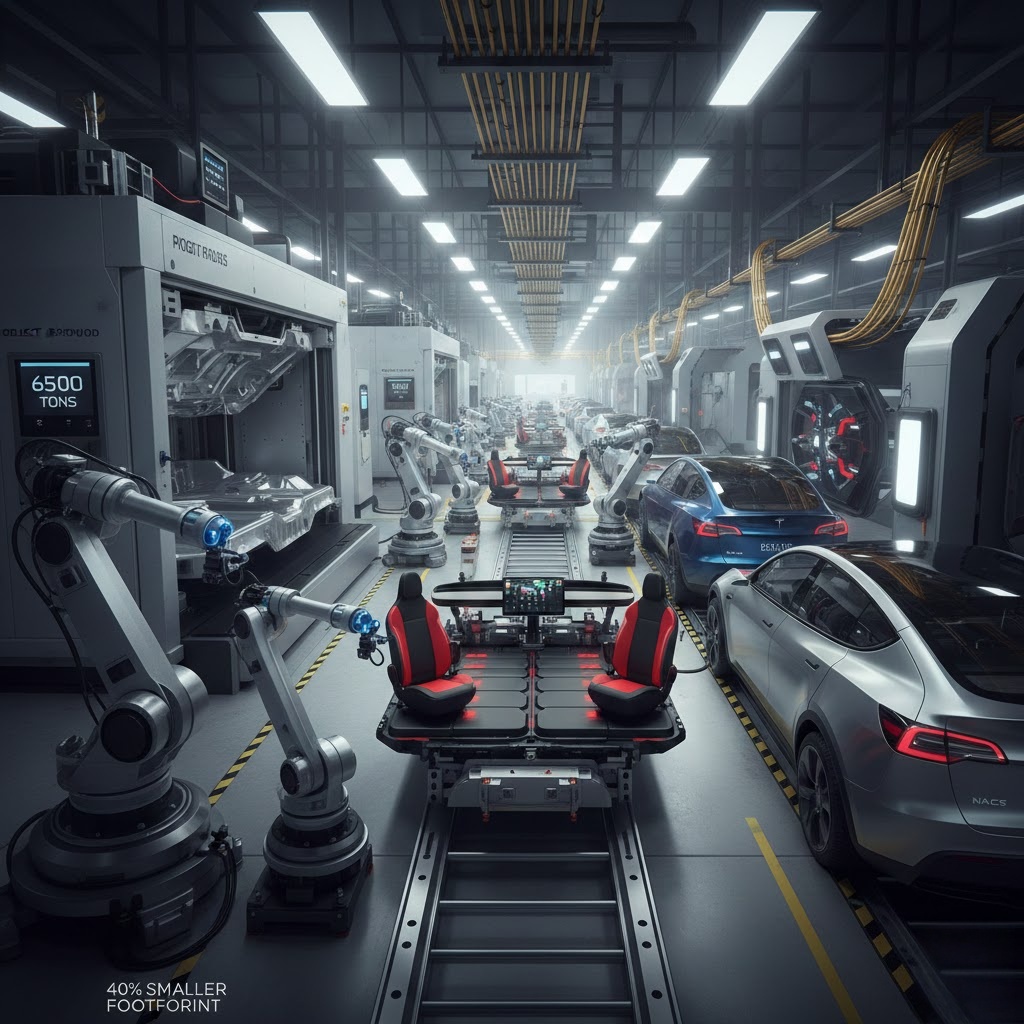
Tesla’s "Unboxed Process" (debuting at Giga Texas and planned for Giga Mexico) throws the rulebook away. Instead of building a car on a single moving line, the Redwood is treated as a collection of independent sub-assemblies:
-
The Front and Rear Underbodies: Massive single-piece castings.
-
The Structural Battery Pack: Serving as the vehicle’s floor and central rigid member.
-
The Side Panels and Roof: Finished independently.
-
The Interior Module: Seats, center console, and dashboard are bolted directly to the structural battery before any "body" exists around them.
This "outside-in" approach means that robots and workers have 360-degree access to the modules. There is no more crawling through door frames to install wiring harnesses. The result? A 40% reduction in factory footprint and a 25% increase in production speed.
Chapter 3: Engineering the Cost—Giga-Presses and 48-Volt Architecture
To hit a profitable $25,000 (or even the rumored $16,000 for a base fleet variant), Tesla is leveraging hardware innovations that the rest of the industry is still struggling to replicate.
The 6,500-Ton Giga Press
Redwood utilizes an even more integrated casting method than the Model Y. By using a 6,500-ton clamping force Giga Press, Tesla reduces the parts count of the chassis from hundreds of stamped pieces to just three main castings. This eliminates thousands of weld points and significantly reduces the weight of the vehicle, which in turn allows for a smaller, cheaper battery.
The 48V Revolution
Following the Cybertruck’s lead, Redwood adopts a full 48-volt electrical architecture. Traditional 12V systems require thick, heavy copper wiring to handle current loads. By quadrupling the voltage, Tesla reduces the required current, allowing for thinner, lighter, and cheaper wiring harnesses. In a mass-market car where every penny and gram counts, this saves an estimated $400-$600 in material costs per vehicle.
Chapter 4: The Specifications—What the 2026 Owner Can Expect
Despite its budget focus, Redwood isn't a "stripped-down" car. Tesla understands that its brand value is tied to technology.
| Feature | Estimated Specification (2026 Redwood) |
| Battery Chemistry | Lithium Iron Phosphate (LFP) - Prismatic Cells |
| Estimated Range | 250 miles (400 km) EPA / 450 km WLTP |
| 0-60 mph | 6.2 seconds |
| Compute Power | HW5 (AI5) with Full Self-Driving Supervised |
| Drag Coefficient | 0.20 - 0.21 Cd (Aero-optimized "Mini-Y" shape) |
The car’s design is a "compact crossover" (C-segment), often described as a "Mini-Y." It features a shorter wheelbase but retains the high seating position that European and American drivers crave. By using a 53kWh LFP battery, Tesla ensures long-term durability and safety, avoiding the higher costs and supply volatility of nickel and cobalt.
Chapter 5: Global Strategic Impact—Giga Berlin vs. Giga Texas
Redwood is a global soldier. While Giga Texas handles the initial pilot production in early 2026, Giga Berlin is the key for the European market. European buyers prioritize efficiency and "parkability." The Redwood’s compact dimensions make it the perfect weapon against the VW ID.3 and the Renault 5 EV.
Furthermore, Redwood provides the hardware foundation for the Cybercab. The "Unboxed" process is designed so that a car can be built with or without a steering wheel on the same line, allowing Tesla to pivot production instantly based on regulatory approvals for autonomy in different regions.
Conclusion: The End of the "EV for the 1%"
The significance of Project Redwood cannot be overstated. It is the final nail in the coffin for the argument that EVs are a luxury plaything for the wealthy. Through the Unboxed Process, Tesla is moving toward an "appliance" level of manufacturing efficiency—where the car is produced with the same speed and modularity as a high-end smartphone.
As we move into the second half of 2026, the success of Redwood will determine if Tesla can maintain its mantle as the world’s most valuable automaker. If they can truly deliver a high-tech, autonomous-ready EV for the price of a Toyota Corolla, the transition to sustainable energy will have officially reached its "point of no return."
FAQ: Everything You Need to Know About Project Redwood
Q: Will the $25,000 price include Full Self-Driving (FSD)?
A: The price covers the hardware (HW5), but FSD will remain a software add-on or a monthly subscription. In 2026, Tesla is expected to offer a "lite" version of FSD for Redwood owners.
Q: Is it a hatchback or a sedan?
A: Leaked prototypes and supplier data describe it as a "compact crossover," featuring a rear hatch for utility, similar to a scaled-down Model Y.
Q: When will European deliveries begin?
A: Pilot production started in Austin in Q1 2026. Giga Berlin is expected to begin localized Redwood production by late Q3 or Q4 2026.
Q: Can it use the North American Charging Standard (NACS)?
A: Yes, it will come native with NACS in North America and CCS2 in Europe, fully compatible with the latest V4 Superchargers.