
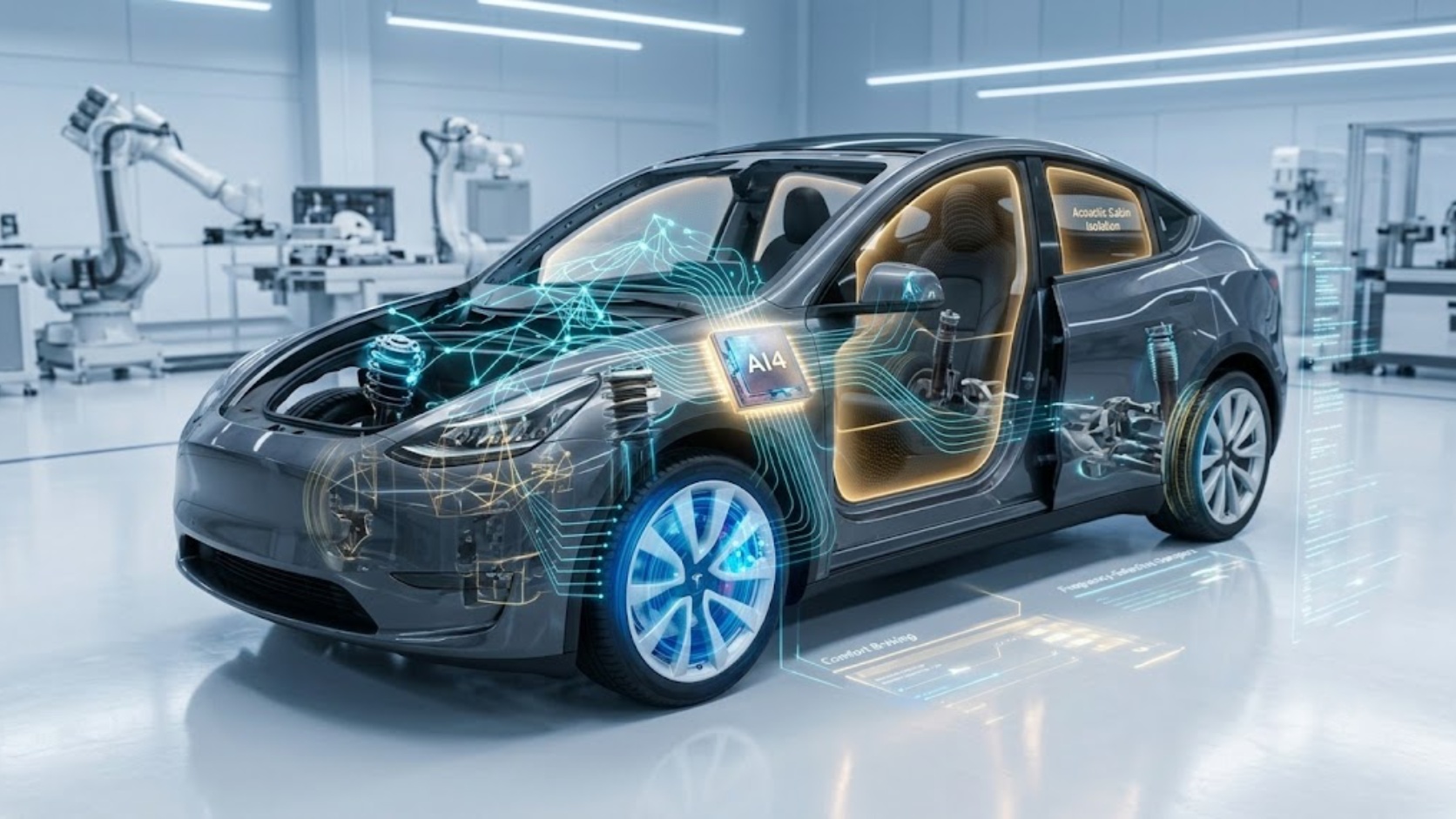
Introduction: The Mid-Cycle Evolution of Tesla’s Best-Seller
The Tesla Model Y stands as the world’s best-selling passenger vehicle. To maintain its market position against growing competition across North America and Europe, Tesla introduced major engineering updates under the "Juniper" mid-cycle platform refresh.
Rather than focusing solely on cosmetic styling updates, the Juniper platform delivers significant technical improvements: next-generation AI4 perception hardware, software-defined suspension tuning, acoustic cabin isolation, and refined thermal management systems.
2. Comfort Braking & Dynamic Suspension Engineering
One of the most notable daily driving enhancements in the Juniper architecture is the introduction of Comfort Braking.
Eliminating Stop-and-Go Jerk
In earlier EV designs, the transition between regenerative motor braking and mechanical friction brakes at low speeds (0–3 mph) could cause a slight jerk right as the vehicle came to a complete stop. The Comfort Braking system continuously samples wheel speed, pedal force, and cabin pitch sensors to precisely modulate brake caliper hydraulic pressure in real time. The result is a smooth stop that eliminates cabin pitch—a welcome upgrade for city traffic on the Los Angeles 405 or stop-and-go commuting in London.
Suspension Dampening and Cabin Acoustics
The Juniper chassis incorporates frequency-selective hydraulic dampers alongside upgraded suspension bushings. Combined with 360-degree acoustic double-laminated glass and enhanced body cavity foam insulation, interior cabin noise levels are reduced by up to 20%, bringing ride quietness in line with traditional luxury sedans on rough highway surfaces.
3. AI4 (Hardware 4) Sensor Suite Breakdown
At the heart of the vehicle’s active safety and autonomous capabilities is the native AI4 (Hardware 4) sensor suite.
Camera Resolution and Dynamic Range
AI4 replaces legacy 1.2-megapixel camera sensors with high-resolution 5-megapixel HDR sensors. This upgrade provides:
-
Extended Visibility Distance: Identifies small road debris, lane markings, and traffic signs at more than twice the distance of HW3 systems.
-
Flicker Mitigation and Low-Light Sensitivity: Accurately reads LED headlights, variable emergency vehicle lighting, and digital traffic sign displays without optical distortion.
-
All-Weather Glare Handling: Advanced anti-reflective lens coatings maintain clear visibility during low-angle sunrise/sunset driving or heavy rainfall.
4. Thermal Management & Low-Voltage Platform
The Juniper architecture includes an updated Octovalve heat pump thermal management loop. During cold winter operations in Canada or Northern Europe, the system scavenges waste heat generated by the electric drive units and AI4 computer board, redirecting it to precondition the battery pack and heat the cabin with high energy efficiency.
5. Maintenance & Accessory Considerations for Owners
For owners and aftermarket enthusiasts, the Juniper Model Y platform introduces refined maintenance guidelines:
-
Jacking and Lifting Geometry: Due to updated underbody aero shields and cast structural frame rails, always use rubber jack pad adapters specifically sized for Model Y chassis points to prevent battery shield damage.
-
Wheel and Aero Cover Fitments: The revised wheel-well aero shrouds require flush-mount aero covers. Using correctly engineered aftermarket covers helps maintain optimal highway range efficiency.
-
Alignment Precision: With stiffer subframe mounting points, keeping alignment parameters within precise factory tolerances is essential to prevent premature inner-shoulder tire wear on heavy dual-motor all-wheel-drive models.
Conclusion
The Model Y Juniper refresh shows how Tesla uses continuous hardware and platform engineering to refine its vehicles. By pairing upgraded AI4 hardware with refined suspension dynamics and software features like Comfort Braking, Tesla ensures its best-selling vehicle remains a benchmark in the EV market.
Frequently Asked Questions (FAQ)
Q1: Can Comfort Braking be retrofitted to older Model Y vehicles via software update?
Comfort Braking relies on updated chassis control firmware, wheel speed sensors, and braking actuators introduced with the Juniper platform hardware. Certain software dampening enhancements roll out to older models, but the complete feature experience requires the updated platform hardware.
Q2: How can I tell if my Model Y has AI3 or AI4 hardware?
AI4 vehicles can be identified visually by the reddish anti-reflective tint on the windshield forward-facing camera lenses and the updated "AP4" designation listed under Controls > Software > Additional Vehicle Information on the touchscreen.
Q3: Does the Model Y Juniper platform use 48-volt low-voltage architecture?
While the Cybertruck introduced a full 48V low-voltage architecture across the vehicle, the Model Y Juniper platform retains an optimized 12V/16V lithium-ion low-voltage system to preserve component compatibility across global high-volume supplier networks.