
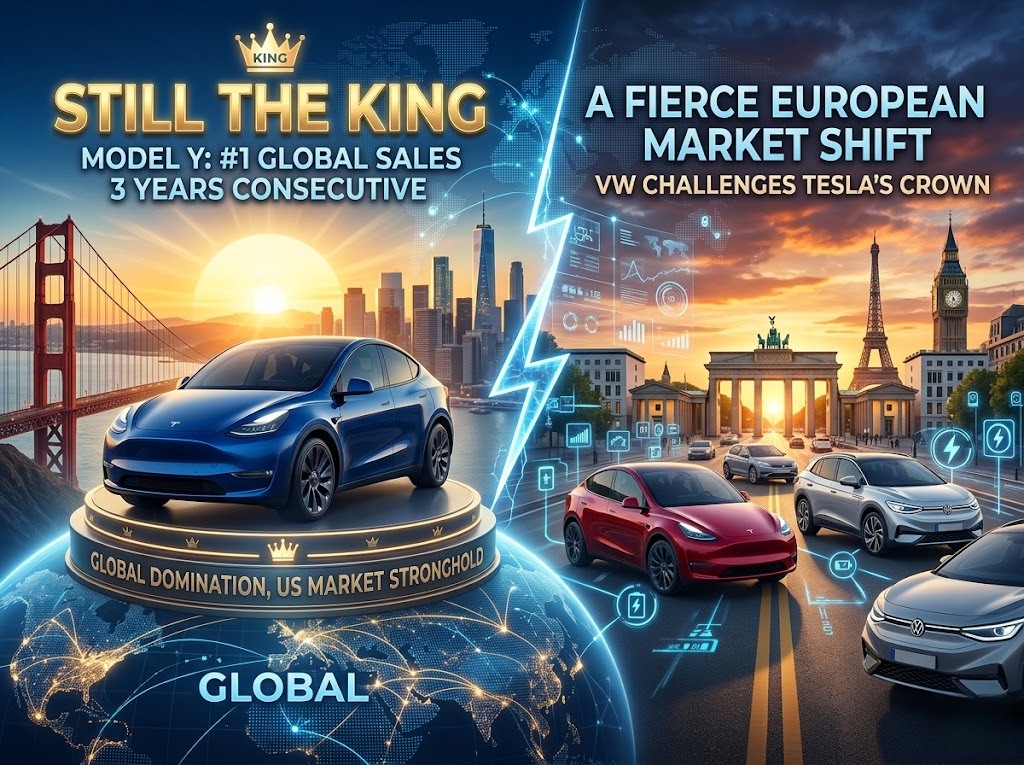
Introduction: The Crown Weighs Heavy
As the final tallies for global automotive sales in 2025 were cemented in early 2026, a familiar, aerodynamic silhouette once again claimed the absolute summit of the industry. For the third consecutive year, the Tesla Model Y has secured its position as the world’s best-selling passenger vehicle, comfortably outpacing legacy internal combustion engine (ICE) titans like the Toyota RAV4 and the Honda CR-V. Achieving this milestone once was a historic anomaly; doing it three years in a row establishes the Model Y as one of the most culturally and economically significant consumer products of the 21st century. It is the undisputed king of the electric vehicle transition.
However, a closer examination of the geographic distribution of these sales reveals a narrative that is far more complex than simple global domination. The armor of the king has developed visible chinks. While the Model Y continues to enjoy an almost insurmountable fortress of market share in the United States, the European landscape has proven to be a brutal, highly dynamic battleground. In a stunning reversal of recent trends, Tesla experienced a near 28% decline in regional European sales, allowing the Volkswagen Group to execute a brilliant counter-offensive and seize the crown as Europe’s top EV seller.
For Tesla owners, prospective buyers, and investors across the US and Europe, understanding this dichotomy is crucial. The era of Tesla coasting on the sheer novelty of electrification is over. We have entered the era of trench warfare, where localized consumer preferences, fierce domestic competition, and shifting macroeconomic policies dictate who wins and who loses. This comprehensive analysis breaks down the anatomy of the Model Y’s global dominance, the specific mechanisms behind Volkswagen’s European resurgence, and the strategic countermeasures Tesla is deploying to defend its empire.
Chapter 1: The American Fortress — Why the US Remains Tesla Country
To understand how the Model Y maintains its global sales crown despite significant European headwinds, we must first look at its absolute dominance in its home market. In the United States, the Model Y is not just a car; it is the default answer to a societal question. When an American family decides to transition away from gasoline, the Model Y is overwhelmingly the path of least resistance.
The Supercharger Moat and NACS Dominance The primary driver of this sustained American dominance is the Tesla Supercharger network. While 2024 and 2025 saw the historic industry-wide adoption of Tesla's North American Charging Standard (NACS), the psychological and practical advantages still heavily favor native Tesla vehicles. Legacy automakers are still navigating clunky adapter rollouts and software integrations, whereas the Model Y offers a seamless, plug-and-charge experience that remains unparalleled in reliability. In the sprawling, road-trip-heavy culture of the United States, range anxiety is the ultimate dealbreaker. Tesla’s proprietary integration of its navigation system with real-time Supercharger telemetry provides a level of travel confidence that competitors have yet to successfully replicate.
The Economics of the American Market Furthermore, the Model Y's pricing strategy in the US has been masterfully tuned to exploit the Inflation Reduction Act (IRA). By constantly adjusting supply chains to ensure battery sourcing complies with strict federal guidelines, Tesla has managed to keep the Model Y eligible for the full $7,500 point-of-sale federal tax credit. When factoring in state-level incentives in massive automotive markets like California, Colorado, and New York, the effective purchase price of a Model Y Long Range often undercuts hybrid crossovers from Toyota and Honda. It is a value proposition that is mathematically difficult for the American middle class to ignore.
The Absence of a Domestic Challenger Finally, Tesla benefits from a surprising lack of highly competent, high-volume domestic competition in the crossover segment. While Ford has the Mustang Mach-E and General Motors is slowly ramping up its Ultium-based Blazer and Equinox EVs, none have achieved the manufacturing scale or the profit margins necessary to engage Tesla in a sustained price war. The Model Y reigns supreme in the US because it operates in a vacuum of equally scaled competitors, allowing it to rack up the massive volume needed to offset losses elsewhere.
Chapter 2: The European Battlefield — The Volkswagen Group's Masterclass
If the US is a Tesla fortress, Europe is a highly contested, fractured terrain. The headline that sent shockwaves through the automotive world in early 2026 was undeniable: The Volkswagen Group had officially overtaken Tesla as the highest-volume seller of pure electric vehicles across the European continent. How did a legacy German automaker, often criticized for its slow software development and early EV missteps, manage to dethrone the reigning champion?
The Power of Portfolio Diversity Tesla's overarching strategy has always been rooted in radical simplicity: build a very small number of models in massive quantities to achieve economies of scale. The Model Y is tasked with appealing to everyone. In contrast, the Volkswagen Group deployed a strategy of hyper-segmentation. They did not try to build one "Model Y killer." Instead, they launched an armada.
By leveraging the MEB platform across multiple sub-brands, VW Group flooded the European market with tailored options. If a buyer wanted a practical, no-nonsense family hauler, there was the Volkswagen ID.4. If they wanted premium interior refinement and acoustic isolation, there was the Audi Q4 e-tron. If they prioritized maximum cargo space and value, the Skoda Enyaq proved to be a quiet, devastatingly effective best-seller in countries like the UK, Germany, and Scandinavia. This multi-pronged attack allowed VW to capture diverse consumer demographics that felt the minimalist, tech-heavy interior of the Model Y was too sterile or lacking in traditional automotive luxury.
The Localized Supply Chain and Consumer Loyalty European consumers have a deep, historically ingrained loyalty to domestic brands. There is a cultural preference for German engineering, French design, and local manufacturing. While Tesla built Gigafactory Berlin to localize production, Volkswagen inherently possesses a century-old network of dealerships, localized supply chains, and established fleet-purchasing relationships. In the lucrative European company-car market (which accounts for a massive percentage of new vehicle registrations), fleet managers often default to legacy brands with vast, immediately accessible service networks.
The Form Factor Mismatch It is also vital to consider the physical reality of European infrastructure. The Model Y is a large, wide vehicle by European standards. While it works beautifully on the unrestricted Autobahn, it can be unwieldy in the dense, medieval urban centers of Paris, Rome, or Amsterdam. European buyers have shown a strong preference for smaller, more agile B-segment and C-segment hatchbacks and compact crossovers—a segment where Tesla currently has no offering, leaving the door wide open for vehicles like the Volvo EX30 and the upcoming VW ID.2 to siphon away potential first-time EV buyers.
Chapter 3: The End of Subsidies — A Macroeconomic Shock
The 28% decline in Tesla’s European sales cannot be solely attributed to Volkswagen’s product offensive; it was heavily exacerbated by drastic changes in government policy.
Throughout 2024 and 2025, several major European nations—most notably Germany, the largest automotive market on the continent—abruptly ended or severely curtailed their EV purchasing subsidies. This macroeconomic shock sent a chilling effect through the entire industry, but it disproportionately impacted premium-priced vehicles like the Model Y.
When the safety net of government subsidies vanished, price sensitivity among European consumers skyrocketed. Legacy automakers with deep pockets and diverse ICE revenue streams could afford to artificially subsidize their EV lease rates to keep volume high. Furthermore, the influx of highly competitive, lower-cost EVs from Chinese manufacturers (such as BYD and MG) introduced a brutal price war at the lower end of the market. Tesla, committed to maintaining healthy margins, found itself squeezed between the premium cachet of Audi/BMW and the aggressive undercutting of the new Asian entrants, making the Model Y a tougher sell in a post-subsidy economy.
Chapter 4: Gigafactory Berlin's Pivot — Tesla’s Strategic Countermeasures
Tesla is famously agile, and the leadership team in Austin is not watching the European market share slip away without a fight. The center of gravity for Tesla’s European counter-offensive is Gigafactory Berlin-Brandenburg. The facility is transitioning from being merely a localized assembly plant into a hub for European specific adaptation.
Refining the Product for European Tastes To combat the perception that the Model Y lacks the refinement of its German rivals, Tesla has been quietly implementing significant hardware changes out of Giga Berlin. European-built Model Ys now feature distinct suspension geometries tailored specifically for the varied demands of European roads—balancing the high-speed stability required for the Autobahn with the compliance needed for cobblestone city streets.
Furthermore, Giga Berlin boasts what Elon Musk has called the world's most advanced paint shop. The introduction of exclusive, complex, multi-layered colors like Quicksilver and Midnight Cherry Red was a direct, calculated move to appeal to the European aesthetic preference for premium, dynamic finishes, countering the somewhat ubiquitous color palette of the US fleet.
The "Juniper" Horizon and Dynamic Pricing To address the aging lifecycle of the current Model Y, the industry is intensely focused on the impending "Project Juniper" refresh. Much like the Model 3 "Highland" update, the Juniper refresh is expected to bring a sleeker aerodynamic profile, vastly improved acoustic glass for a quieter cabin, and upgraded interior materials to better compete with the plush cabins of Audi and Mercedes-Benz.
In the interim, Tesla has weaponized its margins. Throughout 2025 and into 2026, Tesla has utilized dynamic, localized pricing strategies—frequently adjusting the price of the Model Y on a country-by-country basis to aggressively defend market share against the VW ID.4 and the incoming wave of affordable Chinese crossovers.
Expanding the Service Infrastructure Perhaps the most critical countermeasure is the rapid expansion of Tesla's physical footprint in Europe. A historic pain point for European Tesla owners has been the distance to service centers and the availability of replacement parts. Recognizing that customer retention is just as important as acquisition, Tesla has injected massive capital into expanding its mobile service fleet and opening high-throughput service centers across Germany, France, and the UK, neutralizing one of the primary advantages held by legacy dealership networks.
Conclusion: The Evolution from Conqueror to Competitor
The fact that the Tesla Model Y has secured the title of the world's best-selling car for three consecutive years is a monumental triumph of engineering, manufacturing, and vision. It is the car that proved the internal combustion engine is functionally obsolete. However, the data from 2025 and early 2026 paints a clear picture of the future: the era of uncontested, blanket global dominance is coming to an end.
The European market, with its fierce domestic loyalty, diverse form-factor requirements, and hyper-competitive legacy automakers led by the Volkswagen Group, serves as a crystal ball for the global EV industry. It proves that a "one-size-fits-all" vehicle, no matter how technologically advanced, eventually hits a ceiling.
To maintain its reign in the coming years, Tesla must evolve. It must transition from being a disruptive tech company that imposes its singular vision on the market, into a highly responsive, localized automaker capable of engaging in street-by-street warfare. The king still sits on the throne, but the siege has officially begun.
FAQ: Understanding the Global Market Shift
Q: Why did Volkswagen surpass Tesla in European sales so quickly?A: Volkswagen’s success is rooted in its MEB platform strategy, which allows it to produce a wide variety of EVs across different brands (VW, Audi, Skoda, Cupra) and price points. This diverse portfolio caters to highly specific European consumer tastes—from luxury to budget-conscious utility—much more effectively than Tesla's singular reliance on the Model Y crossover.
Q: Is the Model Y built in Berlin technically different from the ones built in Texas or Fremont?A: Yes. While the software and fundamental architecture are the same, Berlin-built Model Ys feature structural battery pack designs, specialized paint options (like Midnight Cherry Red), and critically, suspension tuning specifically calibrated for European driving conditions, which often demand a balance of high-speed stability and rough-road compliance.
Q: Will the drop in European sales lead to Model Y price cuts in the US or UK?A: Tesla operates its pricing highly dynamically based on local supply and demand. Because the US market remains incredibly strong for the Model Y, massive US price cuts due to European performance are unlikely. However, in European markets like the UK and Germany, aggressive pricing adjustments and incentivized financing rates are highly probable as Tesla fights to regain market share.
Q: What is the "Juniper" refresh, and will it help Tesla in Europe?A: "Project Juniper" is the internal codename for the heavily rumored, comprehensive refresh of the Model Y. Expected to follow the design cues of the updated Model 3, it will likely feature a more aerodynamic front fascia, significantly improved interior materials, ambient lighting, and better noise insulation. These premium refinements are exactly what European buyers have been demanding, making it a critical weapon for Tesla to deploy against German luxury rivals.
Q: If European sales are dropping, how is the Model Y still the #1 selling car globally?A: The volume generated by the United States and the Chinese domestic market is absolutely staggering. The Model Y's dominance in the US, combined with strong, sustained volume in China (where it competes fiercely but successfully against local brands), produces enough aggregate global volume to mathematically offset the localized losses in the European theater.