
Introduction
The global transition toward widespread electric vehicle adoption faces a critical, physical bottleneck that no amount of pure software optimization can fully solve: the physical speed of infrastructure deployment. In Western Europe, expanding ultra-fast charging networks has historically been an exercise in administrative frustration.
Automotive charging operators routinely encounter multi-month municipal permit delays, complex civil engineering requirements, and intense pushback from local urban planning boards protective of historical cobblestone streets and centuries-old architectural zoning codes.
To bypass this infrastructural gridlock, Tesla’s European engineering division has executed a brilliant hardware pivot, deploying the continent's first commercial "folding Supercharger" installations in June and early July 2026. This modular system represents a radical departure from traditional civil construction methodologies.
By engineering a pre-fabricated, structural concrete platform that houses all underlying electrical switchgear, high-power cooling lines, and structural charging pedestals in a unified, foldable configuration, Tesla has turned the complex task of building a high-voltage fast-charging station into a simple "plug-and-play" logistics operation.
Section 1: Mechanical Engineering and Pre-Fabrication Design
Traditional Supercharger installations require significant on-site civil labor. Contractors must excavate deep trenches across parking lots, lay extensive networks of protective PVC conduit, pour massive concrete foundations for each individual charging stall, and mount heavy liquid-cooled power cabinets. This process typically takes anywhere from two to six weeks per site and leaves a permanent footprint on the underlying real estate.
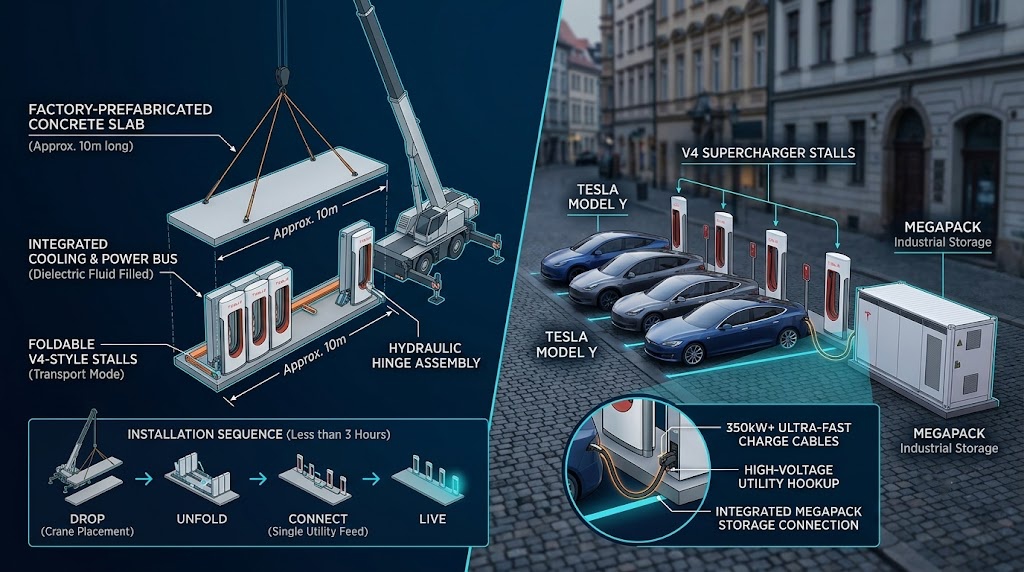
The folding Supercharger system completely re-engineers this sequence through comprehensive off-site pre-fabrication. In a highly controlled factory environment, Tesla engineers construct a structural, ultra-durable pre-cast concrete slab that measures approximately 10 meters in length. Inside the hollow core of this structural slab lies a fully integrated electrical bus-duct system, heavy-duty insulated power distribution blocks, and pre-routed coolant lines filled with dielectric fluid.
The structural charging stalls—utilizing the latest slimline V4 industrial aesthetics—are mounted directly to the slab via high-torque heavy-duty hydraulic hinges. During transport, these charging pedestals are folded flat against the concrete base, allowing a standard flatbed semi-truck to carry a fully assembled, multi-stall charging station without exceeding standard width or height legal limits.
Upon arriving at the destination site, a mobile hydraulic crane lifts the entire concrete platform off the flatbed and positions it directly onto a pre-leveled surface, such as an existing asphalt parking lot or a gravel utility pad. Once positioned, an operator activates a localized hydraulic pump system that smoothly tilts the charging pedestals upright into their locked vertical operational positions.
The site contractor then connects a single, heavy-gauge high-voltage utility master feed cable into the integrated main circuit breaker panel built into the end of the slab. What used to require weeks of disruptive on-site digging and concrete curing is now compressed into an efficient, low-noise installation process completed in less than three hours.
Section 2: Overcoming European Grid Constraints and Historic Preservation Laws
The deployment velocity enabled by this modular design is a game-changer for navigating Western Europe’s notoriously complex regulatory and historic preservation frameworks. In cities like Paris, Munich, or Florence, traditional construction permits that involve cutting through historic pavement or digging near centuries-old subterranean utility lines can trigger mandatory archaeological assessments and bureaucratic reviews that delay projects for years.
Because the folding Supercharger sits entirely on top of the existing asphalt surface and relies on a self-weighted, structural gravity base, it does not require deep excavation or permanent foundation anchors. This architectural independence allows property owners and Tesla to classify the entire installation as a "temporary, relocatable utility asset" rather than a permanent structural modification to the real estate.
This distinction enables Tesla to secure fast-tracked zoning variances and streamlined environmental permits that bypass the vast majority of traditional municipal construction reviews.
Furthermore, this modularity offers unprecedented flexibility for managing seasonal tourism demand shifts across Europe. For example, during the winter skiing peak, Tesla can easily deploy additional folding Supercharger modules along major alpine transit corridors leading into the Austrian Alps.
Once the winter season concludes and traffic patterns shift toward Mediterranean coastal routes for the summer, the modules can be disconnected from the grid, folded flat, lifted onto flatbeds, and redeployed to southern France or Italy within a 48-hour window, optimizing capital asset utilization in ways traditional charging operators cannot match.
Section 3: V4 and V5 Architecture Integration with Megapack Storage
Deploying high-power charging stations at rapid speed introduces a major electrical engineering challenge: localized grid capacity overload. Tesla's folding Supercharger blocks are natively configured to support ultra-high-voltage charging speeds exceeding 350kW per stall, utilizing an optimized liquid-cooled cable architecture designed to service both current 400V vehicle architectures and upcoming 800V high-efficiency drivetrains.
To prevent these ultra-fast charging events from destabilizing local European distribution transformers—which often operate on aging, highly constrained municipal grids—the folding Supercharger platform is engineered to connect directly with adjacent Tesla Megapack industrial energy storage installations. The Megapack acts as an electrical buffer or peak-shaving reservoir.
During periods of low charging demand, the Megapack draws a steady, manageable trickle of power from the local utility grid or directly harvests energy from localized commercial solar arrays. When multiple Tesla vehicles plug in simultaneously and demand an instant burst of high-voltage energy, the system pulls power directly from the Megapack’s internal lithium-iron-phosphate (LFP) battery cells rather than spiking demand on the municipal grid.
This integration not only protects the local electrical grid from voltage drops but also allows site hosts to avoid expensive peak-demand utility surcharges, ensuring that Tesla can maintain highly competitive per-kilowatt-hour pricing for its European customers.
Conclusion
Tesla's folding Supercharger represents a brilliant evolution in infrastructure engineering. By translating a complex civil construction process into a scalable, factory-controlled modular product, Tesla has solved the physical friction points holding back rapid ultra-fast charging expansion in Europe.
The system's ability to minimize on-site construction disruption, bypass traditional zoning delays, and integrate seamlessly with advanced Megapack battery storage ensures that Tesla’s charging infrastructure will remain the gold standard of speed and reliability for EV owners across the European continent.
Frequently Asked Questions (FAQ)
Q: What is the difference in installation time between a standard V4 Supercharger and a Folding Supercharger?
A: A standard V4 Supercharger installation requires significant on-site excavation, conduit layout, and concrete curing, typically taking 2 to 6 weeks. A Folding Supercharger arrives fully assembled on a pre-cast concrete slab and is operational within 3 hours of crane placement.
Q: Does the folding design limit the peak charging speed or power distribution per stall?
A: No. The internal electrical bus-ducts and liquid-cooling lines match the specifications of permanent installations, fully supporting high-voltage charging outputs up to 350kW+ per stall for compatible vehicle architectures.
Q: Are these mobile/folding charging units equipped with integrated battery storage?
A: While the folding concrete slab itself contains only power distribution and cooling lines, the architecture features native plug-and-play interfaces designed for immediate connection to external Tesla Megapack storage units to enable localized grid peak-shaving.