
Introduction
The Tesla Model Y has been one of the best‑selling electric vehicles in both the United States and Europe for several consecutive years. Its success comes from a careful balance of price, performance, efficiency, and practicality. For 2026, Tesla introduced one of the most meaningful updates to the Model Y lineup in recent memory: a newly revised 7‑seat configuration, along with a series of hardware, interior, and software refinements that subtly but clearly shift the Model Y further into the family‑oriented crossover category.
This update is not a radical redesign, but it is strategically important. In the U.S., demand for compact three‑row SUVs continues to grow, while in Europe, buyers increasingly want flexible interior layouts without stepping up to larger, less efficient vehicles. Tesla’s approach with the 2026 Model Y reflects its broader philosophy: incremental, real‑world improvements driven by production efficiency and software integration rather than flashy redesigns.
This article provides a deep, practical analysis of the 2026 Tesla Model Y 7‑seater and related feature updates, focusing on what actually matters to owners and potential buyers in the U.S. and Europe. We will examine design changes, interior usability, safety considerations, performance impacts, pricing logic, regional differences, and long‑term ownership implications.
Chapter 1: Why the 7‑Seat Model Y Matters in 2026
Shifting Buyer Demographics
The original Model Y was primarily marketed as a five‑seat compact electric SUV. Over time, however, Tesla’s customer base has evolved. Many early adopters are now families, and many new buyers are replacing traditional gasoline crossovers like the Toyota RAV4, Honda CR‑V, Volvo XC60, or BMW X3.
For these buyers, flexibility matters more than outright performance. A third row, even a compact one, significantly expands use cases:
-
Occasional transport for children or teenagers
-
Short trips with extended family
-
School carpools or ride‑sharing
Tesla’s decision to refine and relaunch the 7‑seat Model Y in 2026 is a response to these real‑world needs rather than a marketing experiment.
Competitive Pressure
The compact EV SUV segment has become far more competitive than it was when the Model Y first launched. Rivals such as:
-
Kia EV9 (larger, but family‑focused)
-
Volvo EX90
-
Hyundai Ioniq 7 (upcoming in Europe)
are all emphasizing interior space and seating flexibility. While many of these competitors are physically larger than the Model Y, they are also more expensive and less efficient. Tesla’s 7‑seat Model Y positions itself as a middle ground: not a full‑size family SUV, but a highly efficient electric crossover that can occasionally function as one.
Tesla’s Production‑First Philosophy
Unlike traditional automakers, Tesla avoids frequent full redesigns. Instead, it optimizes manufacturing processes and updates vehicles continuously. The 2026 Model Y 7‑seat configuration benefits from years of incremental chassis, battery packaging, and rear‑body optimization, making it more practical than earlier attempts without sacrificing range as dramatically.
Chapter 2: Exterior Design and Structural Adjustments
Overall Dimensions
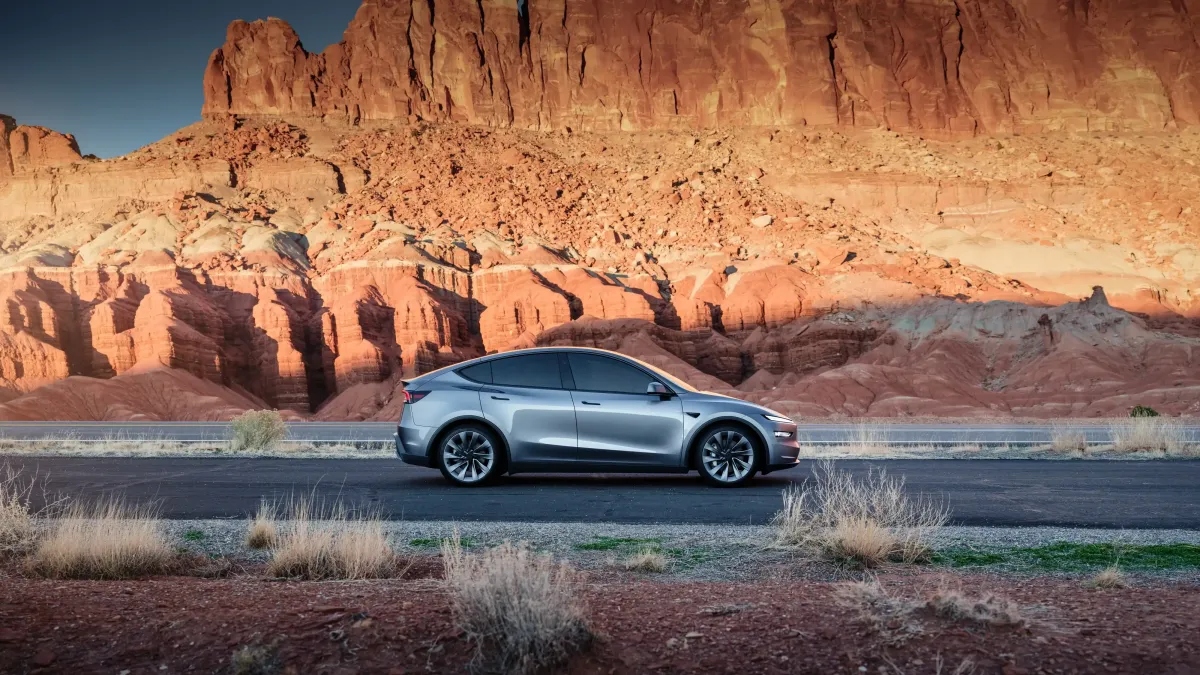
From the outside, the 2026 Model Y looks almost identical to previous versions. This is intentional. Tesla avoids visual changes unless they serve a functional purpose. That said, there are subtle differences:
-
Revised rear floor structure to accommodate third‑row footwells
-
Minor underbody modifications for crash safety compliance
-
Slight changes to the rear bumper reinforcement in certain markets
These updates are largely invisible but essential for safety and packaging.
Aerodynamics and Efficiency
One concern with adding a third row is aerodynamic drag. Tesla mitigates this by keeping the roofline unchanged and avoiding bulky exterior add‑ons. As a result, the drag coefficient remains largely the same, preserving highway efficiency.
In real‑world terms, this means:
-
Minimal impact on highway range when the third row is folded
-
Slight efficiency loss only when the vehicle is fully loaded with passengers
Wheel and Tire Options
For 2026, Tesla refined wheel offerings for the Model Y. In many markets, the 7‑seat version is paired with wheel options optimized for comfort rather than aggressive performance, reflecting its family‑focused positioning.
Chapter 3: Interior Layout and Third‑Row Practicality
Third‑Row Seating: What to Expect
It is important to be realistic: the third row in the 2026 Model Y is not designed for adults on long journeys. Instead, it is optimized for:
-
Children
-
Short‑distance trips
-
Occasional use
Tesla improved the third row compared to earlier attempts by:
-
Increasing knee clearance slightly
-
Improving seat cushioning
-
Enhancing rear ventilation airflow
While still compact, the third row is more usable than before, particularly for families with younger children.
Second‑Row Adjustments
To make the third row viable, Tesla revised the second‑row sliding mechanism. The second row now offers:
-
Improved forward travel range
-
Easier one‑touch folding for third‑row access
-
Better balance between legroom and cargo space
These changes significantly improve daily usability.
Cargo Space Trade‑Offs
With all three rows in use, cargo space is limited. However:
-
Folding the third row restores most of the Model Y’s original cargo capacity
-
The front trunk (frunk) remains unchanged and is useful for smaller items
For many families, this flexibility is preferable to permanently driving a larger vehicle.
Chapter 4: Safety Considerations for a 7‑Seat Configuration
Structural Safety
Tesla engineered the 7‑seat Model Y to meet the same crash standards as the five‑seat version. Key safety considerations include:
-
Reinforced rear crumple zones
-
Adjusted load paths to protect third‑row occupants
-
Enhanced rear seatbelt anchoring systems
Child Safety
The third row is particularly suitable for children, with:
-
Improved head restraint positioning
-
Compatible child seat anchoring solutions in select markets
-
Clear guidance on age and height recommendations
Tesla’s software also plays a role by providing seat occupancy detection and warnings through the vehicle interface.
Active Safety Systems
All 2026 Model Y variants, including the 7‑seat version, benefit from Tesla’s latest active safety software, including:
-
Updated collision avoidance algorithms
-
Improved blind‑spot monitoring visuals
-
Enhanced rear cross‑traffic alerts
These systems are especially valuable when carrying multiple passengers.
Chapter 5: Powertrain, Range, and Real‑World Performance
Battery Configuration
The 7‑seat Model Y uses the same battery architecture as comparable five‑seat trims, depending on market and factory location. Tesla compensates for added weight through software‑level efficiency optimization rather than larger battery packs.
Range Impact
In real‑world testing scenarios:
-
Range reduction is modest when the third row is folded
-
Fully loaded configurations show greater impact, particularly at highway speeds
For most owners, the daily driving range remains more than sufficient.
Driving Dynamics
Despite the added seating option, the Model Y retains its familiar driving characteristics:
-
Quick acceleration
-
Low center of gravity
-
Predictable handling
The vehicle does not feel like a traditional three‑row SUV, which many drivers consider a positive trait.
Chapter 6: Software and Infotainment Enhancements
User Interface Improvements
For 2026, Tesla refined its infotainment interface to better support multi‑row seating. Updates include:
-
Clearer climate control zones
-
Enhanced rear passenger airflow controls
-
Improved seat occupancy visualization
Over‑the‑Air Updates
One of Tesla’s biggest advantages remains its ability to update vehicles remotely. Owners of the 7‑seat Model Y benefit from:
-
Ongoing safety improvements
-
Infotainment refinements
-
Potential future seating‑related optimizations
This ensures the vehicle continues to improve long after purchase.
Chapter 7: Pricing Strategy and Market Positioning
U.S. Market
In the United States, the 7‑seat configuration is positioned as a premium option rather than a separate trim. This allows buyers to add seating flexibility without stepping into a completely different model.
European Market
In Europe, availability varies by country due to regulatory and demand differences. In some regions, the 7‑seat option is expected to remain niche, appealing mainly to urban families.
Value Proposition
Compared to larger electric SUVs, the Model Y 7‑seater offers:
-
Lower purchase price
-
Better efficiency
-
Easier urban maneuverability
This makes it particularly attractive in European cities.
Chapter 8: Ownership Experience and Long‑Term Considerations
Maintenance and Reliability
The 7‑seat configuration does not significantly increase maintenance complexity. Core mechanical components remain unchanged, and interior wear is the primary consideration for families.
Resale Value
Historically, Model Y variants with added flexibility tend to retain value well. The 7‑seat option may appeal to a broader second‑hand market, particularly among families.
Who Should Choose the 7‑Seat Model Y?
This configuration is ideal for:
-
Families with young children
-
Buyers who occasionally need extra seating
-
Owners who value flexibility over maximum cargo space at all times
Conclusion
The 2026 Tesla Model Y 7‑seater is not an attempt to turn the Model Y into a full‑size family SUV. Instead, it is a thoughtful evolution that acknowledges how owners actually use their vehicles. By adding a more practical third row, refining interior usability, and maintaining Tesla’s core strengths in efficiency and software, Tesla has made the Model Y more versatile without compromising its identity.
For U.S. and European buyers seeking an electric crossover that can adapt to changing family needs without the drawbacks of larger vehicles, the 2026 Model Y 7‑seater stands out as one of the most balanced options on the market.
FAQ
Q1: Is the third row suitable for adults?
The third row is best suited for children or short trips. Adults may find it uncomfortable for longer journeys.
Q2: How much range is lost with the 7‑seat configuration?
Range impact is minimal when the third row is folded and moderate when fully loaded.
Q3: Is the 7‑seat Model Y available in all European countries?
Availability varies by market due to regulatory and demand differences.
Q4: Does the 7‑seat version affect safety ratings?
No. The vehicle is engineered to meet the same safety standards as the five‑seat version.
Q5: Is the 7‑seat option worth it?
For families who occasionally need extra seating, it offers excellent value and flexibility.