
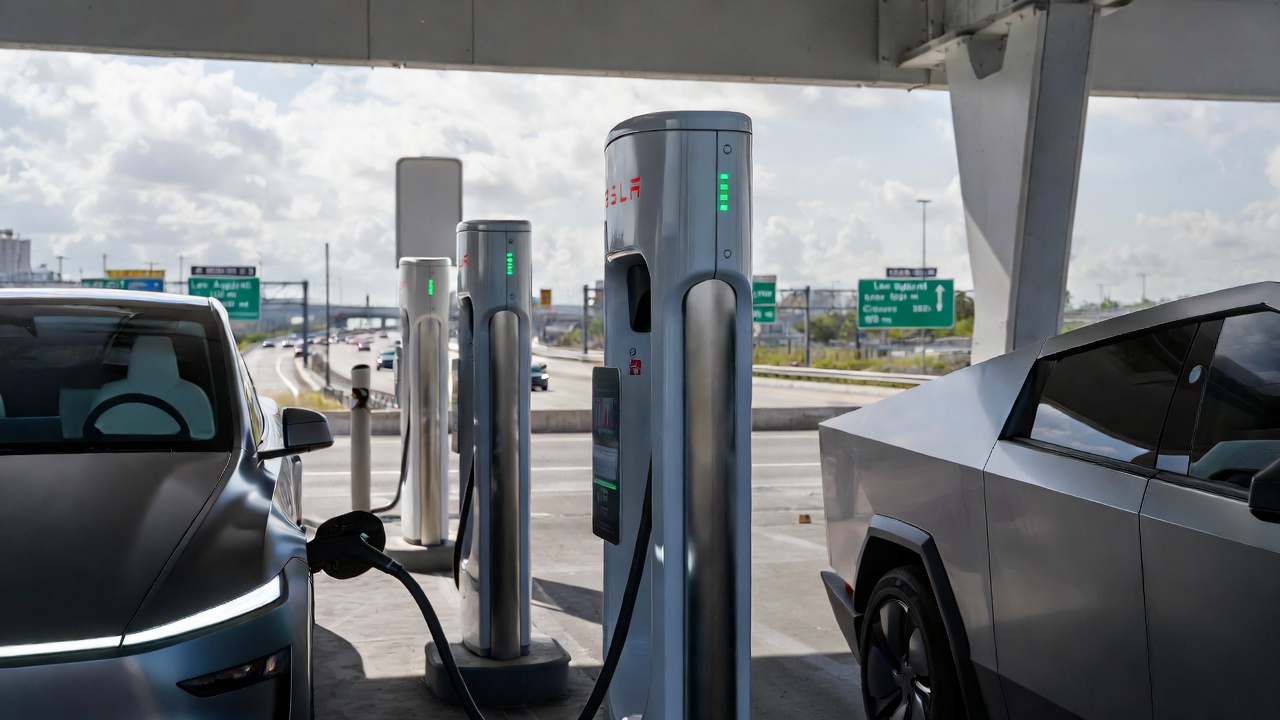
Introduction
Just days ago, on March 16-18, 2026, Tesla quietly crossed a historic milestone at its Gigafactory New York: the final V3 Supercharger power cabinet rolled off the production line. After more than seven years and over 15,000 units built, Tesla has officially ended V3 production and is shifting entirely to next-generation V4 hardware. The announcement, shared by the official Tesla Charging account on X alongside a celebratory team photo, marks the definitive start of the V4 Supercharger era for the global network.
For the millions of Tesla owners in the United States and Europe who rely on Superchargers for road trips, daily commutes, or vacation charging, this transition is far more than a manufacturing detail — it is a fundamental upgrade to the entire charging experience. V3 Superchargers, which have powered the rapid expansion of Tesla’s network since 2019, delivered a reliable 250 kW peak and became the backbone of long-distance EV travel. But V4 brings higher voltage support (up to 1000V), dramatically increased power output (up to 500 kW for compatible vehicles), greater efficiency, and faster deployment capabilities.
Existing V3 stalls across the US and Europe will remain fully operational for years to come — there is no plan to remove or disable them. However, every new Supercharger site and every replacement cabinet going forward will be V4. This phased transition means owners will gradually encounter more V4 stalls during routine travel, delivering measurable improvements in charging speed, especially for Cybertruck owners, while maintaining the same seamless experience for Model 3, Model Y, Model S, and Model X drivers.
In the United States, where Tesla operates the largest fast-charging network with tens of thousands of stalls, this shift aligns perfectly with growing demand from both Tesla and non-Tesla NACS-equipped vehicles. In Europe, where the first V4 sites opened as early as March 2023 in the Netherlands and have since expanded across the continent, the change reinforces Tesla’s leadership in a market that demands compatibility with local CCS standards and high-speed Autobahn travel.
This article provides a complete, owner-focused guide to the V4 era. We will break down the exact V3 phase-out timeline and implications, dive deep into the technical upgrades and real-world charging-time improvements, examine how the transition affects daily driving in the US versus Europe, explore future network expansion plans, and share practical tips to maximize your charging experience right now. Whether you drive a Model Y in California, a Cybertruck in Texas, or a Model 3 in Germany, understanding this shift will help you plan better, charge faster, and reduce range anxiety on every journey.
Chapter 1: The V3 Phase-Out Plan — Seven Years, 15,000 Cabinets, and What Happens Next
The numbers are striking. Over seven full years, Tesla’s New York Gigafactory produced more than 15,000 V3 power cabinets. Each cabinet supported up to four charging stalls, forming the foundation of a network that now exceeds 75,000 Supercharger stalls worldwide. On March 18, 2026, the very last V3 cabinet was completed, and production has officially ceased in the United States.
This does not mean V3 stalls are disappearing from the map. Tesla has been clear: all existing V3 hardware will continue to operate indefinitely. Owners can still charge at the tens of thousands of V3 stalls currently installed across every US state and most European countries. The phase-out applies only to new manufacturing and new site deployments. From now on, every new Supercharger location and every expansion or upgrade will use V4 cabinets exclusively.
Why the switch? Tesla’s stated motivation is straightforward: V4 hardware enables higher charging capacities, supports a broader range of vehicle architectures (400V to 1000V), and allows faster network growth with fewer resources. One V4 cabinet can power up to eight stalls — double the capacity of a V3 cabinet — while occupying a smaller physical footprint and reducing installation complexity. This efficiency directly translates into more charging points coming online quicker, which is critical as Tesla’s vehicle fleet grows and non-Tesla EVs gain NACS access across North America.
For owners, the practical timeline is gradual. In the US, new V4 sites are already appearing in high-traffic corridors such as Interstate 5 in California, I-95 on the East Coast, and key routes in Texas and Florida. In Europe, the transition is even more advanced; many newer stations in Germany, the Netherlands, France, and the UK have been V4 from the start. Over the next 12–24 months, owners will notice an increasing percentage of their charging stops shifting to V4 without any action required on their part.
Importantly, there is no cost increase or change in pricing structure. Tesla’s Supercharging rates remain based on location, time of day, and local utility costs — not on V3 versus V4 hardware. Your existing Supercharger membership benefits (if applicable in your region) or pay-as-you-go access continue unchanged.
This measured phase-out gives Tesla owners peace of mind: the reliable network you depend on today will only get better, never worse. The 15,000 V3 cabinets already deployed represent billions of successful charging sessions and will continue serving the community for the foreseeable future.
Chapter 2: V4 Technical Upgrades in Detail — 1000V Architecture, Double the Power, and Real Performance Gains
The heart of the V4 revolution lies in the new power cabinet and stall design. Unlike V3 cabinets, which were limited to approximately 500V and 250 kW peak output, V4 cabinets support vehicle architectures from 400V all the way up to 1000V and can deliver up to 500 kW for passenger vehicles (and even 1.2 MW for future Semi applications).
One V4 cabinet efficiently powers eight individual stalls simultaneously — a massive leap from the four-stall limit of V3. This architectural improvement reduces the number of cabinets needed per site, lowers installation costs, and allows Tesla to build larger, more convenient stations faster. The physical stalls themselves feature longer cables (improving reach and convenience), a sleeker design, and better thermal management for sustained high-power charging.
Sub-section 2.1: How These Upgrades Translate to Charging Times for Model Y, Model 3, and Cybertruck
For the majority of Tesla owners driving Model 3, Model Y, Model S, or Model X (all on 400V architectures), the headline speed remains 250 kW peak — the same maximum you experienced on V3. However, the improved cabinet efficiency and better power distribution often result in more consistent delivery of that peak power, especially when multiple vehicles are charging simultaneously. Real-world tests show Model Y owners can still add up to 162–175 miles of range in just 15 minutes at a V4 stall, identical to the best V3 performance but now more reliably available across busier sites.
The real game-changer is the Cybertruck. With its 800V architecture, the Cybertruck can now access up to 325 kW at V4 Superchargers (compared with lower sustained rates at V3). This shaves approximately five minutes off a typical 10–80% charge session — reducing it from around 40 minutes on V3 to roughly 35 minutes on V4. Early owner reports and Tesla data indicate that a Cybertruck can gain 137 miles of range in 15 minutes at V4, making long-haul towing or cross-country trips noticeably less time-consuming.
To put numbers into perspective for a typical US road trip:
- A Model Y Long Range owner traveling from Los Angeles to San Francisco (≈380 miles) previously planned two 20–25 minute V3 stops. With V4 consistency, those stops can often be shortened by 3–5 minutes each, saving nearly 10 minutes total and reducing fatigue.
- A Cybertruck owner towing a trailer on I-80 through the Rockies benefits even more: the higher sustained power means fewer and shorter stops, turning a stressful multi-day journey into a more relaxed experience.
In Europe, where highway speeds are higher and distances between major cities are shorter, the same upgrades shine on routes like the German Autobahn or French A-roads. A Model 3 owner charging near Munich can now count on V4 stations delivering full 250 kW more predictably, even during peak summer travel when sites are busy.
Future software updates are expected to unlock even higher speeds for S3XY vehicles at V4 sites once Tesla optimizes the 1000V architecture further. The hardware foundation is already in place — owners are simply waiting for the over-the-air refinements that Tesla has proven it can deliver rapidly.
Chapter 3: Real-World Impact for US and European Owners — Station Upgrades, Compatibility, and Daily Driving Changes
In the United States, the transition is already visible. New V4-only sites are opening in California, Texas, Florida, and along major interstates. Existing V3 stations will receive selective upgrades over time (replacing individual cabinets as needed), but the majority of legacy stalls remain untouched. Owners using the Tesla navigation system will soon see more “V4” icons or higher peak kW indicators on the in-car display and app, helping them prioritize faster stops automatically.
Cybertruck owners in the US gain the most immediate benefit. With 325 kW capability now standard at V4 locations, cross-country hauls become more efficient. Non-Tesla owners with NACS adapters (Ford, Rivian, GM, and now Stellantis vehicles) also benefit from the expanded network and higher power availability.
Across Europe, the story is one of continuity and expansion. V4 Superchargers have been rolling out since early 2023, with many sites in the Netherlands, Germany, France, and the UK already featuring the new hardware. European V4 stalls are fully compatible with the CCS2 standard used by most local EVs, and Tesla’s Magic Dock or native NACS-to-CCS solutions ensure seamless access. Owners in Europe report that V4 sites often feature even longer cables to accommodate the wider variety of vehicle designs common on the continent.
A German Model Y owner driving from Berlin to Munich, for example, can now rely on newer V4 stations along the A9 that deliver consistent 250 kW even when the site is at 70% occupancy — a noticeable improvement over older V3 locations during holiday peaks. In the UK, V4 deployments along the M1 and M25 corridors are reducing wait times and making EV road trips more competitive with traditional petrol stops.
The compatibility story extends beyond Tesla vehicles. As more manufacturers adopt NACS in North America and Tesla opens the network further, V4’s higher power and multi-stall efficiency will help prevent congestion at popular sites. For Tesla owners, this means shorter lines and faster turnover even on busy weekends.
Chapter 4: Future Expansion Trends — Faster Deployment, Larger Sites, and a Denser Network
With V4’s 8-stall-per-cabinet design and smaller footprint, Tesla can now build larger stations much faster. Plans for the world’s largest Supercharger site — featuring up to 400 V4 stalls in a single location — are already underway in select markets, with Phase 1 construction targeted for 2026.
Network growth statistics are impressive. Tesla added hundreds of new stalls in the first two months of 2026 alone and continues to lead the industry. The combination of V4 efficiency and strategic partnerships (including Stellantis and other NACS adopters) means the global count is projected to grow rapidly through 2027 and beyond.
For owners, this translates to shorter gaps between chargers on long routes. Rural US corridors that previously had 100–150 mile gaps will see new V4 clusters appear sooner. In Europe, dense urban-adjacent sites will reduce reliance on slower public chargers. The ultimate vision — supporting millions of Robotaxi and personal vehicles with minimal downtime — is now hardware-ready thanks to V4.
Chapter 5: Owner Optimization Tips — Making the Most of V4 Today
Maximizing the V4 experience requires only small habit changes:
- Use the Tesla app and in-car navigation to filter or prioritize V4 sites on long trips. The system already shows peak kW availability.
- Keep your vehicle software fully updated — many V4 performance improvements arrive via OTA.
- For Cybertruck owners: seek confirmed V4 locations (the app and website now label them clearly) to unlock 325 kW charging.
- Practice efficient charging etiquette: move to a lower-power stall once your session drops below 50 kW to free high-power V4 stalls for others.
- Clean the charge port and cable regularly — V4’s higher power benefits from optimal contact.
- Take advantage of off-peak pricing by scheduling charges via the app during lower-rate windows.
- Join or monitor regional Tesla owner groups for real-time V4 site reports — many owners share photos and speed tests within hours of new openings.
European owners should also check local Tesla Charging pages for CCS-specific tips, while US owners can use the growing NACS ecosystem for backup options.
Conclusion
The V4 Supercharger era has officially begun. With V3 production retired after seven years of faithful service, Tesla has laid the foundation for faster, more efficient, and more scalable charging across the United States and Europe. Existing V3 stalls continue to serve millions of owners reliably, while new V4 deployments deliver higher power, better efficiency, and faster network growth.
For everyday Tesla drivers, this means shorter charging stops, greater convenience on road trips, and continued leadership in the EV charging space. Cybertruck owners gain the most immediate performance boost, but every owner benefits from a network that is evolving to meet tomorrow’s demands.
The transition is seamless, cost-neutral, and entirely positive. Your next Supercharger stop may already be a V4 site — and the experience will only keep improving. The V4 era is here, and it is making Tesla ownership even more enjoyable, one faster charge at a time.
FAQ
Q1: How long will existing V3 Superchargers remain usable? Indefinitely. Tesla has confirmed there are no plans to decommission or remove V3 hardware. All current V3 stalls will continue operating normally for the foreseeable future.
Q2: Do I need to do anything to access V4 stations? No action required. Your Tesla will automatically recognize and use V4 hardware when you arrive. The navigation system and app will display updated peak power and stall availability.
Q3: Will charging prices change for V4? No. Pricing remains based on location, time, and local rates — exactly the same as V3.
Q4: What is the biggest benefit for Cybertruck owners? Up to 325 kW charging at V4 sites, reducing typical 10–80% sessions by about five minutes and adding more range per stop.
Q5: Are European V4 stations different from US ones? Yes — European V4 sites are optimized for CCS2 compatibility and often feature even longer cables. The core power upgrades (1000V support, higher sustained output) are the same.
Q6: Will Model 3/Y/S/X owners see faster charging on V4? Peak power remains 250 kW, but you will experience more consistent delivery and fewer power-sharing limitations at busy multi-stall sites.
Q7: How can I tell if a Supercharger site is V4? Check the Tesla app or in-car display — V4 sites are labeled, and peak kW ratings are shown. Many new sites opened in 2025–2026 are V4.
Q8: Does this affect non-Tesla NACS vehicles? Non-Tesla EVs benefit equally from the higher power and faster site deployment. More V4 stalls mean shorter wait times across the entire NACS ecosystem.
Q9: What about future speed increases beyond 250 kW for S3XY models? The V4 hardware already supports higher voltages and power. Tesla has indicated future software updates will unlock additional performance for existing models.
Q10: Where can I find the latest V4 site map? Use the official Tesla Supercharger map on tesla.com or in the car’s navigation. Community sites and owner forums also track new openings in real time.
This comprehensive guide equips you with everything needed to navigate the V4 transition confidently while enjoying the immediate and future benefits.