
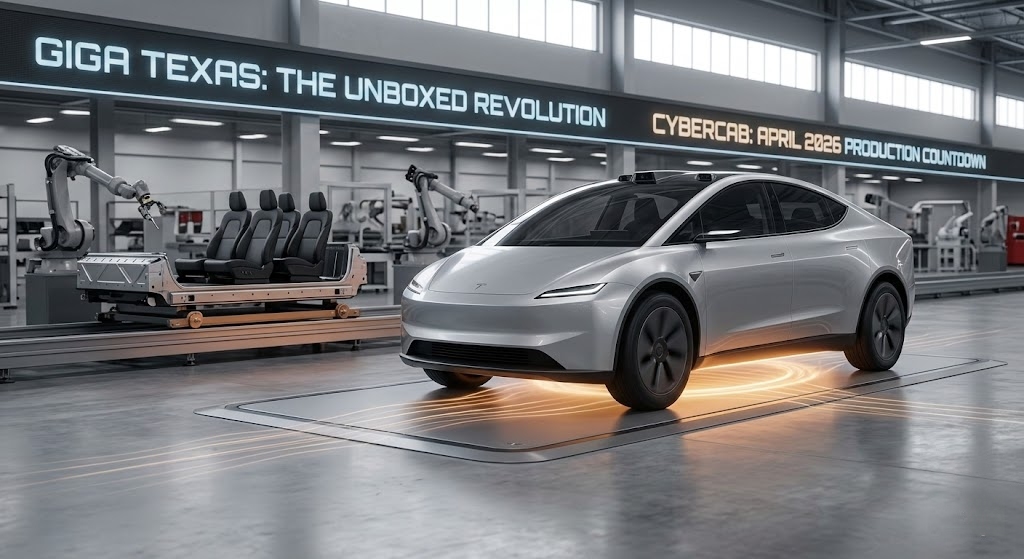
Introduction: Why April 2026 is a Hard Deadline, Not a Vision
For a decade, the term "Elon Time" has been synonymous with visionary but frequently delayed milestones. However, as of March 1, 2026, the skepticism surrounding Tesla’s autonomous ambitions is colliding with a hard, industrial reality. Since the first pre-production Cybercab rolled off the lines at Giga Texas on February 17, the countdown to the official April 2026 production launch has become the most scrutinized timeline in automotive history.
This is not just another car launch. The Cybercab represents Tesla’s transition from a premium EV manufacturer to an AI-driven robotics titan. With a target price under $30,000 and an architecture that excludes steering wheels and pedals, Tesla is attempting to cross the "Autonomous Rubicon"—a point of no return where the vehicle is no longer a tool for human driving, but a node in a massive, self-orchestrating mobility network.
Chapter 1: The 'Unboxed' Revolution — Engineering the Future of Factories
To understand why the Cybercab is expected to reach volume production so quickly after its initial reveal, we must look at the Unboxed Manufacturing Process. Traditional vehicle assembly hasn't changed fundamentally since the Ford Model T: a monocoque frame moves down a line, and workers or robots hang parts on it.
1.1 Parallel Construction vs. Sequential Assembly
The Unboxed process breaks the vehicle into six distinct modules. Instead of a single line, Giga Texas now operates like a "computer assembly plant."
-
Module Independence: The seats are bolted directly to the structural battery pack before the body is even attached.
-
Reduced Footprint: By eliminating the need to move a large, hollow car frame through the entire factory, Tesla has reduced the required floor space by over 40%.
-
The 10-Second Target: Tesla’s internal goal for the Cybercab is a cycle time of one unit every 10 seconds. In the context of 2026, where Model Y production is already highly optimized, the Cybercab’s simplicity (fewer than 80 major components) makes this target technically feasible.
1.2 The All-New "Front-End" and "Back-End" Castings
Utilizing even larger Giga Presses (estimated at 12,000 tons of clamping force), the Cybercab uses a two-piece casting system. This eliminates hundreds of welds, reducing weight and increasing structural rigidity—essential for a vehicle designed to run 24/7 in a robotaxi fleet.
Chapter 2: Hardware 5 (AI5) and the End of the Port
The Cybercab is the first Tesla vehicle to skip the NACS (North American Charging Standard) port entirely.
2.1 Inductive Charging: The Invisible Cord
As of late February 2026, Tesla received critical FCC waivers for Ultra-Wideband (UWB) radio frequencies used in its inductive charging pads.
-
Efficiency: Tesla claims an efficiency rate of over 90% for its wireless charging, rivaling traditional cable-based V2 Superchargers.
-
The "Clean" Fleet: Without a port, the Cybercab can self-park over a charging pad in a "Robotaxi Hub," charge without human or robotic arm intervention, and return to service.
2.2 AI5: The Brain of the Machine
While the Model 3 and Model Y are currently optimized for Hardware 4, the Cybercab is built natively on AI5.
-
Inference Power: AI5 offers approximately 5 to 10 times the inference capabilities of HW4, allowing the vehicle to process high-frame-rate 4K camera data with near-zero latency.
-
No LiDAR, No Problem: Despite industry-wide pivots to LiDAR in 2025, Tesla remains committed to "Vision Only." The 2026.2.3 software update (FSD v13) has shown that with AI5's compute power, occlusion prediction (seeing "through" obstacles via temporal memory) has reached human-level reliability.
Chapter 3: Regulatory Chess — Texas vs. California vs. Europe
The manufacturing is ready, but is the law?
3.1 The Federal Exemption Battle
Current Federal Motor Vehicle Safety Standards (FMVSS) are written with the assumption that a vehicle has a human driver. Tesla is currently petitioning the NHTSA for an exemption to produce more than the standard 2,500 units per year limit for vehicles without manual controls.
-
The "Texas Advantage": Texas has already passed legislation allowing unsupervised autonomous vehicles to operate statewide. This makes Giga Texas the perfect "Live Lab."
-
California’s Thaw: After years of tension, the California DMV’s recent settlement with Tesla regarding "Autopilot" terminology (February 18, 2026) suggests a smoother path for Cybercab deployment in Tesla's biggest market.
3.2 The European "Supervised" Bridge
In Europe, the UNECE regulations still require a "human in the loop." Tesla’s strategy for 2026 in London and Munich involves a "Cybercab Lite" approach—testing the hardware with remote human monitoring to satisfy local safety protocols while the software proves its statistical safety advantage.
Chapter 4: The Economics of the $0.20 Mile
For your European and American readers, the most compelling part of the Cybercab is the disruption of the "Total Cost of Ownership" (TCO).
4.1 Smashing the Ride-Hail Monopoly
The average cost of an Uber or Lyft in 2026 remains around $2.00 to $3.00 per mile. Tesla’s projected operating cost for the Cybercab is $0.15 to $0.20 per mile.
-
Lower Insurance: By utilizing Tesla’s real-time insurance data, the Cybercab fleet can benefit from significantly lower premiums if the FSD safety data continues to show 10x fewer accidents than human drivers.
-
Zero Labor: By removing the driver (the single largest cost in ride-hailing), Tesla allows owners to "hire out" their personal Cybercabs to the network, creating a passive income stream that hasn't existed in the automotive world.
Conclusion: The Final Countdown
As we stand here on March 1, 2026, the Cybercab is no longer a "concept." The factory floor at Giga Texas is humming, the FCC has cleared the wireless charging hurdles, and the software has finally matured into the v13/v14 era.
For owners and investors, the next 60 days will be the most significant in Tesla's history. If the April production ramp holds, we are not just witnessing the birth of a new car; we are witnessing the end of the "Driver Era."
❓ FAQ
Q: Can I buy a Cybercab for personal use in 2026? A: While initial production is dedicated to the Tesla Network (Robotaxi fleet), Elon Musk has confirmed that private sales will begin as the production curve reaches volume, likely by late 2026 or early 2027, at a target price below $30,000.
Q: How does it charge if there is no plug? A: It uses high-efficiency inductive charging. You simply park over a pad, and the car charges wirelessly. Tesla is also expected to sell home-based charging pads for private owners.
Q: Is it safe in the snow or heavy rain? A: FSD v13 includes significant improvements in "adverse weather" processing. However, in extreme conditions, the Tesla Network may geofence Cybercabs until conditions improve, similar to how Waymo operates today.
Q: Does it have a trunk? A: Yes, despite its compact two-seat design, the Cybercab features a surprisingly large rear hatch (powered) that can accommodate two large suitcases, making it ideal for airport runs.