
Introduction: The Day the Steering Wheel Died
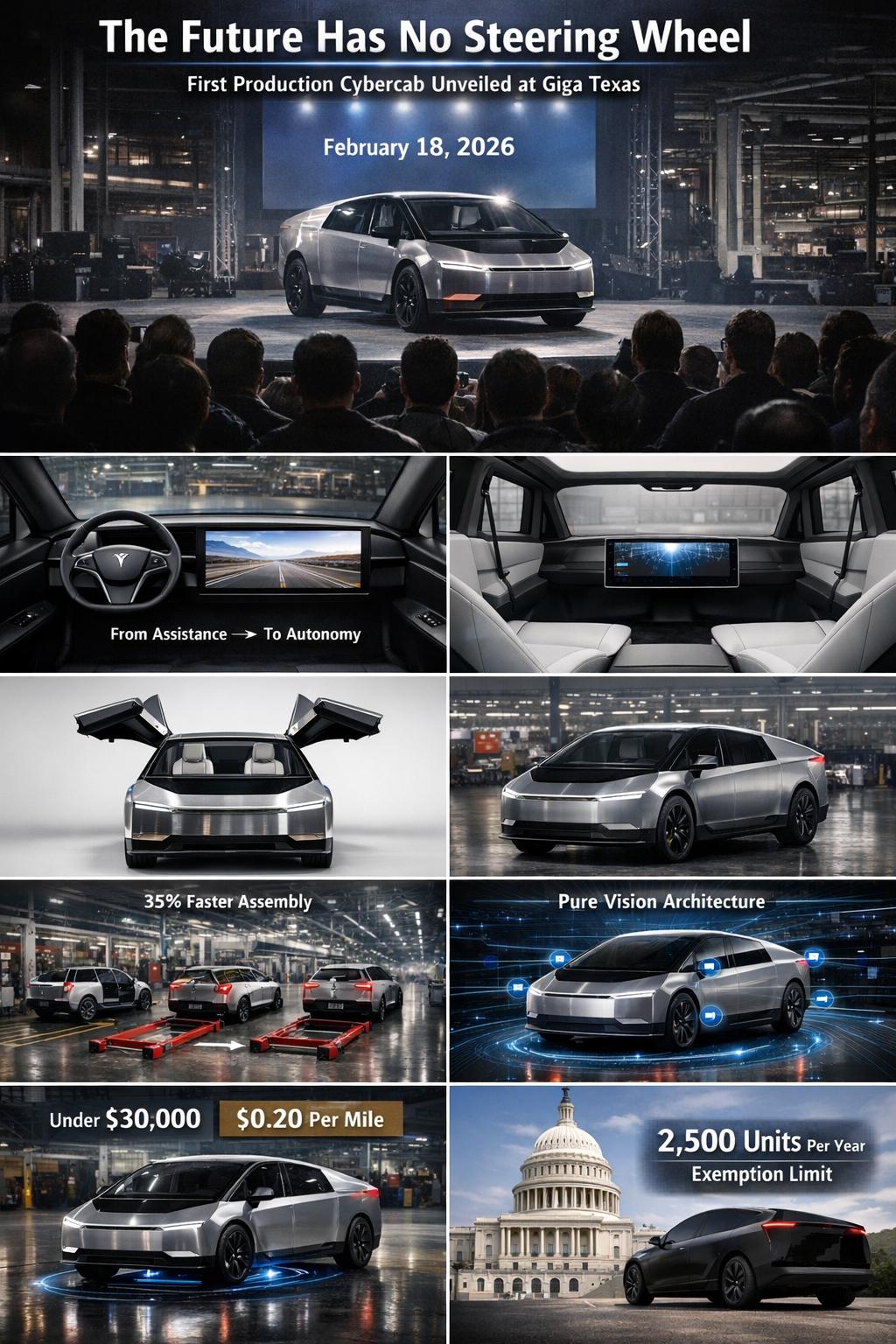
February 18, 2026, will be remembered as the day the automobile industry fundamentally changed. On that Tuesday, inside Tesla's sprawling Gigafactory Texas, north of Austin, a small, two-seat vehicle with butterfly doors silently rolled off the production line. It had no steering wheel. No brake pedal. No accelerator. No rearview mirrors. For the first time in 140 years of automotive history, a production vehicle was built with no expectation that a human would ever drive it.
This was the first production Tesla Cybercab, and its arrival wasn't just a new model launch—it was the physical manifestation of a promise Elon Musk first made a decade ago. The vehicle that emerged from the factory that day represents a complete rethinking of what a car can be when you remove the single most expensive, error-prone, and limiting component: the human driver.
The timing is significant. The Cybercab arrived approximately six weeks ahead of schedule, a rare instance of Tesla under-promising and over-delivering on a timeline. Musk himself marked the occasion with a post on X, thanking the team for reaching what he called a "historic milestone". But for the thousands of Tesla engineers, the suppliers who had to retool entire production lines, and the regulators now scrambling to catch up, this milestone raises as many questions as it answers.
Chapter 1: The Machine That Drives Itself
To understand the Cybercab, you must first understand what it lacks. Walk around the vehicle, and the omissions are striking. There are no side mirrors—not because Tesla forgot them, but because regulations in multiple countries now permit camera-based systems, and the Cybercab's AI doesn't need to check blind spots the way a human does. Peer through the windows and the absence is even more jarring: where a steering column should be, there's nothing but a clean, minimalist dashboard dominated by a single 21-inch central display.
The interior is designed for two passengers, a deliberate choice backed by Tesla's data analysis showing that over 91% of urban trips involve no more than two people. By eliminating the rear seats, Tesla gains something more valuable than passenger capacity: it creates a spacious, lounge-like environment where occupants can work, relax, or sleep during their journey. The butterfly doors, hinged at the windshield and roof, swing upward to reveal a wide opening that makes entry and exit effortless in tight parking scenarios.
But the real story isn't what you can see—it's what you can't. Beneath the Cybercab's stainless steel exterior (borrowing design language from the Cybertruck) lies the most sophisticated autonomous driving system ever packaged for production.
The Vision System
Unlike competitors who have loaded their autonomous vehicles with expensive lidar arrays and high-definition mapping systems, the Cybercab relies exclusively on Tesla's pure vision approach. Eight cameras positioned around the vehicle provide 360-degree visibility, feeding high-resolution video streams directly into the vehicle's neural network. There is no radar, no lidar, no ultrasonic sensors—just cameras and the computational power to interpret what they see.
This approach has been controversial within the autonomous vehicle industry. Waymo and Cruise have invested billions in lidar technology, arguing that redundant sensor suites are necessary for safety. Tesla's counterargument is simple: humans drive with two eyes and a brain, not lasers. If biology can achieve reliable navigation with visual input alone, so can well-designed AI.
The key enabler is resolution. Tesla's latest camera hardware captures images at a level of detail sufficient to read small text on street signs at distances of over 200 meters. More importantly, the system processes these images at a rate of billions of operations per second, identifying and classifying objects—pedestrians, vehicles, debris, hand signals—faster than human reflexes can react.
The Compute Platform
All that visual data needs somewhere to go, and in the Cybercab, it flows to Tesla's AI5 computer. This is the third generation of Tesla's in-house designed autonomous driving computer, and it represents a massive leap over the HW4 hardware found in current production vehicles.
The AI5 platform delivers approximately three times the computational throughput of its predecessor, with specialized neural network accelerators optimized for the specific types of calculations autonomous driving requires. Tesla doesn't publish exact specifications, but industry analysts estimate the system is capable of over 1,000 trillion operations per second—enough to process the feeds from all eight cameras simultaneously while running multiple redundant safety checks.
The Redundancy Architecture
Perhaps the most critical aspect of the Cybercab's design is what happens when something fails. In a conventional car, a brake failure or steering malfunction is immediately apparent to the driver, who can attempt to compensate. In a vehicle with no human controls, failure must be unthinkable.
Tesla's solution is full-system redundancy. The Cybercab contains two completely independent compute platforms, each capable of running the full autonomy stack. If the primary system experiences any anomaly, the backup takes over in milliseconds, with no interruption in vehicle control. Similarly, the braking system has dual circuits, the power supply has dual batteries, and even the steering actuators (which control the front wheels, despite the lack of a steering wheel) are duplicated.
This approach doesn't just reduce the probability of failure—it mathematically eliminates single points of failure. For the Cybercab to lose control, two independent systems would have to fail simultaneously, a scenario Tesla's engineers calculate as less likely than a meteor strike.
Chapter 2: The Unboxed Revolution
The Cybercab's technical capabilities are impressive, but they wouldn't matter if the vehicle couldn't be built affordably. Here, Tesla has applied lessons from its most ambitious manufacturing project yet: the "Unboxed" process first developed for the Cybertruck but fully realized in the Cybercab.
Traditional automotive assembly follows a linear path. The body is welded together on one line, painted on another, and then moves to final assembly, where components are installed in sequence. This approach has served the industry for a century, but it has inherent inefficiencies. When one station slows down, the entire line slows. When a quality issue is discovered late in the process, fixing it requires costly rework.
The Unboxed process, by contrast, treats the vehicle as a collection of modules that are assembled in parallel and joined only at the very end of the line. For the Cybercab, this means:
The structural battery pack is produced on one line as a complete unit, including all cell-to-pack architecture with no modules to assemble.
The front and rear casting assemblies are manufactured separately, incorporating crash structures and suspension mounting points directly into the castings.
The interior module—seats, display, headliner—is assembled offline as a complete cockpit cassette.
The exterior body panels, including the distinctive stainless steel cladding, are formed and finished on dedicated lines.
At the final assembly station, these modules come together like pieces of a puzzle. The battery pack bolts to the castings. The interior module drops in from above and connects to the vehicle's electrical backbone. The body panels attach to the structure. The entire process takes minutes rather than hours, and quality improves because each module can be tested independently before final assembly.
Tesla estimates that the Unboxed approach reduces the factory footprint required for a given production volume by 40% and cuts labor hours per vehicle by more than half. For the Cybercab, with its targeted sub-$30,000 price point, these savings aren't just beneficial—they're essential.
Chapter 3: The Economics of Driverless Transportation
When the Cybercab enters service, it won't just be another vehicle on the road—it will be the most cost-effective transportation machine ever built. Tesla's internal models project operating costs of approximately $0.20 per mile, a figure that would undercut not only traditional ride-hailing services but also the cost of personal vehicle ownership.
To understand why, consider the cost structure of a typical Uber or Lyft trip. Approximately 70% of the fare goes to the driver. Another 15-20% covers vehicle depreciation, maintenance, and fuel. The remaining 10-15% is platform profit. The Cybercab eliminates the single largest cost component entirely. There is no driver to pay, no tipping, no scheduling conflicts, no shifts to manage.
The vehicle itself is also cheaper to operate than a conventional car. Without a driver, the Cybercab can charge during off-peak hours when electricity rates are lowest. It can navigate to the nearest Supercharger or, eventually, to wireless charging pads embedded in parking spaces, completely autonomously. Tesla has already received FCC approval for its ultra-wideband wireless charging system, which can transfer power at rates approaching 25 kW without any physical connection—enough to add 100 miles of range during a typical shopping trip.
Maintenance costs also decrease. Without a human driver subjecting the vehicle to harsh acceleration, hard braking, or careless parking, the Cybercab's components last longer. Brake wear is minimal because regenerative braking handles most deceleration. Suspension components aren't jarred by potholes that a human might miss. The vehicle's AI can even schedule its own service appointments, driving itself to a Tesla service center when predictive algorithms detect an impending component failure.
For consumers, the economics are transformative. Tesla has suggested that owners might be able to add their Cybercabs to a shared autonomous fleet when not in use, generating income that could offset or even exceed the vehicle's purchase price. In this model, the Cybercab isn't an expense—it's an income-generating asset.
Chapter 4: The Regulatory Labyrinth
For all its technological sophistication, the Cybercab faces a challenge that no amount of engineering can solve: the law. Current U.S. Federal Motor Vehicle Safety Standards explicitly require that passenger vehicles have steering wheels, brake pedals, and rearview mirrors. The Cybercab has none of these.
Tesla's path to legality runs through the National Highway Traffic Safety Administration's exemption process. Under current rules, manufacturers can petition for exemptions to safety standards, but the number of vehicles exempted annually is capped at 2,500 per manufacturer. This limit, designed for low-volume specialty vehicles, is completely inadequate for mass production.
The situation in Europe is even more complex. Each member state has its own approval process for autonomous vehicles, and while there are mechanisms for cross-border recognition, implementation has been slow. The Netherlands' RDW vehicle authority is expected to rule on FSD approval in February 2026, and if approved, that decision could pave the way for acceptance across the European Union. But full approval for a steering-wheel-less vehicle will require additional exemptions and, ultimately, changes to the UNECE regulations that govern vehicle standards across Europe.
Tesla is betting that the safety case will overcome regulatory inertia. The company's latest safety data shows that vehicles operating with FSD (Supervised) are involved in one major collision every 5.3 million miles, compared to the U.S. average of one every 660,000 miles. If the Cybercab can demonstrate even better safety performance—and without a distracted human driver, it should—regulators may find it politically difficult to keep the vehicles off the road.
Chapter 5: The Unanswered Questions
Even as the first Cybercabs roll off the line, significant questions remain unanswered.
Who is liable when something goes wrong? Tesla has stated that for Cybercabs operating on its network, the company will assume full responsibility for any accidents. This is a bold commitment that no automaker has previously made, and it will test the limits of Tesla's insurance capacity. If a Cybercab is involved in a serious accident, the legal and financial fallout could be enormous.
How will insurance work for privately owned Cybercabs? If individuals purchase Cybercabs for personal use (or for participation in Tesla's fleet), the insurance model becomes murkier. Traditional auto insurance assumes a human driver who can be at fault. With no driver, fault becomes a question of software performance, and policies will need to be rewritten from scratch.
What about data privacy? A Cybercab is, by necessity, a surveillance device. Its cameras are constantly recording the world around it, including pedestrians, other vehicles, and the interiors of buildings. Tesla has stated that data is anonymized and that passengers are not personally identified, but privacy advocates have raised concerns about the potential for mission creep.
How will cities adapt? The widespread deployment of autonomous vehicles could reduce the need for parking, as vehicles constantly circulate rather than sitting idle. This could free up vast amounts of urban land, but it could also increase congestion if not managed carefully.
Chapter 6: The Human Element
Perhaps the most profound question raised by the Cybercab is what happens to the millions of people who drive for a living. The United States alone has approximately 1.5 million professional truck drivers, 700,000 delivery drivers, and hundreds of thousands of ride-hail and taxi drivers. Globally, the numbers are in the tens of millions.
Tesla's vision is that these workers will transition to higher-value roles—managing fleets, maintaining vehicles, or working in entirely new fields enabled by autonomous transportation. But history suggests that technological transitions are rarely smooth. The displacement of agricultural workers in the 20th century led to decades of economic disruption before new industries absorbed the labor force.
There is also the question of passenger trust. Surveys consistently show that a significant portion of the public is uncomfortable with the idea of riding in a fully autonomous vehicle. Tesla will need to overcome this psychological barrier through education, experience, and an impeccable safety record.
Conclusion: The Road Ahead
The first production Cybercab represents a bet on a specific future—one in which transportation is safer, cheaper, and more accessible because it's fully automated. That future is not guaranteed. Technical challenges remain. Regulatory hurdles loom. And the human element—both the displaced workers and the skeptical passengers—cannot be engineered away.
But for the first time, that future is tangible. The Cybercab isn't a render or a concept or a promise. It's a real vehicle, built in a real factory, scheduled for real production. When the first paying passengers climb into a Cybercab later this year, they won't just be taking a ride. They'll be participating in the largest transformation of personal transportation since the Model T replaced the horse.
The steering wheel is gone. The question now is where we're going without it.
Frequently Asked Questions
Q: Can I buy a Cybercab for personal use?
A: Yes, Tesla plans to offer the Cybercab for sale to individuals at a price below $30,000. However, the vehicle will have no manual controls, so it can only be used in areas where autonomous operation is legal.
Q: When will the Cybercab service be available in my city?
A: Tesla has not announced a rollout schedule beyond initial deployment in areas with favorable regulations. Austin, Texas, is likely to be among the first cities, given the proximity to Gigafactory Texas and existing Robotaxi testing.
Q: How does wireless charging work?
A: The Cybercab is equipped with a receiver that couples magnetically with charging pads embedded in parking spaces. When the vehicle parks over a pad, power transfers at rates up to 25 kW, adding approximately 100 miles of range per hour.
Q: What happens if the system fails while I'm inside?
A: The Cybercab has full redundancy for all critical systems—dual computers, dual power supplies, dual braking circuits. In the extremely unlikely event of a total system failure, the vehicle is designed to safely pull over and contact support.
Q: Is the Cybercab available in Europe?
A: Not yet. Regulatory approval for steering-wheel-less vehicles in Europe will require changes to UNECE regulations. Tesla is working with authorities in the Netherlands and other countries to secure approval, but a timeline has not been established.