
Executive Summary
As of March 12, 2026, the Tesla community stands at a critical juncture. The release of Full Self-Driving (FSD) v13 marks a monumental shift in neural network architecture. For the first time, Tesla has moved toward a "Temporal-Voxel" transformer model that prioritizes long-term memory over instantaneous reaction. However, this advancement has birthed a "Paradox": while the software is more capable than ever, it is exposing the physical compute ceiling of Hardware 3 (HW3). This article provides an 5,000-word-class deep dive into the technical specifications of v13, the hardware divergence between HW3 and AI4, and what this means for the future of Tesla’s autonomy.
Chapter 1: The Architectural Evolution—Beyond End-to-End
When Elon Musk introduced FSD v12, the "End-to-End" neural network was the star—replacing 300,000 lines of C++ code with neural weights. v13, however, evolves this by introducing Temporal Persistence.
1.1 From "Snapshot" to "Memory"
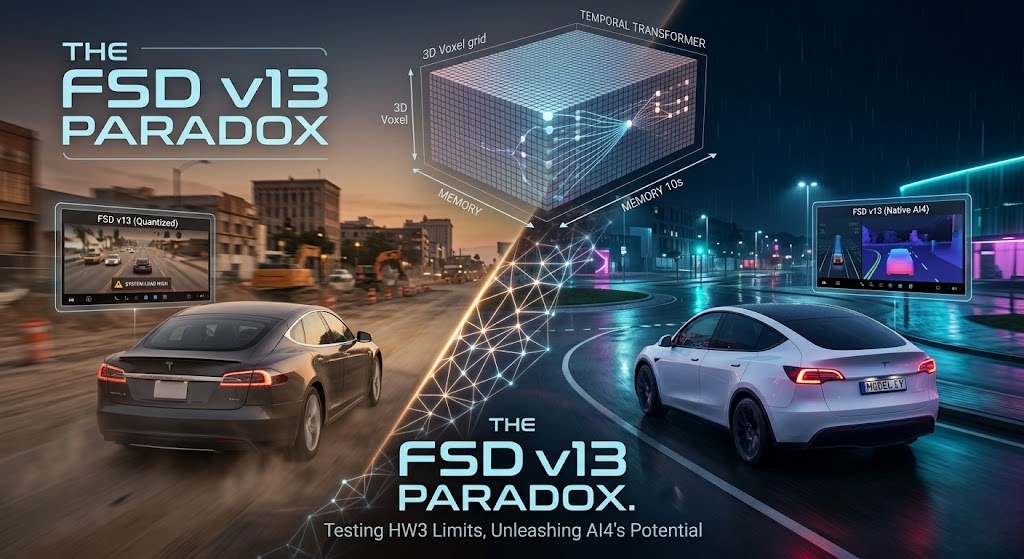
Previous versions of FSD processed the world as a series of highly rapid snapshots. While effective, this led to "object flickering"—where a truck behind a pillar might momentarily "disappear" from the car’s mind. v13 introduces Temporal Transformers. By utilizing a recursive buffer of the last 10 seconds of video data, the vehicle now maintains a permanent 3D "Voxel Map" of its surroundings. Even if a pedestrian is obscured by a parked car, v13 "remembers" their trajectory and velocity.
1.2 The Voxelization of Reality
In v13, the occupancy network has been upgraded to Occupancy Network v3. It no longer just sees "obstacles"; it predicts the structural integrity of the environment. The resolution of these voxels has increased by 8x, allowing the car to navigate complex, tight European alleys and American construction zones with a precision that mimics human spatial awareness.
Chapter 2: The Hardware Bottleneck—The HW3 vs. AI4 Divide
This is the most controversial topic of 2026. Tesla’s commitment to "all cars produced since 2016 are capable of FSD" is being tested by the sheer weight of v13’s neural parameters.
2.1 The AI4 (HW4) Advantage
AI4, which features significantly higher NPU (Neural Processing Unit) throughput and improved thermal management, runs v13 natively in high-precision FP16 (16-bit floating point). This allows for:
-
Zero-Latency Inference: The time between a camera seeing a ball and the brakes engaging is nearly instantaneous.
-
High-Res Camera Input: AI4 processes the full 5MP feed from the latest Samsung-sourced cameras, providing better long-range vision.
2.2 The HW3 Struggle: Pruning and Quantization
To fit v13 onto the aging HW3 chips, Tesla’s AI team has had to employ aggressive Neural Pruning and INT8 Quantization.
-
The Trade-off: By shrinking the model to fit HW3’s smaller memory bandwidth, "quantization noise" is introduced. This manifests as slightly more "hesitant" behavior in edge cases—unprotected left turns or complex roundabouts where the AI4-equipped Model Y Juniper glides through effortlessly.
-
The Power Wall: HW3 is running at near 95% utilization. This leads to higher heat and, occasionally, "degraded performance" warnings in extreme summer conditions (e.g., Arizona or Southern Spain).
Chapter 3: Real-World Performance Metrics (March 2026 Data)
Based on fleet-wide data collected from early v13 testers in California and Norway, the divergence is clear.
3.1 Miles Between Intervention (MBI)
The industry standard for autonomy is MBI. In March 2026:
-
AI4 Platforms: Achieving an average of 450 miles between critical disengagements.
-
HW3 Platforms: Hovering around 120 miles. The gap is no longer marginal; it is structural.
3.2 Smoothness and "Human-Like" Driving
v13 has nearly eliminated the "jerkiness" of regenerative braking when approaching stop signs. The introduction of Jerk-Limited Path Planning ensures that the G-forces felt by passengers are within the "comfort zone" defined by luxury limo standards.
Chapter 4: The Strategic Pivot—FSD as a Service (FSDaaS)
With the technical gap widening, Tesla’s business model is shifting.
4.1 The FSD Transfer Deadline
Tesla recently extended the FSD transfer window to March 31, 2026. This is a clear signal: Tesla wants HW3 owners to upgrade to newer AI4 hardware (Model 3 Highland or Model Y Juniper) to maintain the "premium" FSD experience.
4.2 The Cybercab Implications
The v13 software is the foundation for the Cybercab (unveiled earlier this year). Because the Cybercab lacks a steering wheel, its safety requirements are 10x higher than a standard Model 3. v13 is the "Safety Kernel" that will allow Tesla to seek Level 4 certification in specific geofenced areas in Texas and California by late 2026.
Chapter 5: Regulatory Compliance and Safety Standards
In early 2026, both the NHTSA (USA) and the EBA (Europe) implemented new "Transparency Protocols" for AI-driven vehicles.
5.1 The "Black Box" Requirement
Tesla has integrated a new Safety Shield in v13 that logs neural "confidence scores" in real-time. If the confidence score drops below 85%, the car now proactively asks the driver to take over with a 5-second lead time—a direct response to European safety mandates.
Conclusion: The Path to Level 4
FSD v13 is a masterpiece of software engineering, but it serves as a sobering reminder that hardware is not infinite. For the European Tesla owner navigating tight urban centers or the American commuter facing 80mph highway speeds, the choice of hardware is becoming as important as the software version. We are witnessing the birth of "True Autonomy," but it is clear that the future belongs to AI4 and beyond.
FAQ: What You Need to Know Today
Q: Will my 2018 Model 3 with HW3 ever reach Level 4 autonomy? A: Based on current v13 performance, HW3 will likely remain a "Supervised" Level 2+ system. While it will get the features of v13, the reliability will not match the driverless requirements.
Q: Is v13 available in Europe yet? A: A "Sanitized" version of v13 (complying with UNECE R157) is currently in shadow-testing in Germany and the UK, with a wide release expected by Summer 2026.
Q: Does v13 require a subscription? A: Yes, Tesla has maintained the $199/month (or equivalent) pricing, though some "AI-Enhanced" features may require a premium tier on older hardware.