
Introduction
For Tesla owners in the United States and Europe, the Supercharger network has always been the ultimate competitive advantage—a seamless, reliable, and vast ecosystem that turns long-distance travel from a logistical nightmare into a routine pleasure. But as we navigate through March 2026, this advantage is undergoing a radical transformation. It’s no longer just about having more stalls; it is about a fundamental re-engineering of how charging infrastructure is built, deployed, and experienced.
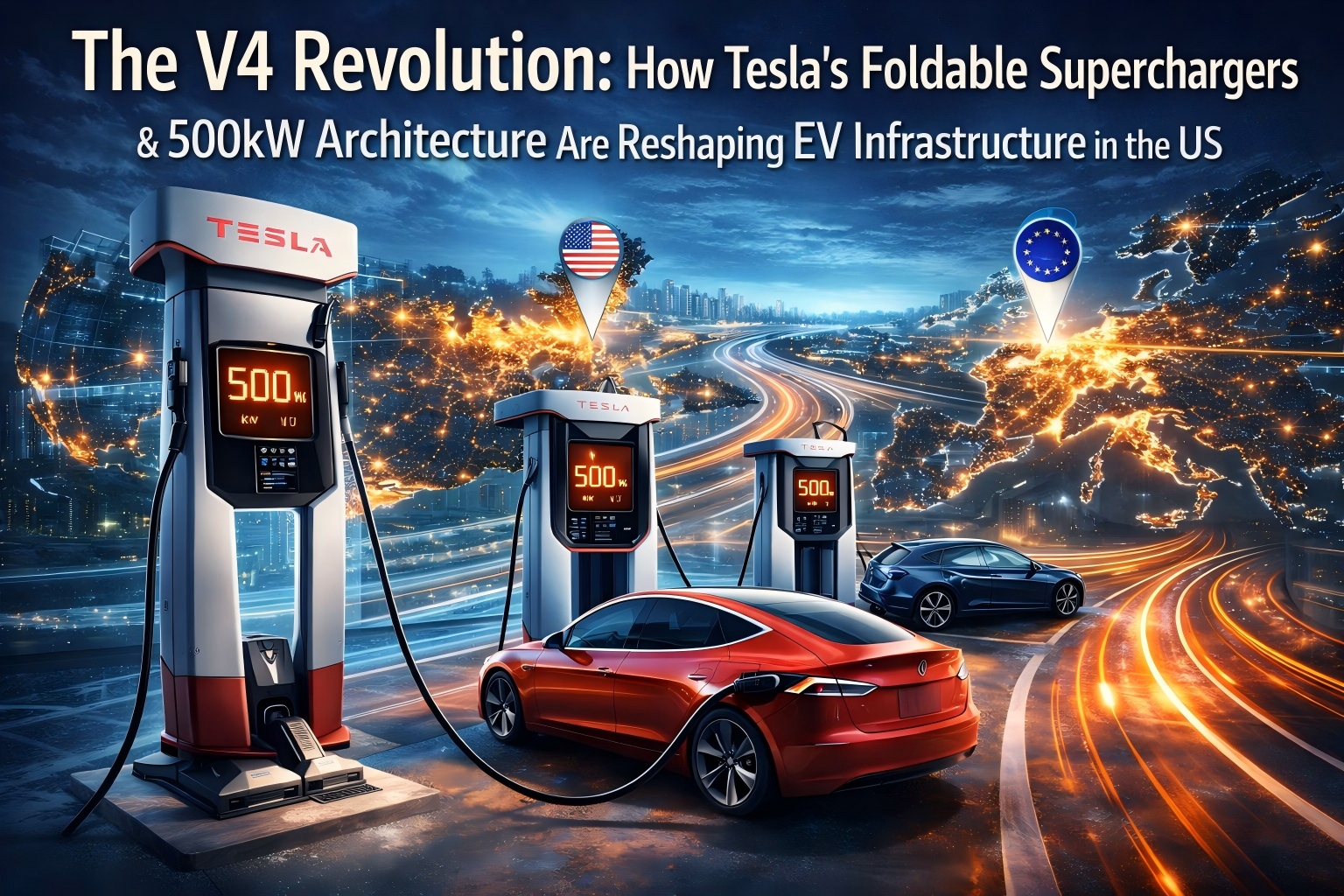
In the past two weeks alone, Tesla has officially closed the book on the V3 era after seven years and over 15,000 cabinets, marking a historic milestone at Gigafactory New York . Simultaneously, the company has launched its most disruptive hardware innovation since the original Supercharger: the Folding Unit (FU) Supercharger—a pre-assembled, foldable V4 system designed to slash deployment costs by over 20% and double installation speed .
This is not merely an incremental update. For the Tesla owner planning a summer road trip from Los Angeles to New York, or a European family navigating the Autobahn from Berlin to Munich, this shift means shorter queues, faster stops, and a network that expands into underserved areas at an unprecedented pace.
Chapter 1: The End of the V3 Era — A Historic Milestone
The numbers are striking and worth reflecting on. Between 2019 and March 18, 2026, Tesla’s Gigafactory in New York produced over 15,000 V3 power cabinets. Each cabinet supported up to four stalls, forming the backbone of a network that now exceeds 75,000 Supercharger stalls worldwide. The final V3 cabinet rolling off the production line was more than just a manufacturing detail; it was the conclusion of a chapter that defined the rapid expansion of EV adoption .
What This Means for Existing Infrastructure
For owners who rely on existing V3 stations, there is no cause for alarm. Tesla has been unequivocal that all existing V3 hardware will continue to operate indefinitely. The tens of thousands of V3 stalls currently installed across US interstates and European highways are not being decommissioned. The phase-out applies strictly to new manufacturing and new site deployments .
However, the strategic shift is profound. Every new Supercharger location, and every replacement cabinet in existing stations, will now be V4. This phased approach means that over the next 12 to 24 months, owners will gradually see the balance shift. A road trip that once consisted entirely of V3 stops will increasingly feature V4 sites, bringing with them the benefits of higher power ceilings and improved reliability.
Chapter 2: The Folding Unit — A Logistics Revolution
If the V4 cabinet represents a leap in power, the Folding Unit (FU) represents a leap in deployment strategy. Unveiled on March 26, 2026, the FU Supercharger is a pre-assembled, foldable V4 system designed to solve the “deployment debt” that has plagued every charging network on the planet .
Technical Deep-Dive
The FU consists of a single V4 power cabinet paired with eight individual charging posts. The entire assembly sits on a heavy-duty concrete mounting plate equipped with an industrial hinge system. During transportation, the 6.5-foot-tall charging posts fold flat against the base using high-flex, liquid-cooled cables. Upon arrival at a site, a small crane lifts the folded unit into position; the posts are unfolded into a back-to-back or side-by-side configuration; and a single “Megawatt-class” quick-connect coupling handles the power hookup .
The Numbers That Matter to Owners
The logistics improvements translate directly to real-world benefits for you:
- Deployment Speed: What previously took two weeks can now be completed in under 48 hours. Civil and electrical work is reduced by nearly 50%.
- Cost Efficiency: The system saves more than 20% on overall site costs, bringing the effective cost comfortably under $40,000 per stall. This cost discipline helps keep Supercharging rates competitive, even with high inflation.
- Shipping Density: Tesla can now load two complete FU units onto a single truck, delivering 16 charging posts in one shipment—a 33% increase over the previous maximum .
For US owners, this means Tesla can now economically justify building sites in rural stretches of the Great Plains or remote highways that were previously marginal due to high shipping costs. For European owners, it allows for dense urban fills in cities like Paris or Amsterdam, where construction disruption must be minimized.
Chapter 3: V4 Technical Performance — Beyond the 500kW Headline
While the Folding Unit handles logistics, the V4 cabinet handles the electricity. The transition to true V4 hardware—as opposed to early hybrid sites that paired V4 stalls with V3 cabinets—is now complete.
The 1000V Architecture
The heart of the V4 system is its ability to support vehicle architectures from 400V all the way up to 1000V. This is a critical technical leap. V3 cabinets were capped at 500V DC, forcing 800V vehicles like the Cybertruck to rely on inefficient onboard converters. The V4 cabinet removes this bottleneck, allowing native support for higher-voltage systems .
Real-World Charging Times
For the majority of Tesla owners driving Model 3, Model Y, Model S, or Model X (all on 400V architectures), the headline peak speed remains 250 kW. However, the experience is significantly improved. The V4 cabinet’s “Global Bus” logic dynamically allocates its massive 1.2 MW total power across up to eight stalls. In a V3 setup, if you were paired with another car on the same cabinet, speeds would drop. With V4, the impact of power sharing is drastically reduced, ensuring you get consistent 250 kW even at busy sites .
For Cybertruck owners, the upgrade is transformative. On a true V4 cabinet, a Cybertruck can access up to 325 kW (with 500 kW promised via future software updates), recovering over 150 miles of range in approximately 10 minutes. This fundamentally alters the calculus of long-distance towing or heavy hauling, turning charging stops into quick “bathroom breaks” rather than extended pauses .
The Cable and Connector
The physical user experience is also upgraded. V4 stalls feature a 3-meter (10-foot) liquid-cooled cable. For US owners, this longer reach solves the “wrong side” problem for non-Tesla EVs, preventing congestion by allowing all vehicles to park properly. For European owners, the longer cable is a practical necessity given the variety of vehicle designs and port locations on the continent .
Chapter 4: Strategic Divergence — US vs. Europe
Tesla’s infrastructure strategy is not one-size-fits-all. The US and European markets are experiencing the V4 rollout through distinct strategic lenses, each with unique implications for owners.
North America: The NACS (J3400) Victory Lap
In the US, 2026 is the year the charging wars effectively ended. As of Q1 2026, every major automaker—from Ford and General Motors to Hyundai and Mercedes-Benz—has released at least one model with a native NACS (J3400) port . This marks the end of the bulky CCS-to-NACS adapter era.
For Tesla owners, this consolidation is a net positive. The V4 rollout ensures that as millions of new non-Tesla EVs hit the road, the network has the capacity and speed to handle them without degrading the Tesla experience. The reliability metric remains Tesla’s killer app: maintaining a 99.9% uptime compared to competitors struggling in the low 90s .
Europe: The “Trojan Horse” Strategy
In Europe, Tesla is playing a different game. The continent’s strict permitting, higher urban land costs, and the need for CCS2 compatibility have led to the “Supercharger for Business” (SfB) program. Under SfB, Tesla acts as a hardware supplier and software provider, selling V4 cabinets to third-party hosts like shopping malls in France or hotel chains in Spain .
This is an “asset-light” expansion model. For European owners, it means more charging options in more convenient locations—not just on highway rest stops, but in the places you actually park.
Moreover, Tesla is tackling Europe’s grid limitations head-on with Megapack-backed Supercharger sites. These sites function as giant batteries. During off-peak hours, the Megapacks charge up from the grid; during peak travel times, they discharge at 500kW directly into vehicles, bypassing grid constraints and ensuring full speed availability on demand.
Chapter 5: The 2026 Road Trip — Practical Owner Guidance
With the infrastructure evolving rapidly, how does a Tesla owner in 2026 plan a road trip differently?
How to Find a “True” V4 Site
As of March 2026, not all V4 stalls are created equal. Some sites are still running on V3 cabinets. To find a true 500kW-capable site:
- In-Car Navigation: The most reliable method is the Tesla navigation system. When you route to a Supercharger, the car predicts your charging curve. If it estimates a peak above 250 kW, you are heading to a V4 cabinet site.
- The Tesla App: Look for updated site icons. Tesla is expected to differentiate between “V4 (250kW)” and “V4 (500kW)” sites.
- Physical Cues: Look for the new, taller V4 stalls with integrated credit card readers. If the station has large Megapack-sized cabinets nearby, it is almost certainly a true V4 site .
The 15-Minute Rule
With true V4 speeds, the optimal charging strategy shifts. For Cybertruck owners, a stop of 15-18 minutes is now sufficient to add energy for 2-3 hours of highway driving. This “15-Minute Rule” aligns perfectly with human physiology—the time it takes to use a restroom, grab a coffee, and stretch your legs .
For owners of 400V cars, the strategy remains the same (charge to 80% for optimal speed), but the peace of mind is higher. Knowing that a site has ample power reserves means you can arrive with a lower state of charge, confident that the V4 cabinet’s power-sharing algorithm will get you back on the road quickly, even if the site is busy.
Chapter 6: The Competitive Moat
Tesla’s charging network has evolved from a cost center (a necessity to sell cars) to a potential profit center and a formidable competitive moat. By opening the network to all EVs and monetizing the hardware through the SfB program, Tesla is turning its infrastructure into a revenue-generating asset .
The 500 kW speed is not just a technical spec; it is a premium product that increases revenue per stall per day through faster turnover. More importantly, the adoption of NACS as the SAE J3400 standard means that every new EV from a legacy automaker rolling off the line is a validation of Tesla’s engineering and a commitment to using its network. The V4 cabinet ensures that when those millions of new EVs hit the road over the next five years, the network they plug into has the capacity, speed, and reliability to handle them.
Conclusion
As we stand in March 2026, the era of 500kW charging is not a future promise—it is the present reality. Tesla’s transition to V4, powered by the logistical genius of the Folding Units and the technical prowess of the 1000V cabinets, represents a decisive leap forward. For Tesla owners in the United States and Europe, this translates to a network that grows faster, charges faster, and remains the gold standard of reliability.
Whether you are driving a Model Y in California, a Cybertruck in Texas, or a Model 3 in Germany, the infrastructure supporting you is now more robust than ever. The charging experience is no longer a compromise of EV ownership; it is an advantage that legacy automakers are only beginning to grasp. The V4 revolution is here, and it is redefining what is possible for long-distance electric travel.
FAQ
Q: Will my Model 3 or Model Y charge faster at a V4 Supercharger?
A: The peak charging speed remains 250 kW. However, you will benefit from more consistent delivery of that power, especially when multiple vehicles are charging simultaneously, thanks to improved power-sharing algorithms.
Q: Are V3 Superchargers going away?
A: No. Existing V3 stalls will remain operational for years to come. The phase-out only applies to new manufacturing and new site deployments.
Q: What is the main advantage of the Folding Unit Superchargers for owners?
A: Faster network expansion. The FU units allow Tesla to deploy new sites in under 48 hours at a lower cost, which means more stalls in high-demand corridors and underserved rural areas sooner.
Q: How do I know if a Supercharger site offers 500 kW?
A: Use the Tesla in-car navigation. If the predicted charging curve shows a peak above 250 kW, you are at a true V4 site. Physical cues include taller stalls with integrated payment terminals.
Q: Are these new chargers available in Europe?
A: Yes. V4 deployments are already active in Germany, the Netherlands, France, and the UK. The Supercharger for Business program is accelerating expansion across the continent.