
Introduction
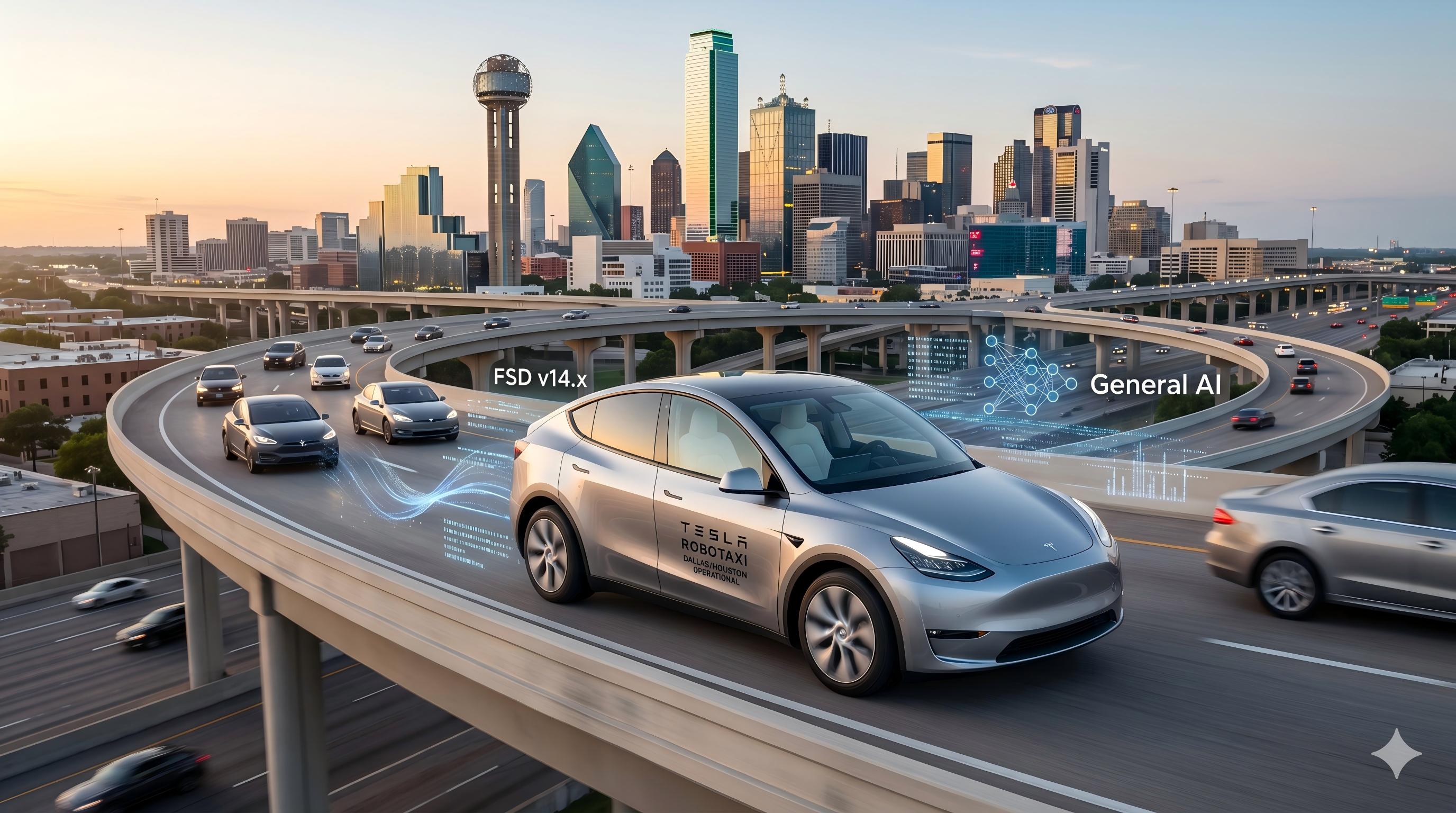
As of April 19, 2026, the landscape of urban mobility has undergone a seismic shift. This weekend, Tesla officially greenlit its fully unsupervised Robotaxi service in two of America’s most complex urban environments: Dallas and Houston, Texas. Following the successful, albeit cautious, pilot in Austin throughout late 2025 and early 2026, the expansion into these sprawling metropolises signifies more than just a geographic growth—it marks the end of the "Safety Driver" era. For Tesla owners and the broader EV community in the US and Europe, this rollout provides the definitive proof of concept for Elon Musk’s long-promised autonomous network.
Chapter 1: The "Unsupervised" Leap
For years, the industry standard for autonomous testing involved a "safety monitor" behind the wheel—a human ready to intervene at the slightest hesitation. Tesla’s launch in Dallas and Houston has boldly skipped this phase for the general public rollout. Vehicles are now operating with empty front seats in geofenced areas covering over 1,200 square miles across the Texas triangle.
Technically, this leap is supported by the maturity of FSD v14. x, which utilized "shadow mode" data from millions of miles driven in these specific cities over the last six months. Unlike Waymo, which relies on heavy LiDAR and pre-mapped HD data, Tesla’s approach remains pure vision. The ability of the vision-only system to navigate the unpredictable multi-lane interchanges of Dallas without human oversight is a testament to the "General AI" capabilities of the latest neural networks.
Chapter 2: Fleet Management & Operations
The service is currently integrated directly into the updated Tesla App (v5.12). Owners in the service area can now toggle between their personal vehicle and the "Tesla Network." When a ride is summoned, a Model Y—optimized for fleet use with durable interior materials and the new "Easy-Entry" door systems—arrives.
A critical component of this operation is the Tesla Hub. Unlike traditional taxi depots, these are automated cleaning and charging centers. Utilizing the recently standardized V5 Superchargers and the robotic "snake" chargers first teased years ago, the fleet maintains 99% uptime. For the customer, the experience is frictionless: no driver, no tip, and a climate-controlled cabin set to their personal Tesla profile settings upon entry.
Chapter 3: Comparative Analysis: Tesla vs. Waymo
In the streets of Houston, Tesla is now in direct competition with Alphabet’s Waymo. While Waymo has held a lead in "perceived" safety through its cautious, geofenced-first approach, Tesla’s scalability is proving to be the differentiator.
-
Cost: Early data shows Tesla’s cost-per-mile is roughly 30% lower than Waymo’s, primarily due to the lower capital expenditure on vehicle hardware (no LiDAR) and the massive vertical integration of the charging network.
-
Safety: While critics point to the "wide safety gap" in Austin's early data, the Dallas rollout features a refined AI compiler that has reduced "latency-induced hesitations" by 40%, potentially bringing Tesla's safety metrics in line with, if not above, human-driven counterparts.
Chapter 4: The Path to Europe
European owners are watching the Texas rollout with a mix of envy and anticipation. The RDW in the Netherlands has already given preliminary approval for FSD v14 testing on Dutch roads, but "unsupervised" operation faces a tougher regulatory climb under UNECE regulations. However, the successful data harvest from Dallas and Houston provides the "statistical certainty" that European regulators like the UK’s Department for Transport have been demanding. Predictions for a London or Berlin Robotaxi pilot have moved forward to late 2026.
Conclusion
The Dallas and Houston expansion is the "iPhone moment" for the automotive industry. Tesla is no longer just selling cars; it is selling miles. For the owner, this validates the investment in FSD-capable hardware. For the world, it is the beginning of a shift toward a utility-based transport model where the cost of moving from A to B drops below the cost of a bus ticket.
FAQ
-
Q: What happens if the vehicle encounters an unmapped construction zone?
-
A: The vehicle uses real-time vision to navigate. If the path is blocked, it contacts a remote Tesla assistance operator who can provide a "path hint" without taking over the driving.
-
-
Q: Can I put my own car into the Robotaxi fleet today?
-
A: Currently, only Tesla-owned vehicles are in the "Unsupervised" fleet to ensure strict maintenance standards, but the "Owner-Fleet" opt-in is expected by Q4 2026.
-
-
Q: Is the service available 24/7?
-
A: Yes, with peak-hour dynamic pricing similar to Uber/Lyft.
-