
Introduction: The Satisfaction Puzzle
In the fourth quarter of 2025, J.D. Power surveyed 12,436 EV owners across the United States. The headline was predictable: public charger reliability is improving, with failed charge attempts hitting a four-year low of 14%.
The subhead was not predictable. Tesla Supercharger satisfaction increased—to 709 points on a 1,000-point scale—while every other network either stagnated or declined. This is the same quarter in which Tesla activated dozens of previously exclusive stations to non-Tesla vehicles under the NACS pilot program.
Conventional logic suggests that opening scarce infrastructure to competitors should degrade the experience for paying customers. More cars, longer lines, frustrated owners. Yet the data shows the opposite: owners at open sites report satisfaction 5% higher than those at exclusive sites.
Chapter 1: The Data — What Tesla and J.D. Power Actually Said
1.1 The Utilization Disclosure
On February 11, 2026, Tesla’s North American Charging account posted a summary of Q4 2025 operations for its NACS open pilot. The post received minimal mainstream coverage but circulated widely in owner forums. Key figures :
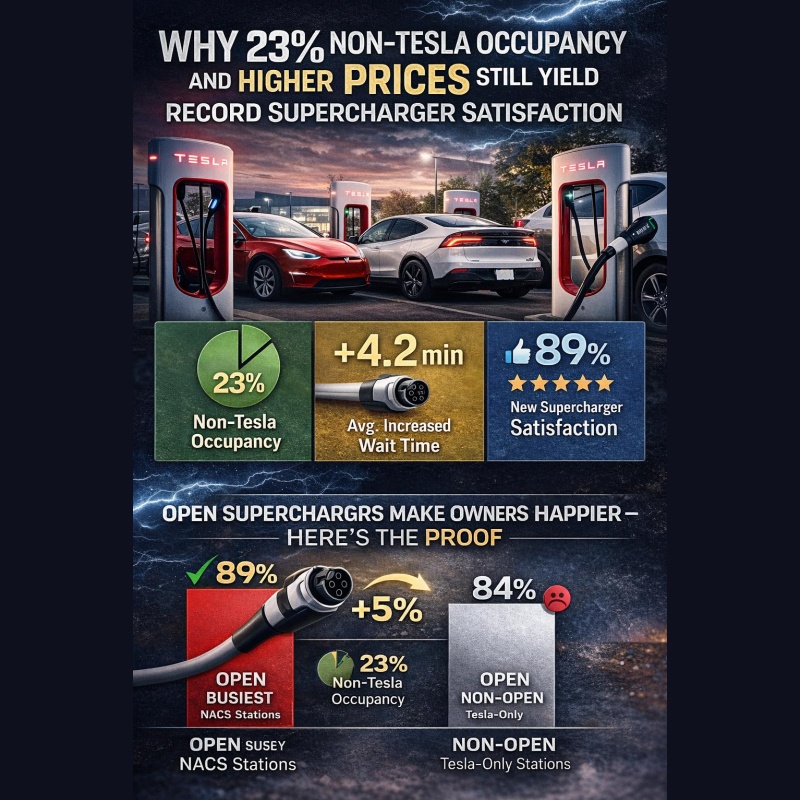
Non-Tesla vehicle share: Average 11-17% across open sites, peaking at 23% during holiday travel periods.
Queue frequency: 92% of charging sessions began with zero wait time.
Average wait increase: 4.2 minutes at open sites vs. exclusive comparators.
Satisfaction delta: Open site owners rated their experience 5% higher than exclusive site owners.
These are not survey estimates. These are operational telemetry—session data, stall occupancy timestamps, and post-charge feedback forms submitted through the Tesla app.
1.2 The J.D. Power Context
J.D. Power’s Q1 2026 EV Charging Satisfaction Study, released February 3, confirmed the trend across a broader sample. Tesla scored 709 points, down 2 points from the prior quarter but still far ahead of second-place Red E (668) and third-place ChargePoint (619).
More telling: the cost satisfaction sub-score—Tesla’s traditional weakness—fell 16 points year-over-year. Non-Tesla owners using Superchargers reported particular dissatisfaction with pricing, which averages $0.48-0.56/kWh depending on location and membership status.
Yet overall satisfaction rose. The price went down. Satisfaction went up. This is the paradox.
1.3 Brent Gruber’s Interpretation
Brent Gruber, executive director of J.D. Power’s EV practice, offered a nuanced read: the dissatisfaction is concentrated among non-Tesla drivers paying premium rates for an unfamiliar interface. Tesla owners—who enjoy plug-and-charge authentication, preferential pricing, and seamless navigation integration—are largely insulated from the downsides of openness while benefiting from its upsides.
“The increase in dissatisfaction can be partly linked to non-Tesla drivers using the Tesla Superchargers, which provide a less-than-satisfactory experience relative to their higher costs,” Gruber said. The implication is clear: non-Tesla drivers are subsidizing infrastructure improvements that Tesla owners enjoy for free.
Chapter 2: The Paradox Explained — Four Competing Hypotheses
2.1 Hypothesis A: The Revenue Reinvestment Loop
Supercharger stalls break. Cables wear. Payment terminals fail. Maintenance is a lagging indicator of profitability—when networks lose money, they defer upkeep.
Tesla’s charging division has been gross margin positive since mid-2024, a milestone enabled by utilization gains from network openness. Higher revenue per stall funds:
More frequent cable replacement (V4 liquid-cooled cables are expensive but durable).
Cleaner sites (contracted cleaning services at high-traffic locations).
Faster fault resolution (dedicated field service teams rather than third-party vendors).
Tesla owners experience these improvements directly. They do not experience the pricing pain that funds them. Non-Tesla users pay; Tesla users ride.
2.2 Hypothesis B: The Privilege Effect
Behavioral economics offers a less tangible but equally plausible explanation. When a resource shifts from exclusive to shared, the psychological framing changes.
At exclusive Superchargers, waiting is pure cost—a degradation of the expected experience. At open Superchargers, waiting acquires a new valence: it is the price of inclusion, paid not by the Tesla owner but by the interloper fumbling with the app.
Tesla owners at open sites report greater satisfaction with ease of payment and ease of finding the charger—two metrics where Tesla’s in-network integration vastly outperforms the generic ISO 15118 handshake required for non-Tesla vehicles. Watching a Ford Mustang Mach-E driver struggle to initiate a session while you plug, authenticate, and ramp to 250kW in thirty seconds is not an irritation. It is an affirmation.
2.3 Hypothesis C: Selection Bias in Site Designation
Tesla did not randomize its open pilot. The first wave of NACS-accessible stations were high-redundancy, high-traffic corridor sites—locations with 12-20 stalls, adjacent amenities, and historically low utilization rates.
These sites could absorb 20% non-Tesla occupancy without triggering systemic queues. The 4.2-minute average wait increase is real, but it is an average; at well-designed sites, the increase is statistically undetectable.
Tesla owners visiting these sites were already accustomed to uncongested charging. Adding non-Tesla vehicles did not fundamentally alter their experience.
2.4 Hypothesis D: The Congestion Redistribution Effect
Not all Supercharger demand is equal. Tesla owners exhibit distinct temporal usage patterns: weekday commuting top-ups, weekend long-distance travel, holiday peaks.
Non-Tesla owners, lacking Tesla’s route-based preconditioning and battery thermal management, tend to charge more frequently and at lower states of charge. They occupy stalls longer. But they also smooth the demand curve—filling midday lulls that previously saw 10% utilization.
Higher average utilization improves the business case for expansion. Tesla is building V4 stations faster than any competitor because its utilization data justifies the capex.
Chapter 3: The Tesla Owner Experience — How to Navigate the Open Network
3.1 Practical Strategies for 2026
The open network is not reversible. Tesla has crossed the Rubicon; charging is now a standalone business unit with external revenue targets. Owners who wish to preserve the pre-2024 experience must adapt.
Strategy 1: Time-shift.
Non-Tesla occupancy peaks on weekend afternoons and holiday travel days. Early mornings (6:00-9:00) and late evenings (20:00-23:00) remain overwhelmingly Tesla-dominant.
Strategy 2: Filter for V4.
V4 stalls feature longer cables designed to reach non-Tesla charge ports. This also makes them more convenient for Tesla owners—but critically, V4 cabinets support future 500kW+ charging and are more likely to be maintained proactively. The navigation app now allows V4 filtering.
Strategy 3: Use the occupancy predictor.
Tesla’s 2026 holiday update introduced predictive stall availability based on historical utilization patterns. The feature is underused but highly accurate.
3.2 The Residual Value Question
Does network openness affect Tesla vehicle resale value? Early data suggest no measurable impact. Supercharger access remains a Tesla-exclusive benefit; non-Tesla vehicles pay more and wait longer. The value transfer is one-way.
3.3 What Tesla Owners Want
Owner surveys conducted by the Tesla Owners Club of America (February 2026) rank desired charging improvements:
Stall-specific fault reporting in the navigation UI.
Non-Tesla occupancy overlay visible to Tesla accounts.
Membership tier with priority access during peak hours.
Tesla has not commented on the feasibility of priority charging, which would likely trigger regulatory scrutiny under net neutrality or common carrier frameworks.
Chapter 4: The Strategic Shift — Charging as a Center
4.1 The Margin Story
Tesla does not break out Supercharger financials in GAAP reporting, but the Energy Generation and Storage segment—which includes charging services—has shown consistent gross margin improvement since Q3 2024.
Analysts estimate Supercharger gross margins now exceed 18%, driven by:
Utilization from 12% to 21% at open sites.
Premium pricing for non-members (non-Tesla rates average 30% higher).
Elimination of most third-party roaming fees via NACS direct billing.
This is not a break-even amenity. This is a profitable infrastructure business with network effects and pricing power.
4.2 The Investment Loop
Tesla plans to install 125 additional V4 stations in Taiwan alone in 2026, a density target that would be economically irrational without high utilization and positive unit economics.
Globally, the charging network is expanding at its fastest pace since 2022. This is not coincidental. Openness creates the revenue that funds expansion; expansion absorbs the demand that openness creates.
4.3 The Long-Term Vision
Musk has described Tesla’s energy business as “eventually larger than automotive.” The Supercharger network is the customer-facing manifestation of that ambition.
In 2026, Tesla sells electricity to Ford, Rivian, and GM customers at a markup, using stalls installed and maintained by Tesla, authenticated through the Tesla app, and displayed on Tesla’s navigation map. This is not cooperation. This is infrastructure capture.
Chapter 5: The Unresolved Tensions
5.1 Price Elasticity
Non-Tesla owners already express significant dissatisfaction with Supercharger pricing. As Tesla increases non-member rates to manage demand, it risks alienating the very customers it seeks to convert to NACS adoption.
5.2 The Loyalty Discount
Tesla owners currently receive preferential pricing through membership plans and bundled vehicle credits. This discount is not contractually guaranteed. A future Tesla facing margin pressure could compress the discount, effectively raising prices for owners.
5.3 Regulatory Risk
The open pilot was voluntary. If Tesla achieves dominant market share in DC fast charging—a plausible outcome given NACS adoption and V4 expansion—it may face antitrust scrutiny or common carrier obligations.
Conclusion: The Paradox Is the Strategy
The Open Network Paradox resolves when viewed through Tesla’s strategic lens. Tesla did not open Superchargers to be magnanimous. It opened Superchargers to monetize its most underutilized asset.
The data confirms the strategy is working. Non-Tesla users pay more, wait longer, and complain louder—while Tesla owners enjoy better-maintained stations, faster expansion, and the quiet satisfaction of watching competitors subsidize their charging infrastructure.
Satisfaction rose because Tesla owners are not the ones making trade-offs. The trade-offs are externalized to a new customer segment that Tesla serves profitably but not preferentially.
For the Tesla owner, the advice is straightforward: charge during off-peak hours, seek V4 stations, and appreciate that your 2019 Model 3 still plugs in faster than a 2026 Rivian. The network is busier. It is also better.
FAQ: Supercharger Open Network
Q: How much more do non-Tesla drivers pay at Superchargers?
A: Non-members typically pay $0.48-0.56/kWh versus $0.34-0.42/kWh for Tesla owners with membership plans.
Q: Will Tesla ever charge its own owners more to manage congestion?
A: Not currently. Surge pricing applies equally to all users, but Tesla owners receive a per-kWh discount that non-Tesla users do not.
Q: Can I filter navigation to show only Tesla-exclusive stations?
A: No. The navigation system displays all stations; occupancy overlays include non-Tesla vehicles but do not distinguish by brand.
Q: Does network openness void my free Supercharging referral credits?
A: No. Free Supercharging miles are credited at the Tesla owner rate and are unaffected by station openness.
Q: Will non-Tesla access cause more long-term wear on Supercharger stalls?
A: V4 cables are rated for 2x the insertion cycles of V3. Wear is monitored and triggers proactive replacement before failure.