
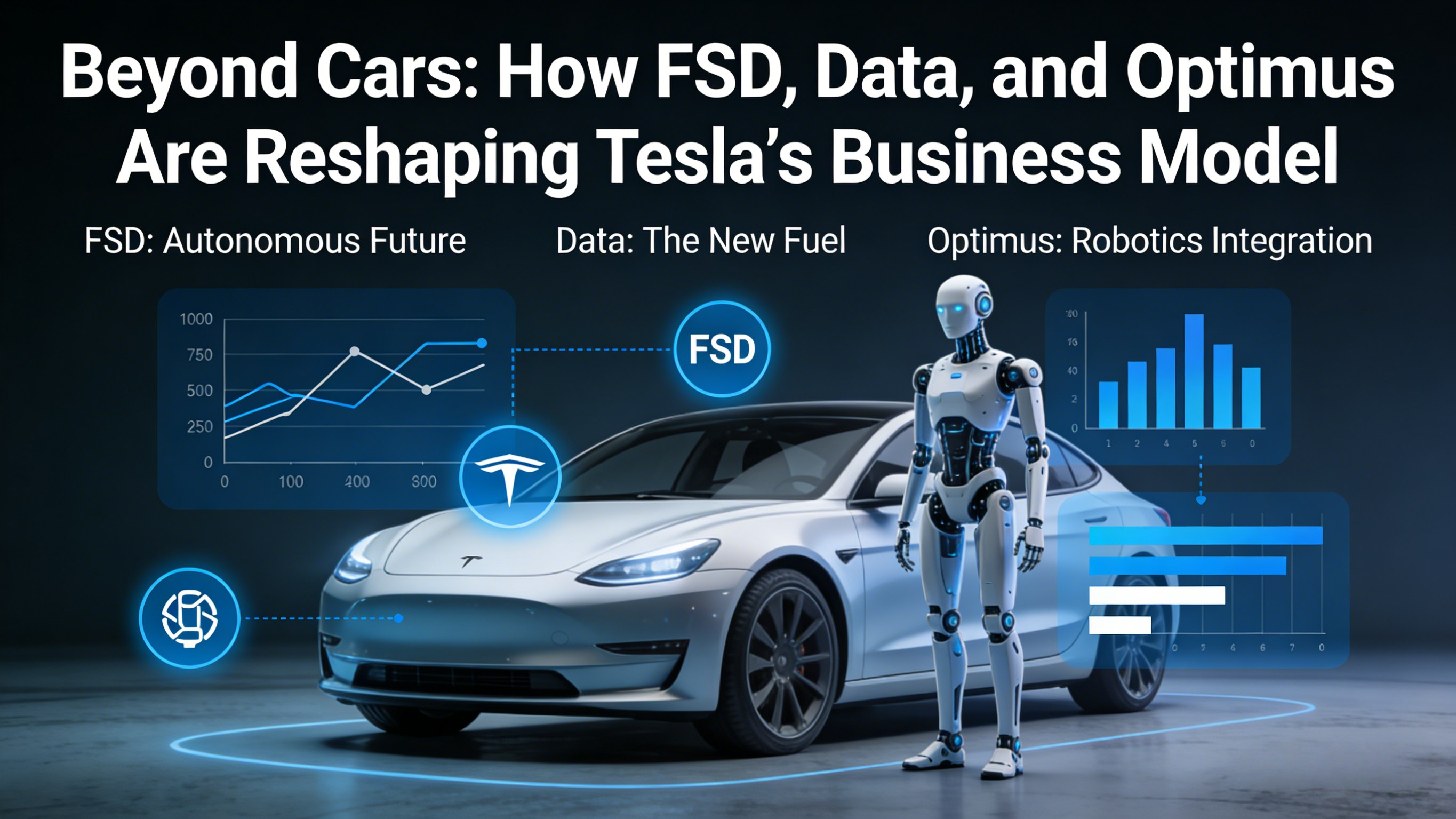
Tesla is no longer just a company that sells electric cars; it is actively rebuilding itself as an AI, software, and robotics platform that happens to manufacture vehicles and batteries. For owners and investors in the US and Europe, this shift shows up in three places: how Full Self‑Driving (FSD) is sold, how Tesla uses data, and how the Optimus humanoid robot is moving from flashy demo to real product roadmap.
I. From Carmaker to AI and Robotics Platform
Tesla’s official messaging in 2026 makes it clear that the car is only the starting point of a much larger AI infrastructure bet rather than the end goal. In multiple shareholder communications and media analyses, the company is described as building a “software-defined infrastructure layer for autonomous transportation,” with vehicles, chips, and robots all feeding the same AI engine.
For owners, that means your Tesla increasingly behaves like a rolling computer and sensor platform whose most important asset is not the body style or trim, but the neural networks and compute that sit behind the screen and cameras. For investors, it means looking beyond quarterly delivery numbers to software subscription adoption, FSD miles, and Optimus deployment as the true leading indicators of value.
II. Tesla’s 2026 Business Model: Hardware as the On‑Ramp
Economically, 2026 marks a turning point where Tesla explicitly leans into software and AI as core profit drivers while treating vehicles as the main on‑ramp to that ecosystem. Analysts now highlight that FSD, other software features, and future robot services offer structurally higher margins than selling cars, even if headline revenue is still dominated by hardware.
This change became especially visible when Tesla decided to discontinue its high‑end Model S and Model X lines in order to free up manufacturing and engineering resources for Optimus humanoid robots. AInvest reports that internal targets call for 50,000–100,000 Optimus units in 2026 alone as part of a strategic shift away from incremental vehicle refreshes and toward large‑scale robotics. At the same time, the company has ended one‑time FSD purchases and pushed owners into subscription models, which investors view as a recurring software revenue stream layered on top of the vehicle base.
From a car owner’s perspective, this can feel like Tesla is taking away the comfort of “buy once, own forever” and replacing it with yet another monthly bill. But from Tesla’s perspective, it converts lumpy, up‑front option sales into a more predictable, compounding revenue engine that scales with the installed base of vehicles and features.
III. The FSD Subscription Pivot: An Economic and Strategic Shift
FSD goes subscription‑only
In early 2026, Tesla confirmed that Full Self‑Driving (FSD) would no longer be available as a one‑time purchase and would instead be offered exclusively via subscription. Elon Musk announced that the company would stop selling the FSD package after February 14; after that date, owners who want FSD (Supervised) must subscribe, typically at 99 USD per month in the US.
Previously, buyers had a choice: pay around 8,000 USD up front for FSD or pay monthly at 99 USD, with the break‑even point over many years of ownership. By removing the one‑time purchase, Tesla effectively rewrites the deal: FSD becomes an ongoing service whose price can be adjusted over time, rather than a permanent asset attached to the vehicle.
Why Tesla prefers subscriptions
There are three reasons this shift is strategically powerful for Tesla.
-
First, recurring FSD revenue is far more visible and model‑able for investors, which can support higher valuation multiples if adoption rises.
-
Second, subscription models can be tuned by region and over time; Tesla can experiment with price, bundles, or “tiers” of autonomy without having to honor old, fixed contracts indefinitely.
-
Third, tying FSD to a subscription makes it easier to keep monetizing vehicles as they age; a six‑year‑old Model 3 or Y can still be a fresh software revenue source if the owner decides to subscribe, especially as features improve.
Internally, this aligns with AInvest’s characterization of FSD as Tesla’s “core AI engine,” not just a feature toggle. The more drivers subscribe and use FSD, the more training data Tesla collects, strengthening its neural networks and reinforcing the “AI flywheel” that underpins both autonomy and robotics.
What this means for owners
For owners, the trade‑offs are nuanced. A driver who keeps a car for eight years and subscribes continuously may pay more than they would have under the old one‑time purchase regime. On the other hand, a driver who wants FSD only for long trips, winter seasons, or specific months can now treat it like a streaming service—turn it on and off as needed.
The bigger question is psychological: are owners comfortable with the idea that some of the most important capabilities of their car are “rented” rather than owned? This is not unique to Tesla, but Tesla is pushing the logic further than most by making FSD one of the most visible, high‑stakes car subscriptions in the market.
IV. The Data Flywheel: Why Every Mile Matters
If FSD is the revenue engine, then Tesla’s data flywheel is the physics that makes that engine spin faster. In 2026, multiple analyses describe Tesla’s competitive edge as its “massive data flywheel—millions of cars on the road feeding video data back to its training clusters, a scale no competitor can currently match.”
How the flywheel works
At a high level, Tesla’s loop looks like this:
-
Millions of vehicles collect real‑world driving data through cameras and onboard sensors, including rare and “edge case” scenarios.
-
This data is sent back to Tesla’s AI training infrastructure, where neural networks learn to better perceive and respond to road situations.
-
Improved FSD models are deployed back to the fleet via over‑the‑air updates.
-
As more owners use FSD, particularly in complex environments, the system encounters even more varied situations, feeding step 1 again.
Electric‑vehicles.com reported that Tesla’s FSD software logged roughly one billion miles in just the first 50 days of 2026, illustrating how quickly the training set grows once adoption crosses a certain threshold. AInvest notes that FSD adoption recently passed a key “12% adoption threshold,” which it views as a tipping point for software‑driven growth.
Chips, AI models, and cross‑company synergies
The flywheel is not only about raw data volume; it also depends on the hardware and AI models that can make use of that data efficiently. KuCoin’s analysis describes how Tesla and Elon Musk’s AI ecosystem—including xAI and SpaceX—are converging around shared chips and models.
Tesla is developing AI5 and AI6 chips, with AI6 tied to a 16.5 billion USD foundry contract with Samsung and explicitly designed for “Optimus robot and data centers.” Meanwhile, xAI’s Grok models (with parameter counts in the trillions) are being integrated into Tesla vehicles, offering conversational interfaces and improved navigation while leveraging the same compute that supports autonomy.
For a driver in California or Berlin, this may show up as better voice interactions, smarter route planning, and more capable FSD behavior that appears to “learn” over time. Under the hood, however, those experiences are byproducts of an industrial‑scale AI infrastructure that no traditional automaker currently matches in scope.
V. FSD Today: Supervised Autonomy as a Bridge
Despite the ambitious branding, Tesla’s FSD in 2026 remains a supervised driver‑assistance system rather than a fully autonomous robotaxi product. Reviews continue to emphasize that drivers must keep their hands ready and eyes on the road, and that the system can still make mistakes in complex or unstructured environments.
Capabilities and limitations
Current FSD (Supervised) handles highway driving, lane changes, urban streets, traffic lights, and roundabouts with varying reliability, depending on road type, weather, and local rules. Owners in the US report dramatic improvements in smoothness and confidence compared to early versions, but also occasional regressions or “weird” decisions after major software updates.
From a technical standpoint, the supervised phase is an essential bridge: it exposes the system to enormous variety while keeping the human in the loop as a safety backstop. From an owner’s standpoint, it can feel like an expensive beta program where you are effectively co‑developing the system with Tesla.
The trust gap
This leads to the trust gap that characterizes Tesla’s autonomy story in 2026. Musk has spent years promising imminent fully autonomous capability, and as Electrek points out, those timelines have repeatedly slipped. Investors and regulators therefore treat future autonomy revenue with caution, even as the software demonstrably improves.
For owners, the question is simple but profound: do you see FSD as a convenience feature worth a monthly fee today, or are you paying for a future robotaxi capability that may or may not arrive on the timeline advertised? The answer to that question often determines whether FSD feels like a smart investment or a speculative bet.
VI. Optimus: From Demo Bot to Strategic Bet
If FSD is the most mature expression of Tesla’s AI, Optimus is the boldest. The humanoid robot program has moved rapidly in the last two years from awkward prototypes to Gen 3 units that show surprisingly fine motor skills in promotional material.
Gen 3: Better hands, better motion
Recent coverage shows Optimus Gen 3 performing tasks like tearing paper towels, opening cabinets, folding laundry, catching objects, and walking on uneven surfaces, indicating a major leap in dexterity and balance. A detailed breakdown of the latest hand design notes that Optimus Gen 3 uses around 50 actuators in its hands alone, enabling more human‑like grasping and manipulation of objects.
Tesla and third‑party analysis emphasize that these hardware improvements are designed not for show but for deployment; Gen 3 is described as the first Optimus revision “meant for mass production.” Musk and Tesla have committed to deploying Optimus units inside Tesla factories starting in 2026, with factory‑floor deployment expected in the second half of the year to handle specific repetitive tasks and collect training data.
Internal use first, consumer later
Both Tesla and outside observers are clear that the first phase of Optimus is inward‑facing: solving Tesla’s own labor and productivity challenges. The Fremont facility is being restructured to support Optimus manufacturing, effectively repurposing the production capacity once dedicated to Model S and X, which underlines how serious this pivot is.
At the same time, reporting from Electrek notes that, despite earlier claims, no Optimus robots are yet doing “useful work” in Tesla factories as of early 2026, and that the program remains in an intensive R&D phase. Musk has spoken about a long‑term goal of manufacturing up to one million Optimus units per year, but has also cautioned that near‑term deployments are limited and experimental.
For owners and investors, this reveals both the ambition and the risk: Tesla is betting meaningful capital and mindshare on a product that may not generate significant external revenue for several years.
VII. Shared AI Stack: Why FSD and Optimus Belong Together
One reason Tesla is confident in its ability to scale Optimus is that it largely builds on the same AI stack used for FSD. The core competencies—visual perception, environmental understanding, planning, and control—are transferable from cars navigating roads to robots navigating factories or warehouses.
Vision‑based learning across domains
Both Tesla vehicles and Optimus rely heavily on camera‑based vision systems and large neural networks trained end‑to‑end on video data. The company’s massive dataset of driving scenes not only helps vehicles but also provides insights into physical interaction, human behavior, and real‑world edge cases that can inform robot training.
Moreover, the same AI chips that power FSD inference in vehicles are being positioned to run Optimus workloads and support data center operations tied to xAI’s large models. This hardware unification means that improvements in cost per unit of computation or power efficiency benefit the entire ecosystem, not just one product line.
The unified “AI infrastructure” thesis
AInvest captures this in its framing of Tesla’s 2026 strategy as an “AI infrastructure bet beyond the car,” where FSD, Optimus, and in‑house chips are components of a single flywheel. FSD subscriptions fund and generate data for better AI models; those models are then reused in Optimus and potentially external AI services, which in turn create more data and value.
From this viewpoint, a Tesla car is effectively a node in a giant, distributed AI training and inference network. As an owner, this means your daily commute is not only about getting from A to B; it is also feeding a global system that might one day control millions of robots and autonomous vehicles.
VIII. What This Means for Owners and Investors
For owners
If you are a Tesla owner in the US or Europe, the short‑term implications are mixed. On the plus side, you benefit from an accelerated software cadence: more frequent FSD updates, smarter navigation, and potentially new AI‑powered features in the cabin as Grok‑style assistants get integrated more deeply into the car.
On the downside, you face a world where the most powerful capabilities—FSD, premium connectivity, perhaps advanced in‑car AI—are services you rent rather than own. You may also feel like an early participant in Tesla’s grand AI experiment, especially if you live in regions where FSD is still refining its behavior in complex city environments or under strict European regulations.
For European owners in particular, the regulatory pace will determine how quickly you see the benefits of Tesla’s AI investments. Efforts to obtain exemptions and approvals—starting with regulators such as the Dutch RDW—will shape when and how FSD‑like capabilities become legally usable across the EU.
For investors
For investors, Tesla’s pivot is both the main bull case and the main risk. If FSD subscriptions scale, Optimus deployments ramp, and AI chips achieve promised performance and cost advantages, Tesla could evolve into a multi‑vertical AI and robotics company with revenue streams far beyond car sales.
However, the same pivot hinges on deep uncertainties: regulatory approvals, technical breakthroughs in unsupervised autonomy, safe and economically viable robot deployment, and the ability to keep funding massive AI infrastructure without overextending. The gap between promotional videos of Optimus folding laundry and robots performing reliable, economically valuable work at scale is still substantial.
In that sense, buying a Tesla vehicle in 2026 is not just buying a car; it is a small, personal bet on whether Tesla’s broader AI and robotics thesis will succeed in the decade ahead.
IX. Regulatory, Ethical, and Social Questions
As Tesla pushes deeper into autonomy and robotics, regulators in the US and Europe are grappling with questions that go far beyond EV incentives.
Safety, liability, and shared streets
For FSD, regulators must decide how to classify and certify systems that blur the line between driver assistance and self‑driving. Liability in crashes, data retention policies, and the fairness of using public roads as training grounds for private AI systems are all active areas of debate.
For Optimus, future deployment in public spaces or outside tightly controlled factory settings raises questions about worker displacement, safety standards, and the acceptable level of autonomy for humanoid robots around humans. While 2026 deployments focus on internal use, the long‑term vision clearly extends into broader labor markets.
Data, privacy, and concentration of power
Tesla’s data advantage depends on constant collection of video and behavioral data from vehicles and, eventually, robots. Policymakers and privacy advocates are likely to scrutinize how that data is stored, anonymized, and used—especially in Europe, where GDPR and other privacy frameworks are more stringent.
At the same time, the combination of Tesla, xAI, and SpaceX into a shared AI flywheel—complete with custom chips and orbital data centers powered by Tesla batteries and solar, as described in KuCoin’s analysis—raises questions about the concentration of AI and infrastructure power in a small number of entities.
X. Conclusion
Tesla’s 2026 story is not primarily about new paint colors or minor range increases; it is about whether the company can successfully transform from an automaker into an AI and robotics platform without alienating the customers and regulators that made its first act possible. FSD’s move to subscription‑only turns cars into recurring revenue nodes, the data flywheel turns everyday driving into fuel for increasingly capable neural networks, and Optimus represents the most dramatic extension of Tesla’s AI stack into the physical world.
For owners, this means your Tesla will likely keep changing under your feet—or rather, under your hands and wheels—via software, sometimes in ways you welcome and sometimes in ways that feel imposed. For investors, it means the company’s value increasingly depends on AI adoption curves and regulatory outcomes rather than pure unit sales.
Whether this grand bet pays off will be decided not in slide decks but in the lived experiences of millions of drivers and, soon enough, workers who interact with Optimus and with roads full of increasingly autonomous vehicles.
FAQ
Q1: Will my existing Tesla benefit from Optimus‑related AI advances?
In principle, yes: Tesla’s AI stack is shared, so improvements in perception, planning, and control for Optimus can inform FSD and other vehicle features over time. However, the timelines are uncertain, and near‑term Optimus work will mostly improve factory‑specific behaviors first.
Q2: How realistic are Tesla’s timelines for unsupervised FSD and robotaxis?
Historically, Elon Musk has repeatedly over‑promised timelines for full autonomy, with several years of missed targets. While software capability and data scale are genuine strengths, regulators and independent analysts remain cautious about near‑term robotaxi projections.
Q3: Could Tesla’s focus on robotics hurt car quality or service?
Reallocating resources from high‑end vehicles like Model S/X to Optimus shows that there are real trade‑offs in where Tesla invests its engineering talent and factory capacity. If not carefully managed, this pivot could temporarily strain vehicle programs or service operations, though Tesla argues that robotics will ultimately improve manufacturing quality and efficiency.
Q4: Is FSD subscription worth it if I mainly drive in cities?
The value depends on local performance, regulatory permissions, and your tolerance for supervising a system that is still learning. Urban environments offer more potential benefit but also expose FSD to more edge cases, so owner satisfaction varies widely by region and driving pattern.
Q5: When will Optimus be available to businesses or consumers outside Tesla?
Musk has spoken about large‑scale production goals and long‑term commercial deployment, but as of early 2026 Optimus is still in R&D with limited internal trials planned for later in the year. Most commentary suggests that meaningful external availability is likely several years away and highly dependent on the success of factory deployments.