
Executive Summary
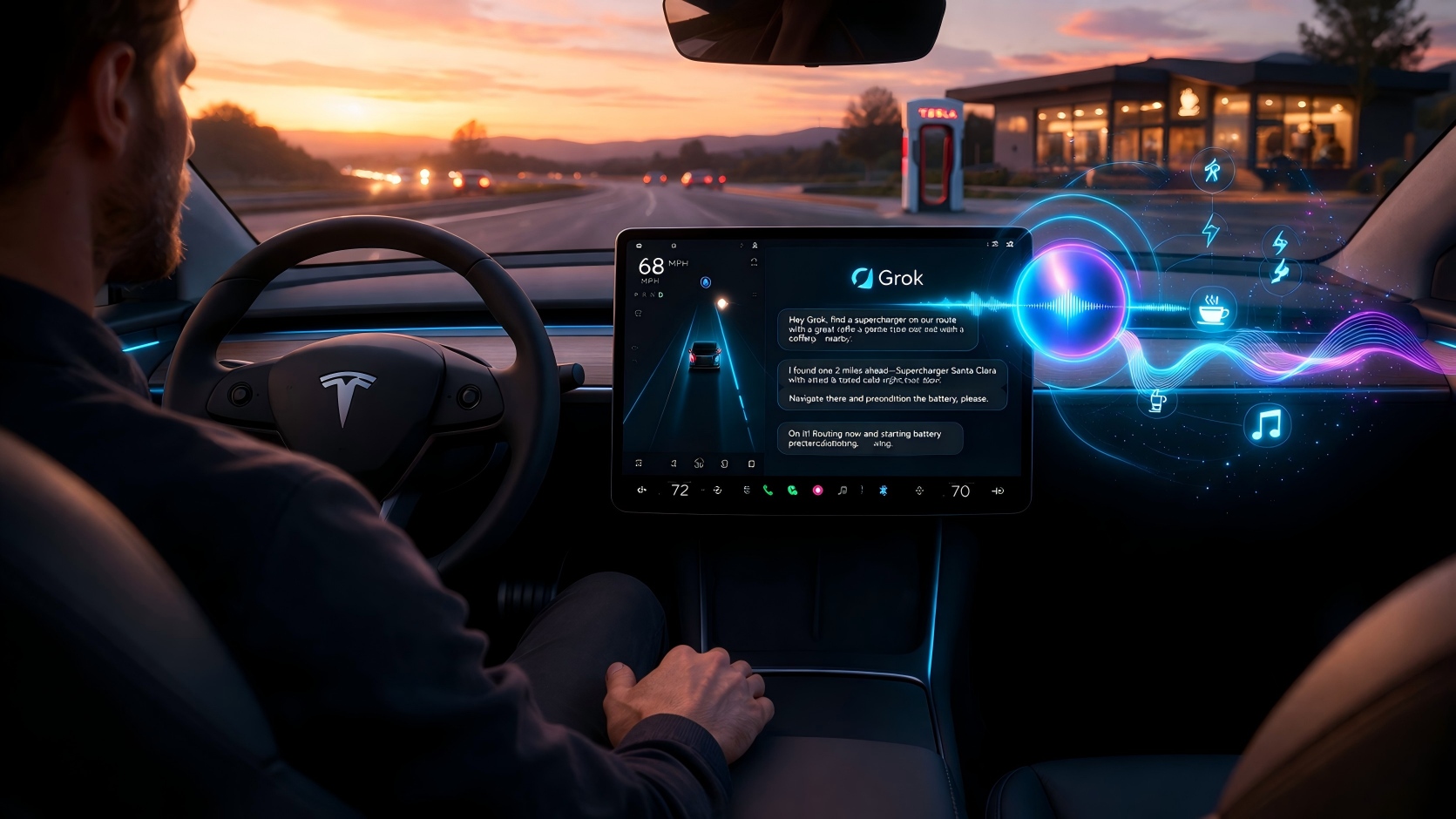
In March 2026, Tesla completed the deep integration of xAI’s Grok language model into its vehicle fleet, marking the most significant evolution of the Tesla in-car experience since the introduction of the touchscreen interface in 2012. What began as a simple voice command system—capable of adjusting climate control or setting navigation—has evolved into a conversational AI assistant that understands context, answers general knowledge questions, and interacts with natural language across multiple languages and accents.
This transformation represents a fundamental shift in how drivers and passengers interact with their vehicles. The Grok integration, now fully rolled out with the 2026.8.3 software update, turns the Tesla cockpit from a command-driven environment into an intelligent conversational space. For European and American Tesla owners, this means reduced driver distraction, enhanced passenger entertainment, and a genuinely novel experience that sets Tesla apart from competitors relying on limited voice assistants like Apple’s Siri or Google Assistant.
Chapter 1: From Voice Commands to Conversational AI
The Legacy System
Before Grok, Tesla’s voice control system was functional but limited. Owners could press the right scroll wheel button and issue commands like “set temperature to 70 degrees,” “navigate to 123 Main Street,” or “call John.” The system relied on a relatively narrow set of pre-programmed command structures. If a driver deviated from expected phrasing, the system often returned the infamous “Command not understood” error.
This approach worked reasonably well for basic functions but fell far short of what users had come to expect from modern voice assistants. Apple’s Siri, Amazon’s Alexa, and Google Assistant had trained consumers to ask natural questions and receive natural answers. In comparison, Tesla’s legacy voice system felt like using voice recognition software from a decade earlier.
The xAI Connection
Elon Musk founded xAI in 2023 with a stated mission “to understand the true nature of the universe.” While ambitious, the practical output of xAI has been the Grok language model—a large language model designed with a distinctive personality: witty, slightly irreverent, and willing to answer questions that other AI assistants might decline.
The integration of Grok into Tesla vehicles was announced in late 2025, with initial beta testing beginning in early 2026. By March 2026, with the 2026.8.3 software update, the integration became standard across the fleet, though with some features requiring Premium Connectivity.
What Changed
The fundamental change is architectural. Previously, voice commands were processed through a relatively narrow intent-recognition system. Today, voice input flows through xAI’s Grok model, which interprets natural language, understands context, and can chain multiple requests together.
For example, a driver can now say: “What’s the weather like in Chicago? Actually, navigate to the Art Institute there, and on the way, find me a coffee shop with good reviews that’s open now.” Grok understands that “there” refers to Chicago, that navigation should be set, and that the coffee shop should be along the route. The system processes this as a single conversational interaction rather than three separate commands.
This shift from command-and-control to conversational AI is subtle in daily use but profound in its implications. It changes the cognitive load required to interact with the vehicle. Instead of mentally translating a request into a rigid command structure, drivers can speak naturally—a crucial safety benefit.
Chapter 2: Technical Architecture and Capabilities
Cloud vs. Edge Processing
Grok voice processing operates on a hybrid architecture designed to balance responsiveness with capability. Basic voice recognition and simple command processing occur on the vehicle’s onboard hardware—the same AI4 or AI5 computers that power Full Self-Driving. This ensures that common commands like “turn on the seat heaters” or “open the glovebox” execute instantly, even in areas with poor cellular connectivity.
Complex queries—those requiring general knowledge, multi-step reasoning, or internet access—route to xAI’s cloud servers via the vehicle’s cellular connection. This cloud dependency explains why Premium Connectivity is required for full Grok functionality. Owners without the subscription retain basic voice command functionality but lose conversational AI capabilities.
The onboard processing hardware is notable. Tesla’s AI4 computer, standard in all new vehicles since late 2023, includes dedicated neural processing units that can run large language models locally. The upcoming AI5 chip, expected to enter production in 2027, is reportedly optimized for onboard LLM inference with 40-50 times the compute capacity of AI4.
Language and Accent Support
The 2026.8.3 update introduced expanded language support, including the notable addition of a British English voice option dubbed “Leo.” This option is more than cosmetic—it represents a genuine expansion of the language model’s accent training. European owners, particularly in the UK, Ireland, and Scandinavian countries, have reported significantly improved recognition accuracy with the Leo voice profile.
Beyond English, Grok voice now supports:
-
German: With regional accent recognition for Bavarian, Swiss, and Austrian variants
-
French: Including Canadian French for Quebec owners
-
Spanish: With separate models for European and Latin American Spanish
-
Italian, Dutch, Swedish, Norwegian, Danish: Full support with local accents
-
Mandarin and Cantonese: Critical for the Chinese market but also used by diaspora communities in North America and Europe
-
Korean and Japanese: Full conversational support
This multilingual capability is particularly valuable for European owners, where cross-border travel is common and households often speak multiple languages. The system can recognize and respond in whichever language the driver uses, without requiring manual switching.
Contextual Awareness
Perhaps the most sophisticated aspect of Grok voice is its contextual memory. Within a single session (defined as the period between vehicle entry and exit), Grok maintains conversation context. This allows for follow-up questions without repeating context.
Consider this interaction recorded by a Tesla owner in California and shared on social media:
-
Driver: “What’s the population of Paris?”
-
Grok: “Paris has a population of approximately 2.1 million within the city limits, with over 12 million in the metropolitan area.”
-
Driver: “What’s the weather like there?”
-
Grok: “In Paris, it’s currently 14 degrees Celsius with light rain expected this afternoon.”
Grok understood that “there” meant Paris. This contextual understanding extends to vehicle functions as well. A driver can say “set the temperature to 70” and later say “make it cooler,” with Grok referencing the original setting.
Vehicle Integration Depth
Grok’s integration with vehicle systems goes beyond basic controls. The assistant can:
-
Report vehicle status: “What’s my current range?” “How many miles are on the odometer?” “What’s the tire pressure?”
-
Control media with nuance: “Play something I’d like” triggers algorithmic recommendations. “Skip to the part where the guitar solo starts” uses audio analysis to navigate within tracks.
-
Manage charging: “Find a Supercharger with available stalls” or “Schedule charging to finish by 7 AM” uses real-time network data.
-
Access vehicle cameras: “Show me the rear camera” or “Record that” can trigger Dashcam or Sentry Mode actions.
-
Control third-party integrations: For owners with Tesla solar or Powerwall systems, Grok can report home energy status: “How much solar power is my house generating right now?”
Chapter 3: The User Experience Revolution
Reducing Distraction
The primary safety argument for voice control is distraction reduction. A driver who can adjust navigation, climate, or media without looking at a screen is objectively safer. Tesla’s previous voice system already offered this benefit, but the Grok upgrade expands it substantially.
With the old system, a driver needing complex information—like the weather at the destination, the availability of Supercharger stalls, or the hours of a restaurant—had to interact with the touchscreen. Each interaction required visual attention, taking eyes off the road. With Grok, these queries become voice interactions, keeping the driver’s attention where it belongs.
Data on this safety benefit is still emerging, but early studies by the Insurance Institute for Highway Safety suggest that conversational voice assistants reduce cognitive distraction compared to touchscreen interactions. The ability to speak naturally rather than memorize command structures reduces the mental load of interaction.
Passenger Entertainment
While safety drives the driver experience, Grok voice has become a surprising source of passenger entertainment. Families with children have discovered that Grok answers questions endlessly—a feature that transforms long road trips.
Parents report that children can ask Grok about anything: “How deep is the ocean?” “Why is the sky blue?” “How fast can a cheetah run?” The system provides educational answers in a conversational tone, occupying young minds without requiring parent intervention.
For adult passengers, Grok can serve as a travel companion, providing local history, restaurant recommendations, or simply engaging in conversation. The system’s slightly irreverent personality—a design choice from xAI—adds character that distinguishes it from more sterile assistants.
The European Experience
European Tesla owners face unique challenges that Grok voice addresses particularly well. Cross-border travel is common, and language diversity is high. A German driver traveling to Italy can ask for navigation in German, receive directions in German, and ask about Italian points of interest—all without language switching confusion.
European city driving also demands more complex interactions. Narrow streets, restricted traffic zones, and complex parking rules mean drivers need frequent information. Grok can answer “Is this street open to traffic?” or “Where can I park near here?” using localized data.
The system’s ability to understand European accents is notably improved with the 2026.8.3 update. Scottish, Irish, and Scandinavian English accents, which previously challenged voice recognition systems, now work reliably.
Chapter 4: Privacy, Data, and Trust
The Privacy Question
Conversational AI requires sending voice data to cloud servers for processing. This raises legitimate privacy concerns. Tesla has addressed these through a layered approach:
-
Local processing: Basic commands and voice recognition never leave the vehicle.
-
Anonymization: Voice clips sent to xAI servers are anonymized before processing.
-
Opt-out options: Owners can disable cloud voice processing entirely, reverting to basic local commands.
-
Transparency: The vehicle displays an indicator when voice data is being transmitted to cloud servers.
Tesla’s privacy policy explicitly states that voice interactions are not used for advertising profiling, a common practice with other voice assistants. The company does not sell voice data to third parties.
The Subscription Question
Full Grok voice functionality requires an active Premium Connectivity subscription, which costs $9.99 per month in the US or regional equivalents in Europe (€9.99 in most markets, £9.99 in the UK). This requirement exists because cloud processing incurs data costs—both for the cellular bandwidth and for the xAI server infrastructure.
Basic voice commands remain available without subscription. This means owners can still control vehicle functions with voice, but cannot ask general knowledge questions or engage in conversation.
The subscription model has generated some owner pushback, particularly in Europe where subscription fatigue is high. However, most owners who use Grok voice regularly find the $10 monthly fee justified by the functionality—especially when bundled with other Premium Connectivity features like satellite maps, streaming media, and live traffic visualization.
Chapter 5: Competitive Context
Tesla vs. Traditional Automakers
Traditional automakers have been slow to integrate conversational AI. Most luxury brands offer voice assistants, but these are typically based on limited on-board systems or outsourced to third parties like Cerence. The result is functionality that lags significantly behind Tesla.
Mercedes-Benz’s “Hey Mercedes” system, for example, offers basic vehicle controls and some general knowledge queries, but lacks the conversational depth and personality of Grok. BMW’s Intelligent Personal Assistant is similarly limited. These systems are designed to be safe and reliable, but they are not designed to be genuinely useful for complex interactions.
Tesla vs. Tech-Integrated Vehicles
The more direct competition comes from vehicles with deep tech integrations. Ford and GM vehicles with Google built-in offer Google Assistant, a powerful alternative. Google Assistant has years of development behind it, excellent language support, and deep integration with Google services.
However, Google Assistant lacks the deep vehicle integration that Grok offers. It can control navigation and media but cannot access vehicle telemetry, control charging, or interact with Tesla’s specific hardware features. For owners who live in the Google ecosystem, this may be acceptable, but for those seeking maximum integration, Grok has the edge.
Volvo and Polestar vehicles, also built on Google’s Android Automotive platform, face the same limitation: Google Assistant is excellent for general queries but limited for vehicle-specific commands.
The Apple CarPlay Question
Tesla has famously refused to integrate Apple CarPlay, a decision that generates constant owner discussion. CarPlay includes Siri voice control, which many Tesla owners wish they could use. Musk has stated that Tesla wants to control the entire user experience, and that integrating CarPlay would represent ceding control of the interface.
The Grok voice integration is Tesla’s answer to this criticism. Rather than conceding to Siri, Tesla has built a competitor that, in many respects, exceeds Siri’s capabilities. Siri is designed for iPhone integration, not deep vehicle control. Grok can adjust vehicle settings that Siri cannot even access.
For owners who prefer Siri, the lack of CarPlay remains a frustration. But for owners willing to learn Tesla’s system, Grok voice is now a legitimate alternative.
Chapter 6: Future Trajectory
Offline Capability
The current cloud dependency is the largest limitation of Grok voice. Owners who frequently drive through areas with poor cellular coverage—common in rural America and parts of Europe—find that Grok’s advanced features become unavailable precisely when they might be most useful.
Tesla is reportedly working on offline conversational AI capabilities. The AI5 chip, expected in 2027, is designed with sufficient onboard compute to run a compressed version of Grok entirely locally. This would enable full conversational capabilities without a cellular connection—a transformative upgrade for rural and remote driving.
Visual Integration
The next major evolution may combine voice with camera understanding. Imagine pointing the car’s cameras at a building and asking “What is that?” or looking at a menu and asking “What’s the most popular dish?” This multimodal capability—combining voice with visual input—is a natural extension of Tesla’s camera array.
xAI is actively working on multimodal models that can process images alongside text. Integration with Tesla’s vehicle cameras would create a genuinely new interface paradigm, one where the vehicle understands both what you say and what you’re looking at.
Personalized Profiles
Currently, Grok voice is the same for every driver in a given vehicle, aside from language preferences. Future updates may bring personalized voice profiles that recognize individual drivers by voice, maintaining separate conversation histories, preferences, and even personality settings.
This would allow each driver to customize the assistant’s personality, response style, and even voice characteristics. Some owners might prefer a terse, businesslike assistant; others might enjoy the current slightly irreverent Grok personality; families might want a child-friendly mode.
Agentic Capabilities
The ultimate frontier is agentic AI—systems that don’t just respond to commands but anticipate needs and take action independently. A truly agentic Grok might notice that you’re running late for an appointment, check traffic, pre-heat the battery for optimal charging, and suggest an alternate route—all without being asked.
Tesla’s job postings for AI engineers have specifically mentioned “agentic AI” as a focus area. The combination of vehicle sensors, navigation data, and conversational AI creates a platform uniquely suited for agentic functionality.
Conclusion: A New Standard
The integration of Grok voice into Tesla vehicles represents a fundamental upgrade to the driving experience. What began as a limited command system has become a genuinely conversational partner—one that understands context, answers questions, controls vehicle systems, and entertains passengers.
For American owners, the value is in distraction reduction and convenience. Long highway drives become less isolating when a conversational AI is present. Complex multi-stop trips become easier to manage with voice control. For European owners, the value is enhanced by multilingual capability and adaptation to local driving conditions.
The Grok integration also positions Tesla strategically. As traditional automakers struggle to modernize their software, Tesla has leapfrogged to conversational AI as standard. The gap between Tesla’s in-car experience and that of competitors has widened, not narrowed.
There are limitations: the subscription requirement, the cloud dependency, and the continued absence of CarPlay for those who prefer it. But for owners willing to embrace Tesla’s vision of the in-car experience, Grok voice is now a defining feature—one that transforms the vehicle from a transportation device into an intelligent space.
The 2026.8.3 update, with its expanded language support and refined integration, shows that Tesla continues to iterate rapidly on this capability. The trajectory suggests a future where voice becomes the primary interaction modality, with the touchscreen receding to a secondary role. For now, Grok voice is the best voice assistant available in any production vehicle—and it’s improving with every update.
FAQ
Q: Do I need Premium Connectivity to use Grok voice?
A: Full conversational capabilities require Premium Connectivity. Basic vehicle commands (climate, navigation, media controls) work without subscription.
Q: Is my voice data recorded or stored?
A: Voice clips sent to cloud servers are anonymized. You can disable cloud processing entirely in settings, reverting to local-only commands.
Q: Can Grok understand multiple languages in one conversation?
A: Yes. The system automatically detects language and can switch between supported languages without manual intervention.
Q: How does Grok voice compare to Siri or Google Assistant?
A: Grok offers deeper vehicle integration but less third-party ecosystem integration. It’s superior for car-specific tasks but more limited for general smartphone functions.
Q: Will Grok voice work offline in the future?
A: Tesla is reportedly developing offline capabilities for future vehicles equipped with the AI5 chip, enabling conversational AI without cellular connectivity.
Q: Can I change Grok’s voice or personality?
A: Currently, the “Leo” British English option is available. Future updates may expand voice and personality options.